Dan - this might possibly ‘hijack’ the thread to a discussion away from the original topic?
I’ll proceed with this caution in mind…
This is also a knot geek forum, so on that basis I feel that I can provide a long discussion…
With regard to single leg loading versus dual leg loading, this was something that I had contemplated many years ago while trying to classify all knots, bends, and hitches.
As you know, this is not an easy task - and there are many factors to consider.
With specific regard to hitches: - and to give some background…
I had posited that all hitches require a ‘host’.
If the host is removed, the hitch loses structural integrity (and usually collapses).
I had posited quite some time ago that hitches could be categorised as follows:
slide and grip hitches
noose hitches
binder hitches
load control hitches
termination hitches (an example of which is the 'Tensionless hitch #2047)
Look - this is the best categorisation I have come up with, but I recognise there will always be edge cases which confound this categorisation.
To give context, I consider #206 Crossing hitch (ie Munter hitch / Backhanded hitch) to be a load control hitch.
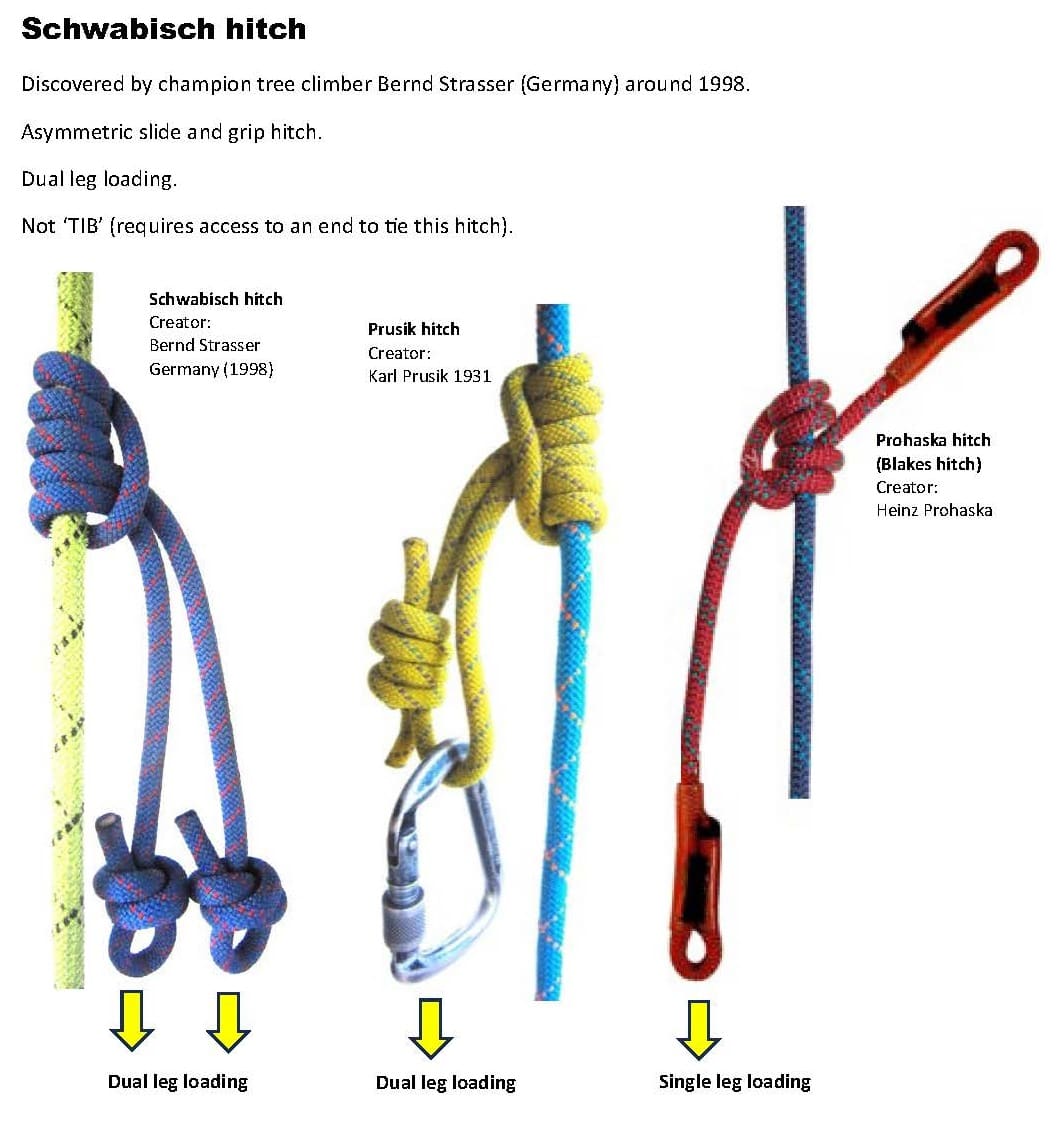
I consider the classic Prusik hitch to be a slide and grip hitch.
And I consider the Constrictor hitch to be a binder hitch.
I consider the ‘Schwabisch hitch’ to be regarded as a ‘slide and grip hitch’.
I have always tried to attribute each ‘knot’ to an individual inventor/discoverer.
I think you have favoured this approach - given the research you had done with the ‘Zeppelin bend’, and with Heinz Prohaska’s so-called ‘Blakes hitch’ (which I think you like to refer to as ‘Prohgrip’, or something similar?).
All research I had done had always pointed to Bernd Strasser.
I actually wrote to him quite a few years ago and got a reply that he “does not reject the idea of the hitch being attributed to him.”
He basically said that it is possible that ancient sailors may have invented it much earlier - but he had no evidence as such.
I have lost the email communication from him unfortunately (am going off memory).
Back to dual versus single leg loading.
It does seem obvious that all slide and grip hitches have an intended loading profile (at least to me).
The Prohgrip’ (aka Blakes hitch) appears to be intended for single leg loading. I think this is undisputed?
It certainly appears to me that Karl Prusik intended his Prusik hitch to be dual leg loaded.
Although I have seen instances where the Prusik hitch has been single leg loaded (some refer to this as a ‘split tail’ configuration).
I have no test data comparing single leg loading to dual leg loading of a prusik hitch. Although I suspect dual leg loading to provide better grip.
I am of the view that Bernd Strasser intended his ‘Schwabisch hitch’ to be dual leg loaded.
Now, with regard to issue of ‘equalisation of loading across both legs’:
Perfect equalisation is possibly not immediately achievable.
After a period of loading, the hitch will have a tendency to settle into a state of equilibrium.
I see this as a form of ‘entropy’.
That is, all slide and grip hitches will have a tendency toward an entropic loading state, where forces will balance out across the hitch structure.
For example, I see this effect with the Machard (French prusik) - that with loading, both ‘legs’ tend toward a balanced loading state.
Note that a Machard hitch is more precisely classified as quad leg loading.
As discussed earlier, a Prusik hitch is intended for dual leg loading - again, the force propagation along each ‘leg’ will tend toward an entropic state over time.
Another way of classifying slide and grip hitches is in terms of:
- Tiable In the Bight (TIB); and
- Open or linear.
For example, a Schwabisch hitch is not ‘TIB’.
In fact, virtually all of the slide and grip hitches invented by tree climbing arborists are of the open/linear geometry.
In other words, these hitches are not ‘TIB’ - meaning that access to a free end is required to tie the hitch.
In contrast, slide and grip hitches invented or used by mountaineers/rock climbers are ‘TIB’.
EDIT:
An interesting web page on slide and grip hitches is here: https://www.linkedin.com/pulse/knots-mechanics-genealogy-climbing-hitches-arborists-based-restrepo