Would like to open discussion on the stability and security of the sheet bend (#1431 and #1432).
Some US rope rescue teams use what they call a ‘becket’ - which is really just a sheet bend (actually versions of #1434 & #1435) - although Ashley insisted the term Becket should be reserved for cases such as #1900 and what Ashley calls the double becket at #1902 (ie tied to a seized eye). So I’m not 100% sure why US rope rescue teams use the term ‘becket’ (basically they tie 2 turns of rope around a tree in the form of ‘wrap 2-pull 1’…similar to the ‘wrap 3-pull 2’ as is routinely tied with 25mm wide tubular webbing).
Anyhow, there would be 2 different baseline structures to choose from - being #1431 or #1432.
Ashley suggests that #1431 is the more secure form (although I suspect this might have something to with the type of rope available in his era). I have noticed that #1432 seems to be more stable/secure (admittedly only quick playing around by hand tension - no serious load tests to confirm).
Am interested in comments on these 2 forms of the sheet bend and reasons why one form may be more secure and stable than the other.
And dare I allude back to Derek’s comment about the core essence of all Bowlines being a “bight component gripped by a nipping loop” (see lengthy thread on ‘What defines a Bowline’). Obviously, a Bowline is an end termination loop knot - but it does have a bight component gripped by a nipping loop. The sheet bend is not a loop knot - and input force to the nub is applied only on 2 opposite rope parts pulling in opposite directions. In the case of a Bowline, input force is applied on 3 rope parts (the standing part and also both legs of the eye loop). So the loading profile of the Bowline and Sheet bend are different.
And no, this post is not really about Bowlines - not here to start a lengthy battle on what defined a bowline. I’ll leave that argument for the Bowline post. I have included images of #1010 purely to draw comparisons with the positioning of the tail inside or outside of the eye-loop in the hope that this might aid analysis of the sheet bend! What you have to do is imagine that you have a knife and you cut the eye loop of the Bowline (thereby removing the 3-way loading profile).
Mark
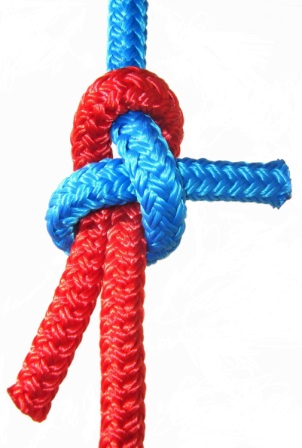
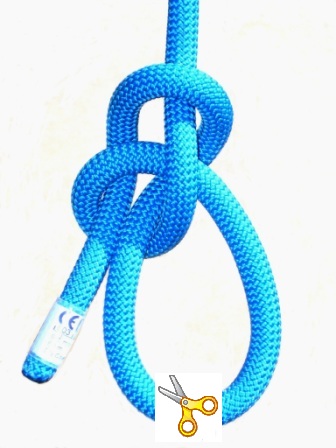
[4/18, 26 : edited to add information & better present some results]
The opposite-sided sheet bend (#1432) is less secure, I think,
as push comes to shove. It seems to draw up more squarely
in contrast to the way the same-sided sheet bend takes a tilt,
but this very squareness enables flow of the bight part (“U”)
around the other end, and it lessens the other’s nip on the
bight part’s tail. --quick analysis (also Ashley’s & Day’s views).
I recall that Rob Chisnall published in Knotting Matters a quick
report in which he had mixed results, which surprised me.
Keep in mind that Dave Richards’s (now not easily findable) testing
found the (presumably --it’s the more commonly shown) #1431(3)
version to slip in some kernmantle ropes, interestingly :
- 10.5mm dynamic rope : single SB slipped, “double” version held
(slippage seen in both bight (“U”) & loop (hitching) part);
- 12.7mm low-elongation rope : single held, double slipped(!!?)
(slippage in bight part only);
- 7mm “accessory” cord : both versions slipped
(with --unsure of note-- single needing both tails stopped, dbl. just bight’s).
–quite interesting results, these!
For a secure-when-slack like bend, tie #1431 in reverse AND
THEN take a 2nd turn & through-the-bight tuck of the tail
–or more. This will draw up tightly; it has some vulnerability
to forceable loosening by pulling apart the bight legs to pry
out some of the hitching end’s SPart, sufficient to then
work the knot loose --YMMV w/force & materials.
(I guess that we can refer to this line of bight-hitches as
“Lapp bend” variants.)
–dl*
More playing around (but no test to destruction with load cell as yet) indicates to me that #1432 appears more secure and stable than #1431 (albeit on climbers accessory cord).
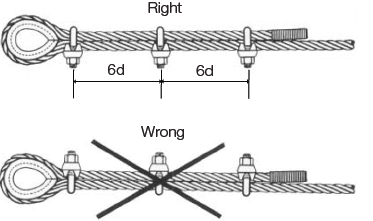
In examining what is happening I remembered my old rigging/dogging training with steel wire rope and installing cable grips. There is right way and a wrong way to install cable grips (see attached image). Perhaps there is a correlation with the Sheet bend since load is directed on either the standing (live) part or the opposite tail (ie dead) part. There is an old saying in rigging when installing wire rope grips - ‘Never saddle a dead horse’.
In #1432, initial force from the blue rope crushes/compresses on the standing part of the red rope. Is this fact important? Examine the wire rope grip image for comparison.
Mark
Any further description to “appears more secure & stable”
could be helpful.
In initial loading, it has usually seemed to me that there
is more movement/slippage in #1432 (“opposite-sided”),
although that can be seen to diminish on further tightening
–but it leaves one wondering what would occur under some
greater load.
I suppose that the more “squarely” drawn up #1432
will not loosen so readily as the “same-side”/#1431 with
its bit of tilt in coming to closure?
In either case, though, as with the bowline, there will
be situations in which neither version should be used
without further precautions. On variation on #1432
is to tuck the bight’s tail back under the collar it forms.
(This was published in an early KM as an interesting find.)
In #1432, initial force from the blue rope crushes/compresses
on the standing part of the red rope. Is this fact important?
Or, one can surmise that before the hitching end reaches
around to nip the bight’s tail, it loses force on some turns,
and thus nips with less conviction!?
(I surmise that the orientation of wire-rope clips is to put the
material-crusing U parts’ bites on the less-important tail, so
that the highly loaded SPart comes through comparatively
undeformed, compressed by the matching short sections
of tail pressed against it and the broad parts of the clips.)
–dl*
The rule about wire rope clamps is made because the pressure from the U-bolts can damage the cable. The larger areas of the saddles exert less pressure on the standing part of the cable.
True. But perhaps also were there to be any slippage,
it would come on the non-U-bolt side --the bolts biting
into the cable–, and so the wrong way conceivably could
pull out from the unbitten tail if tied wrongly,
and otherwise the bitten tail would move towards and
jam against the eye. (Might have to u-bolt Dyneema
to see this sort of behavoir, eh?!  )
–dl*