Big fan of all the discussions here, but (evidently) first time poster.
I would like your expert opinions on the ‘Soft Eye’ used in anchor construction as taught mainly in Europe.
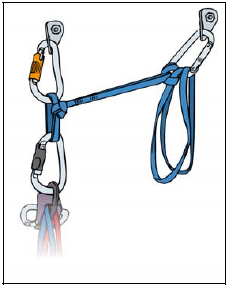
Allow me to introduce the concept from the climbers perspective. When one climbs a route and comes upon the place where the anchor needs to be ‘build’, and finds there two bolts which appear to be bomber (as in extremely strong with zero doubt that they should fail), the method of anchor construction advised by climbing associations (e.g. Dutch, German, Swiss and Austrian) is the use of sling (circular webbing) in which a knot creates a ‘Soft Eye’ which is attached with a carabiner to a bolt. The remainder of the sling is attached to the second bolt and serves as a backup. See for examples http://www.alpenverein.de/chameleon/public/07ace84a-bc33-615a-62a3-151e7b8b859a/Standplatzbau-Juli-2012_19947.pdf (figures 17 and 19) or the dutch translations: http://www.nkbv.nl/fileupload/Kenniscentrum/Sportklimmen/StandplaatsNKBV2010_1.pdf (figures 2 and 3).
http://www.w-hillmer.de/stand-neu-02.jpg
The common practice teaches that an overhand knot in the sling works and is acceptable, but since it is hard to remove after loading, a bowline on a bight is preferred (which incidentally is also significantly stronger), referred to in dutch as ‘dubbele paalsteek’ or ‘bulin-knoop’ and in german as ‘doppelte palstek’ or ‘doppelte bulin’. Now standard anchor building practice taught all over the world uses acronyms such as ‘SERENE’, ‘ERNEST’ and ‘STRADS’, where in each instance the ‘R’ stands for redundant. If one then takes a look at the ‘Soft Eye’ method, one might question the redundancy of it. In case of a single overhand knot, there is only 1 strand of webbing material that forms the eye, hence, a tear in that single loop would mean total failure (and serious injury or death). I have been told that this danger is taken away by the bowline on a bight which provides redundancy by having 2 strands of webbing in the ‘eye’. However, on this forum it has been discussed that a bowline on a bight readily fails if only a single strand is loaded (I can’t find the link for where this was discussed, possibly here: http://igkt.net/sm/index.php?topic=19.0 ) which would mean that a tear of a single loop could still mean total failure. I was hoping someone could confirm or disprove this ‘feature’.
On a second note, would you agree that the eskimo variant of the BoaB is more appropriate for the application, since the loop will practically only be ring loaded. (http://igkt.net/sm/index.php?topic=4168.0)
Lastly, if you find that the BoaB is unsuitable when redundancy is a requirement, do you have a better alternative. Remember that due to the nature of the ‘sling’ (circular webbing) you do not have access to any tails, however, it does not necessarily mean that it has to be ‘on a bight’ since you do have easy access to the ‘other’ end of the sling. I’ll post a suggestion of my own for your consideration.
 )
)