I’m going to add one caveat to this and that is regarding the actual ends/tails of the ropes.
In a flat representation the ends/tails as they come into the knot from infinitely far away might cross over two ropes before passing under one. On a sphere, I’m not sure what we’re supposed to do with the tails. There is no infinite flat plane for them to approach from. I guess we make them turn out 90 degrees to the surface and just go away. Ok, in that case the two “over” crossings would disappear. This though isn’t really a result of using a sphere but is a result that the sphere forces you to cheat with the ends. We can also cheat that way on a plane, have the ends turn 90 degrees up off the plane. That would also avoid those two crossings on the plane and get the same number of crossings.
We can instead “fix” the sphere by drawing a small circle somewhere on the sphere. No part of the knot should be inside that small circle and four rope ends start there. If you prefer, they turn out at 90 degrees there. So long as no rope crosses this small circle then this will be equivalent to the normal rules for flat representation and will require the same number of crossings.
Who argued about this tautology ? Not me…
I was talking about the number of crossing points of “the loose and flattened knot”(sic). Read what you quote !
Take a loose knot. Project it on a plane / “flatten” it. You get a 2D representation / diagram of this knot.
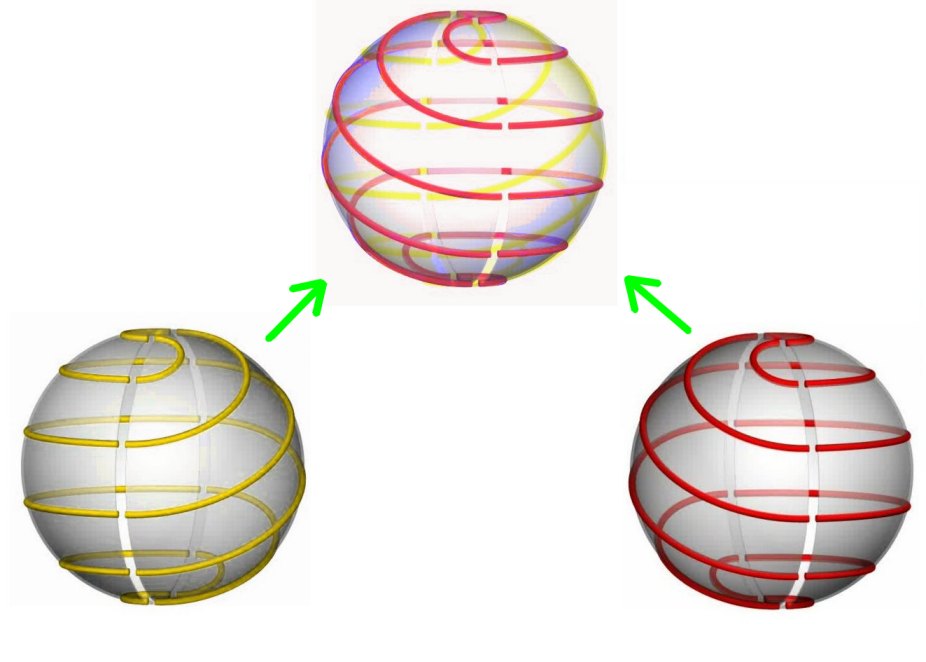
In general, and if this knot is not a very simple one ( an overhand knot, for example ), the diagram which you will get will not have the minimum number of crossing points ! You will need to “explode” the “under” side of the loose knot a lot, so the “over” side will not be projected on top of it, but inside it. On the contrary, in a spherical representation of the same knot, you will not have to distort the one side more than the other.
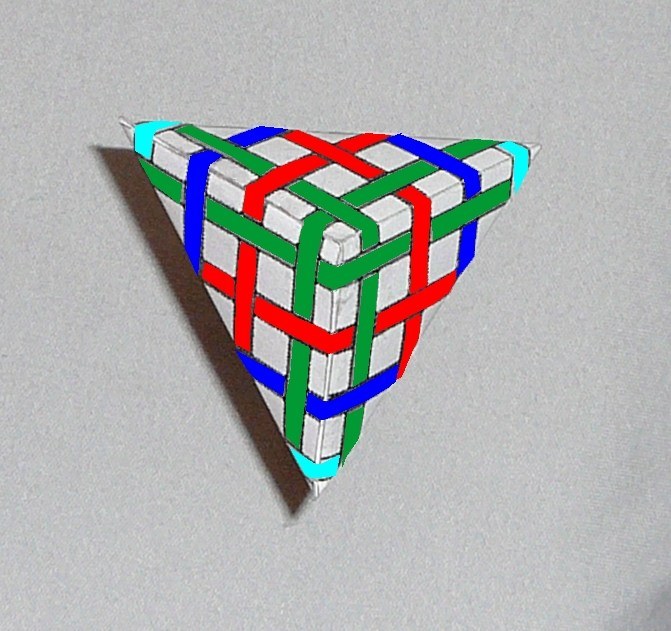
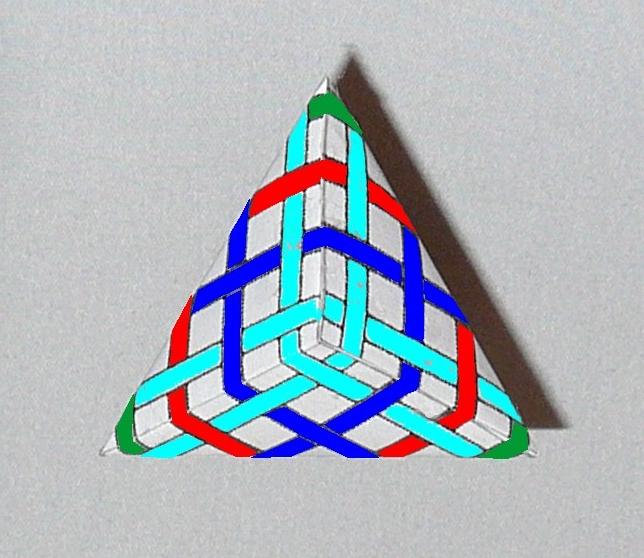
Draw the plane representation of the Cuboctahedral bend with the minimum number of crossings, and compare it to the spherical representation.
My main point was that, if we do not project on a plane, from a point outside the knot, the “over” and the “under” sides of a knot the one on top of the other, but we project them on a sphere, from a point inside the knot, the “over” side on the one hemisphere and the “under” side on the other hemisphere, we get a spherical diagram which, geometrically, will not differ much from the shape of the loose knot itself.
Start from the “final”, compact form of the knot, and imagine that the path of the rope in 3D remains the same, but the size of the rope shrinks by, say, 50%. What you get is a loose form of the same knot.