Once again, you get defensively delusional :
the point is the putting thoughts YOU imagine
into others’ minds --whether about convenience
or about recognition or .
Please X1,
Stop pounding your keyboard for a moment and go tie the knot(s). Simply put, they are one and the same, absolutely identical - aside from the tail’s orientation.
alpineer
Well, let’s just say that “didn’t notice” doesn’t mean
–nor surely imply-- “didn’t note/type/state”; the latter
is the case, but it’s a speculative matter re the former
(and nothing to do w/motives). So, we’ll want to laugh
about something else --laughter, the best medicine!
Now, I won’t hold with “exactly the same”, for they clearly
differ in actual geometry. There are times when such differences
are deliberately/purposely --and we should hope purposefully–
made, but also they can occur more by the vagaries of loading.
E.g., the dbl./multiple(extended) Hedden hitch & Klemheist
are essentially equally coils of a bight, and in the former
the SPart reaches far & coils back, in the latter it’s opposite.
But in the first case, the reach itself can become a sort
of outer wrap in what I call “cascading” of the away-most
turn(s) to flow around the others; in the k. it would
be the “bridge” bight doing such sympathetic wrapping.
The double bowline has a change by this sort of
re-dressing which is my “#97” which I once tested,
and which seemed pretty decent, but possibly unremarkably
so vis-a-vis its topologically identical popular kin, and others.
–dl*
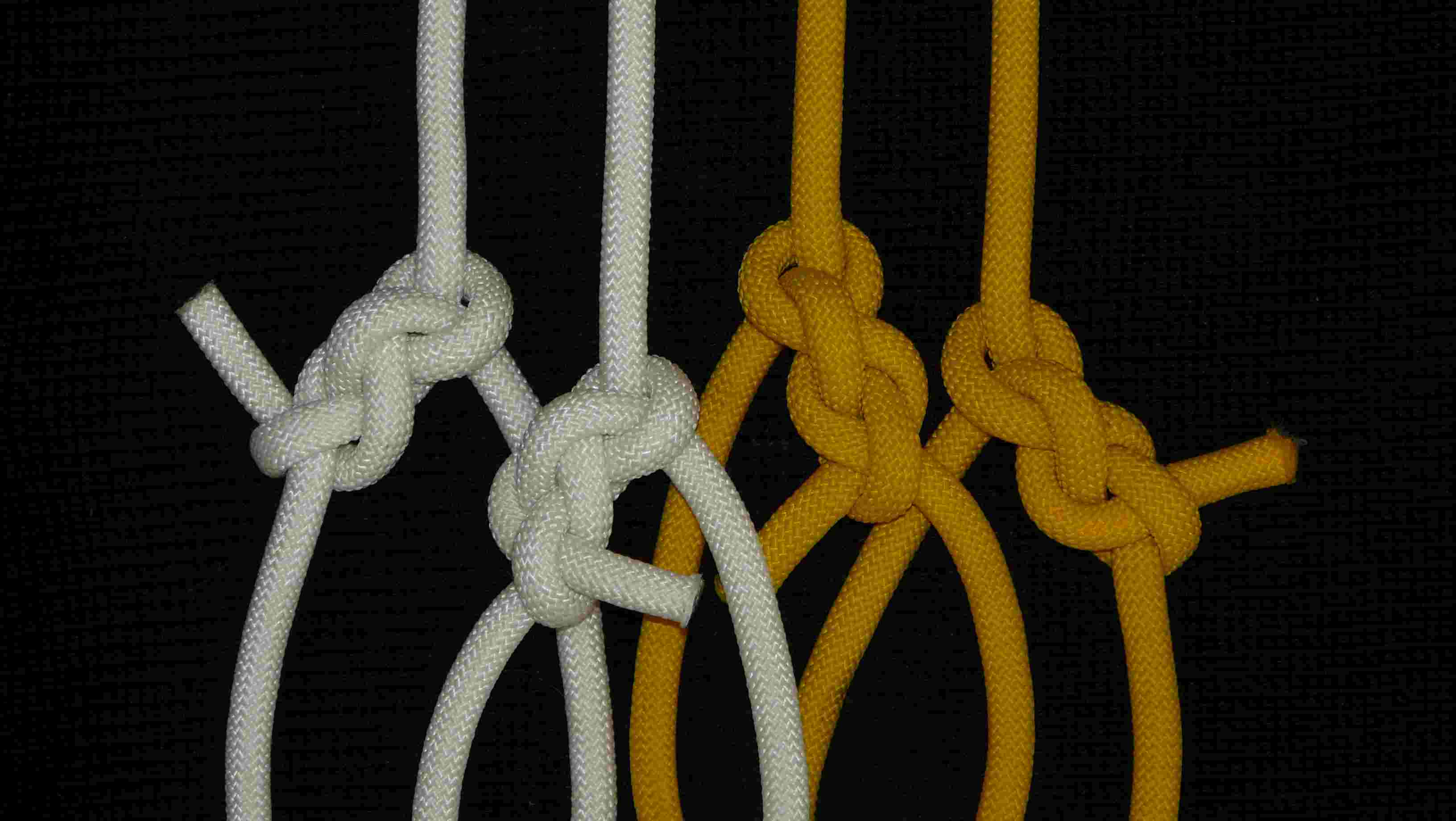
You put is simply, but wrongly nevertheless : And this " one and the same , absolutely identical " confirms that, for whatever reasons ( my inability to communicate, by “pounding the keyboard”, what I mean, etc.. ) you simply had not understood what I had tried to point out - which, in fact, is quite evident - just look at those two X crossings on the surface of the surrounding the eye legs nipping “tube”, at your knot, which are absent at the knots presented by Dan Lehman. " I am laughing" you “saw”, at once, the unknown to you knot of the “knot-puzzle” I had tried to conceal the other day, and now you do not “see” the knot you had tied by your own !  Please, read again Reply#17, because there are more things there than the results of “keyboard pounding” !
You would nt believe how much I agree with this ! I apologize for the fact that, sometimes, my laugher degenerates into a sarcasm. Mea Culpa.
This “outer wrap” I call surrounding " tube ". It can be formed by legs of the nipping structure ( the SPart ), and/or the collar structure ( the second leg of the collar), as in (1).
HOWEVER - and I have to repeat it again, pounding the same keys of the keyboard in a different sequence - it matters a lot if the turns which flow around the others, do it in a “over / under” pattern or not - if they make X s ( like the two X s clearly visible on the nipping “tube” of the knot alpineer has tied ), or not. If there is this "cross-gartering", or not. I have seen what Malvolio himself had seen, too, ages before me : that the fact that some turns go “over” and “under” others, in an alternating, “regular” pattern, disrupts the flow of the tensile forces that run through the penetrating eye legs more efficiently than in the case of a simple coiled tube. ( Well, Malvolio was speaking to Olivia about the disruption of the blood in his veins ,caused by his cross-gartered yellow stockings, but I think he essentially meant the same thing…)
So, how exactly do those turns flow over the others ? By following one helical path, or two helical paths of the same helicity, thus forming a smooth “tube” with no crossings " Or by following two helical paths of the opposite helicity, thus forming a “tube” with “G-points”( dL s terminology ) on its surface, that bite into the body of the penetrating legs of the collar at each and every “node” they meet each other ? The first is the method of the fishing bends and of most climbing gripping friction hitches, respectably, the second is the method of the rat-tail-stopper, throughout its length, of the Valdotain Tresse , at its “lower” part - and of the Tresse bowline - even if his creator does not “see” that !
There is a common practice in this forum, when we do not understand something, to simply ignore it, to laugh at it, or to dismiss the guy who is trying to communicate it as just a…OK, I will not repeat what I have heard in this Forum, because I would then have to buy a new keyboard !
Simply put, the rat-tail stopper, and the Valdotain Tresse on its “lower part”, utilize the one and same, identical cross-gartering way to nip the surrounded / penetrating tail the Tresse bowline does. The Locktight loops do not. ( Is this put simply enough ? )
Just go tie both knot(s), in their set form and compare.
The Tresse B. yes, but not the m.tresse shown in your reply #17 (my photos). The proper tresse over/under crossing points must alternate sequentially. The m.tresse sequence does not. This is why I called it a Modified Tresse.
I believe I had tied those knots, and then some - simply because I tie [i][b]all the possible[/b] [/i]post-eye-tiable loops, in a dumb but systematic and exhaustive way, for some time now. So, it was natural for me to tie the Tresse loops, and then compare them to the Locktight loops that had already been presented. As I tried to explain to you again, although I had tied the Tresse loops, I had not appreciated their remarkable stability, because, at the time, I was more interested in "Eskimo-like" PET eyeknots, i.e., eyeknots where the returning eye leg remains perpendicular to the axis of the loading, since this form provides a "step" to the returning eye leg, and a "handle" to the standing part : an L- shaped deflexion of the returning eye leg, that is a most effective means in making the job of the nipping structure much easier.
I think that it is the existence of the crossings ( the X s, the cross-gartering of the strands that form the nipping '“tube”), and not the sequence of the crossings ( the alternating or not character of the “over” / “under” pattern ) that matters most. I always had prefered the “regular” “under” / “over” pattern, so that both helical paths of opposite helicity will, in their turn, the one after the other, be used as “hammers” and as “nails”, as riding turns and as wedges that will block the slippage of the penetrating tail, working in tandem, and equilibrium. However, I have seen, to my surprize, that, in some cases, this might not be so important I had though it would be - the sequence of the crossings might not be as important as the mere existence of the crossings (1).( See the attached pictures : At the “white” loops, the double nipping loop is “regularly” crossed, the Standing Part of the nipping structure goes “over” / “under” itself at the two crossings / nodes - while at the “yellow” loops it remains on the one side : “over” / “over”, or “under” / “under”. However, I have not seen any difference in the final, loaded knots, as I had expected ! It seems that if there are crossings, they “must not alternate sequentially” - they just have to be there.)
I thought that the “modified” was just a way to say "double, yet still crossed ". Your pictures clearly show two X s, two , while the Locktight loops have only the one necessary crossing, as “the SPart reaches far & coils back”.
Not so fast : I don’t give up variations of the SPart’s
path en route to it coiling back : it can "twist* with
the tail beneath those coils (i.e., I would likely wrap
it around a finger to be replaced with the tail’s return;
else, have the tail effect the twisting w/the SPart
–the point, again, to try to take away some load
before the SPart “U-turns” into the coils. This is
shown in one of the knots in my sketches. The
essence of “lock-tight” is those binding overwraps
(“coils”), which as you’ve remarked are often part
of some fishing knots, such as a snell or Bimini twist.
The locktight(s) have a back door to open via
the bowlinesque collar for ease of untying.
I also tried using the strangle form to build such
an eyeknot, but wasn’t satisfied that it would remain
easy to untie (having worked something into the
away-from-eye end of the knot as an aid to untying).
–dl*
Take two Half Hitches and don’t call me in the morning.;D A different dressing - even a less stable dressing as depicted in dl’s Locktight #5 - does not a different knot make. All the dressings in my photos are also the same knot. Why do you insistently belabor other’s statements with your incessant grandstanding? It’s not just about you.
http://www.wisegeek.org/what-is-grandstanding.htm#slideshow
I had said sooo many things about when, and how, and why a different dressing can make a different knot, I had described in such a detailed way so many cases where a minor geometrical difference can cause a major structural difference, I had even defined a class of such topologically identical but different nevertheless knots ( the "bistable" knots (1) ), that I will not be able to repeat all of them in the foreseen future, I am afraid ! The topology of “real” knots does not determine, in a unique way, their geometry - topologically identical but geometrically different knots can differ - in their structure, in the way they work as rope-made machines - so much, that we can not but consider them as different knots.
I’ll throw my own spanner into the works here, but I wouldn’t quibble about different dressings.
The knot surely might be a lot more secure than a simple bowline knot, but it does indeed not “cure” for any other shortcoming than security.
Among the features of the bowline, ease of untying is one of its most wanted virtues, which by the added security is lost to a great degree. In fact, most additions to the bowline make it more complicated to tie and more difficult to undo. The most simple of all these measures is the Janus re-tuck through the nipping structure.
An eskimo bowline with a Janus re-tuck is among the most secure alterations we can make to the bowline, because it caters for two of the most important issues about its security. But the drawback of untying difficulty is severe.
The bowline has become a favourite among sailors because of its ease of tying and untying.
What is accomplished here is a knot that is more difficult to tie, as well as more difficult to dress and to untie. To me, that is not a “cure”.
I do not wish to add or to subtract even a single word to the previous post, so all what is left for me to do, is to refer to some variations of “Eskimo” Janus bowlines.
http://igkt.net/sm/index.php?topic=4329.msg27086#msg27086
http://igkt.net/sm/index.php?topic=4125.msg27149#msg27149
When the angle between the legs of the bowline s eye is 120 degrees or so, there is not any significant formal and/or structural difference between an “Eskimo” and an “ordinary” Janus bowline. See the attached picture, where the standing end s position is (deliberately) not indicated.
But that is the “.:.” / QED of the OP’s problem,
to wit
With respect to life-critical applications [which presumes use of kernmantle cordage --often firm & smooth] the central issue concerning the common [i]Bowline (ABoK #1010)[/i] lies with the "single loop" nipping structure's propensity to loosen under slack conditions, thus giving opportunity for the tail to move out of the knot.
Among the features of the bowline, ease of untying is one of its most wanted virtues, which by the added security is lost to a great degree. In fact, most additions to the bowline make it more complicated to tie and more difficult to undo.True, but "ease of untying" comes in perhaps less fine gradations for the OP's use than for some others : i.e., if one [u]can untie the knot w/o much effort[/u], albeit though perhaps with some extra time, the goal is met. And given the simplicity and quickness of some tying methods for the [i]#1010 bowline[/i], it would be hard not to lengthen that by significant degree --hard to come close to as quickly done!
And I will repeat that the OP’s knots differ from the
locktight eyeknot I designed in 2000, by not having
the SPart-side eye leg exit with the sharp turn around
the SPart --a feature designed to greatly hinder that
part from loosening, from letting material flow in along
that path, the turn being too hard (in contrast to the
turNip of the bowline, which as a loop can just open
and widen/enlarge).
But there is a locktight version designed for those very
stiff, “cable-like” ropes in which the sharp turn isn’t
attempted --that would be spitting into the wind!
An [i]eskimo bowline with a Janus re-tuck[/i] is among the most secure alterations we can make to the bowline, because it caters for two of the most important issues about its security. But the drawback of untying difficulty is severe.Are you denoting the knot first shown in the first thread that X1 refers to in his reply? --i.p., that the "Janus re-tuck" is in the exact position of the [i]bowine's[/i] collar?! (Note, from my comment in that thread that I favor a similar version but with slightly different paths in the tucks, the symmetric could-be tails running through the center.) For some reason, I find this knot preferable to the identical structure loaded [i]bowline-[/i] vs. [i]Janus-bowline-[/i]wise. (I.e., one can *connect* the closure of the eye to either a part that makes Janus'd [i]bowline[/i] and then the other end is tail; or connect to this other end and then the first awaiting-connection-or-not part is tail.)
When the angle between the legs of the [i]bowline's[/i] [or any "eye knot's"] eye is 120 degrees or so ...Then it begs the question of whether this is any longer and **eye** knot! As far as the OP's issue is concerned, even tying around obese Americans will not see such a broad angle when loaded. ;D
–dl*
ps : I have returned from Cape May with yet further photos
of capsized or nearly capsized bowlines, as well as one quite
untight Eskimo bowline (!). I wonder about their trying
instead the #1033 carrick bowline to resist the capsizing?!
It is easier to obtain such a wide angle when the "eye"knot is tied around a slim than around an obese climber ! (See the attached pictures. The distance between the nub of "eye"knot, on the one hand - which I call the eyeknot, because, to me, the legs and the tip of the eye do not belong to the knot - and the surface of the object, on the other, gets smaller, as the curvature of the object gets rounder.)
A bird s eye, or a fish-eye view of an eye…
Sailors should happily sail on, secure in the knowledge that their beloved #1010 is perfectly adequate for their tasks (the right knot for the job). But your argument is misplaced as climbers must necessarily place the greater priority on absolute knot security and are therefore willing to accept some additional degree of complexity/difficulty in tying/untying in order to achieve this. The degree to which this is acceptable is relative, not only within the Bowline family but including all other knots which may be considered for tying onto a harness. The most obvious other tie-in knot, the F8, is no less “difficult” (i.e. time consuming) to untie when not having been loaded, but the F8 is an order of magnitude more difficult to untie after being heavily loaded - when compared with any security enhanced Bowline.
Do you find the concept of iteration difficult to understand (think Triple Bowline and it’s series of overhand nipping loops)? Do you find the concept of “tied as one” difficult to understand (think of treating multiple nipping loops as a single nipping loop for tying purposes. All you need to know is how to make successive loops and how to make the single bowline. Beyond this, tressing of the common Bowline introduces the concept of opposite handed loops. The combination and the sequence of overhand+underhand loops determines the end result.
The Tressed Bowlines are not at all difficult to to tie or untie though you may have some difficulty if you cinch up the Collar tight against the nipping coils, but this is not necessary nor desirable to do so. So the simple solution to easy untying is…wait for it… don’t do it. That being said, in climbing rope diameter materials I’ve had no problem untying the knot, even when I’ve cranked the nipping coils and the collar so tight that the knot felt like a rock. I’ve just pushed the “CoilSideEyeLeg” back between the SPart and the Collar, uncranked the nipping coils and pulled the Tail out from the Collar side.
On another note, the Tresse feature makes a TIB Bowline which renders the two eyes virtually independent of each other - regardless of the materials I’ve tied it in, including slick PP.
I suggested this knot to potholer(caver) Pete Knight as an alternative to the Double Bowline on a Bight or the Fusion Knot aka Karash Double Loop.
But we can dispense with any sort of ad-hominem attributes
and ask simply about experience behavior : do the knots
solve the problem? ‘knots’ here is to denote actual,
physical entities- (which by another “knot” are identical).
I.e., do you think that sailors suffer some failures but are
not terribly upset by these? --or do their knots NOT fail,
whereas the rockclimbers’ do ; in this case, we might look to
what differences there are --of loading, duration, materials, … !?
I have occasionally remarked/noted some photos of yachting
bowlines quite loose collars, which should provide ample
material to facilitate capsizing; and yet I surmise that these
images came from users who have sailed w/o failure!?
Then, again, I have seen many --and a quartet soon to share
(“Knots In The Wild”)-- trawler docklines with fully or nearly
capsized bowlines !? (current theory : highly frictive rope
grabs and keeps parts from shifting into non-capsizing
position, or … !?)
Do you find the concept of [...]s difficult to understand ?I'm sure his understanding has the scope & strength to follow these musings; maybe some problem-appropriate cordage would go some way to enhance the process! (As for me, seeing the 12-strand HMPE just slide/flow through a [i]double bowline[/i], or longer ago having to wrestle (!) with intractably stiff PMI "pit" rope (or just aged BWII) opened my mind to unimagined problems with "*knot*"!)
I will say that I’ve seen Brion Toss --IIRC-- put in one
simple tail-tucking (laterally between collar & turNip)
with notes that some slicker modern cordage (and I’m
thinking it was more of polyester braids than hi-mod
stuff, which in any case is more often used with some
traditional sheath) might need this recourse.
–dl*
To this a big +1 and is my hope to provide some evidence for this in time.
To this a big -1 … and my belief that no “evidence” whatsoever, coming from “outside” the knot itself, can turn a “good” knot into a “bad”, and vice versa. A knot should be examined per se. It is an altogether different matter if this knot can, at a particular instance, solve a particular “problem”, or not. Knots are rope-made physical mechanisms - they can serve as tools, and they can sometimes solve a problem, and sometimes they can not this problem, but they can solve another one. A tool can always “solve” one, at least, “problem” ! The block and tackle mechanism can be used to pull a particular rock out of a path, or not. No “evidence” from its success or failure in “solving” this “problem” can make it a “better” or a “worse” mechanism than it is already !
But hard evidence is what we need in order to confirm that a particular knot solves a particular problem for a particular application.
Indeed. And I would add that even this is not enough ! We need proofs, that can be obtained only by the systematic study of the performance of this knot in the field, the collection of data, and the careful statistical comparison and evaluation of those data with the data collected by independent researchers. In short, a long way to go ! Good luck, Tresse bowline !