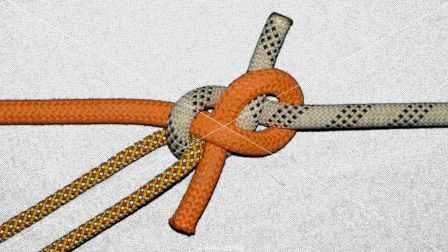
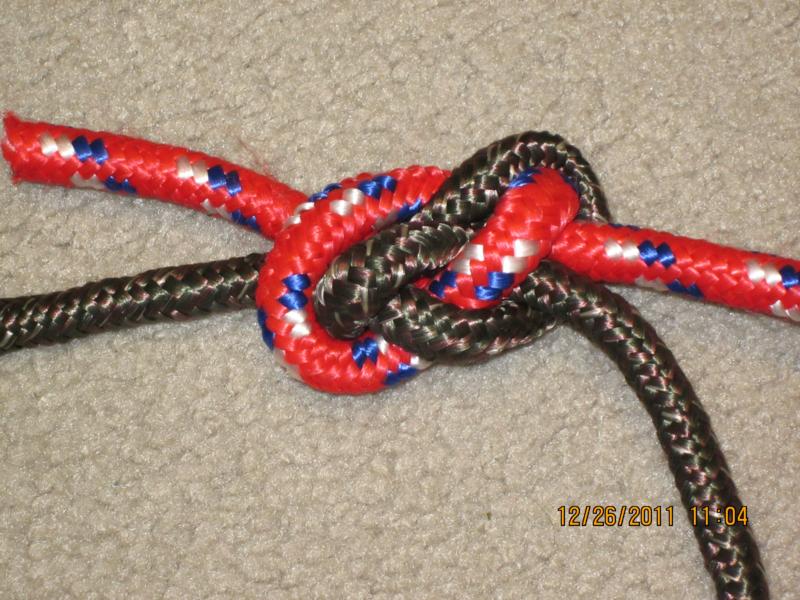
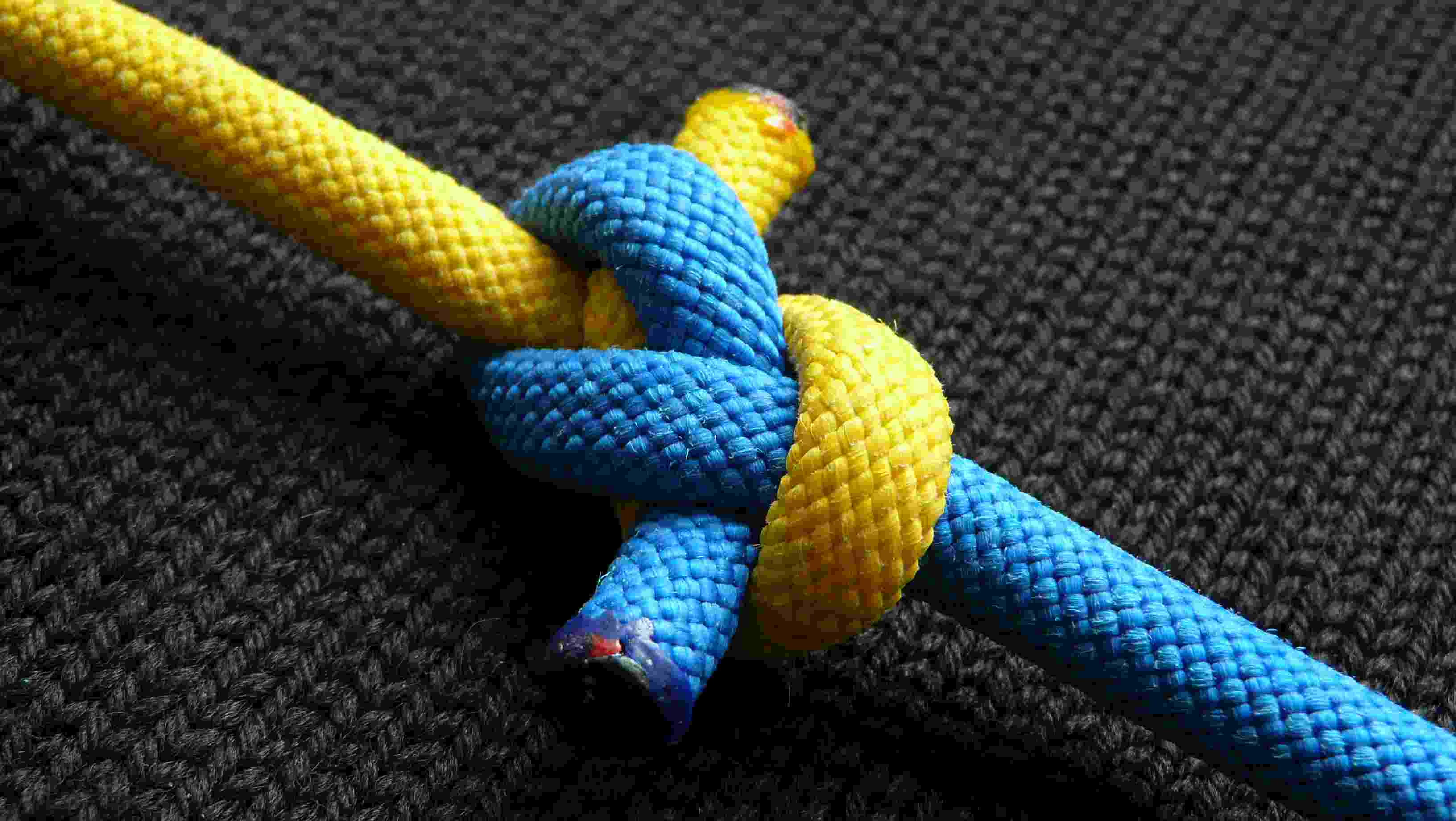
My dear SS369, we live in different continents, so I am sleeping while you are not ! The picture of the mat of the symmetric sheet bend I posted was correct - but it is based upon the mat I now call “ABoK#1440 b” - and not on the original ABoK#1440 ( as you rightly spotted ) ( I have edited my previous post, and, because I lost the original text somewhere, I had to re-write it from the beginning…Sorry, have another look at it, please)
My point is that we can start from the “ABoK#1440 b” Single Garrick mat, and tie the symmetric sheet bend easily, without having to hold the tails not to slip while we pull the standing ends, iff we tie it with the same ropes and the same ends again and again, in a stiff material. It seems that some stiff materials “remember” the form they had in their previous loading -may be because they are temporarily deformed in some way - and so they are easily, almost automatically driven to the same form they had taken previously. Had you noticed anything like this, with the plethora of materials you use ?
P.S. The ABoK#1440 “Single Carrick” mat is one tuck different from the symmetric sheet bend s mat, the “ABoK#1440 b”- so it is no wonder that it leads to the Sheet bend - which is one tuck different from its symmetric cousin.
Touche’ . Trying the knot in 3/4" laid ropes (PP + Poly-Dac),
the exercise shows Roo’s point --manual setting doesn’t make
much difference to these particular not-so-flexible ropes. Now,
it might be that some setting assistance is available in a device.
Or, maybe some knot-holding device is used (tape, seizing).
Again, I’m reaching for some use in which the knot’s appeal
is (a) efficiency of material, (b) simplicity of tying (yes, with
some learning of setting/dressing), (c) relative strength (this
remains to be seen; I think there are issues that affect …),
and (d) ease of untying (by hauling on ends, to capsize-loosen).
And against the better-known carrick bend, I think there’s
an uphill battle.
Re (c), two issues --perhaps at times connected-- are the ambidextrous nature (both-handed; which the Fig.8 has, too)
of the knot, and the potential for race conditions to lead
to imbalance in loaded geometry --i.e., one SPart stays
more straight than the other, sharply bent (which might
result from differences in surface condition --slickness).
Whereas the carrick bend has the SParts staying more
each-to-its-own-side business & formation; capsizing from
the lattice form can be problematic in mixed cordage, but
once dressed, loading shouldn’t introduce biases.
But to the issue of practical knots, I defend this knot’s
presence under that title in that it presents a possible
joint, with the brevity of the sheet bend, square knot,
& grass bend , which can be used for small tasks of little
consequence (albeit perhaps w/no more to recommend
it than variety --but maybe the forcible loosening ).
One could see all this captured under a theoretical remark
put under the …Explorations… heading, too.
After reading the latest installments here I went to the shed and got an old worn and hard bull rope of .75 inches. I tied it using the method I have described earlier, all in hand and yanked it tight as I could fast. I did not fiddle with slow dressing as I don’t seem to need to do this with this knot (even with the smallest of cords).
If I can get through my soggy yard in the days to come I will tie this in a loop fashion around a tree and using my truck I will see if it turns loose under a load that I can not approximate by hand and leg.
This bight can serve as a rope-made pin for the “grenade” :), that, if pulled, can release the corresponding tail, and untie thebend - as mentioned in Reply#53 (1). I can not predict if there will ever be a practical use for this trigger…but many quick-release mechanisms are utilized for safety/security purposes.
The symmetric sheet bend would be more stable with a Zeppelin-type tuck, although this makes the bend less simple. The tucks also make the SSB look more like my “small fancy bend”.
Yes, because we get fig.8 shaped links, and the bend becomes an interlocked fig. 8 bend (1). One tuck more, in a one-tuck bend, is too much , I am afraid ! On such simple a thing, adding something, however small, is equivalent of subtracting almost anything else…because this bend has not much more, than its outmost simplicity.
I have tied the symmetric Sheet bend and the What knot - GrassBend (ABoK#1406-ABoK#1490) with various elastic and springy cords. Big advantage for the WhatKnot-GrassBend ! While the elasticity of the material tends to push the tails of the symmetric Sheet bend in the wrong place, and the knot to degenerate into its evil impostor, it helps the tails of the WhatKnot-GrassBend remain in the correct place - and the knot to close into the secure form, and not degenerate into a loose Thief knot. ( The springy elastic material seems to be at least as helpfull - and perhaps even more… - for the GrassBend, as the - commonly used fot this bend - flat semiflexible material.)
So, if you have an elastic, springy material, you better tie the closest relative of the symmetric Sheet bend, the WhatKnot -GrassBend (ABoK#1406 -ABoK#1490).
The ingenious knot tyer Desmond Mandeville had found a way to arrive at the “Symmetric Sheet bend” ( which he had also met, and had named “Tumbling Thief” bend ) by a certain re-arrangement of a Carrick mat. See the attached picture. I have copied this image from the chapter " Trambles ", written by Geoffrey Budworth, at : History and Science of Knots, World Scientific, 1996, p. 306
In the same book, p. 316, one can find many references to Desmond Mandeville s work, some of which was published in Knotting Matters.
There are many ways a knot can be tied, and the “Symmetric Sheet bend” / “Tumbling Thief bend”, although the most simple symmetric bend possible, is no exception. The series of moves shown by Desmond Mandeville is not supposed to be an “easy” tying method, of course - it is a manipulation and transformation of one particular Carrick mat ( the a ) to another ( the e ). D. Mandeville had built a whole “mini-universe” of known and unknown bends, by performing similar manipulations / transformations. To be able to explore the hidden relations between apparently different knots, and arrive at any one of them starting from any other, by a series of similar “moves”, seems fascinating to me. In a sense, all the thousands of practical knots are but a limited number of them, plus a certain sequence of such “operations”. That is all what science is about, an effort to “reduce” the apparent multiplicity / infinity of phenomena to a small / limited number of simple “elements” - to "make everything as simple as possible, but not simpler".
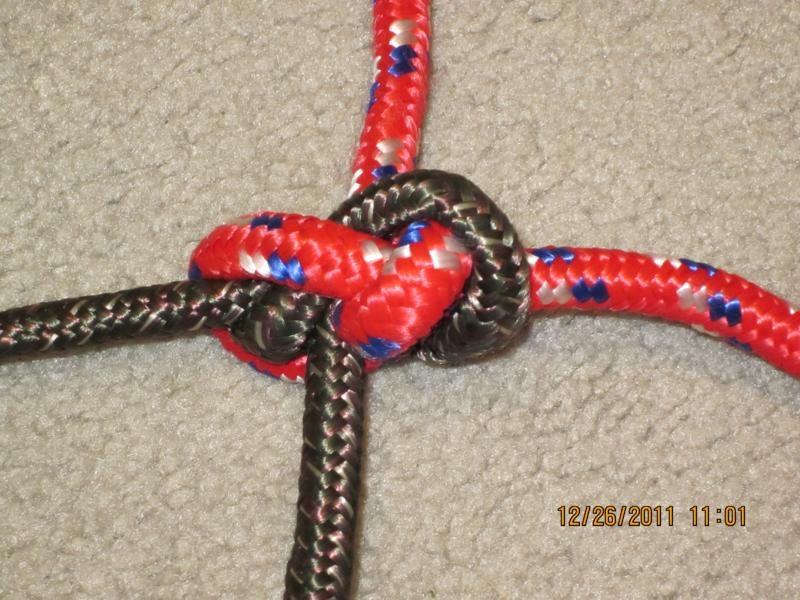
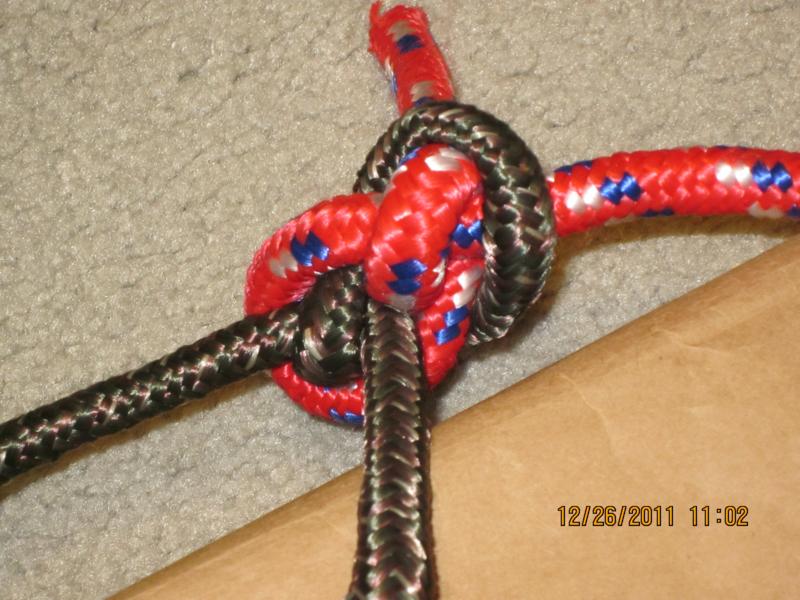
Two pictures of a Tumbling Thief knot, after hard loading : I use to haul a horizontal line taut by a Trucker s hitch, then step and jump on it, and then I repeat the procedure a number of times, until the nub of a bend in the middle of it becomes rock-solid… It seems that the more the bend is tensioned, the less vulnerable to any accidental release and “insecure” it looks ( even to people that do not understand how the friction between two adjacent lines is greatly enhanced by their local saddle-shaped deformations ), while the easiness of its untying remains exactly the same.
 The picture of the mat of the symmetric sheet bend I posted was correct - but it is based upon the mat I now call “ABoK#1440 b” - and not on the original ABoK#1440 ( as you rightly spotted ) ( I have edited my previous post, and, because I lost the original text somewhere, I had to re-write it from the beginning…Sorry, have another look at it, please)