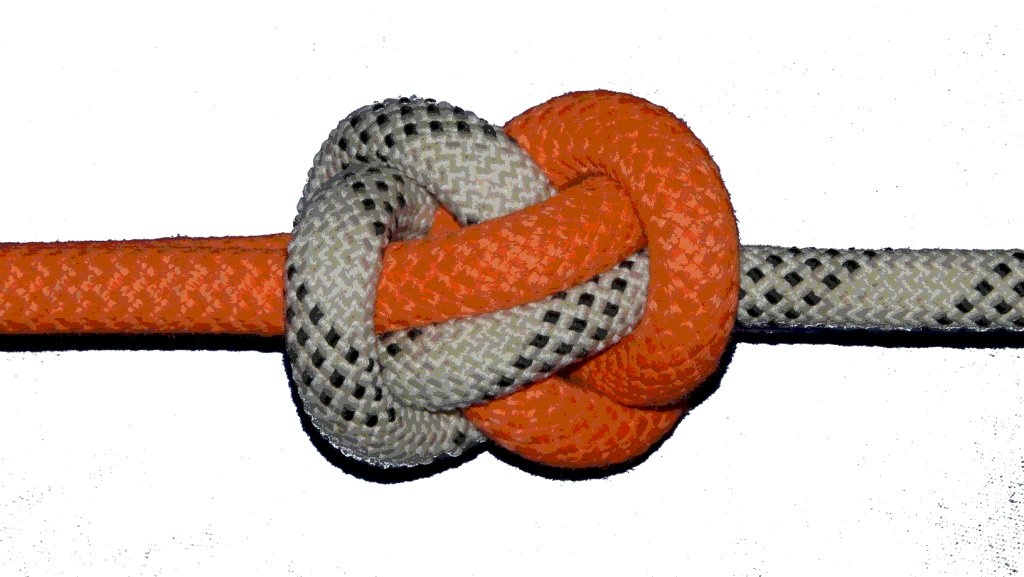
A fine symmetric lanyard bend, by Roger E. Miles ( Symmetric Bends, How to Join Two Lenghts of Cord , 1995 ). Bend B 27, tying diagram at p. 96, picture at p. 114, notes at p. 129 ). Similar to the slimmer “Teedledee” bend, A 24, tying diagram at p. 85, picture at p. 106, notes at p. 123 ).
In the Vice Versa bend, the four ends pass through two bights, while at the Tweedledum bend they pass through four bights. So, in a sense, the Tweedledum bend is a double Vice Versa bend.
This “double Vice Versa” description is more representative for the simpler and slimmer Tweedledee bend ( A 24 ), - which I had called 88 bend, when I was not aware of Miles book (1, 2). Perhaps here is the right place to show a simple variation of this bend, ( named Teedledee X bend), where the ends are crossed before they exit the knot s nub. See the attached pictures, where the simple Teedlwdee bend is also shown, for an easy comparison.