Hello, my name is John Hartzog, I am 61 and live in Florida, USA. My story begins in the late 90’s. At the time I was working the midnight shift at a new roadway toll plaza that wasn’t very busy so I had plenty of time on my hands. A few years prior I had taken up dual line sport kiting as a hobby (never did get good at it). I had bought a pair of small stunt kites that were trained together with 5 train lines that were supposed to be of equal length. They were tied in hollow core Dacron kite line and they were anything but of equal length. The need for train lines to be exactly equal is important because unequal lines means an unstable train. This is a problem with 2 trained kites, a disaster with more. I suck at tying lines of equal length using the traditional Double Overhand Loop Knot, at least at both ends of the line.
I knew that there had to be an adjustable loop knot available and wondered why no one was using it. So I borrowed every book the library system had on knot and set out at night at work to find it ( I bought a copy of The Ashley Book of Knots). But search as I did, I was so disappointed that there just was not such a not in existence. Now I knew why no one used one. Then late one night as I sat in my booth practicing a few knots from a book I tied a loose Figure of Eight Knot. Playing around I passed the free end (working end) through the loops of the Figure of Eight Knot and pulled it tight with a snap by putting my finger into the loop made by the free end and pulling on the standing part. Lo and behold I sat in amazement as studied the loop knot in my hands. It was exactly what I was looking for! I could not believe that I had discovered, or invented a new knot so for years I kept looking and asking others as I showed them my knot. But to this day I have never found the knot in any publication that I have looked in.
To this very day I have a hard time believing that I have actually come up with a new knot. I have been so afraid that I have not that I have only sent it to one person in the kiting world, Rod Beamgard, in order for them to see if they knew of the knots existence. He was unable to find anyone who had seen the knot before. I still have reservations about sharing this because I am so afraid that either I have not discovered a new knot, or I have waited nearly 20 year and some one else had discovered it and has submitted it. But here goes.
I have used the TALK to successfully tie kite train lines in hollow core 150 lb.test Dacron. The knot has not ever slipped in this line. I have successfully made 100 foot and 150 foot long dual line kite flying lines, of exact equal length, made of 75 to 150 lb. test twisted and braided Spectra kite line after sleeving the Spectra line with 150 ld. test hollow core Dacron. I have never had the TALK slip in these flight lines. I have used these lines on large kites that have a heavy pull, strong enough to drag my lovely 110 pound wife down the flying field. I have tied the TALK in Para Cord and tested it to the extent of my strength and have never had the line slip even though the end of the loop was open, just my finger stuck in the open loop. I have tied the TALK in 1/4" thick Nylon rope without the knot slipping. I have also tied the TALK in various strings, where it can be almost impossible to adjust because it cinches so tightly. I have also tied the TALK in natural hemp rope of small diameter and never had the knot slip.
Because of the way the force is directed straight down the standing part when pressure is exerted at the apex of the loop, the cord is cinched tightly and will not slip. Of course extra strength is added when the loop is actually looped around an object and secured with a simple hitch. The less slippery the line the tighter the knot becomes although I have tied it in bare braided Spectra kite line and it held. I have tied it in slender rubber and plastic coated braided core electrical wire. It held.
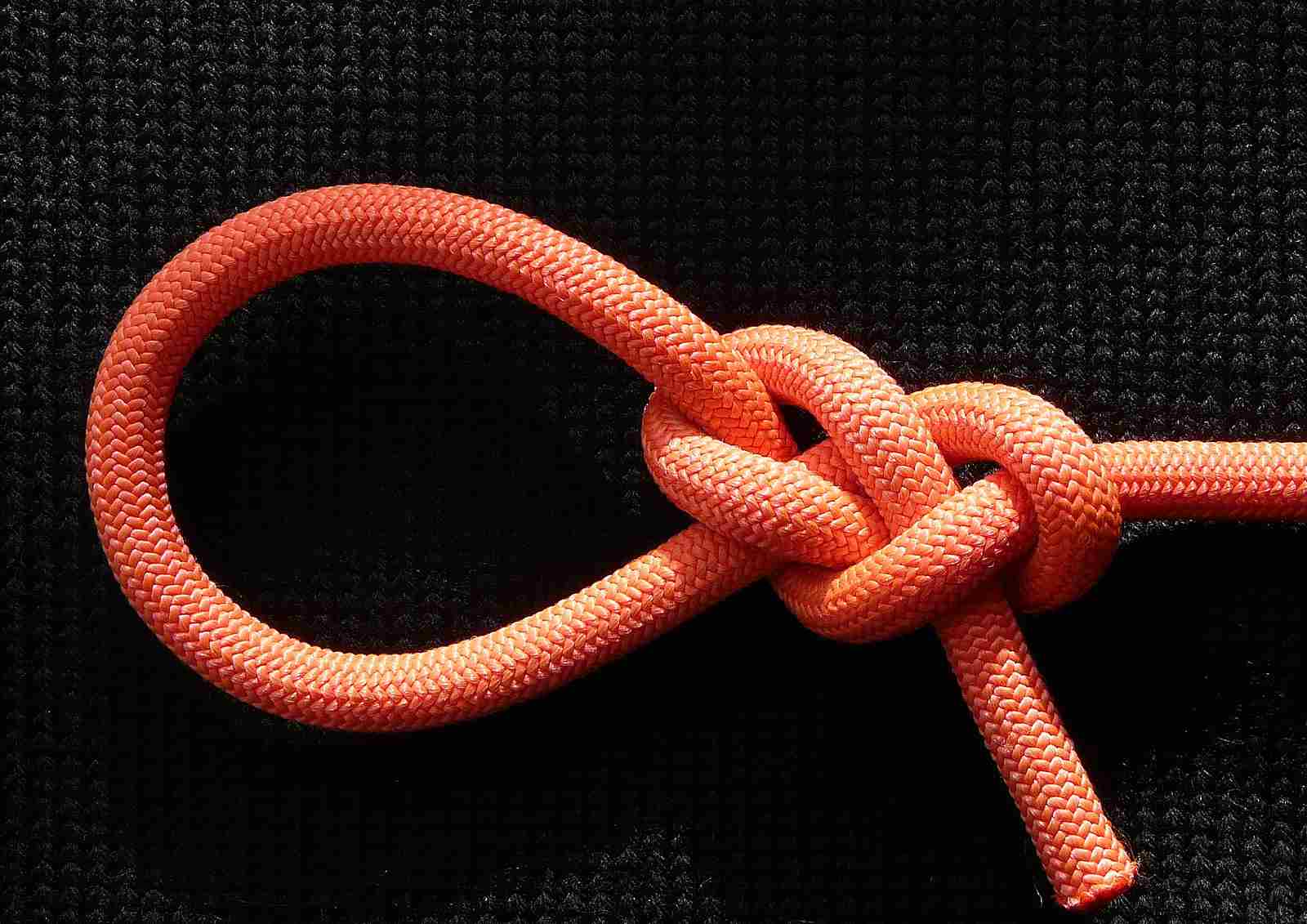
I am attaching 2 pics showing how I tie the TALK. I have even tied it in the opposite “hand” by reversing the way the Figure of Eight knot is tied.
Fig. 1 shows a Figure of Eight knot with the working part passed back under the right hand loop on the same side that it first passed. Then passed over the center crossing, then passing under the left hand loop beneath the standing part. To cinch the knot simply hold the working end and the standing part in one hand while placing a finger inside the loop created to the right of the Figure of Eight Knot and pull fast and hard.
Fig. 2 shows the cinched TALK. To adjust the loop thus adjusting the length of the line overall, simply hold the central part of the TALK and pull on the working end to loosen the knot. Once loose simply adjust the loop longer or smaller by pulling either the inside or outside of the working end.
The TALK can be used anywhere a Double Overhand Loop is used and in much the same way only with the added benefit of adjustability.