True Adjustable Loop Knot or TALK for short

This is a veeery difficult issue, which we had discussed time and again in this Forum, without becoming able to reach at any consensus. I want only to point out that a ( practical ) “knot” is already a rope mechanism - and perhaps it is nothing more than that.

Interesting point. However, when the loop is loaded ( even with a fraction of the total, final working load ), the first / “higher” overhand knot does most of the job, so what you really gain is not that much.
The problem is more essential : as I said, the continuation of the returning eye leg, when it goes through the first, more tight nipping structure, follows a U-shaped, rather than an L-shaped path. This maximizes the friction and the capstan effect at the tip of the U-turn, and so makes the job of the second / “lower” overhand knot a lot easier, but it also makes the adjusting of the loop a two-stage, more difficult and less quick procedure, if it is even partially loaded.
I believe I had tied and tried all the single-knot adjustable loops there can be, and I had not seen anything more secure, and TIB, than the Pretzel loop.

:slight_smile: The first wheel was good enough ( one would even say “perfect enough” :slight_smile: ), but we have been improving it for six thousand years now… :slight_smile: :slight_smile:

This knot is a Helical loop (1) - but a not-good one ! :slight_smile: The symmetric-Pretzel-based Helical loop shown in this thread ( third picture, at Reply#3 ) is a much-much better knot. The asymmetric-Pretzel-shaped Helical loop is also TIB (2).
I wonder how people can tie some “new” knots that seem promising, but then do not try to understand how they work, in order to become able to improve them further. Any convoluted enough knot, on the continuation of the returning eye leg, which is wrapped inside one or more helical turns, on the continuation of the Standing End, belongs to this family of Helical loops - but this “gangspesknut” is probably one of the worst !

  1. http://igkt.net/sm/index.php?topic=4949
  2. http://igkt.net/sm/index.php?topic=5227.msg34173#msg34173

OR… Or a figure 0 ! :slight_smile:
I mean, instead of having the continuation of the returning eye leg pass through a closed overhand knot, we can reeve it through the open eye of a slipped overhand knot, the same way we do in the Trucker s hitch.
Going one step further, if we want to avoid tying a second / “lower” overhand knot altogether, we can drive the Working End around the encircled object for a second time ( that is, use a double loop ) and secure the Tail End in between the two opposed bights, a la Trucker s hitch, the way explained in (1) and shown in the attached picture.

OR… Or let the continuation of the returning eye leg pass firstly through the less tight overhand knot, the “lower” one, then pass again around the object for a second time, and finally be secured at the more tight overhand knot, the “higher” one.
Both those double loop / two-eye solutions use much more material, of course, but they are also much more secure - the tensile forces running along the four legs of the two eyes are smaller, therefore the load the last leg and the last, “higher” overhand knot would have to carry, is lighter.

See also :
http://igkt.net/sm/index.php?topic=3937.msg23378#msg23378
  1. http://igkt.net/sm/index.php?topic=1870.msg17364#msg17364

The Guyline hitch itself is not such a simple knot as it looks… Each of the two overhand knots has three openings, and the penetrating line can pass through them from the one or from the other side : 2 x 3 x 2 = 12 distinct possibilities. Under heavy loading, some of them may be re-dressed by themselves into some others, so the total number is not 12 - but it is not 1 either ! :slight_smile: (*) Moreover, both knots may have the same ( both overhand or both underhand ) or the opposite handedness - and the last leg of the Tail End may be parallel or twisted around the eye leg in a clockwise or counter-clockwise way… Oh, my KnotGod ! :slight_smile: I have seen that there ARE differences in the choking power ( regarding the first knot ) or the holding power ( regarding the second knot ) of those distinct loops, but I am not able to measure them.
One has to tie all of them, load them, and see which tend to be transformed into others and which retain their individual form, and then test them in a systematic way…

(*) For example, see one of the many district forms of the Guyline hitch at the attached picture )

THAT is not the guyline hitch commonly cited,
but a mistaken image of it : the overhands BOTH
lie in the S.Part of the commonly cited structure,
not one each in S.Part/tail.

–dl*

Correct, the picture I had used was a picture of a different, or of a wrongly tied knot - I edited my post, and I now use a picture taken by me, to illustrate what I was talking about.
My intention was to point out that we can tie “overhand/underhand” knots of the same or of different handedness, we can pass the penetrating line through them from the one or the other side, and that the last leg can be parallel to or twisted around the eye leg, etc.
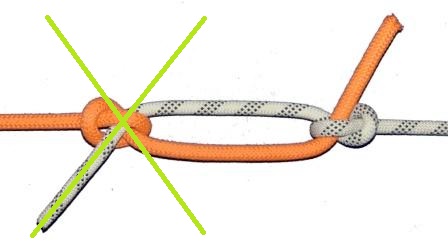
The way/angle lines meet each other influences the friction forces generated between them at the area of contact. In the binder shown below, the green lines show the directions of the two segments of the rope as it reaches/leaves this area - we see that they are not parallel to each other, as in the Guyline hitch cited “commonly” :).


A simple adjustable binder.JPG

For what it’s worth the “Guyline Hitch” referred to in http://www.netplaces.com/knots/making-hitches/guy-line-hitch.htm is actually a Bowstring Knot with an overhand added around the loop leg in the final picture - which seems pointless - an overhand in the working end is all that’s needed.

Barry

The verbal description of the knot is OK, it is the third sketch that is wrong.

" 1 Make an Overhand Knot some distance from the end, so that you leave enough running end to pass around the object and then back to the Overhand.
2 Pass the running end back through the bottom of the Overhand Knot.
Sometimes two Overhand Knots are tied next to each other in the standing part. The running end is passed through the first one to provide the grip and the second one to hold the end down.

3 Tie two Overhand Knots in the standing part, and tuck the running end into the second one."

To see a step by step pictorial of how I tie the TALK go here http://trueadjustableloopknot.blogspot.com/

Hi Dan! Looks like Oneloneknot doesn’t believe you or anyone else who tells him that his knot is published already. Such scepticism is not an unreasonable attitude for anyone who reads posts in an Internet forum. But perhaps he could be convinced if you were to post a photo or a scan of that “Figure Eight Throat Tie” figure in the Encyclopedia of Knots and Fancy Ropework. “Seeing is believing”, as they say.

/Twine

I have to admit that I didn’t understand your U-shape and L-shape distinctions, but now I have played around a bit with Oneloneknot’s TALK knot, compared it to the Slippery 8 and the Guyline knot, and I think I see what you mean. The Slippery Eight and the Guyline both have these U-shapes, while the TALK knot (AKA the Figure Eight Throat Tie) has the L-shape, right?

Right. I should perhaps had said “upside down” U, and “upside down” L - but what is “up” and what is “down” ? :slight_smile:
A U-shaped continuation of the returning eye leg is more secure, regarding slippage, but an L-shaped one can be adjusted more easily. I believe that it is difficult to achieve a U-shaped turn which, when we pull the Tail End in order to adjust the loop, is not too tightly nipped into the surrounding nub ( unless the nub is O-shaped at the tip / point of the turn, that is, unless we use an open bight, like the one we use in the Trucker s hitch ). Anyway, if the nub is tight enough ( as it happens in the case of the Pretzel loop ) even an L-shaped segment can be griped, “locked” and immobilized, very efficiently.

But we have more local sights, as I noted above (in bold),
with a URLink to my own images & knot. (My old findings
in notebooks pretty well suggest that I did NOT realize
how secure the knot the OP presents is --in that in the
cases I found, I had run the tail back through the body
for presumed needed security! I didn’t find where I first
made what I call the “quick8” --the OP’s knot.

(There is a difference in the orientation (top/bottom, so to speak)
of the knot’s image in EKFR, which might be what has
deflected the OP from realizing the match. Beyond that, as I noted,
“Hansel & Gretel” give no helpful information about its actual use
& loading (–“a figure of 8 knot tied through the bight …” :: huh!!!)

BTW, I was unable --from one system-- to see the references that
Roo cited, so don’t know what images (or not) are present there.)

–dl*

Let me be perspicuous* re this :: OneLoneKnot has discovered
for/by himself a pretty neat/good knot !! --no matter where
it might have resided unknown to him (et al.). I think that
I might’ve gotten there first, but what does that matter,
if so? I’m sure that when I first got to that neighborhood
I did NOT recognize this knot as such, and thought to further
tuck the tail. I’m more happy that we both found it, and it has
seen light --extra light via his efforts, I think!

Let me add that the tail of the OP’s knot can be tucked
back into the knot between the eye legs at their entry,
and snugged down to be fairly secure-when-slack
–with assured security when (normally --not “ring-”-- loaded).
(This particular tucking came with my realization of the OP’s
knot whenever that was; the earlier re-tucking was to make
a bowlinesque collar, which I thought was necessary,
whereas for the latter tucking I was deliberately seeking
not in-load-security but slack-security.)

–dl*

[*Yes, “perspicuous” : use it or lose it! :o]

But your knots at that URL, http://igkt.net/sm/index.php?topic=3810.msg22474#msg22474 are not adjustable loops, they are fixed eyes, so they’re not the same, neither in function nor geometry, as the knot of the OP. Thus, they don’t constitute prior publication.

(My [u]old[/u] findings in notebooks pretty well suggest that I did NOT realize how secure the knot the OP presents is --in that in the cases I found, I had run the tail back through the body for presumed needed security! I didn't find where I first made what I call the [i]"quick8"[/i] --the OP's knot.

Are you saying that your discovery of the Quick8 (if it really is the same as the adjustable loop the OP calls TALK, which is hard to determine due to lack of picture or description of Quick8) pre-dates his discovery? I seem to recall reading of a knot by the name of Quick8 somewhere, so you may well have a point, but I can’t seem to find it anywhere right now.

Oh, I found a description of it now. Inside a parenthesis in your post at
http://igkt.net/sm/index.php?topic=3810.msg22474#msg22474
which I quote here:

I'll attach photos to this post of what I proudly name the "Lehman8" and --hmmm-- "Collared8" (to which knots' common mid-state of completion lies what I call the "Quick8" and then "tucked Quick8"

A picture would have been better, but okay, what you describe (and do not depict) must be the same as what Oneloneknot calls the TALK knot, so the structure wasn’t new. But did you also come up with the idea of using it to make an adjustable eye?

(There is a difference in the orientation (top/bottom, so to speak) of the knot's image in [i]EKFR[/i], which might be what has deflected the OP from realizing the match. Beyond that, as I noted, "Hansel & Gretel" give no helpful information about its actual use & loading (--"a figure of 8 knot tied through the bight ..." :: huh???!)

“a figure of 8 knot tied through the bight …” ::slight_smile: Heh. A very strange description. And that’s all they had? And did you say that in their illustration the end was seized to the standing part? To me, that makes it obvious they didn’t mean it as an adjustable loop.

BTW, I was unable --from one system-- to see the references that Roo cited, so don't know what images (or not) are present there.)

I followed Roo’s link to the usenet post depicting the Slippery 8, and I arrived at a horrible jumble maning nothing. Turns out that Dave Poston had made some ASCII art to show his knot, but ASCII art turns to a mess when viewed with a proportional font. (See attached picture)
I copied it into Notepad and took a screenshot of it, and it shows a clearer picture. (See the other attached picture)

Note to Oneloneknot: The pictures show (or attempt to show) the Slippery 8; it is NOT the same knot as yours, but it shows a somewhat similar structure. The difference is that in the TALK knot the working end is reeved through the figure 8 in the opposite direction. Personally, I find the TALK a marvel of simplicity, and I happen to agree with Leonardo da Vinci who said that “Simplicity is the ultimate sophistication.”

/Twine
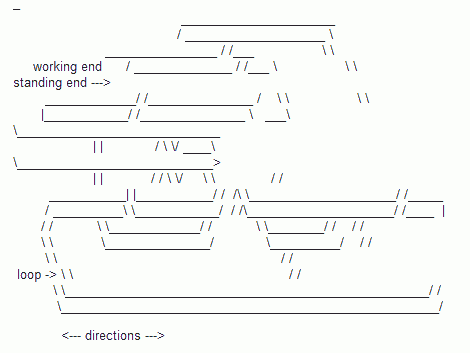

slippery 8 messy.gif

The word perspicuous isn’t very perspicuous to me; I had to look it up. :slight_smile:

I can easily imagine that you or many other knot-tiers of IGKT have come up with the fairly simple structure of the TALK, but I think Oneloneknot at least should be honored with discovering how surprisingly strong and secure it is while using it as an adjustable eye for kites. I imagine that kite string is very strong and slippery, like monofilament, but I may be wrong, of course.

Let me add that the tail of the OP's knot can be tucked back into the knot between the eye legs at their entry, and snugged down to be fairly [i]secure-when-slack[/i]

But the whole point of this knot is that it is easily adjustable. That property is ruined by your extra tuck! Instead, you could tie a stopper knot on the tail. That would keep the adjustability, but prevent the knot from coming undone.

/Twine

Attached is #308 from the Encyclopedia of Knots and Fancy Ropework and it is the same as the “TALK” knot. The book calls it the Figure-of-Eight Throat or Emergency Tie, but gives little indication of any real evaluation of it and stupidly fails to indicate which end is the standing part. But this is a visual indication of what was being discussed relative to the the Slippery Eight Loop in rec.crafts.knots.

Thanks for providing the picture, Roo. The picture shows that the authors of the Encyclopedia had no understanding of the knot. I can imagine no practical use for the seized form as shown. And what do they mean by Throat Tie? Am I supposed to use it to tie my scarf or my necktie? (Maybe not a bad idea, come to think of it, but do I really want to seize the ends of my scarf together?) And “Emergency Tie” is quite ambiguos too. What emergency? A fire, a car accident, a robbery, an asthma attack or what? So since the Encyclopedists fail to say anything instructive about it, we must assume they copied it from some other source. If they had invented it themselves they would have had more to say about it.

By the age of the Encyclopedia in question, we can determine that the knot was discovered some time before 1943. Therefore, both Dan and Oneloneknot have independently discovered or invented this knot, but were probaly not the first to do so. Since it already has the name Quick8, I think we should keep that name, and not add the name TALK as well. The names in the Encyclopedia of Knots and Fancy Ropework are possibly misleading, so even if they are older, I would not advocate their use.

I found a post in this forum (http://igkt.net/sm/index.php?topic=4965.msg32752#msg32752) where Dan explicitly speaks of the Quick8 as an adjustable loop, so we see that Dan and Oneloneknot are not only speaking of exactly the same structure, but also have the same usage in mind.

I think we must conclude that Dan Lehman’s publication of the knot predates Oneloneknot’s, but that there may well exist an earlier publication, which the Encyclopedia writers have looked at, misunderstood and simply copied.

/Twine

Sadly, which leaves me heartbroken (I knew that I could not have invented a new knot) that EKRW308, which I think you all are calling the “Quick 8” is a LEFT HAND version of my TALK and is tied exactly like I tie a left handed TALK. Thanks for all your time and effort on my behalf.

-John

Don’t be sad, Oneloneknot! At least you have discovered a great knot. Not everyone can do that. The greatest thing about inventing a knot isn’t really some kind of fame and glory from being the first discoverer of it, but the pride and joy in one’s own creativity and inventiveness. Also, you shouldn’t be surprised that Dan Lehman found it before you, because he’s a genius at knot-tying. I don’t think he is sad about not being the first to think of the structure of the Quick8.

Me, I have never come up with a new, good knot by myself. My last attempt was to lock two half-hitches in the same way as Xarax (another genius knot-tyer on these boards – we have lots of them) locked a cow-hitch, i.e. by a single tuck of the end under the rest of the hitch. But it turned out that his locked cow hitch was better, because it both grips harder and is easier to untie. Anyway, I wouldn’t be at all surprised if Xarax or someone else has already tried that hitch and found it lacking. Every knot I use regularly is invented by someone else, it seems. Does that make me sad? No, I take great comfort in just knowing many knots so I can try to pick the best for each purpose and be fairly sure it isn’t a bad knot.

The adjustable figure of 8 loop, Quick8, is both neat and practical, and I’m grateful that you brought it to my attention, because I had never seen it before. Well, I may have seen Dan’s description, but a wordy description without illustration doesn’t often inspire me to try tying a knot to see what it’s like. But I’ll remember it now, and I think I shall often use it when I need an adjustable loop from now on.

What kind of string do you use with the kites? Is it something like Kevlar?

/Twine