Well since you learned me  I been thinking about security. I do realize adding a second knot will not increase strength. An 80% knot with another 80% knot is still 80%
But thanks for your detail.
Well since you learned me I been thinking about security. I do realize adding a second knot will not increase strength. An 80% knot with another 80% knot is still 80%
But thanks for your detail.
Not to dredge up this old argument, and I don’t wish to start a new one. Out of curiosity I decided to test the MA for giggles. So I rigged up the “2:1” configuration using strictly rope.
Setup Exp 1.
Two 3.5 lbs (7 lbs) on load side.
I then added one 3.5 pound weight on the force end. (No movement of the load)
I added incremental weight until force overcame load.
I ended up using 6 pounds for a MA of 1.16
Setup Exp 2.
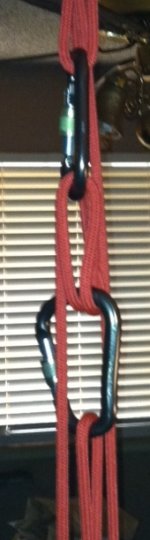
Same setup as above but added carabiners to reduce friction (See attached photo).
This time adding 3.5 lbs on the force end lifted the load end moved slow but it did move. So I would say 2:1
You’re right about the adding of knots --the weakest link
is the determinant, not some sum of strengths/reductions.
But you didn’t really “add a 2nd knot” to the presumed
basis of a fig.8 end-2-end knot : you changed
the knot to a fig.8 eyeknot (in effect/structure), of which
there are two, efficiently sharing eye legs. And THAT might
just win you strength over the (single) end-2-end knot.
Good to put actual forces in play to check MA.
But I’m lost on what your structure is --I see
too many ends running out of the frame to
understand what’s doing what.
Okay, The setup was kinda long so to get a clear image I had to stand close. I will redo the setup outside for better lighting and get a full length shot. for all I know my setup was wrong. We will see.
Yes, in a regular Trucker Hitch with all rope, MA will be substantially less than 3:1. By the way, note the nominal MA in a regular Trucker Hitch without friction is 3:1. Who knows what the nominal MA is for a Versatackle? Every Versatackle is different.
Anyway, the option of using steel carabiners/sheave/rings is not a desirable option for most applications. If you nearly eliminate the friction by using a steel sheave/carabiner/ring, then you also eliminate the holding force that allows you to take a breath before you tie off. That’s bad and dangerous, as you will quickly discover when you’re trying to bear down hard to generate a highly tensioned rope. It’s also dangerous when you untie the highly tensioned rope. I imagine eliminating friction is useful mainly in applications where you’re pulling something and don’t need to tie off the load, like maybe a tug-of-war, lifting a heavy object, etc.
In contrast, the friction that reduces the MA in an all-rope Trucker Hitch is both bad and good. Yes, using all-rope reduces the MA, but the friction also provides a valuable holding force before you can tie off the Trucker Hitch. This valuable holding force is particularly apparent in a Versatackle. The holding force is good friction that outweighs the bad part of the reduced MA.
There are ways to increase the MA in an all-rope Trucker if you must do so for whatever reason. There is a thread somewhere on this forum directed specifically toward MA in a Trucker Hitch.
I currently have some Trucker Hitches in my garage that have a nominal MA of 9:1. It’s kind of like a Trucker Hitch within a Trucker Hitch. Of course, the actual MA is nowhere near 9:1.
I wonder how much more MA is generated when you loop the working end twice through the Trucker Hitch’s center knot? I’ve noticed by tying the TH in this manner, you get much more tension and tightening of the whole system. It’s very easy to tie off the final half hitches too, much easier than if you just took the WE through the center knot once, which is the traditional way of tying the TH. This manner of tying the TH seems similar to a Versatackle in some ways.
That’s a 5:1 nominal MA if you pull around the second anchor twice and through the loop twice. That’s up from nominal 3:1 MA. Also, pulling around the loop the second time forms a nip with the first segment of rope passing through the loop. That nip provides the extra friction that allows the easier tie off. So, this configuration provides more MA and more friction for tie off. It’s great if you have the extra rope and need to crank down hard on the tension. I call this configuration the Lazy Versatackle.
Again, the nominal MA is for identification purposes only. The actual MA is always less because you cannot eliminate 100% of the friction.
Use some weights and find out (even to just witnessing the
“moves” / “doesn’t move” differences between different weights,
w/o being able to get more precise about where the tipping point
and probable actual MA is) --it can be an eye-opening experience!
(Report your results : open many eyes.)