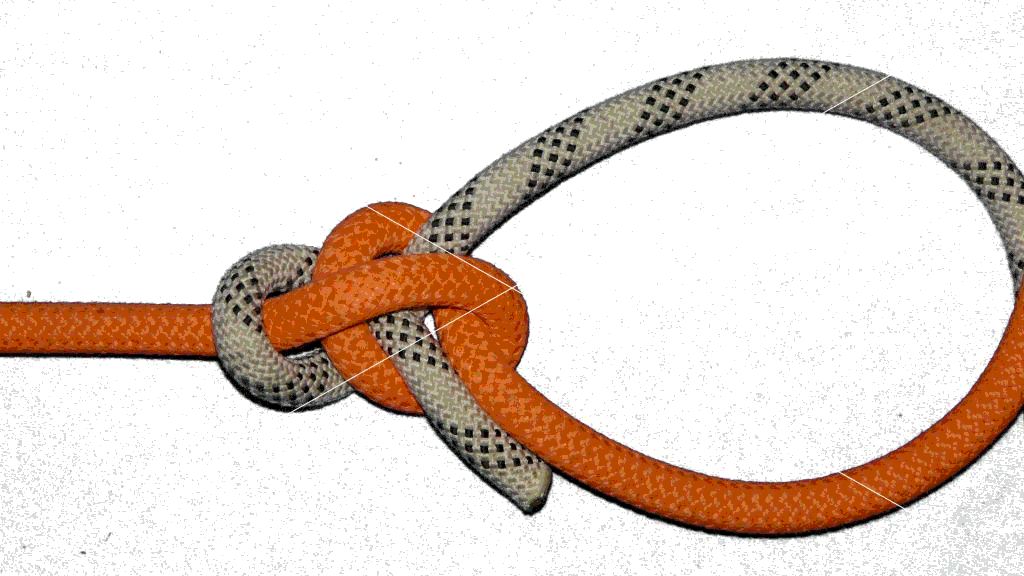
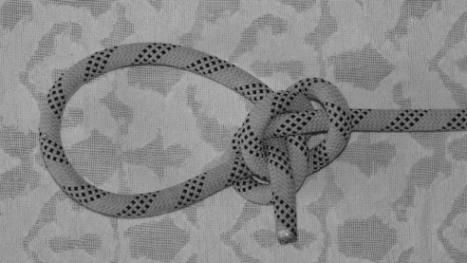
Hi All, I have a loop here, not pratical Loop, quite secure,difficult to tie, but easy to untie.
I like the tucking fall in place nicely.
Thanks, alan lee
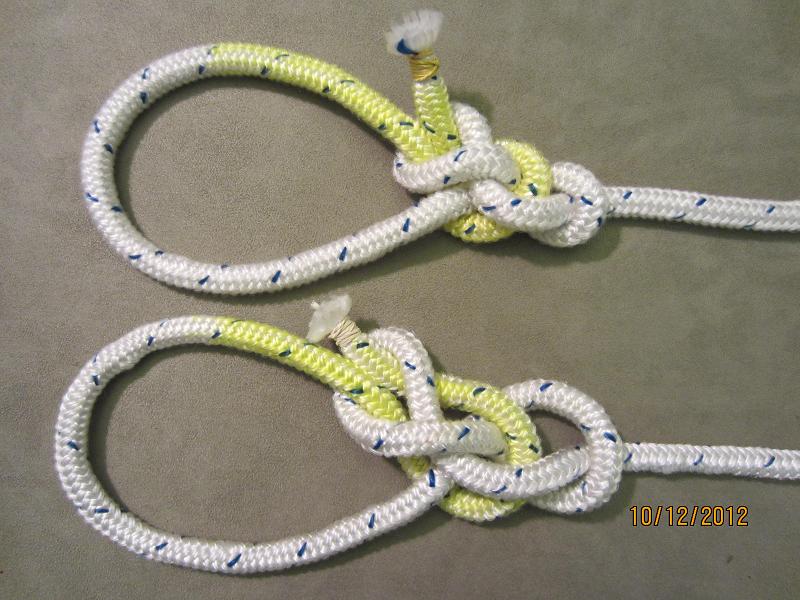
Hi All, I have a loop here, not pratical Loop, quite secure,difficult to tie, but easy to untie.
I like the tucking fall in place nicely.
Thanks, alan lee
If you like the “8” shaped nipping structure, I believe there is no point to go any further than the Constrictor bowline. Beyond this, the bowlines become too complicated, and much of their structure is redundant, or even detrimental to the nipping purpose they are supposed to serve.
Hi All,
As Xarax advise, I simplefy little more and she look alright, Just don’t know how she will behave under load.
Thanks, alan lee.
All those “8” shaped nipping loops are more stable, and self-stabilizing, than the nipping loop of the standard bowline - so , under extreme loading, they should be less vulnerable to capsizing. However, in this bowline the working end participates in the half of the whole of the convoluted nipping structure - and I do not see any reason for this. If one has already formed such a complex nipping structure, why he would suddenly decide to speed and simplify things, and pass the working end through a portion only of it ? If you reach this point, it seems natural to drive the working end right to the top, and form the collar around the standing end, as in the standard bowline - so the two legs of the collar would be nipped at both the two “o” of the “8”, in 4, not only 2 points.
Hi All,
I have another loop for Visual Pleasure , this time the “8” shaped nipping loop on working end, seem like quite secure, just wonder when under heavy load, the nub will wheel toward the load or not.
Thanks, alan lee.
The simple answer is that it will depend, upon the load and the material. The double collar structure resembles the structure of the Constrictor (a riding turn over the pair of the embracing each other / twisted tails), so it can be wrapped around the nipping loop quite tightly. ( One can also use a Strange-looking knot, tied around the standing end and the eye leg of the bight or the rim of the nipping loop).
See the different variations at the attached pictures, and at (1), where there was a lengthy discussion on bowline “locks”.
Hi Xarax and All,
Thanks you very much for your time.
I have more loops for visual pleasure,a while back, I posted a zeppelin like bend on (Chit Chat ? Zeppelin Bend -april-14-2012). I turned it into loop, she have some similar look as this (reply#4 loop)She look great, but the tail collar need some help to pretie it , again i modify it as Lee+Zep+X+bowline modify by Xarax(Knotting Concepts & Explorations ? New Bends and loop ? Reply #6) I think it turn out very nice looking loop, easy to make the tail collar tight, have 3 rope diameter on the nipping loop, also all three leg are nipping on the tail.
Thanks and well come to all comments. alan lee
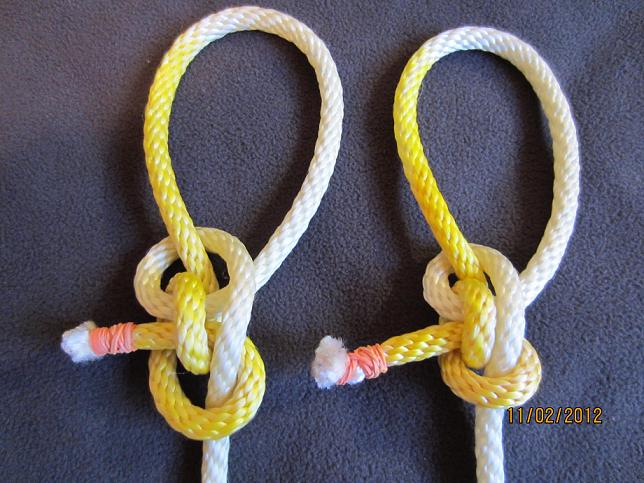
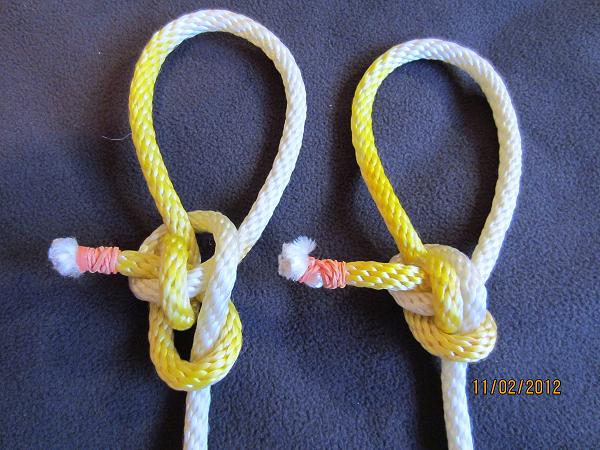
The name " Lee " is the most common name in the world, I guess, although OUR Lee is the best knot tyer of all the Lees - and the name bowline is the most common adjective of all the end-of-line loops, although THE bowline is the best end-of-line loop af all the bowlines. Now, destiny tied things so that the name " Lee" was tangled with the name “bowline”… and the situation had jammed a little bid ! 
There are two different Lee Zep bowlines, and, by crossing the tails ( twist the one around the other, so the knot locks in an X : crossed tails configuration ), one can derive their two X = crossed tails variations. ( See the attached pictures). Till further notice, I denote those two bowlines as (V) and (H), ( V : Vertical, H : Horizontal ), from the orientation of the loops in their original publication. The truth is that the (V) variations " look like" the Zeppelin bends more than the (H) variations ( but they do not “correspond” to the Zeppelin bends ), but the (H) variations might be more secure - as the nipping loop is stabilized by an additional turn of the eye-leg-of-the-bight around its legs. ( Of course, this is only a theory…it can well be disproved by experiments).
And as if those were not enough, we have 3 + 1 Lee bowline-like loops based upon a “Pretzel” nipping loop ( see the attached pictures ). And two Lee bowline-like loops with two collars… and the two crossing-knot loops, the more simple (A), and the more complex (B) one ( see the pictures of the next post).
I guess we need some housekeeping here, Alan Lee !
What we surely need, is to test all those end-of-line loops under heavy loading, and a variety of materials, to see if some are proved to be much better ( secure/strong/easy to untie) than the rest - because our toolbox has became too large. The same is true for all the bends and the hitches published in this forum. We have compiled a large collection of simple knots, but we have not tested ANY of them !
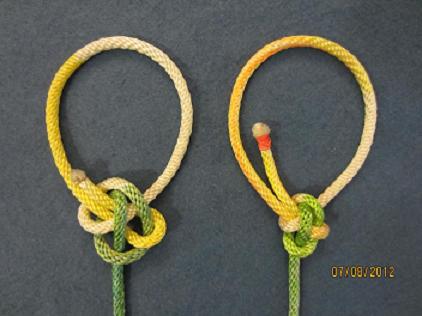
More Lee loops.
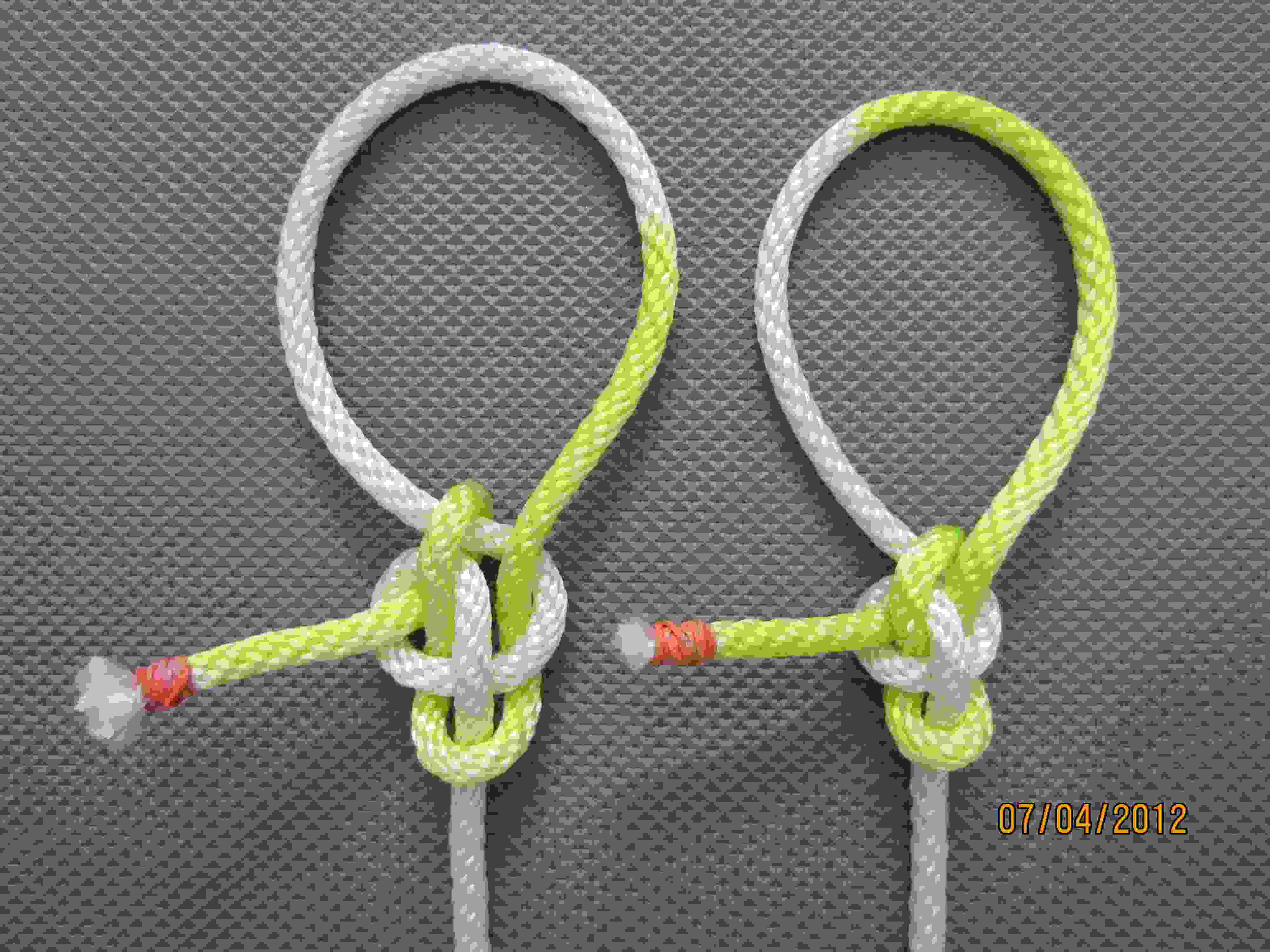
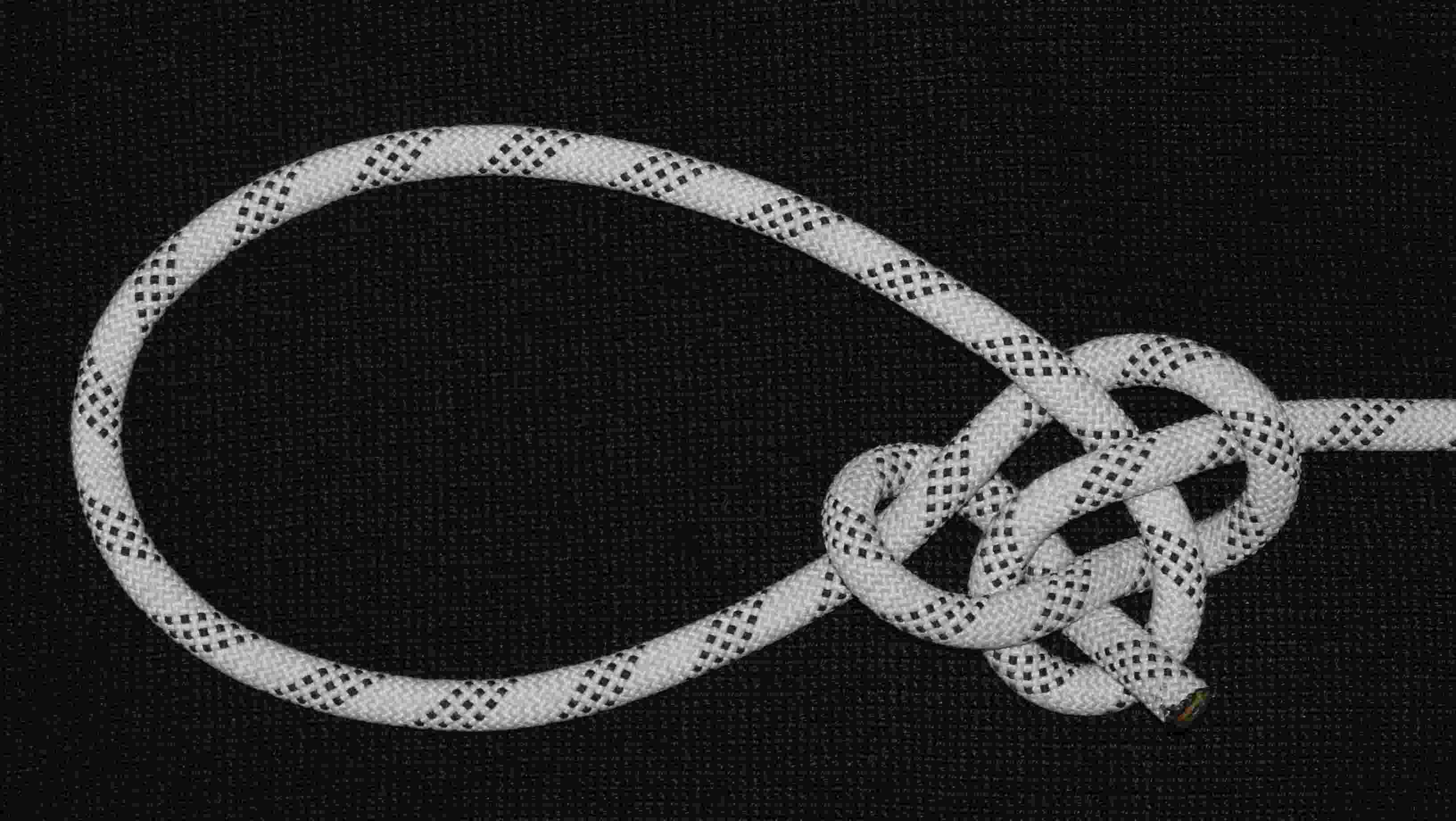
Hi All,
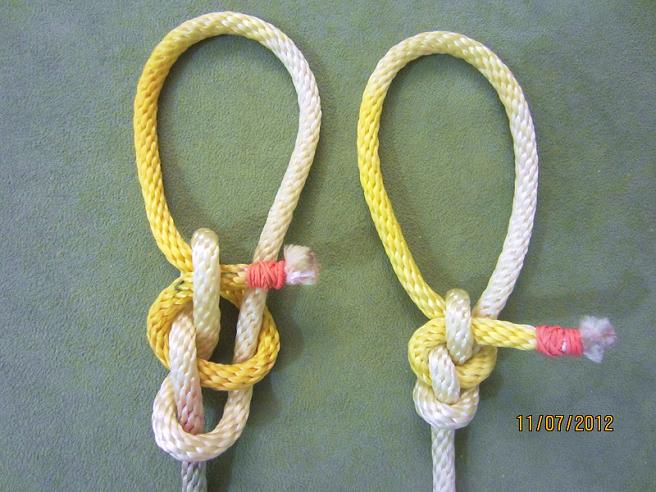
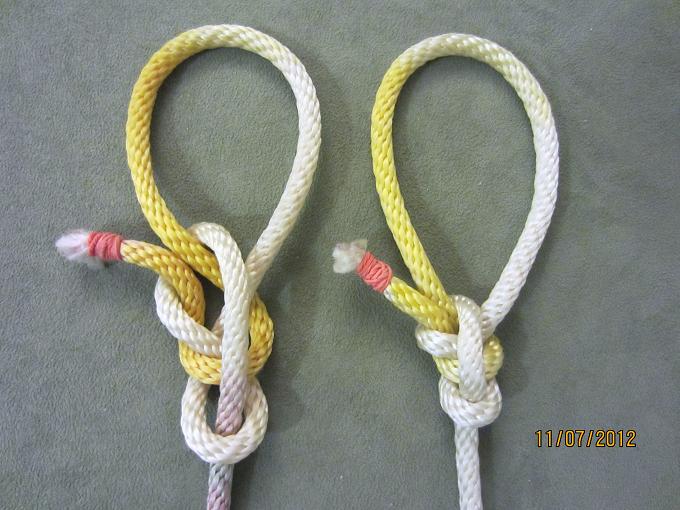
I have two “8” shaped nipping structure loops, just something to see, not sure, may be ok ?.
Thanks to the people and Xarax in this forum, I learn a lots from you guys.
alan lee.
We learn much more from you than you learn from us, that is for sure !
The first loop uses this wave-like “8” structure that is very interesting. ( I have once used something like this for a collar structure, back in the old good days, attached within a Pretzel-like nipping structure, which I used to call “Helical bowline”. Have a look at the last two attached pictures.)
However, this particular loop suffers from the same thing that another, previously presented loop by you, suffered, too - it is very sensitive to ring loading : If we spread the two legs (of the bight…), we can see that the one of them drags the collar of the tail along with it, loosens the collar structure, and tends to pull the tail out of the nipping structure.
The second loop can be tied in more variations. See the attached pictures for another one. I think that the first curve of the standing part, which is capable to squeeze a segment that it encircles more forcefully that the other parts of the knot s nub, should better encircle the second leg of the collar, the tail, and not the first one (as it happens in the variation you have presented here ). As I have said in the past, it is better if the strongest nip of the collar structure, the last line of defence against slippage, is applied on the last part of the working end, the direct continuation of the tail.
Regarding this second loop, my opinion is the same as for the previously presented 8 structure loops : If we go that far, we tie such a complex nipping structure, it is better if we drive the eye leg of the bight right at the top, and tie a proper bowline collar - because, if we do that, the collar structure would be more entangled with the nipping structure, and the two legs of the collar would be nipped at more points. So, in relation to this loop, I believe I would prefer one of the Constrictor bowlines, or one of the Girth-hitched bowlines you had presented the other day.
Hi all
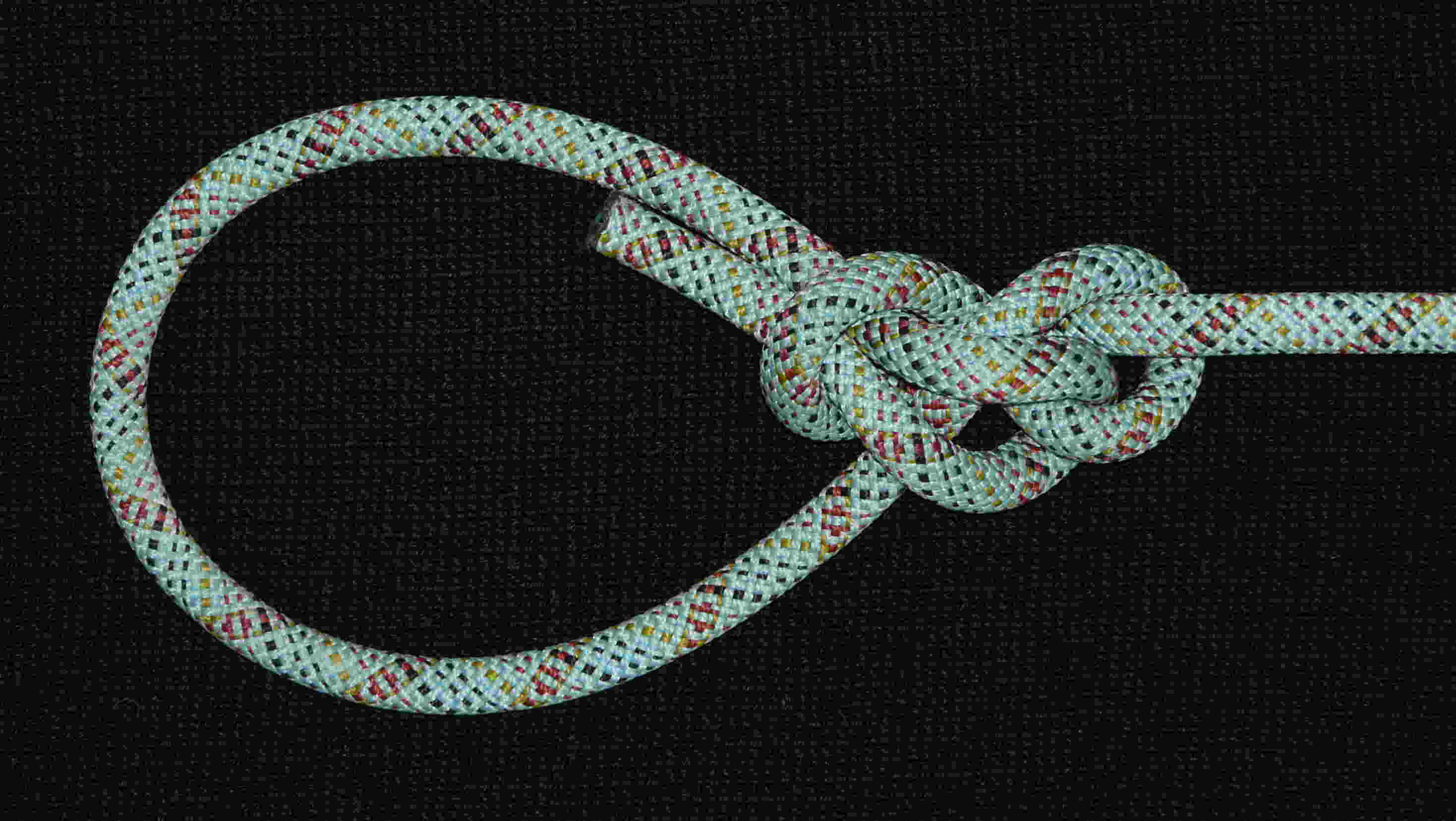
I just wanted to clarify that the following knots were slightly modified by Xarax
Lee Zep X bowline (H).JPG
Lee Pretzel loop (B)
Lee two collar bowline (H)
Lee crossing knot loop (B)
Also the Lee crossing knot loop (A) below was previously posted here:
http://igkt.net/sm/index.php?topic=2197.0
It may not be appropriate to put my name under this knot.
Once again I would like to thank Xarax for helping me out with the images and encouraging me to stay interested in trying to invent new knots.
Thanks alan lee
Hi All, Just another loop for visual pleasure,
Thanks alan lee
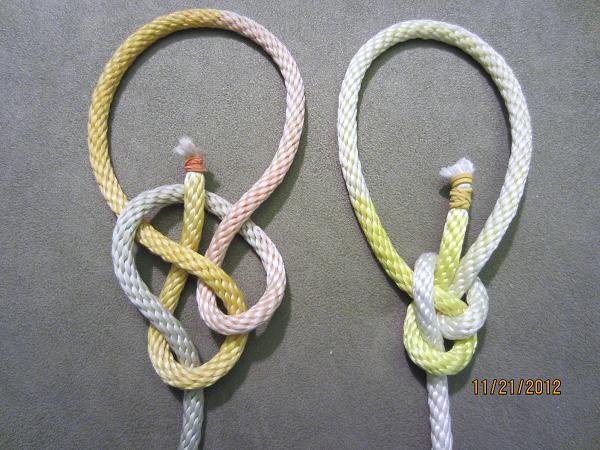
This is a crossing knot loop, very similar to the first one you have presented in this Forum ( See the attached picture). The tail, instead of penetrating the nipping loop at a point higher than the crossing point of the two legs of the bight, as it did there, here it does the same thing at a point lower than it.
However, here we have a problem similar to the one I had tried to explain in (1). The two legs of the bight, as they cross each other, form the two sides of a triangle - the third side of the triangle being the continuation of the standing end, a portion of the standing part s first curve. The tail penetrates this nipping triangle going through its centre - and I argue that, by doing this, it is not nipped as well as it should be. It can slip through this triangular opening between the two legs of the bight, which cannot squeeze it there very efficiently by themselves. AND, at the same time, this triangular void forms a space where the tail can live “protected”, in some degree, by the embrace of the two legs of the bight - protected from the strong squeeze imposed upon it by the third side of the triangle, the continuation of the standing part. ( See the attached drawing ). When the tail is squeezed by a continuation of the standing end, it should better be pressed upon a perpendicular rope segment that would be able to bite it hard and prevent any slippage, not towards the tip of an embracing V, formed by two oblique rope segments, from where it can slip through more easily.