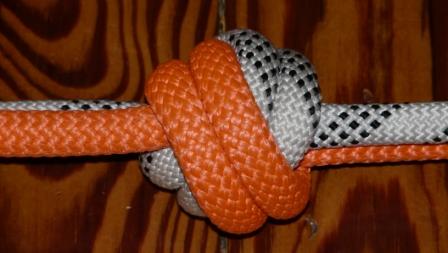
Wanted : A bend for very stiff ropes

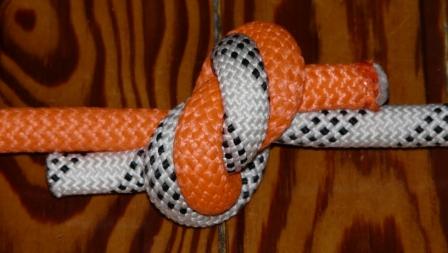
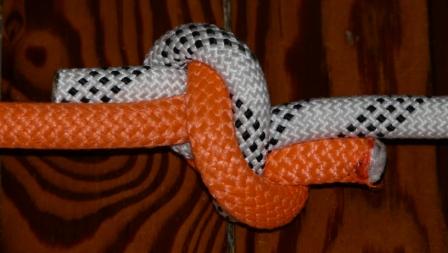
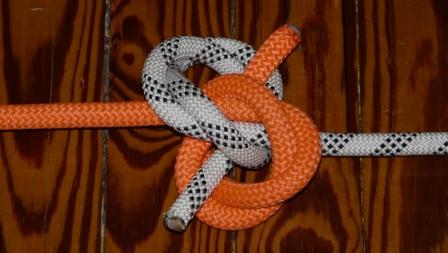
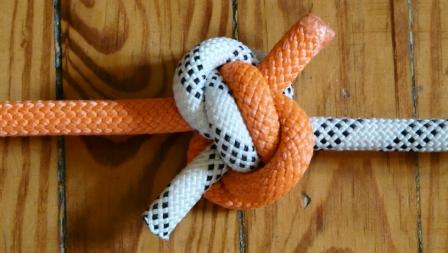
A bend for very stiff ropes? The Water X bend. X : crossed Standing parts, in relation to the “normal” Water bend.
I present some new pictures of this bend, so that the difference of this bend with the bend posted at (1) is more clearly shown. In the Water X bend, the two links are geometrically identical and symmetrically placed in the knot s structure. The crossing of the Standing parts forces them to follow wider curves, necessary in cases of knots tied with stiff rope

  1. http://igkt.net/sm/index.php?topic=2893.0

Water X bend (top view).JPG

Water X end (bottom view).JPG

You may not consider this solution to be a bend/knot - so be it. Try tying a Carrick Bend and DO NOT DRAW IT UP. Instead, seize each working end to the standing part with small twine (size depends on size of hawsers) twice if need be to get a solution. I see no point in trying to tie line this stiff into a suitable knot/bend if it will not bend to less than 4 diameters. Just a thought…

SR

HI xarax,

Nothing in my response indicated that this is the only bend that is available (my emphasis added), allowed or otherwise possible. There is, I feel sure, something else available but not yet tried and true for me - the advice I gave was on the basis of what I know to work. Do you want a bend that is capable of being drawn up into a capsized form or should it exist as a bend capable of being tied in large or inflexible line? I have made such with wire rope and found there not to be a problem. Are you able with a retraced CB to get the required (by you) increase in radius? Is such a retrace impractical? I have never tried it so I cannot say. Have you tried it and is that why you suggest it? What has been your experience? Would I wish to try it? I think not because I would use the solution that I have suggested - I have tried it and it works, so no need to improve the function if it works and is practical.

OTOH - if I am trying to improve something I may be tempted to try some other bends, but I do not take the time because time is precious and I would only wish to try what is previously known to work - I am not a researcher. Such work is the work of those who wish to examine theory rather than practice. When enough theory has been posited and tried (and I am not against such trials provided someone else has done the work) then I may try it. Such is the work of theorists and not necessarily the work of practitioners who post here. If I find myself without a bend for a specific purpose I may well resort to using what material I have and that I know works. For those jobs I have something that works. For theoretical applications I await the erudite responses of those whose work it is to do research. Thanks for posting!

SR

Have you ever actually SEEN such a connection?
I know that it’s written about (along with other myths),
but I have trouble understanding how this is supposed
to work, in practice : because if the seizing is to take
little load (as e.g. Brion Toss asserts), then the knotting
of the ends must not slip at all, and … --it just doesn’t
make sense. To me, the seizing in fact would need to
be effectively making an eye --for as the Spart is
drawn away from the knotted parts, the seized tail must
come along for the ride : how can it do that without
sharing (along with the distance moved) the force?!

Note that Ashley is quite perplexing regarding these two
supposed forms for the Carrick Bend : at #1439 he talks
of “hawsers and cables” being a special problem for joining,
because “the material is heavy and inflexible …” ; yet on
just the following page (to p.262-3), p.264 at #1446,
asserts that “Hawser Bends are always seized and frequently
parcelled to save wear”
--none of which special processing
is even hinted at just the page earlier!?

I’m not sure how stiff modern hawsers are; certainly many are
quite flexible, more so than XaraX’s purported rope (cord).
Frankly, I have trouble buying his claim, but in any case, PMI
regular pit rope takes a firm grip to bend to about 2 diameters,
and that’s problem enough. The Figure 8 & Grapevine bends
are knots used in the caving & SAR field. I don’t think users of
a stiff hawser would even consider knotting it, or else use two
Bowlines, reeved together. I don’t know under what circumstances
such a joining would be called for.

–dl*

I can relate to the question, and I know how stiff a kernmantle rope of polyamide can become when it has absorbed water. It becomes stiff and somewhat springy and resists bending. The usual knots still work, i.e. those for caving and climbing. A bowline is not secure, but a Zeppelin or a Carrick Bend will be usable, as will the fig8 variations. But you should set the knot well before using it, and for this rope, it might make sense to double the Zeppelin (although I think it is overkill).

The knot that would fare worst is the EDK/ORB, because although this stiff rope seems rigid, it elongates more than a dry rope when loaded. Water-saturated polyamide becomes very resilient, much more than dry polyamide. For climbing, I would recommend discarding a rope in that condition (among climbers often done by cutting it up in shorter pieces to be used for tying down load on the trailer and such).

PMI is definately very stiff Rope. I live about 30 miles from PMI manufacturing. I have quite a bit of their rope i play with frequently. I find the Zepplin bend work well with it, when life support is not a factor. In a situation where a life is involved, I would definately opt for the Dbl Fisherman.

Not being terribly critical, but it doesn’t look/seem to be any better, really, than the Zeppelin B with the WE’s re-tucked into the center nip arena.

Could this knot actually be tied in really big stuff and still be secure?

I do re-tucking and slipping on most of the knots I tie, just to see the results. Some it adds “cushion” to and some just get bulked up. A few seem to be better secured, but it is overkill and un-needed.

In my humble opinion “Double Zeppelin Bend” is not what I think of when I re-tuck the working ends (only) back into the center nippers.
“Double Zeppelin Bend” means to me that the whole knot has been doubled.

Just an off the cuff observation here. > This “Water Bend X” looks like it could easily capsize under load. I haven’t tied it and am going by knotter’s instinct. :wink:

Enthusiastic knot tyers tie them all and leave their “toolboxes” overflowing.

May the Knots be with You.

Scott

In a way, yes --but really, “no, or I’m not sure” : Heinz Prohaska prosed
the reverse (load opposite ends, so that tails lie interior ) of this
for webbing, as a means to prevent one tail from being snagged
and pulled out (which some of us find incredible, but reportedly it
caused one death and was replicated in the lab!). Otherwise, I’m not
sure of the imperfectly dressed such knots if this particular version
surfaced --bit I’ll wager that if it did, it was, like the others, merely
a consequence of actions not seeking some particular aim with it.

But, I hardly see stiff ropes being bent together in this way,
pratically.

–dl*

After more mulling over this stiff-ropes problem,
I’m coming up short : trying to find a solution that
begins with a twist of opposed ropes burdens one
with a lot of material spent in the knotting, and the
inevitable compression of that upon the loading,
likely producing some ugly loose bulk as SParts
cut to the chase, so to speak;

trying another theme, of making a circling of ends,
and then … <what?> got me to no good place

–other than an appreciation perhaps of what the good
Commander Rosenthal thought in recommending his
bend for mooring cables. (And won’t it be --said optimisticly–
good to learn from where he got the idea --inspiration,
or some other source!?)

So, to the Rosenthal’s & carrick bends, one can add some
variation of SmitHunter’s bend where the ends reach to
collar around in the opposite direction (which should leave
one with a non-jamming knot) --though of these I think
that Rosenthal’s looks best.

–dl*

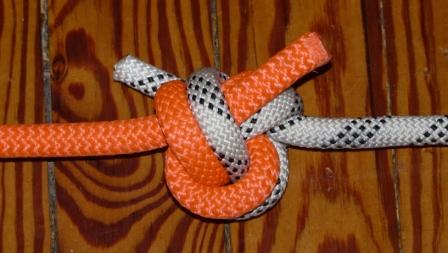
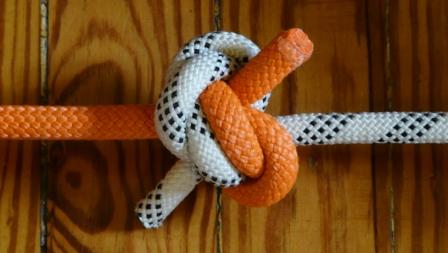
Re-tucked Water bend. Is this a useful bend solution for very stiff ropes ?
Its standing ends are forced to follow a gentle curve, around 3 rope diameters. ( The re-tucked ends serve this purpose, to “feed” the standing end/tail pair with another, auxiliary, rope diameter ).
I was surprised by its " 3 axis", peculiar, “symmetrical” (?), form. I think this old knot can be seen from a new perspective, and reveal interesting decorative aspects.
It is not much bulkier than the double Zeppelin, may be it is less ( shorter, more compact )
I guess it is a safe bend, ( and does not suffer from the usual gradual slippage of the simple Water bend , which I have read, but not experienced…)

A humble advice : The pictures do not show the peculiar 3-axis “symmetry” and subsequent decorative value of this knot ! I suggest the reader to tie the knot by himself ( two ropes of different colours is always helpful), and play it turning it around and watch it from all sides.


re-tucked Water bend (view right).JPG

Hi Xarax,

I had fun messing with this, thank you.
Made me think of another knot to try re-tucking. Try this > ABOK2421 twofold overhand bend. AKA two strand Mathew Walker knot.
A link to a picture on Wiki posted by Author: Frank van Mierlo May 2, 2006 http://en.wikipedia.org/wiki/File:True_Lover's_knot-0.jpg
It is of the non-re-tucked version, take it from there. :wink:

If needed we can start a thread for this one to discuss its merits(?). Perhaps use this one started already >http://igkt.net/sm/index.php?topic=1919.0

Scott

Moving my answer to this thread > http://igkt.net/sm/index.php?topic=1919.15

SS

+1 The Zeppelin.

Yes and no, http://www.nineofcups.com/Articles/Seriesdrogue.pdf, There is some talk of it here.
In all my years of going to sea I have heard talk of it, and seen an elaborate form of the Carrick Bend ( a lot more turns to extend it ) in a old towage and salvage book, it was made up to form a stretcher in a tow line.
It might be used in an emergency to join a parted tow line, though you would be left with the problem of whipping the ends in a hurry, I would consider cable ties as a quick alternative.
I know the mantra that goes with the Carick Bend when being shown how to tie it, The Carrick Bend goes flat over the drum end, That is it can be retrieved by using a capstan or drum end.
Yes Dan it is a mysterious bend!

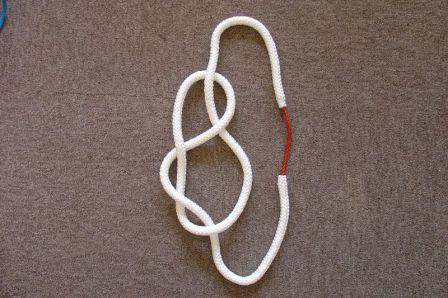
Looking for a bend where the rope strands are following gentle, wide curves all over the knot s nub, I have tied a promising bend ( I named it “the trefoil bend”, for obvious reasons ( See the first post, at (1)). I post here a picture of the loose knot, ( that gives an indication about how it can be tied - a very easy thing ). If there is an interested reader, who is more skilful in testing knots than me ( that last thing is really easy… :)), he is kindly requested to have a look, and tell me/us his results.

P.S. If the two “trefoil”- looking links / retucked-overhand-knots are not identical, i.e., if they are not both right handed, or both left-handed, they are not “locked” to each other very well. So, we have to pay attention to tie the second knot in the same orientation in which we have tied the first one.

  1. http://igkt.net/sm/index.php?topic=1919.msg16396#msg16396

trefoil bend (loose).JPG

interlocked trefoil bend (front view).JPG

interlocked trefoil bend (front-tilted view).JPG

Xarax, notice that if the crossing of the ends (S.Part & tail)
is reversd (over/under), you move from a double overhand
to a #525 (what I call “Symmetric Fig.9”). That form can
be traced (like the oh. is in the Water knot/Ring bend).
Abbreviated (to overhand from nine), it is in that form #1425.

It makes a good eye-knot (S.Part flowing through symmetric 9,
tail stopping short at the overhand formation, emerging roughly
perpendicular to tension axis).

I worry that your shown knot will tend to rotate-roll undone
in loading in stiff stuff.

–dl*

Hello Xarax.

Interesting development of the trefoil knot into bending use.

I think it is a bit too “round” in its dressed, but unloaded form. When I tied it in very stiff rappelling rope and loaded it using arms and legs it did distort from the very pretty form. And since it is so bulky I feel sure that it will not replace some bends that are used with abseiling gear.
Though it is simple in design I feel that the tying procedure is slower than a re-tucked Zeppelin (yes bulky, but it is My go-to knot). For me at least.

Having read long ago (where, who knows) that interlocking hitches make good bends I went about trying some with the stiff rope I have. Didn’t find anything I care to share at the moment. But maybe someone will find a great bend whilst fiddling around with this idea.

For the hay of it I tried using a Ashley style stopper knot on a whim. What I did was to form the stopper knot loosely and the reverse traced the original line using the second.
Pretty symmetrical and the nipping points were matched. Nothing world shattering with this, but it indicates that you can try just about any knot out there and arrive at something that can work.
Maybe even best some out there.

Tried doing the same with the bowline loop, reverse tracing the original with the second line and it was interesting. Tried it in the big loop form and cinched and dressed form.

As far as these being best in class for stiff lines, I don’t think so. But it is fun.

The merits of these reverse traced “bends” deserve to be in the other thread >“Interlocking knots” http://igkt.net/sm/index.php?topic=1919.0
IMHO

SS

Thank you Dan Lehman, SS369,

Probably I should have presented the second variation of the “trefoil bend” along with the first, but, because their differences are so minute, I decided not to confuse the reader more than necessary. The main thing in my interest with this knot was the wide curves of the rope strands all over its nub, and, in this, the two variations do not differ much…( in fact, they are almost - for all practical purposes - identical). Moreover, the “trefoil”/re-tucked overhand form I have used and shown, is the most “natural” that one is inclined to tie, I believe. It is produced by any careless re-tucking of (the/one) tail of a simple overhand knot through its central opening, without passing between the other end and the already shaped perimeter of the overhand knot. So, I have called this second form “trefoil X”, meaning that the standing end and the tail are crossed before they exit the central opening. ( Of course, the first form is also an X / crossed form of the second, as well. But I believe that the first form is more “trefoil-looking” than the second :slight_smile: ) ( See the first attached picture).
To tell the truth, I have tied both variations, and I thought that the second one, the “trefoil X” bend was slightly better, as the standing end goes over the tail as it exits the knot s nub, so it secures it “more”. But that is so secure a bend, its strands are so convoluted, embracing/twisting around each other so many times…I decided that “theoretical” “added” security was of no importance. So, I have to admit that I presented only the first variation for KISS and marketing purposes ! :slight_smile:
As of the relation/transformation of ABoK#525 to a figure 9 shape, I have not investigated how this could produce other bends. I think that, during that transformation, the most symmetrical form is the initial “trefoil X” one, and I have a soft spot on symmetry ! Moreover, it is unlikely that other bends will force the rope strands to follow that wide curves, everywhere, all over the knot. I am sure one can tie many different bends if he interlocks some of those “transitional” knot forms, from #525 to figure 9. I have learnt about this transformation only recently, from a page of Charles Hamel s site, (1), from which I have copied and re-posted a picture here. (2) More pictures are shown at (3)( I thank SS369 for the information about this site and this wonderful man).
SS369, you have very strong arms and legs, to be able to distort the symmetrical round form of this bend! :slight_smile: May be you could have not achieved it if you have tightened it pulling the standing end/tail pairs of each link/part, independently and in succession, before you load the interlocked whole.
The “trefoil bend” is not sooo bulky, certainty less than the double Zeppelin. It is wide, but not fat ! :slight_smile: The Double Zeppelin is perfect, almost as perfect as the Zeppelin, but one should not stay all his life with the first perfect woman he finds, should he ? :slight_smile: Your re-tucked true lovers / MWalker 2strands bend is also perfect, much more elegant than the double Zeppelin. ( It is one of the most beautiful knots I have seen ! ) If I have the time, or the experience to dress it correctly, I would tie this bend instead of the Double Zeppelin ! Its curves are a lot wider, so it is worth the added effort for a more “permanent” stiff ropes bend, I believe.
SS369, start a new thread about re-tucking common, old, known knots. There are much interesting things waiting for us there, I guess.

  1. http://charles.hamel.free.fr/knots-and-cordages/bats_belfry_5.html
  2. http://charles.hamel.free.fr/knots-and-cordages/img/525-to-fig9-sum.jpg
  3. http://charles.hamel.free.fr/knots-and-cordages/PICASA_Slideshow/Du-525-au-Fig9/index.html
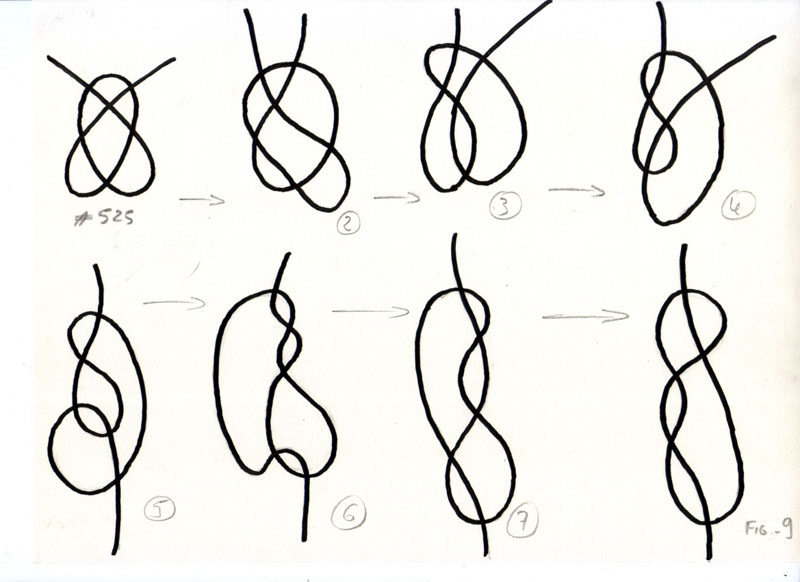
Charles_Hamel_transformation.jpg

Charles_Hamel_transformation4.jpg

The Strangle bend
( I wonder what made me to miss this bend for soooo long !
It seems that sometimes, one has to go from Europe to India through West Indies…)
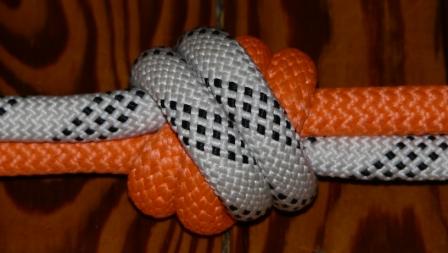
Two interlocked strangle hitches/binding knots, form a beautiful bend, that I call as it should have been named : " The Strangle bend ".
A fine solution for a bend of very stiff ropes.
(We can also see it as two interlocked (rearranged) double overhand knots.)

Pictures are incorrectly named and should be “Strangle Bend”.


The Strangler bend (back view).JPG

The Strangler bend (top view).JPG