Water Zeppelin

Noope…
First, the tails of the Zeppelin bend do not need to be “touched” at all, at any stage - this knot is self-dressing, and it always settles in the same final compact form. A very useful thing is that this bend, while it shrinks, it does not “eat” its tails - as it happens in almost all the numerous other bends based on interlocked, interweaved or interpenetrating overhand knots we have. ( Another such bend, which also does not consume any portion of its tails, is the Ashley s bend ). This is another advantage of the Zeppelin bend, and another reason we do not need to “give the tails a light jank”, as we do in most other knots.
Second, the angle we are talking about does not depend of “how you dress the knot” ( not that you can dress it in many different ways, without trying a lot ! )- after heavy loading, this knot always settles in the same form. Of course, if you deliberately twist the tails around each other, and then manage to “lock” them tightly, before they get the chance to settle in their natural position, you may get some odd-looking forms - but even on those, the angle between the “knuckles” and the “pins” remains closer to 90 than to 45 degrees.
In order to make any sense, the sentence "It is only if you don’t touch the tails that they can end up jammed in the 90 degrees position ", should be changed a lot :
It is only if you twist the tails around each other, and you keep doing this until a stage when the pulling of the Standing ends makes the knot “locks” around them, that they may end up in a position slightly different from their natural 90 degrees one. ( I believe you know that the Zeppelin bends, in particular, and most of the Zeppelin-like knots, in general, do not “end up jammed”).

Is this “try it” as sarcastic as the previous advice, to “[i]try tying the Zeppelin bend in thicker line (eg 10 mm)”/i, and not “be so inflexible regarding [my] inability to make an error in observation”? Because, if you really believe that I ( or, for that matter, anybody else in this Forum ) have not “tried” the Zeppelin bend, you should not lose any more of your precious time with me.

(Allow me to be just a little bit sarcastic, for the last time …)
Evidently ! :slight_smile:
However, if you follow my advice as much as I had followed yours, and read my posts again, trying to understand and not just to argue, you may “see” how.
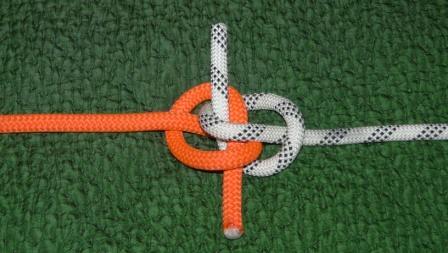
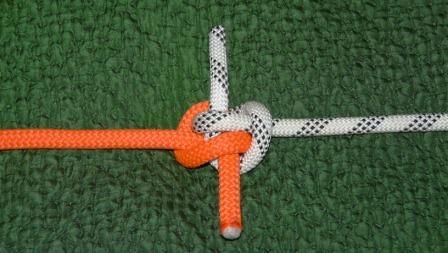
There is a big difference between “touching the tails” not being needed and being entirely the wrong thing to do.

I have NEVER done the above.

All I have done is held onto the two tails with the standing lines draped down completely loose and given the tails a light tug. They always end up at 45 degrees to the standing lines. I have never read anywhere that giving the tails a light tug will weaken the knot because the tails end up at the wrong orientation. With heavy loading (and I can exert a reasonable amount on my large winch) the tails remain in this spot. They do not move to the 90 degree position.

I maintain the only way you can end up with the tails at 90 degrees is if you do not touch them at all during dressing. And I repeat, I do not mean any weird twisting, just hanging onto the two of them and giving them a tug.

Let us agree to disagree on this issue.

BTW There has never been any sarcasm in any if my comments. I may be disagreeing with you completely, but no sarcasm has been employed. It is totally unnecessary in any civil discussion/debate.

As this angle gets more acute or more obtuse than 90 degrees, the pulled knuckles tend to slide on the obliquely oriented pins, so the pins run the danger to be pulled our of the obliquely oriented knuckles - in order to be able to withstand this, the pins should withstand more friction forces, and less shear forces. I believe that what I keep saying all this time may not be sooo acute, but it is not sooo obtuse either ! :slight_smile: :slight_smile:
I have not tied your variation on Dyneema, and I have not loaded it heavily - but I think I can “see” that the knuckles will slide on the pins, and will drag them out of their castings. I do not believe that the supposedly tighter grip of the Clove hitches / half hitches, will be able to prevent this. I see that the angle is not so close to the “right” angle, as it should had been, and that the only thing that can help the Tail Ends not be pulled out of the hitches is the one, only, sharp U-turn. However, as it was noticed by allene in this thread :
http://igkt.net/sm/index.php?topic=4756.0
in this extremely slippery material, one or even two U-turns will not be enough. The double/double Zeppelin bend ( bowled over and twice collared ) is a much better knot, IMHO : the angle is right, the alignment of the continuations of the Standing Ends is almost perfect, and the U-turns the Standing Parts make are sufficiently many.

When you will buy the hydraulic jack, or the pull-back hydraulic ram, and find a way to attach it on board of your boat, we will see !  :) The proof of the pudding is in the eating...

https://www.google.co.uk/search?q="pull+back+hydraulic"&hl=en&gl=uk&authuser=0&source=lnms&tbm=isch&sa=X&ei=7_uzU8P9Bcva0QWI4YDYDQ&ved=0CAgQ_AUoAQ&biw=1600&bih=763

There are a couple of ways to dress & set the
knot, and frankly I think that variance in tails
angle is pretty slight among them, and roughly
perpendicular --at least in the sense that they
are clearly NOT so amenable to being secured
against SParts, as commercial fishers are wont to do.

Clearly “noooooope” to this : a loose z. will take
an open form with rather bowlinesque nipping turns
in the SParts. (A Real KnotTyer™ would know this.)

;D

I come back to what I hinted earlier, creating bulk, to avoid that the end slips into the knot.

Contrary to what has been stated somewhere, there is no “pin” in the Zeppelin, and anyone observant enough will see that the ends do not emerge perpendicularly to the standing parts. Just as in any other knot, it is friction that holds when it is tied in ordinary stuff (not HMPE). Friction is helped by deformation within the knot form, so that friction is increased, when the material of the end has to be compressed in order to be pulled into the knot.

HMPE is another creature altogether. It does not elongate, and it cannot be compressed, and moreover its friction coefficient is too low for just about any knot formation.

So there is where the wedge I suggested comes in. If some of the material, by back-splicing, is brought back into the braid, there will be bulk, which has to pry the knot a bit more open, in order to slip back into it. In other materials, deformation creates saddle-like shapes, which resist further deformation and help to build up friction, but not HMPE. It may change form a bit, but not volume. It is just as resistant to compression as to elongation.

So the HMPE knot will have to rely on another feature than only friction, or it will pull the end into the knot, ultimately undoing it. My suggestion is bulk. A rather short back-splice might do the trick - I think it is worth trying. If the end is bulkier than the rest of the rope, it might hold like the mushroom head of a rivet, resisting to be pulled back into the knot.

This surreal knot-tyer knows that this is not a pipe, that a rose is a rose is a rose, and that he was not talking about a loozzze zzz.
Now, on a less imaginary world, there is never a “final” form ; as long as the knot shrinks ( and it shrinks until the very moment it breaks and explodes ), it becomes more and more compact, so, strictly speaking, its form changes - on some knots, during the “final” stages, it makes some funny things, indeed. However, in comparison to the changes from the loose to the compact form, these changes are not so pronounced that would allow us to talk about a different geometry. If that would had happened, if there was a continuous change in geometry, we would be talking about a multi-stable knot - or rather about an un-stable knot !

Well, you should do it now, to see what happens.
Do not think of this twist as a “bad” thing ! If it is a genuine twist, it is beneficial to the knot, because it increases the bulk of the central core, and forces the first curves of the Standing Parts ( = nipping/gripping loops, “knuckles” ) be rounder and wider. Rounder and wider nipping loops are supposed to be stronger, and, in any case, they are more fluid, smooth structures, without sharp curves, which are able to distribute the forces acting inside the nub more evenly, along a more extended area.
When you will test the single and double Zeppelins, do not forget to test the Zeppelin X bend as well ( X = crossed tails ) :
http://igkt.net/sm/index.php?topic=2088.0


Zeppelin bend X (crossed)(loose).JPG

Zeppelin X bend (tight).JPG

However, a double structure is a double structure - and two of them, the one next to the other, may become too tightly wrapped around themselves ( due to the friction forces between their adjacent wraps ), and around the “pin(s)” of the Zeppelin-like bend ( where we would had needed more balance, to deal with the shear forces, not more friction ). Even at the most simple Zeppelin bend, the percentage of the initial tensile forces able to reach the tails, is very small : after those three successive U-turns they make, until they become Tail Ends, the Standing Part have uploaded already most of them into the knot s nub. What is paramount is the alignment of the adjacent ( but parallel, not “hooked” within each other ) first curves of the Standing Parts, and the angle between them and the penetrating pin(s), so they will be able to confront the shear forces they have to withstand. The result of the more friction within and between those tightly wrapped double structures will be a knot that will not be tied or untied easily any more, and will not be self-dressing - two of the great advantages of the parent Zeppelin bend. See the attached picture, for a not-too-ugly, but still too-tight and not easily tiable and untiable bend, based on parallel, not “hooked” within each other Cow/Girth hitches ( instead of Clove hitches, as in the bend shown at Reply#18 (1).

  1. http://igkt.net/sm/index.php?topic=4946.msg32576#msg32576

Which supposition remains to be deeply analyzed by
careful testing. In any case, one should be suspicious
of this variation on account of its asymmetry
–what might be good for the goose (one side) will not
obtain for the gander (and better see what does!)

(In contrast, there is such a crossing for SmitHunter’s bend
that does yield such improvements (in shape, if not
in effects on strength), AND makes it resist jamming.)

There are other careful ways of dressing the knot so as
to try to affect SPart curvature, but that becomes tedious
and … without a firm basis in testing (and with some
realization that any difference likely would be irrelevant).

–dl*

I think it is worth the while to think about how a rope actually works. It takes a longitudinal load, and all parts within a knot will carry some fraction of this longitudinal load. Hence it is always friction in the “nub” that governs its resistance to slip.

The problem with HMPE in this regard is that the longitudinal force, due to low friction in all the different turns the rope takes, will remain substantially to the last point where the end emerges from the knot, and that the friction that holds the end back can be lower than the power that tries to pull it in. This force is present also in the Zeppelin, and for more normal ropes, there is ample friction to prevent the ends from being pulled into the knot. When tying in HMPE, this cannot be guaranteed, and I would expect it to fail just as the double bowline did.

One has to go beyond looks and think of how the forces work within the knot, to understand it better.

If we create bulk, by back-splicing the very end, this bulk will act as a wedge and try to pry the knot more open, when the end is drawn into it. Testing will show whether this is sufficient to avoid the catastrophic slippage we have seen. Whether the knot is “strong” is entirely another matter. The same approach to prevent slippage can be applied to other knots, as the grapevine, but then of course there is the problem of jamming at high load.