What is a knot ? Gordian knots.

How do you know it ? I mean, you have not examined each one fiber under electronic microscope… to be sure that, after a severe turn, there are not some parts of some fibers that have been deformed locally - and will never return to their previous physical characteristics - have you ? This local deformation is called "fatigue’, and it will deteriorate the physical properties of any rope, especially when you force them to turn around such extreme curvatures.
When a rope of a circular cross section is bent, the fibers that are forced to cover the longer outer paths are subject to extreme elongations. Are you sure that those elongations would remain within the limits of elasticity region in each and every fiber, and no fiber would be stressed enough to reach the plasticity region ?
I say that, to make a turn of minimum or zero diameter, a rope has to be physically deformed, and/or change cross section beyond normal, i.e. flattened to a point where it is not a rope anymore, it is a stripe or whatever, and certainly it is not the rope it was before it was forced to such a tight turn.

I have not said that it should be only of circular cross section, I said that it should be of (approximately) constant cross section. Also, that it should be flexible only in the lengthwise dimension/ direction. Otherwise, any piece of elastic material could have been considered a rope, and we do not want this, right ?
I would be glad if you could help us here, to define what a physical rope is, so that we exclude any piece of any plastic or elastic material whatsoever, that just happens to be spatially elongated.

Scott, I like your analogy of considering a sand filled pipe. However, I think the kernmantle taking a non zero diameter turn is an almost opposite model.

Consider the soft copper pipe to be filled with a bunch of high tensile steel wires. The pipe is as you say, the braided (mantle) while the wires are the (kern). The cores of some ropes are braided, giving the rope bend flexibility, but my climbing rope is full of a bunch of aligned straight monofibres - like a copper pipe filled with steel wires.

Now we bend them.

In the case of the sand filled pipe, the pipe is ductile, so it responds to the bending forces by thickening on the inside of the bend and thinning on the outside of the bend. The sand is essentially incompressible, but it can flow, so as the inner curve volume shrinks, the outer curve volume expands and the sand flows / shifts but maintains an approximate round pipe section.

If on the other hand we try to bend the pipe filled with steel wires, the tube stretches easily, but the wires inside it refuse to stretch. Because the pipe is full of wires, the tube keeps the wires in their places - the inner wires cannot move or ‘give’ their excess length to the outer wires that require extra length to accommodate the larger outer radius. We are struck immediately with the fact that the pipe full of thin wires is now behaving as if it were a bar of solid iron.

In some climbing ropes the core fibres are given a light braiding, in others like my kernmantle, the core fibres run straight and parallel from one end of the rope to the other, and although the individual fibres are much more elastic that the iron wires in the coper pipe, the effect is the same as we try to bend the rope, the outer braid constrains the fibres to remain ‘in their place’, so the outer fibres remain running all the way around the outer radius of the curve.

These fibres are more elastic than the iron wires, so they stretch under the tension imposed by the larger outer radius. But the amount of stretch required to expand the outer radius to accommodate the turn quickly escalates to the working load of the fibres. If I were to use a mechanical system to continue to tighten the curve, eventually I would overload the tensile limit of the outer fibres and they would fail.

A rope however, with a laid or braided core is able to allow the outer tension to be ‘fed’ from the inner fibres that are under compression, the flow of the braid from one side of the cable to the other is responsible for giving us the amazing flexibility of cordage so critical in its usefulness not only to pass round pulleys, spars etc, but also to pass around the cordage itself and engage in the aspect we are all here for - the creation of knots.

Derek

That is the kind of ropes I use most of the times… because they tend to remain of constant, circulat cross section, so they “write” nicelly on the camera s image sensor.

That was exactly what I have said . However, I would like to comment on the first sentence, " The differences seem to be related to flexibility". Of course, but why are mantle’s ropes not flexible enough to bend around small diameter curves ? Because the fibers of the core are not allowed to slide freely inside the sheath. If we could imagine an array of flexible parallel fibers, enclosed loosely inside an outer soft envelope, that rope would be a mantle’s rope, yet it could bend around as small a diameter as one single fiber would allow it to do, i.e. almost zero.
It would be interesting if one could actually make such a rope - by enclosing nylon monifilament fishing lines inside a most flexible tube, for example - and see if it can be forced to bend around almost a zero diameter, or not…

When I was young, I remember I had made a modern rocking chair, by bending steel tubes…There were two ways I knew that could secure an almost circular cross section alongside the bent tube. Besides sand, one could fill the tube with pine resin, or any other liguid material that could be pressed to flow and fill the tube, yet solidify at the end of the process. I had used both methods, and, at the end, I made my chair using a normal tunbing bender … :slight_smile:

Although it might have been considered as a unnatural limitation, I have not included webbing in my attempted definition of a physical rope. I have made this decision on purpose. I tend to think (just a naive though, that is) that the knots made by flexible tape-looking strips ( elognated, rectangular cross section) work in a altogether different way than the knots made by flexible tube-looking, round ropes ( almost circular cross section ) - , and while I have recently came to learn some things about the various mechanisms utilized by the later, I am a 1000% ingnorant of what on earth is happening with the former. Perhaps some more experienced knot tyers in this forum could help us here… How do the knots made by flexible strips really work ? What are the differences with the knots made by round ropes ?

Noope ! If the wires can slide inside the tube, relatively to the inner surface of this tube and relatively to each other, we essentially have a wire rope, where the individual fibers are not connected together by each one of them making helical turns around the bunch of the others - the usual way of the wire ropes-, but by being inside the envelope/mantle of the steel tube. While the whole compound rope is forced to bent, the wires of the inside paths can remain as they were, even be compressed a little bit, while the wires of the outer, longer paths can stretch and also can slide relatively to the others. The cross section can remain round, and the flattening can be minimized.

Indeed Xarax,

If the wires slide inside the tube, then they do not need to be stretched, they only need to conform to the curve.

If we follow this with a theoretical tube bend around zero diameters, then you would see the inner wires (the wires near the tight bend) protrude from the tube, because the part of the tube they were in has now squished in on itself. About a third the way out, the wires would be flush with the ends of the tube, and right out at the outer edge of the tube, the wires would have retreated inside the tube, because they have remained the same length while the tube has been stretched around the outside of the curve.

The question you posed back in post #22 can be answered if you take a very short piece of kernmantle with parallel core threads, lightly tape the sheath to stop it from unravelling, then bend it around a zero diameter turn, the inner fibres will protrude, while the outer fibres will run inside the sheath. If these fibres were prevented from slipping, then they would have had to have stretched by the amount they shrank into the sheath, and to stretch them, they would have had to have been put under extreme tension, possibly even beyond their breaking point (dependant upon their intrinsic elasticity). In a non sliding core, the inability to stretch the fibres enough would resist the closure of the bend to a zero diameter.

Derek

Right. So, why it is exactly the kermantle static climbing ropes ( those with parallel fibers) the ropes that DO NOT ,bend around small diameters ? What prevents the parallel fibers from sliding along each other ? The outer woven sheath is, most of the times, very flexible, and not so tightly woven, I think, that could induce great friction forces between the fibers of the core, and so prevent them from sliding.

  1. (Rock)climbing ropes DO NOT have parallel fibres! Parallel
    fibres are used for minimal stretch; climbing ropes have
    hard-laid core cords (in equal balance between Z/S-lay)
    (though long ago one --Rocco, of Spain?-- used some braided
    core).

  2. IMO, the amount of material packed per-length in such
    ropes impedes their bending; the sheath is relatively tight
    around the core.
    (Caving’s infamous PMI original, “pit” rope, is maybe the toughest
    I’ve found --though I have some tough laid marine rope–, with
    reluctance to bend to 2dia. (in 11mm rope), let alone that 5mm!!)
    Relative tightness in the rope, and lesser flexibility, can be
    seen as help in resisting ingress of foreign material (dirt),
    and abrasion resistance.

Rockclimbing ropes have some uniform measure of flexibility,
which IIRC is determined by setting an overhand knot with
a given weight and then measuring the size of the hole in
its belly with a graduated conical device.

–dl*

AND for maximum strength, in a given diameter and weight. I have many kernmantle ropes that have parallel fibers - I do not know if they are sold as “climbing ropes”, or not. ( I use them only because they are stiff, and keep their round cross section even when bend around tight curves. )

Yes, but is it tight enough to squeeze the fibers and prevent them from sliding alongside the bunch ?

Thank you for this information, but I wonder why they use an overhand knot -where there is some additional friction between the tails - and not just a single 360 degrees bight, a single nipping loop ?

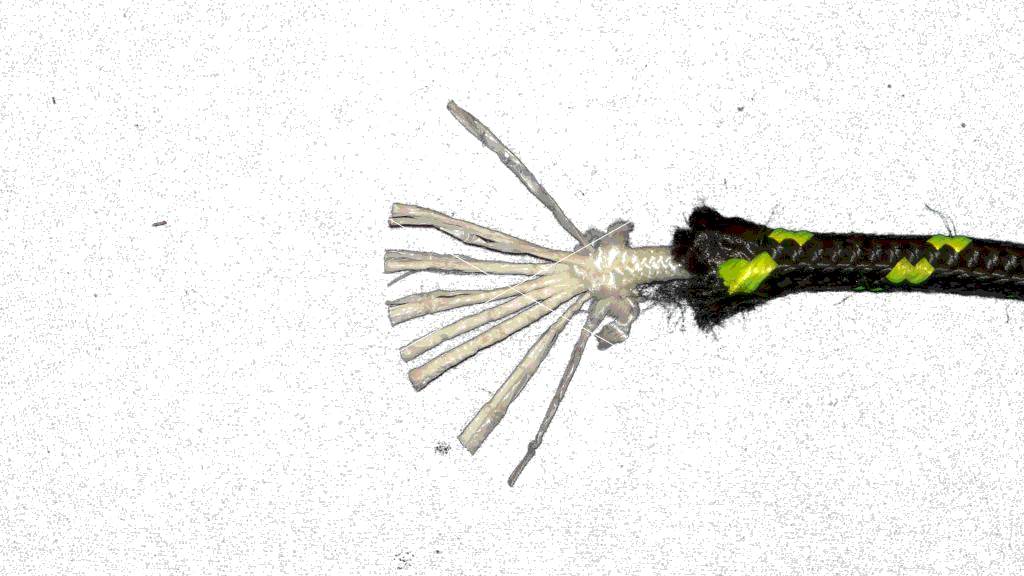
 Here is the dis-section of one of them. However, in this rope, the parallel fibres are placed in 6 individual bunches, and each bunch is firmly wrapped inside its own "tube" by a plastic tape spiral tube ( See the first attached picture). Then, around those 6 bunches, there is another  tightly woven sheath - not the final, outer one,  but an inner, second layer sheath, much more tightly woven than the outer one. So, I guess that, by those three successive envelopes outside them, the parallel fibres are held together tightly enough, and they can not slide relatively to each other.

In most of the permanently ropes I have dissected, the fibres are first woven into laid or braided sub-cords - 3 to 13 (?!) of them - , then those laid or braided sub-cords are placed in tight parallel bunches inside the outer woven sheath. ( See the second attached picture). So I can see how the individual fibres do not slip, but I do not understand how the laid or braided bunches of those fibres do not slip…because the outer sheath does never seem to be so tightly woven. Perhaps the “grooves” of the surfaces of the laid or braided sub-cords have a role to play in this…


rope dissection 1.JPG

Hi xarax.

I think that the bundles of fibers, whether braided or twisted, do slide. But that is most likely a very small slide, more like a small movement. The reason for the wrap of “plastic” around the core strands in one of your ropes is most like to protect them from each other since some kern fibers that are very strong are also frictive/abrasive to each other. The inner sheath holds the bundle relative and the outer sheath is the protective mantle.

I personally think that the core issue here is more of the tensile and compressive nature of the relationship of the components. Some hard laid strands just don’t have the same amount of room between the fibers and will only compress and elongate so far and have counter rotated strands next to them, while braids have more space within to do more moving.

So as for sliding, I think they do just not very much.

SS

Believe it or not, I had not thought of this simple and obvious to me (now) explanation ! :slight_smile: Thank you. So, this spiral tube made by this plastic tape, is just protecting the fibers from abrasive contact, and it is not playing any other role.

So, you say that a bundle of many sub-bundles with braided fibers, is more fxexible than a bundle with the same number of sub-buntles, but with twisted, laid-woven fibers ? The black-yellow rope shown, although it does not have any laid woven elements, but only this tightly woven inner sheath, is VERY stiff… Probably because the fibers of each sub-buntle, being parallel to each other, do not have any room to move, and the tightly woven inner sheath keeps them even more close to each other. I am guessing that parallel is tighter to laid , as laid is tighter to braided, and that, if you put parallel fibers into a tightly woven braided inner sheat, you have a very stiff rope.

The plastic core wrapper(s) may have, additional services, e.g., water resistance, methods of actual manufacturing, etc. That may be a stretch, but I think it is primarily to insulate the fiber bundles.

Yes it is my understanding that a core bundle of braided material will be more flexible because of the many directions the fibers are woven than a hard laid (twisted) core bundle of “parallel” fibers.

The closer to perpendicular, to the path of the rope’s direction, the spiral is the more spring there will be in the resistance to lengthening. The straighter the fibers are, the more stiff in tension it will be. A rope of perfectly straight fibers, although “strongest” will be the least forgiving if shock absorption is a criteria.
The stiffness to knotting and bending will be a direct correlation to the density of the bundle.

SS

I have tried to imagine what will happen, if those individual bundles of parallel fibers are only loosely included into a flexible outer envelope/sheath, so they can slide and reposition themselves inside the it (1). I guessed that a rope made this way will be a knot-friendly rope, because the knots tied on it would be more like multi-line knots - and multi line knots are stronger than single line ropes (of the same total cross section area).
Let s say we wrap loosely 6 such bundles into a compound rope like this. When bent around a tight curve, it is expected that the cross section of such a rope will be flattened easily and maximally, and there will be three bundles running the inside, shortest path, and three bundles running the outside, longest path (i.e., the cross section would become rectangular, like that of a strap ). The length difference of the two sets of paths around the curve will be smaller than those of a normal rope, where the cross section have to remain more or less circular. Moreover, the individual bundles, acting like individual lines, will adjust themselves inside the knot s nub as well, and they will be able to absorb the tensile forces collectively, so more effectively : there will be more than one “weak links” in sections maximally loaded and/or curved, so I guess that such a multi-line rope will break later than a normal rope. We would have a rope that can bend around curves of smaller diameter, and a rope that can deform itself, so it can absorb maximum loading into the knot s nub more effectively. To remain round when not maximally loaded, such a rope can have its individual bundles arranged around an soft, elastic central core, which could be easily compressed and deform, to allow the stiff individual bundles of parallel fibers to reposition themselves when the rope is bent.

  1. http://igkt.net/sm/index.php?topic=3169

One of the things that immediately comes to mind with this able-to-flatten rope is that there will be bunching of the outer sheath along with the tendency of the rope to “milk”. By that I mean that the core and sheath will move too independently.

Conceivably there could be parts within the knot where the mantle is wrinkled causing the core fibers to have higher loads induced against them.

It is on the recommendation of industrial sling manufacturers that no knots be employed at all, ever. Though they do not discourage the use of a a choker hitch set up. I have two endless round slings that are core strands within a loose fitting sheath.

SS

I like this able-to-flatten adjective ! :slight_smile: That is the idea, to have many almost independent, sliding cores, within the same loose encompassing sheath ( that should be very flexible, perhaps also elastic…). As the mantle is always secondary, I do not think that any wrinkles would cause much trumble in the tension bearing capabilities of such a compound, many-lines rope. Yet another thing one has to test, I guess…

A KnotTyer (1) diagram of the Gordian bend, presented at Re#12 :
http://igkt.net/sm/index.php?topic=3610.msg20970#msg20970
Here is an attempt to use this bend as a counter-example against the (false) claim that : " Topology determines Geometry" :
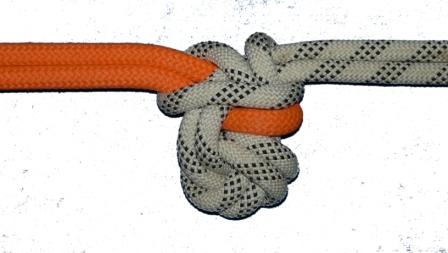
Let us suppose we do not have access to any of the four ends of a bend. We can loosen this rope tangle, re-arrange it, and then tighten it again. Will we get the same knot ? Nooo! We may well get another knot, topologically equivalent but geometrically quite different. So, topologically identicall tangles, when they are dressed differently, generate geometrically different knots. Moreover, there can be cases where the initial tangle, when tightened, can lead to a knot, or not. The Gordian bend shown here has the same topology with two not-linked open loops. We can loosen it, without changing the topology of its links, and tighten it again. Depending upon the particular dressing, at the end of the tightening we may get a secure tight bend, or two loose unknotted loops ! The interest thing is that this fact is not depending upon the physical characteristics the ropes. Any bights with inaccessible ends, however slippery the ropes they are made of would be, can be linked by this bend.

in other words;

" At the attached files, you can see a 2D diagram and pictures of a bend I call " Gordian" . It is a link between two closed bights/loops, where we do not have access to their one tip. ( I have drawn these inaccessible “ends” as been warped around two poles, to show that we cannot use them, but also for decorative purposes…)
The most interesting/important thing is that this bend does not use friction to work ! It will work even if the ropes well 'ideal" - in the same sense we call the abstract mathematical structures that some mathematicians and physicists study, as " ideal knots" . The two links will not slip the one through other, because in their way to do this, they encounter obstacles imposed by the volume, the bulk of knots tied on the ropes. In this particular bend, there is a double line overhand knot tied on the one link (blue/white), and the accessible bight of this link is warped around it and it cannot overcome it. The bight of the other link (red) is trapped in this tangle.

Of course, we can untangle the bend, in the same way we have tied it in the first place. However, once we have tightened the bend, to be able to untie it this way, we have first to set the bend a little bit loose, to un-tighten it for a while. Then we can pass the bight over the bulk of the double line overhand knot, pass it through out the other s link bight, and release the tangle of the two closed loops.
So, once the bend is started to be tightened, and this tightening does not stop and is not reversed for a while, the bend can not be untied in an way - unless you cut the rope ! ( This is the reason I have called it " Gordian bend’ ) Also, do not forget, this is independent of the low or high friction of the ropes, it will have happened even if our ropes were infinitely slippery, i.e. if they were "ideal’ ropes.

The 2D diagram of this bend is the one shown. at the attached file. However, the topologically equivalent 2D diagram, is just two not-linked closed loops ! You can pass from the one diagram to the other, without having access to the ends of the ropes.

So, topology DOES NOT always determine the geometry of the knots, even if these knots are “ideal” knots."

  1. http://daveroot.co.cc/KnotMaker/

Gordian bend (1)(back view).JPG