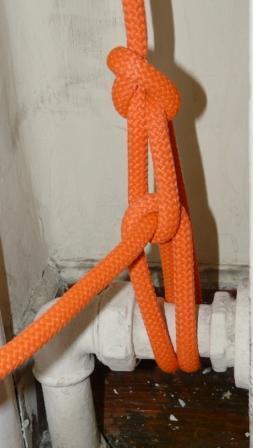
So, two different friends (who really should know that I only tie decorative knots) have asked me: what loop knot can be tied then tightened by pulling on a free end which then remains tight?
the first one that comes to mind is the tautline hitch. I’ve used it in loop form to adjust tent guylines.
But there are many friction hitches that will do here as used in a loop.
Hope this helps.
More information re use is needed in order to well answer
this. There are various things that can give the illusion,
at least, to doing this. (That almost suggests decorative
tying, doesn’t it?! )
The versatackle mechanism might come closest to doing
the trick, as when hauling those structures tight, the parts
that will end up doing the binding (and which are wrongly
counted in figuring rough mechanical advantage) can go
pretty slack, out of the way; whereas most other possible
solutions are what I call “Paul Bunyan” structures --they
demand greater force in setting than they deliver (the force
needed to overcome the very friction that will secure them).
E.g., one could form a Prusik structure in the SPart and
run the tail back through this; setting tight would come by
pressing one hand against this knot and hauling the tail
through it, the increasing force ever building resistance
to the tightening. There are simpler such contraptions;
there might be some that “remain tight” in a sufficiently
long enough temporary state to allow one to tie off the
knot securely, which might meet some need (in contrast
to simply letting go and being done). Now, that was for
the “remaining tight” part; anyone want it later to be
untied? Hmmmm, … !
So, your friends’ exact needs …
.
.
.
might just be to see if you can do any useful knotting.
(Or if whom you associate with are worth much!)
;D
postscript : I should remark about the Subject wording
–re “zip tie”. I take this to be those ratcheting plastic
securing bands. In good ol’ American buy-&-trash behavior,
these petroleum products are wasted more than they need
be : they usually can be undone, by inserting something
(sufficiently thin, narrow, & strong) to push the locking
tongue back so that the band can be slid undone.
Recently I found some in use at an arts festival for holding
signs that were large enough that one could effect the
release with a thumbnail! Great!
The footnote for the Slippery 8 Loop even discusses how it can be difficult to release if tensioned without an easy-release mechanism on the other end of the rope. Happy knotting.
How about the guyline knot that consisting of 2 overhand knots spaced apart on the standing part with the end then taken around eg a tent peg up and down through the two overhands - pull on the end and it tightens and stays there - very similar to a nylon tie but it may not be effective around eg a pole. This was the first website I came across via a Google search which shows a drawing - http://www.shurdington.org/Scouts/GuylineHitch.htm.
Barry
With a little ingenuity, one can work a trucker’s hitch + Gleipner into
a solution. But this is also not so easily loosened from a taut state.
(For easy loosening, friction hitches seem best.)
The discussion seems to be directed to guyline type systems. But if the problem is a loop around a package which is then tightened by pulling on a free end which then remains tight, then the solution might be a buntline hitch. I don’t think I saw that mentioned. I guess my question is: what then remains tight? the loop or the standing part?
It would be interesting to compare the Guyline hitch, with the similar simple binder shown at the attached pictures.
For a more secure solution, try a Versatackle-like lock on a Trucker s hitch - which is a ock of a double loop.
I just got done playing around with the Guyline Hitch. I remember now why I dismissed this knot a long time ago. If I really bear down on the tension, this knot is a pain to untie. In fact, I’m currently in the middle of unjamming the overhand knots of a Guyline Hitch. I took a break to write this post. I’m confident I won’t be using this knot again, unless I don’t need to untie.
For the same reason, I won’t be using a Trucker where the loop is tied with a Slipped Overhand. The Overhand tends to be difficult to untie if you bear down hard with the tension. My preferred loop in a Trucker is a Span Loop.
I have a feeling sometimes people just post a knot here without much experience using the knot. It’s difficult to imagine why anybody here would recommend a Guyline Hitch or a Trucker Hitch with Slipped Overhand. At least there should be a note about the tendency to jam, when there are so many other hitches that work perfectly fine while being easy to untie.
…Maybe I’m just irritated because I still can’t untie the Overhand knot in my Guyline Hitch. :-\
Maybe these knots have worked amply well for their expected
tasks, where “really bearing down” isn’t part of the situation!?
Maybe you can form the slipped overhand better, in that
form more like the “half-hitch” bight hitch recently posted
by X1 (“Constant”? --seems a variable; “c” is the constant).
Of course, some folks make a couple of twists of the bight
around the line before slipping it through, to mitigate the
jamming --just got some pics of this in laid PP to tie down
exhibit tents (to those big drums of water (sand?)). “Really
bearing down” manually on half-inch PP rope doesn’t so
much influence it.
That said, the guyline h. looks less than an easy untying
job, IMO --not something I’ve played around with. (What if
it were a compromise/hybrid w/trucker’s h. : make the
away overhand slipped, and so just the to-be-half-loaded
nearer-to-anchorage one would do the nipping --will that work?
The OP asked for a substitute for a plastic tie which tightens and locks when the end is pulled - there was no mention of trying to untie the whole thing later (unfastening a zip tie is at best fiddly and sometimes all but impossible). I have used the guyline hitch and left it on the cord for re-use rather than untie it - it was on each of 4 guylines on a child’s tent which had none to start with but kept blowing around when unoccupied). Leaving tied is not really an option with the TH and I agree the slipped overhand is a bad idea in that case. It does depend on how much force is applied of course - using this in paracord I found it easy enough to slacken off but I don’t think I’d use it if I had to untie it every time (but then again I wouldn’t untie a tautline either in the circumstances).
I’m not sure how you’re tying your Trucker, but I would be able to leave it in the line if I wanted. Actually, with a Trucker, there seem to be more options. I can leave tied (1) everything, (2) everything but the first anchor, (3) just the Span Loop, or (4) nothing. If I decide I want to leave everything tied, I can remove the rope from the stake by loosening the Trucker Hitch a bit if necessary, or I can leave the stake attached to the Trucker and remove the stake from the ground.
So, the Guyline is not unique in that regard. Based on my observations, the distinguishing features of a Guyline are (1) it’s relatively easy to remember compared to other hitches mentioned here, (2) it’s simpler than a Trucker, and (3) it’s potentially difficult to untie. These features may be desirable depending on the application and the skill of the person. By the way, whenever there is a tendency to jam, it should always be noted and should never be assumed as common knowledge.
While it will slip, unlike a Zip-tie, the butcher’s knot (ABOK 183) serves a similar purpose. It tightens like a Zip-tie, and holds long enough to secure it with a half hitch. With practice it can be tied quickly.
A Zip-tie is used for binding. They often bind wires and cables as in automotive wiring harnesses. They are also popular in law enforcement as back-up handcuffs, again a binding application. That is why I suggested the butcher’s knot in my other reply. The Packer’s knot (ABOK 409) is similar to the butcher’s knot, but the tautline hitch, guyline hitch, and trucker’s hitches are very different and would not serve in place of a Zip-tie.
Not so fast, before you add the Half Hitch at the end, the Butcher and the Packer are quite similar in function to the Tautline (or Rolling) and the Guyline. You can easily add the Half Hitch after you’re done adjusting a Tautline (or Rolling). In fact, before you add that additional Half Hitch, the Tautline (or Rolling) outperforms the Butcher and the Packer in zip-tie behavior.
The Versatackle and the Trucker are in a different class and outperform those hitches in the areas of tensioning and security. Yeah, the original poster asked about a knot that resembles a zip-tie, but the poster is also a novice to practical knots. It’s our job to discuss other options that the poster may not even be imagining.

 )