We can consider a knot which jams, as a rope-made ratchet device : it accumulates and stores within its turns the tension which is induced in it by the pulling of its ends out of it - and it is able to do this, because there is something in its geometry which “locks” it in itself. What is this ? Is it possible to isolate, and point out what kinds of knot shapes / geometries lead to jamming knots, and which to knots that remain easy to untie ?
I think that the “triggers” of the jamming mechanism of a knot are those riding turns, woven around the core of its nub, which prevent a knot which shrinks, during tensioning, to expand back. They work as selective membranes, which allow tension to get in, but dis-allow / forbid / prohibit it from getting out. The C-shaped rim of the overhand knot, the S-shaped, oblique rim of the fig.8 knot and of the Constrictor, the semi-circular riding turns of the Clove hitch and the Clove X hitch… There is always this/those curved segment(s) which engulf the nub, and “swallow” all the tension forces inserted into it, without “spewing” any of them out. In a sense, a jamming knot is a snug hitch, hitching itself - and as it happens in all such hitches, the ends are “locked” into them by being buried under overriding turns.
The task of explaining why a knot jams, and so of becoming able to predict if a knot will jam or not, can help us tie more easy-to-untie knots - a permanent requirement in practical knotting.
I would like to explore ‘What makes a particular knot structure jam resistant’.
In comparing the ‘Lehman8’ to #1047 - I found that I was able to untie the Lehman8 with only minor manipulation (no tools required). However, at the load I applied to the Lehman8, #1047 would have been jammed to the consistency of wood - and I would not have been able to untie it.
Bowlines based directly on #1010 with a single helix nipping structure can be easily untied - as can those based on a double helix nipping structure (eg Alan Lee’s locked Bowline). However, some of the more complex nipping structures may not fair so well (I am going to test some of Alan Lees creations to find out).
I also (some time ago) started a topic on comparing #1425A (Phil D Smith Riggers bend / aka Hunters bend) compared to the so-called ‘Zeppelin’ bend - and that although both involve the use of inter-locked overhand knots - one jams and the other doesn’t. However, by crossing the tails of #1425A - perhaps it is jam resistant? And if so, why?
Still unclear about the ‘Zeppelin eye knot’ - and at what loading jamming is triggered (if at all). Will test to determine this…
Was it a significant percentage of the MBS of the line ( say, 50%, 33.3%, or even 25% ), or only an insignificant portion of its “Working load” ?  ( Mind you that the so-called “Working load”, or “Suggested load”, can be as low as even the 1/20th of the MBS ! )
My trials told me otherwise - but I will not comment on this issue any more, before we have decent TESTS, based on ROPES ( not fishing lines of grand-mother s treads ). I believe that, ideally, we should test those knots on climbing / rescue kernmantle ropes of 1/2, 3/8 and 1/4 inch sizes, and 50%, 33.3% and 25% of the MBS of the lines themelves.
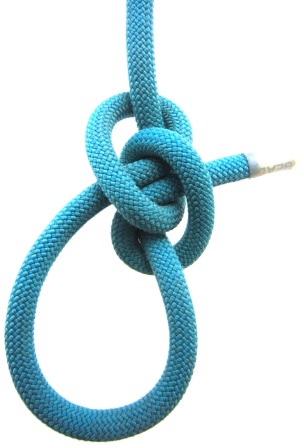
If you insist to deal with such not-bowlines, not-PET, and probably not-easily untiable loops, you can also examine the Ashley s bend turned into loop - and if it jams, you can try less convoluted bends, like the Butterfly bend, the ABoK#1408, the ABoK#1409, and the Shakehands bends.
… say what your “trials” [sic] were, will you?
Were they a “significant percentage of MBS of the line”[sic]?!
(Rule-of-thumb SWLs are often 20% and also said
to be for pure rope and so in need of adjustment if
the rope is knotted --something that knot tyers seem
happily to ignore, and then sometimes conjecture
that the SWL is intended to compensate for knots!)
There is the UIAA standard for the “peak impact force”
that lead ropes must not exceed; usually, though, one
will not find published breaking strengths for these ropes.
IIRC, in the old days of 11mm & 7/16", it was around
5_000 #; and the UIAA impact force was to be 2,600
or less --for initial drop, and subsequent ones need only
survive (5 minimum), but will have greater forces.
Now, most ropes come in well shy of the limit,
and might do so through a few of the repeat-drops
(even though modern ropes are regarded as “thick”
and heavy at just 10, 10.5mm !)
In practice, such test falls shouldn’t occur,
and the usual rockclimber will deal with forces well
less than that. (In a severe drop, untying the knot
will be one of the least concerns.)
–dl*
Things can become difficult in elastic rope (which is part
of your domain), as elasticity entails diameter diminution
on loading, and then a fattening upon relaxation,
which can see material outside of the nub quickly
fatter than the opening it had fit in in its skinniness!
And YMMV depending upon surface friction, and other
things.
(I have a notion I call “forcible loosening” (and related words)
by which I mean that there is a way to apply force to the
knot to pry it open, fairly reliably. E.g., I think that in most
cases, a multiple Lapp bend can be forced to return S.Part
material by pulling apart the U-part’s tail & S.Part --one
gets a short run of this before the pulling tail puts a
right-angle bend in S.Part and one can’t continue further.
It’s enough to then work material through.
(Now, were the material such that what one got in this
rather short pull mostly stretch, which stretched back
as one went to try to do that working looser, … you’d
utter oaths of anger!)
–dl*
Yes. ( But not 50% ).
There are some knot tyers, or notknottyers, in this Forum, who imagine that knots are used only in climbing…
Good for them - they have to think and imagine less…
This is a too-vague answer : state your method,
so others can understand what has been done.
There are some knot tyers, or notknottyers, in this Forum, who imagine that knots are used only in climbing... Good for them - they have to think and imagine less... :):P There are knot tyers who understand that knots many activities need knots, and have to think about these particular conditions in making a choice from the infinite. Maybe there are others who eschew this extra thinking, and work in a space w/o gravity or materials and just knot their minds tight against tangible aspects. (But I did not know that ideal knots could jam --ideal jam, is it sweeter than raspberry jam?)
–dl*
No, “ideal” knots do not jam - but the minds of ex-knot tyers, who become knot-casters ( so, not-knot-tyers ), do !
I did nt know that “idea”( virtual ) knot-tyers would ask from “real”( actual ) knot tyers, those who, in their virtual mirror see as " working in a space w/o gravity or materials, and just knot their minds tight against tangible aspects", to present their methods ! !
Keep kissing your frogs - just do not be so sad and mad when they do not turn into princesses… Not-knot tyers, in not-knotland, should be able to move in front of their mirror twice as quickly as their reflection doas - a veeery difficult job, indeed. However, to talk twice as fast as you think, is much easier - and I can not blame you for choosing that method…
state your method, so others can understand what has been done.
So, this is YOUR method --rubbish keystrokes of derision.
We are left what is too easily agreed : “not to 50%”.
–or just “not”.
