I’m going with a clip-on tie. I’m not putting a Windsor in one of my five slots.
You could well, believe me, live, without even ONE knot !  Many ( most ? ) humans had lived, and continue to live, without knowing any knot.
I agree with the Constrictor ( it can be used, as a base, in the Constrictor safe bowline, as an adjustable “helical loop”, as a “lock” for the bowline, and elsewhere (1)(2)(3)) , but the Strangle, as a hitch, is less depended on the specific direction of the pull, and, at the same time, is the “same” knot as the double overhand stopper, so you can have two feet placed into the same shoe… I believe that the game of choosing a small number of knots, say 5, 7, 10 or 12 is interesting, because it makes us try to imagine a different world, with fewer objects, and that is a good thing ! Do this homework, and let us know your selection.
As I hardly ever get to use knots in a readily practical manner, I claim to be an “average Joe”.
The following short list is what I have fought hard to make use of:
Slipped reef knot for shoelaces
Timber hitch and half hitch for brooms and rakes in the garage
Turks heads as binders (fairly permanent)
Matthew Walker as stopper
I did use a sheepshank for towing a car once. But I don’t consider it proper.
I might start a new thread for this…
If the question is ONE knot, then it would probably be a Strangle, ASSUMING that a Strangle
with two lines (e.g., retraced or on bight) is also considered to be a Strangle. I could then make an end loop, bight loop, adjustable loop, bend, binder, hitch, and stopper. Heck, I might even be able to get a fishing knot out of it.
I may have to cut rope occasionally, which is the compromise for having only one knot.
Roo, I set out to make a quick video of how I tie the double dragon, hopefully making it easier to follow than the other videos I’ve seen, and then I discovered that what I was tying was a little different from what appears in everything else I’ve seen. So I made the video with both versions, hopefully along the way making it easy to see how both are tied. It’s a method of tying that makes it possible to thread the loop through an object.
I started a new post for it here: http://igkt.net/sm/index.php?topic=4430.0
OK folks, I’ve picked out 5 knots that should cover most eventualities for me, as follows in no particular order:
[b]1. Round turn with two half hitches.
-
Slipped Buntline.
-
Alpine Butterfly.
-
Standard Bowline.
-
Zeppelin Bend[/b]
Mostly for tying down a load, towing a vehicle and in the unlikely event of a rescue situation. I can now tie all the above 5 knots with my eyes closed.
Should I be feeling secure?
That’s a very nice list. Well done.
You have 2 one-wrap hitches / nooses in 5 knots…Too much ! I would have replaced the one with a binder ( the Gleipnir), or a tight hitch ( the Strangle).
Also, you have 2 loops, one end-of-line and one mid-line… You can merge the two to one, that is even more secure than the bowline, and can also be tied in the bight ( be TIB) .
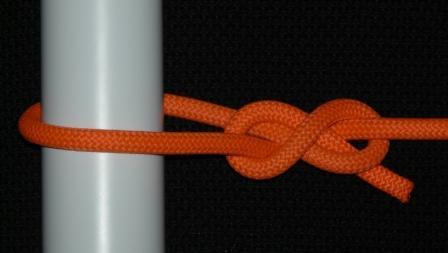
The Buntline is OK, but it is not so unique and indispensable, as many knot tyers believe… See a similar one, at the attached picture.
I’m a very serious fisherman so I simply can not limit myself to a list of five knots. I’ll give five nautical/outdoors favorites and then several fishing favorites.
-
Round turn and two half hitches
-
Double Bowline
-
Trucker’s Hitch (This includes learning a midline loop for the knot system)
-
Constrictor
-
Zeppelin Bend
Fishing Knots I favor
1)Snell-main line to hook
2)Uni to Uni-For joining two lines together
3)Surgeon’s Loop
4)Palomar-for attaching certain lures where the Snell knot isn’t acceptable.
I love this type of thread because these favorites of everyone are so frigging debatable. In the fishing section in particular, big game fisherman would opt for the Spider Hitch or Bimini Twist instead of a Surgeon’s Loop. They would possibly choose the Yucatan or Jimmy Albright Special when joining lines…fishing knots are VERY interesting to study as I’ve recently found.
In the camping and outdoors world of knotting you can debate knots just as well. I like the Trucker’s Hitch being on the list because it’s so practical for the average person who will need to know how to secure items from time to time in the back of their truck or car. This list should be made up of knots that scream practicality, not knots that scream KNOT MASTER. The Double Dragon borders on the knot master type of knot IMO, I’ve only tied it a handful of times and can’t remember how to even tie it as I type. I think a Poacher’s Knot would be a good one to put on a little bit bigger list.
That’s certainly a great list of knots to know. With those applications in mind, if it were me, I’d do the following:
-
Drop the slipped buntline. It does the same job as the round turn and two half-hitches, and it’s more secure, but the latter is more versatile. If you want extra security, you can tie a secure loop around the object.
-
Drop the Bowline. What you’re talking about is applications involving heavy loads and possibly the need for maximum security, so I would choose a loop that will do these jobs well, even if it’s overkill for other things.
-
Learn the zeppelin loop, for two reasons. First, it’s a maximum security loop, much better than the bowline, especially for a rescue situation, and is fine for just about any other use. Second, if you learn to tie a zeppelin loop, you can use the exact same method to tie the zeppelin bend. You don’t have to learn any new movements, just be working with a second line rather than the looped working end of the same line. Two for one; not sure if this is cheating, but you’re the one making the rules, so count it however you want
-
You don’t have a knot on there that will help you get really good tension in a rope you’re using to tie something down. Add either a trucker’s hitch or the kind of hitch that can be tied back onto the same line to create an adjustable loop (Blake’s is my preference, also adjustable grip, tautline).
-
You need a binding knot IMO. I think the need to tie things in a bundle or cinch down a line running over a pile of stuff is common enough to warrant a knot in your list of five. I think a reef or Gleipnir would be best for a variety of situations, but you could economize by using the tension knot you pick above (e.g., Blake’s hitch) as a binding knot (tie it to the other end of the same rope and cinch it around an object). Again, two for one.
So here’s my suggested list. Of course, if you have those five down so you can tie them with your eyes closed, you’re more than ready to expand your list:
[b]1. Round turn and two half-hitches
-
Alpine butterfly
-
Zeppelin loop / bend using the same tying method (cheating?)
-
Blake’s hitch
-
Reef knot[/b]
X1, that looks like a great knot, at least tying it for the first time. Seems like it would have a great grip. What’s your experience with it? Does it jam? Can it be slipped? Does it need to be? How is it’s hold compared to the buntline?
TMCD,
Thank you for your list. My 5 knots are not necessarily my favorites. They are compromises for having only five.
Also, the conversation is entirely different if we get to add even just one more knot. Your 8+ knots are for a different thread because the conversation is completely different than the 5-knot conversation. To cover your fishing needs, you could have listed a Uni knot as one of the five…maybe not ideal, but doable.
Also, if you force yourself to make 5 only, you may discover (as I did) that the Double Dragon is perhaps the most practical on the list. By the way, tying the Double Dragon is EASY compared to the Uni. You just haven’t practiced the DD in order to make that statement.
If somebody does not know how to tie the Zeppelin bend, you suggest to learn the fake so called “Zepelin loop” so he “can use the exact same method to tie the Zeppelin bend” ? Thank you, erizo, that was a funny thing about this lamentable ugly tangly that I would nt expect one could have thought of !
No, it does not jam more than the original Buntline. Personally, I would nt use a slipped Buntline, if the grip the un-slipped Buntline is able to offer would seem inadequate… I would rather prefer to add one or more round turns, or tie a proper slide-and-grip lockable hitch. For the same reason, I would nt tie a slipped “Buntline extinguisher”, as I whimsically call it for the time being. I believe it offers a better grip than the original Buntline, indeed, and - what is very important too - a more controlled grip : one can increase a little bit the amount of force by which he pulls the returning line, so the hitch will hold a little bit more. It may happen that you use a rope for the same time, and you do not know how slippery it is in advance, and if a hitch tied with it would hold or not - it is important to be able to gradually increase the amount of force you use to make it hold, as much as you want it to hold.
! I have never thought this use of a climbing friction hitch ! That is the good thing with this game, it makes you think how to get " two for one".
I should give credit for this to knot4u. He mentioned this much earlier in this thread when he gave his list of five, and that was actually the reason for my learning Blake’s hitch in the first place. I agree, a terrific use of a climbing friction knot. I’ve tied it this way in several different kinds of rope, and once you dress it tight, it’s not going anywhere.
It’s interesting, the first way I learned to tie the zeppelin bend was the overhand knot followed by working the end of the other line through it (the way the loop is tied), which if you’re just learning the bend is unnecessarily complicated compared to the “b and q” method. But having learned it that way, when I wanted to learn to tie the loop, there was nothing new to learn, aside from using the working end of the same line to finish the knot instead of another line.
For my purely practical purposes, the zeppelin loop’s fakeness, lamentableness, and ugliness don’t really enter into it. It’s a very secure loop that can be tied by a method that’s also used for a very secure bend, which to me makes it worth learning. Liabilities like not being post-eye-tieable are less important to me than security, although of course other people’s calculus when choosing just one or two loops may be different.
…regarding the Zeppelin bend. If you learn how the Zeppelin bend works, you will understand that the “fake-ness” of the so-called “Zeppelin loop” - and you will find hard to justify utilizing the Zeppelin bend as a base for your loop, and not any other bend, which is not a rope-made hitch, as the Zeppelin bend is - i.e, any bend of the dozens of dozens bends we have, where the standing parts form first curves which are “hooked” around each other. You can start by trying the dozens of Hunter s bend and falsely-tied Hunter s bend based loops, for example ! If you find ANY difference in security, between the fake so-called “Zeppelin loop” and all those bends, I swear I will be tying the ugly tugly for the rest of my life ! So, the “security” of a loop based on a bend can not be a reason for choosing this particular bend and not any other… The Zeppelin bend, as a mechanism, has something different from most of the bends we know, and when you throw this away, you throw away its best part - and you keep the insignificant remaining “commodity”, the interlinked nature of the two overhand knots, which you can find in so many other bends.
If the Zeppelin bend is able to make you happy, the fake, so called “Zeppelin loop” will make you cry, believe me…Yes, a Ferrari has four wheels, as any other car if you are interested only to use it as four-wheeled trolley, your Ferrari has become lamentable…Using the Zeppelin bend ( and not any other bend ) for its two interlinked overhand knots, you do exactly the same thing…
Oh, that belongs to the eye of the beholder ! I believe that nature offered us a great gift, with the beauty of the Zeppelin bend - if one can not appreciate that, the difference between any beauty and any beast disappears, indeed. Perhaps the world would have been a more fair place if there were not an beautiful things around ?
I have tried to tell you that the ability tie be able to tie and/ot untie an end-of-line eyeknot in one stage ( without any pre-knot that has to be tied and then has to be untied again on the standing part, i.e. without a “relic” overhand knot remaining tied on the standing part after the main loop has been opened up and the line had been freed to move ) enhances security, in the broadest sense of the word. Evidently, I have failed - but that would not be my first time ! We,knot tyers, we are conservative, and, I would dare to say, frightened people, by the apparently vast complexity of the KnotLand s landscape, that our brains can not conceive, just because human brain did not evolve to grasp complex curvilinear 1D lines in a 3D space…We can not easily learn new knots, or even new things about the knots we already know ! When you will learn the Zeppelin bend, as a rope-made hinge mechanism, and the big, HUGE difference in convenience but also in security, in a broad sense, between the post-eye-tiable eyeknots and all the rest, I will come back ! Till then, there are plenty of “easy” web sites, advertising your beloved ugly tugly. It has almost become a fashion, because, if you follow the fashion, whatever fashion, you are not supposed to explain why you wear this instead of that. A loop based on the Zeppelin bend, you said ? Ouaou ! It should be a great loop, let me wear this around my neck, like just another happy proud fashion victim.
Perhaps you or knot4u should start a new thread, about hitches around poles based on climbing friction hitches, like the one you mention.
The drawback I see is this : the climbing friction hitches are not meant to distort the straightness of the main line in any significant way. On the other hand, many “ordinary” hitches induce a local deformation of the main line, a shallower or deeper curve ( pull the returning line of the “Buntline extinguisher” we were talking about, to see this effect ), or even entangle it within the initially sliding part of the hitch ( as it happens in the arthroscopic slide-and-grip lockable hitches ). This Is a great advantage, because, on a local “bump” of the main line, acting as obstacle, the whole sliding part and the returning leg of the main line can be attached “easier”, with greater security.
What is the knot you refer to that is even more secure than the bowline?
I have tied the buntline replacement as per your pic and it’s a grand knot but I don’t know if it would be easy to remember how to tie (for me).