In the book, he suggested that we could contact his publish with errata. I’m sure pretty sure I have found one oversight (on page 176, Petit says he invented the the use of a sheepshank where you improvise two little loops in a tensioned cord, but that is ABOK 202).
I’m curious, however, about another. Try as I might, when I follow the instruction on page 194, I do not end up with a perfection loop. Has anybody been able to use that method to successfully tie a perfection loop?
I recently got that book and like it. Nice clear drawings.
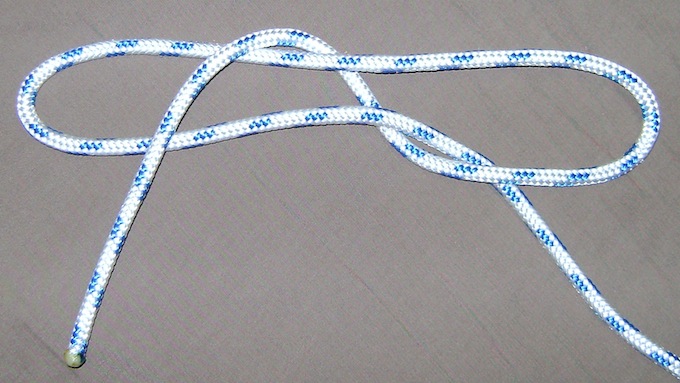
I tried his version of a Perfection Loop on page 194 and can’t make it work either. It doesn’t have the stabilising overhand knot structure of the standard version:
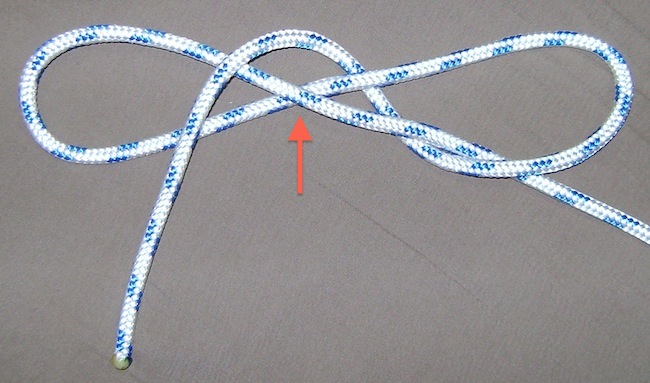
A simple modification to WK’s tying method produces a standard Perfection loop.
Note the direction of the twist, with the standing part leg of the twisted loop crossing over the returning leg (red arrow).
(EDIT: This is more or less the same as the method given in Handbook of Seaman’s Ropework, by Svensson. He calls it a standing eye. Figure 47, page 28, 1971 Edition.)
                  Why knot also called Flying bowline or Tub boat bowline.
                  Here is the links and include my Quick Angler's loop video at youtube.
                  http://www.baggy.me.uk/knots/
                  http://www.youtube.com/watch?v=vxrZ7bKEwQc
                  http://www.youtube.com/watch?v=tLgPVm03OGI

                  謝謝   alan lee
We’ll be interested if you try to do this with how
such contact is received.
In the case of the supposed angler’s loop he has
clearly botched the knot --that should be obvious
(e.g. in comparison with his own Ashley reference).
I happened to find this book in the National Building
Museum gift shop, so paused to look through it for
other trouble spots.
I don’t know how it is that he intends his “same”
to be heard, but calling the strangle & constrictor
“the same knot” is wrong in the usual sense of
“same” --which should be obvious from his showing
the two, but … ?! That the latter but not the former
can be formed in the bight should prove the point;
I didn’t look at his text to see if he discusses such
tying (and was seeing this under transom knot).