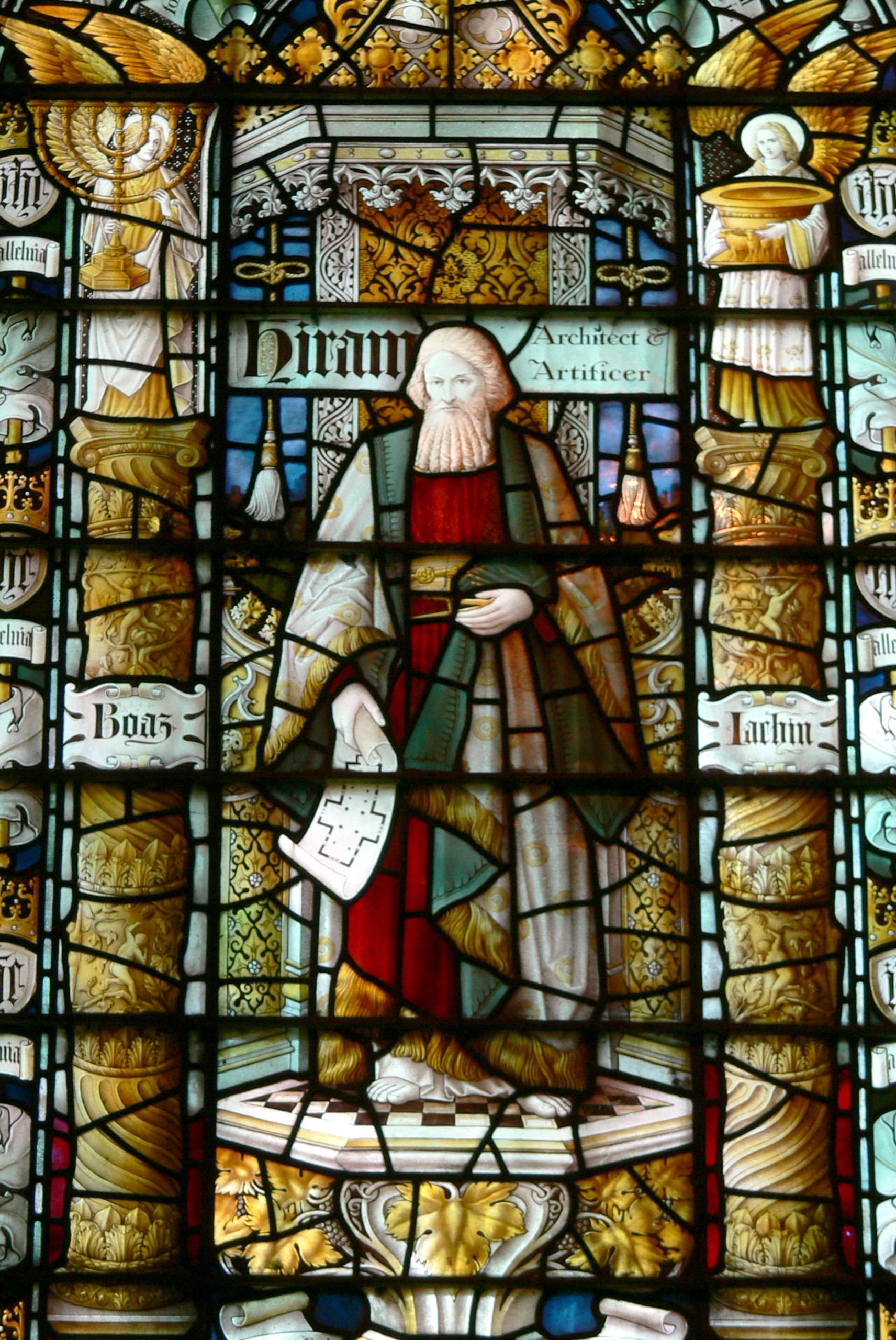
Over at the Wikipedia reference desk/Humanities, there is a query concerning the knot in a stained glass window (depicting the architect T. M. Lockwood as Hiram Abiff) at St John the Baptist’s Church, Chester. We would like to know the type of knot and hopefully any associated symbolism. Its not the typical Masonic figure of eight knot.
Thanks in advance. If you wish, you can join the discussion (registration not required, but doing so will hide your IP), or I can transfer any replies from here.
The Minister of this church (the Reverend David Chesters OBE) is a friend and old colleague of mine (we both worked for HM Customs & Excise in the UK) and despite the fact that I have been in this church many times I had never noticed this part of the window! Having looked at the picture I am not sure that it is a knot as such - it may be simply a pair of illustrations (one reversed) but the detail if not very clear. When next in Chester I will take binoculars and have a look in the meantime perhaps someone will recognise it.
It took me a while to even find the questioned knot
–which occurs in spaces at about head high on both
sides of the central figure.
As best I can tell, it does seem to want to BE some
kind of actual knot --based on what looks to me to
be clear indication/illustration of rope crossing other
rope (looking at lines of the lay). I’m having trouble
picking a part and then following around through
the entire structure.
And it looks as though --maybe-- a single actual knot
was the model, and rotated on the vertical axis to give
the apparent mirroring look!? --which means that we
are kindly being shown both faces, which should help … .
I don’t know a name to assign to this knotted structure, but it looks like, upon zoomed inspection, to have been tied by opening up the lay of the twisted strands and had the crossing loops threaded through the vertical part.
Well, I doubt that, but indeed the vertical parts/strands
don’t really allow sufficient room for them to be much
at all involved in actual (vs. artist’s rendering) knotting!
Note the similarity (re mirror’d on vert. axis) of the small
low center loop from left to right, but not quite exact vis-a-via
over/under crossings of other strands!?
(And IIRC, there isn’t presentation of through-strands
whole-part splicing in any old literature? Hensel & Gretel
have that weird construct where strands are twisted into
a first-stage kink and then a whole-rope reeved through
those strand-eyes, but otherwise, I don’t think I’ve seen
indication of what I do see in commercial-fishing constructs.
)
Zoomed and marked picture attached.
I see the lay opened front and back with the eyes threaded through the main line.
I hope someone else see this as well.
That is the only way I can see this being tied, regardless of what fishermen commercially use.
I believe it only had/has a decorative application.
See attached image…
He remarked that: “…it is just a type of simple double loop with communicating eyes…
It is meant to be hung from somewhere, hence its vertical orientation.”
Yes, the knot offered by agent smith/xarax looks similar, but I don’t believe it is what is depicted in the stained glass you’ve linked to.
I quickly tied, in some small three strand cord, what I think is the item in the image. I did not try to make it neatly, just proof of open lay construction as I spoke of in previous posts.
There’s a problem with both of these, vis-a-vis the
center/lower loop : SS369’s can be remedied I think
but making one end of this loop cross OVER a side
bight-leg; X’s simply shows that as constructed the
tendency (physics) will be for this loop to not open
much on the side where the part exits/enters vertically.
(But it might indeed be the artist’s model, and the
glass image has different physics!)
Note that the glass rope is S-laid (“left-handed”)!?
If someone had made a mold of Z-laid rope, this
is what would appear in the mold. !?