Zeppelin Loop and Double Dragon Loop - security based on experience

To answer Alan’s question, and redress this continued
opining, the “so-called” zeppelin eyeknot has been put
to some break tests and found to be, in the report of the
tester:

[ref. [url=http://www.treebuzz.com/forum/threads/the-zeppelin-loop-vs-the-f8-in-pulls.15928/#post-228947]www.treebuzz.com/forum/threads/the-zeppelin-loop-vs-the-f8-in-pulls.15928/#post-228947[/url] [ zeppelin vs. fig.8 eyeknots ! There is also similar discussion of the end-2-end knot on this site. ]

Now we have a reliable and strong loop [eye] knot
that is super easy to take apart even after a huge load.
& also
the ZL is stronger and just as secure, if not more so
than most bowlines and it’s just as easy to untie.


(I didn’t see the remark that he was able to untie
the survivor-of-2, but believe that that was the case.
–new forum format has fouled the quoting, alas (at
least as I viewed it w/local system).)
There is some “YMMV” per particular materials (his
I think was 9mm kernmantle rope, or similar); one
can figure that in HMPE things will be different, and
if the knot holds to break, that it will be jammed,
so much force flowing around … . .

Alan, note that the overhand component is oriented
like a minimal timber hitch, and this is what gives
it chance to avoid jamming.

–dl*

[i]“In the report of the tester”/i ? ? ? I see this “conclusion” only as a reply to the report of the tester - a reply by some other author, who, I hope, is not you… :slight_smile:

First, as the title itself tells, the test was about the so-called “Zeppelin” loop, in comparison to the retraced fig. 8 loop - so irrelevant with was claimed by the cited “wise” pseudo-conclusion…
Second, the test was about the strength of those knots, not about the easiness to untie them - which was not measured with any means. It is true that, to measure it, one would had needed some sophisticated laboratory instruments - but that does not mean that, in the absence of such instruments, one can say anything it happens to cross his mind !
Third, “security” was examined in its narrow sense, as something that is related only to slippage. In fact, in the real world, in order to speak about security, in a broader sense, we should also take into account how easy is to tie or to untie a knot, because, in some dangerous situations, time can play a major role.
Fourth, the “most” bowlines is a joke ! I am sure that the “wise” knot tyer, who replied in such a superficial way, does not know more than a small fraction of the bowline-like knots, and that he had tested not more than a small fraction of this fraction !
In short, the above reply of what was really reported in the article by the tester, is but a wishful thinking of its author, and nothing more, I am afraid.

Touche’ --as I whined, the visible '[ quote ] ’ … markers
instead of their intended effects made sorting out who
wrote what troublesome.
BUT, the 2nd quoted-by-me testimony to easy
untying of the zeppelin eyeknot IS from “Ron”, tester.

Meanwhile, we can note differences in knots’ behaviors:

After using it [[i]zeppelin end-2-end knot[/i] on a tightline with a 5:1 it was fairly hard to untie but a trace 8 would've been welded. // [And elsewhere "Moray" reports breaking round-sling "loops" in which 2 pieces of utility cord were joined at both ends w/same knots --to ensure that there would be a survivor knot--, and that the [i]z.[/i] survivor was "ridiculously easy to untie" !! So, some *YMMV*.]

As for the remaining rabble, what more can be said?

First, ... the cited "wise" pseudo-conclusion... Second, ... which was not [i]measured[/i] with any means ... . Third, "security" ... . Fourth, the "most" bowlines is a joke ...., and nothing more, I am afraid.

While I won’t dare hope to overcome the self-delusion
expressed above, I have yet hope that others will be
able to see clear, and so post these words here.

–dl*

To answer Alan’s question, and redress this continued
opining, the “so-called” zeppelin eyeknot has been put
to some break tests and found to be, in the report of the
tester:

[ref. [url=http://www.treebuzz.com/forum/threads/the-zeppelin-loop-vs-the-f8-in-pulls.15928/#post-228947]www.treebuzz.com/forum/threads/the-zeppelin-loop-vs-the-f8-in-pulls.15928/#post-228947[/url] [ zeppelin vs. fig.8 eyeknots ! There is also similar discussion of the end-2-end knot on this site. ]

Now we have a reliable and strong loop [eye] knot
that is super easy to take apart even after a huge load.
& also
the ZL is stronger and just as secure, if not more so
than most bowlines and it’s just as easy to untie.


(I didn’t see the remark that he was able to untie
the survivor-of-2, but believe that that was the case.
–new forum format has fouled the quoting, alas (at
least as I viewed it w/local system).)
There is some “YMMV” per particular materials (his
I think was 9mm kernmantle rope, or similar); one
can figure that in HMPE things will be different, and
if the knot holds to break, that it will be jammed,
so much force flowing around … . .

Alan, note that the overhand component is oriented
like a minimal timber hitch, and this is what gives
it chance to avoid jamming.

–dl*

Hi All,

  Dan I don't quite follow what you trying to said here. but my nose is quiet sensitive, I felt guilty of my nose.
  I smell something I shouldn't have to, your body release someone else's perfume. I don't like it. 

  I like this popular chinese phrase 真的假不了 假的真不了 I use google to translate 
  = Reality Bites can not really fake

  Tomorrow I will post the rest of the test as Roo request

  謝謝  alan lee

I don’t recall this request. Maybe you’re thinking of someone else.

Hi All, 

   Roo,this is how you reply on reply #17 (Alan, Have you considered that you're exceeding the working load 
   limit of this rope? 3000 lb / 5= 600 lb),so realise my way is wrong, you way is the standard way, 
   and I automatically think I should do the test right way, 
   due to my poor English, I misunderstand it, I am sorry. 

   Since I already got it tested, I think some of reader may like to see it, what to you think should I post it? 

   謝謝 alan lee

There is NO “standard way” to test and measure the easiness or difficulty we can untie a knot ! AND, as I have mentioned many times, there is no “way”, even considered as “best practice”, other than just puling and pushing, bending two different parts of the knot s nub relatively to each other, etc.- i.e., some manipulation of the knotted rope we are not able to quantify or measure.
To take the various values of the “working” load of a rope, suggested by various organizations for various occupations and activities using ropes, and mis-use them as limits under which we should examine if a knot is easy to untie or not, is a <edited, by me… :)>. I have seen “working loads” ranging from the 1 / 4 to the 1 / 15 of the MTB… There are many situations where the ropes and the knots happen to be loaded, accidentally or on purpose, with loads approaching their MTB, so far beyond the recommended “working load” - and in those situations the need for an easy-to-be-untied knot may be even greater than in normal, everyday situations. To suggest that, iff a knot can be untied iff it is loaded with the 1 / 5 th of the MTB, it would be OK, is a DANGEROUS thing to do ! It reveals a total ignorance of what is happening in “dynamic” loading, or accidental loading, with loads far greater than those we had anticipated.
Of course, this stupid idea was nothing but an ad hoc pseudo-invention of somebody who tried to saved a mediocre knot that has been occupying his brain cavity ( of unknown volume ) from time immemorial. I had only COMPARED the difficulty to untie this knot, with the easiness to untie the Zeppelin knot, or the bowline-like, PET knots. ( I have no sufficient experience with the Double Dragon knot to have an opinion - I have tied it only a few times, and, until recently, I had confused it with another “similar” knot ! :)).
In boating, for example, one is confronted with such situations all the time ! Suddenly the mooring or the anchor line of another boat is entangled to yours, and both boats start moving towards a third one ! :slight_smile: In general, one is seldom able to predict what will really happen in a outdoor activity - and ANY limits put on the “working” loading in advance will not help a jammed knot get untied !
It is true that we should better quantify the mostly subjective quality we describe as “easiness to untie”, and one way would be to specify the different loads and loading patterns under which a jamming of a knot can occur. Some time ago I had proposed to sort the knots in five categories, defined by the maximal loading under which the knot can still be untied easily - whatever we decide that will mean. The 1 / 4, 1 / 3, 1 / 2, 2 / 3, 3 / 4 of the MTB of the rope ( to keep the ratios simple enough, and to compare the limit of the “easiness” according to a quantity/value/number of the rope, not of the knot ).
I am sure that almost ALL knots would be easy to untie, if the “working” load of the rope is sufficiently small, compare to its MTB… I imagine that NASA, for the space walk tethers connecting the astronaut with the space vehicle, uses “working loads” of 1 / 100 - under such “working loads”, I am sure that there is not ANY knot, even worse than the fake, so-called “Zeppelin loop”, which will NOT be “easy to untie” - so, why should we bother to measure it ?
Of course, another thing we have to consider is the softness or the stiffness of the rope. When we claim that a knot is “easy to untie”, we do NOT mean that it is “easy-to-untie-iff-it-is-tied-on-boiled-spaghetti” ! :slight_smile: ANY knot can be untied easily, if it is tied on a soft enough rope ! AND, if the rope is veeery soft, any knot can be untied by itself, without us ! :slight_smile: So, when we say that a knot is “easy to untie”, we mean “it is easy to untie if tied on whatever rope” - provided this rope is not made from Velcro ! :slight_smile: So, the < edited, by me > idea, that we can claim a knot is “easy to untie” when it is easy to untie iff it is tied on soft enough ropes, is < edited, by me >.
A knot tyer ( actual, or would-like-to-be, it does not matter…) wants to make some $ ( dollars ) from a site ( pathetic or not, it does not matter ) of his - and he sell commercials, which are paid according to the number of clicks / visitors of the site. That is not sooo stupid - people visit much-much more pathetic sites, and even pay for their visits to them ! However, when he USES a public Forum, like this, to advertise his own site, over and over again ( in almost ANY thread, he inserts references to the same pages of his web-site, again and again…) , that is starting to smell badly. And when he starts “INVENTING” new meanings, by twisting the meaning of words already in use by everybody, THAT is worse… AND when his pseudo-inventions are referring to SECURITY, and he claims that a knot is easy to untie, even iff it is only “easy to untie when loaded by the working load”, THAT is dangerous ! When he will discover that in some other uses of ropes there are recommendations of “working loads” even smaller than the 1 / 5 th of the MTB ( like the 1 / 100 ? in space walking … :)), he will baptise each and every pathetic knot as “easy to untie”, and secure ! And he will be able to gain more $ by this !
I am not sympathetic to the vagrant knot sellers, not because of the occupation, but because of the low quality of their merchandise : most knotting sites and books are ruminating the same knotting myths - and, as we have seen, some of them are even producing new ones ! ( However, I am sympathetic to the difficulty of people, like Dan Lehman, who feel they have to defend them, somehow… :)) This new myth, that a knot is easy to untie even if it is easy to untie only when loaded by a fraction of the MTB ( fraction not specified, as the “working load” in the various activities involving ropes vary…), is DANGEROUS - because security, in the broad sense, is related not only to slippage of a knot, but to the easiness of tying and untying it as well.
As I had said many times, the difficulty of untie-ness is only the last from a long series of disadvantages of the fake, so-called “Zeppelin loop”. I will not repeat them here - the interested reader can “search” the words : fake, so-called, “Zeppelin loop”, and read - BUT, what is FAR better, he can TIE this mediocre eyeknot, load it, and SEE for himself. Then, if he still wishes to buy whatever knot-sellers sell, he will have no one to blame except himself.

Alan, try reading with your eyes --if your nose
is hitting the screen, you’re too close to it! ;D
What I said is quite simple : you thought that
any overhand in a knot must make it jam,
and I found evidence to the contrary --where someone
had tested the “zeppelin loop” to high forces (i.p.,
to where a fig.8 eyeknot on the opposite end of the
test specimen had broken) concluded that it was easy
to untie.

–dl*

X., you’re deep in the manure pit now, and
it’s best to put a lid on that --and you, if you
that’s where you prefer to stay.

Others, where is YOUR reply to this BS?
The cited reference is after all readable by all,
and it clearly says :

... [ QUOTE ] [b]#1[/b] [ QUOTE ] [b]#2[/b] Now we have a reliable and strong loop knot that is super easy to take apart even after a huge load.

[/ QUOTE ] #2-close
!? But there is already quite a set of Bowlines for that – old technology, complemented with various methods to secure the knot.

[/ QUOTE ] #1-close
[& here, RON’s --the tester-- commentary]
The ZL is stronger or as strong as an F8 and can be untied much easier.
The ZL is stronger and just as secure, if not more so, than most bowlines
and it’s just as easy to untie.

I hope that all unbiased readers can comprehend this.
In other cases, though …

Poor Ron, he made some pathetic kitchen-located tests, on three ( THREE ! ) samples, he does not even report all the other details of the experiments [u]as he should had done[/u], and, suddenly, he has [i]fans[/i], and he became a wise "tester" we should respect ! :) . . . There is NOTHING in the post you cited that tells something about the easiness of untying, neither the absolute one, nor the relative one ( = comparatively to ANY bowline, . . . Poor Dan Lehman, he reads the quotes of the replier to the tester as quotes of the tester himself

Again, with the lamentable BS from one who
has done nothing but whine about what others
have or have not done when whichever does not
serve to support his claims! EStar did not do good
enough testing on the entire spectrum of knottable
materials and all possible knots …,
and Ron did only “pathetic kitchen tests” (funny how
this someone’s own kitchen cannot produce even such
tests!), and yet he broke ropes and was able to see
that the “zeppelin loop” was able to be untied, easily,
in the kernmantle rope he used.

:frowning:

What an interesting test! I pulled an F8 against an F8 tied in PMI 9mm (I had formerly posted 10mm; it was in fact 9mm)EzBend to get a baseline and one of the F8s failed at 3465 lbs. I think that’s a bit low, but…

This is the version of the Zeppelin loop I tested:

[​IMG]{ See the attached picture }

I then pulled a ZL (Zeppelin loop) against an F8 loop and the ZL failed at, 3601 lbs. I told you that F8 vs F8 seemed a bit low!

I repeated the test - new rope and knots of course, and guess what? The F8 failed at 3397 lbs!

I repeated the test a third time and the F8 failed at 3536 lbs!

So in summary:

1- F8 vs F8 - failure at 3465 lbs
2- F8 vs ZL - ZL failed at 3601 lbs
3- F8 vs ZL - F8 failed at 3397 lbs (notice how close that failure is to the F8 vs F8)
4- F8 vs ZL - F8 failed at 3536 lbs

Ron, May 24, 2010


4633672329_e8cc04146a.jpg

Alan, try reading with your eyes --if your nose
is hitting the screen, you’re too close to it!
–dl*

Dan, Yes my nose is close to the screen, but I am not afraid to look at myself.

   謝謝  alan lee

Quit being such a flaming ass, X.
You cannot be so stupid, but you surely are
again resorting to an ugliness and deliberate
bias in these forums that is unforgivable.

SOB, you cut off my prior post OF RON’S COMMENT
exactly where he does conclude what I said (and,
yes --unlike you–, I acknowledged my misreading
regarding the prior quote, which was from Moray
(who, mind you, is one who also does knot testing)).

So, one more time I will post this. If Alan gets his
nose out of the way (I will not even hope you get
your nose back in joint) and stops looking at himself
he can see it for himself.

... [ QUOTE ] [b]#1[/b] [ QUOTE ] [b]#2[/b] Now we have a reliable and strong loop knot that is super easy to take apart even after a huge load.

[/ QUOTE ] #2-close
!? But there is already quite a set of Bowlines for that – old technology, complemented with various methods to secure the knot.

[/ QUOTE ] #1-close

[& here, RON’s --the tester-- commentary]
The ZL is stronger or as strong as an F8 and can be untied much easier.
The ZL is stronger and just as secure, if not more so, than most bowlines
and it’s just as easy to untie.

–dl*

I will not follow in THAT kind of discussion, dL…

I will make a last attempt to summarize the issue, for those who would like to learn something. Now I am sure dan Lehman had read my posts related to his false claims, I will delete them - they are no more useful to him, than his posts are useful to me. I will leave him alone in his raving ( to use another term of his -normally, I would had used the term “delirium” ). Evidently he needs it, more than the truth. No wonder - the truth can not be afforded by all people, and it seems that, among knot tyers, this happens more often than one would had expected by people who are supposedly interested in tools.

This thread was about the so-called “Zeppelin loop”, and the Double Dragon loop. So far, nothing has been said for the later. I am not qualified to have an opinion about it, because I fo not know the Double Dragon loop well enough : I have tied it only a few times, I have not (yet) studied it, and, until quite recently, I was confusing it with another, “similar” loop !
About the so-called “Zeppelin” loop, Alan Lee presented some pictures of tests made by him, and he concluded that, under heavy loading, the so-called “Zeppelin loop” can not be untied easily. He explained this as a consequence to the fact that the so-called “Zeppelin loop” uses an overhand knot tied on the Standing Part, which “closes” around itself, and becomes difficult to untie.
In response to this, a member of the Forum I would prefer not to repeat his name, replied that Alan Lee loaded the knot above the “working load” of the rope he used, so he was not allowed to conclude anything about how easy to untie this knot is, because one is not allowed to load the ropes and the knots so much. So, he implied that the “working load” should be considered a limit, regarding strength AND easiness to untie : When a knot is tied on a rope loaded with a load equal to the “working load”, and it does not break, we can say that it is a strong knot. Also, if a knot is loaded with the “working load”, and then it is easy to untie, we can say that it is a knot easy to untie. So, we should examine, regarding hoe easy we can untie it, the so-called “Zeppelin loop” only when it is loaded by the “working load”, not more.
I have questioned this, on many grounds, as one can see if he reads my replies. In summary, I think that knots and ropes are often loaded by loads well above the working load, either accidentally, or on purpose, when the situation demands it, and the risks coming from the heavy loading are more than the risks of not using the knot at all. In those situations, it is even more important to have a knot really easy to tie and to untie, because these are, by definition, dangerous, critical situations, and the easiness to tie or untie a knot under such conditions is a matter of security, in the broad sense. In boating and sailing, for example, I have repeatedly found myself in such emergency situations, where I was forced to load a knotted rope far beyond the “working load” recommended by the manufacturer, and then I had to untie it in a hurry.
Neither the member of the Forum who first “invented” this restricted definition of a knot easy to untie even if it is it easy to untie when it is loaded with no more than the working load, nor dan Lehman who tried to defend whatever this member says ( as he always does, for unknown to me reasons, which, I want to believe, they are NOT financial ), nor anybody else, ever replied anything to this. However, the definition of the load under which a knot is easy to untie each time, is a debatable issue. I had, in the past, proposed five distinct classes of loadings, as percentages of the MTB of the rope, and the classification of knots in the corresponding class of the higher load under which each knot is easy to be untied.
Then Dan Lehman though that he could defend his mate in another way, and shifted the goalposts again…He discovered a post in an arborists site, where a member had presented a comparative test about the strength of the so-called “Zeppelin” loop, in comparison to the fig.8 loop, and presented numbers of loadings under which those two loops broke. On THIS test, and on THOSE numbers, on subsequent posts there were conclusions about how easy is to untie any of those two loops ( no number was offered, of course, not any description of the methods of the test which has supposedly lead to the examination of how easy is to untie those two loops - a test which was concluded after it produced four ( FOUR !) numbers, regarding strength, and strength only ). Notice that the comparison was about those two loops, an issue which was not raised in this thread - but which was though by dan Lehman that it could be utilized somehow, for his knotting or other purposes.
Never ever had I claimed that the so-called 'Zeppelin loo" is more difficult to untie than the fig.8 loop ! I had said that the so-called “Zeppelin loop” is not so easy to untie as the genuine Zeppelin knot, the Zeppelin bend, or any of the bowline, PET loops which do not have an overhand of rig.8 knot tied on the Standing part. Also, I had said that, even if this overhand or fig.8 knot is tied after the eye ( Post Eye ), on the returning eye leg, the loop may become difficult to untie. The fig.8 knot has, obviously, not one, but two fig.8 knots tied on it, so it should be expected that it would be difficult to untie.
However, this is irrelevant to the subject of this thread, and it was only used by dan Lehman for his own purposes. He cited a phrase, in this irrelevant thread in the other Forum, which I have to repeat :
The ZL is stronger or as strong as an F8 and can be untied much easier. The ZL is stronger and just as secure, if not more so, than most bowlines and it’s just as easy to untie.
WHO actually wrote this sentence, we do not know - we can not judge from the texts ( but he does - perhaps he wrote it by himself, and he is afraid, for unknown to me reasons, to admit it…). However, THIS is not the issue - as the poor man tried to present…

The issues were, and still are :

  1. If THIS “conclusion” is corroborated, in ANY way, by the four ( FOUR !) numbers on strength ( STRENGTH ) presented by the “tester” .
  2. WHERE, on earth, had this “most of the bowlines”(sic) came from ! The “tester” and dan Lehman never ever spelled a word about HOW are those four (FOUR!) numbers tell anything about the “most of the bowlines”. They had never ever explained which of the DOZENS bowlines they mean, and in which calculation, of which numbers, does this quantitative adjective "most"(sic) refers.

Judging from the absolute silence of dan Lehman about those issues, I have to conclude that, either the “tester” and Dan Lehman are the same person, or they are connected by some relation, unknown to me ( like the relation between dL and the other member of this Forum ), which I HOPE it is not financial. Dan Lehman feels the need to defend his mates by everything he is able to discover, and, in doing that, he hits below the belt anybody he finds in front of him. He recently tried to do the same thing to Alan Lee - but I am not going to defend Alan Lee, of course : he is a superb knot tyer, whose work speaks for itself. I feel sad for Dan Lehman s recent decent into the pit, because he could had been such a great teacher of knots, and, at the bitter end, he became the worst of all - but that is not the first time he disappointed me…
I would be glad to see REAL, scientifically sound tests of the so-called “Zeppelin loop” , in comparison to any other of the many loops we know - and iff it is proved, indeed, that :

The ZL is stronger and just as secure, if not more so, than most bowlines and it’s just as easy to untie (sic),

then I would be the first proponent of this knot ! I have a great respect for the “experimental method” called science, and I will not allow myself be driven away from the TRUTH, for selfish reasons, as dan Lehman, unfortunately for him and us, did…
However, even before those test, I would be also glad to BET :slight_smile: on this ! Whoever of those brave knot testers and their lawyers ( who, nevertheless, are afraid of loading the ropes more than the “working load”, because they fear the rope “can recoil after rupture and leave a nice hole in their [pretty, I presume] face” (sic) :)) wishes to put his money where their mouth is, is challenged to join ! We will tie ALL the bowlines we know, each and every one of them, even if they are going to be a lot ! We will test them under ANY loading, be it the 1 / 4 or the 3 / 4 of the MTB of the rope. And we will examine how easy or difficult they are, regarding tying and/or untying, in comparison to the infamous so-called “Zeppelin loop”.
Whoever dares to tell that I am talking BS, and that I am deep into the manure pit, and my ass is flaming, he should first be sure that the S or the M are not his, coming out of his A ! Oh my KnotGod, I am soo tired from the cowards !

I had decided to end this meaningless tit-for-tat, but there is something that made me think it should probably be more fair to give it another try…
I was really surprized by the language dL used against me. ( Not by his overall behaviour, where he always defend, by anything he can think of, right or wrong, anything my prominent opponents in this Forum say against me, right or wrong - roo and Inkanyezi, for example…). I had not expected from hit hits below the belt - although he did just that once, when he revealed/utilized publicly fragments of a PM I had sent to him.

Now, he accuses me of something I would never ever even imagine to do : to deliberately cut, truncate, censor a quote by somebody - that is, to twist his words, in order to prove something. He accused me of concealing a part of his post, where he wrote that the “conclusion” about the easiness of untying the ZL loop was coming from the “tester” himself, Ron, and not from the “replier”, and that I had not revealed ( what he claims it was ) Ron s line.

I did not : I simply quoted directly the first part of his reply, where he, dL, stated that the line

Now we have a reliable and strong loop knot that is super easy to take apart even after a huge load.

was written by the “tester”, Ron, and not by the “replier”, for a SECOND time - although he had acknowledged his mistake, after the first time ! That was sooo silly, and was done in such an obviously stupid way, I thought I had to SHOW the part itself of dL s post, where he did it again, to laugh at it ! That was the most funny, hilarious thing about dL reply, and that was what I had wished to emphasize. So, that part was the only one where I used the [QUOOTE] - I did not wanted to use the [QUOOTE] for the whole dL post, with all the other things he has written - included the nice adjectives he had used against me…

dL tried to capitalize on this, telling this :

However, in the part of my reply he shows, HE DOES NOT SHOW the remaining, subsequent part, where I quoted the original post of Ron s=“tester” s / “replier” s too, with the “conclusion” - and HE DOES NOT SHOW the remaining, subsequent part where I said that we simply can not be sure who wrote this "conclusion, because the [QUOOTE] labels, in the original post, do not help us in this, and that, in the end of the day, THAT does not matter, and it was not the issue of the discussion. ( The issue of the discussion was if that “test”, with its four numbers, was about, and if it was telling anything about, the easiness to untie the ZL, or not…).
So, HE is the one who cuts, truncates and conceals part of his opponents post, not ME !

Now, I was frustrated sooo much with this nasty trick he used, and with his language, that I had deleted all my other replies and written a new one, the one at my previous post. Unfortunately for me, I had not kept a record of the post where I wrote what I say I wrote, so I can not now PROVE what I say…
However, the poor man is unlucky - because something happened that makes me be sure that I HAD quoted, indeed, the passage from his and “testers” = Ron s / “replier” s posts he claims/pretends I did not : I had re-produced the [QUOOTE] word, and the editor of our Forum interpreted it as a quote, so the whole remaining post was shown as a quote ! To fix this, I was forced to add a second O into the [QUOOTE] word, just as I do here…and THAT I remember very well ! So, I am sure, for a second, technical reason, that I had quoted his and “tester” s = Ron s / “replier” s line, indeed - because for a first, moral reason, I was sure right from the start - I simply am not a liar, and a crook , but I can not tell the same for my opponents !

So , I ask from the Moderators to retrieve and present my deleted relevant post, the one with the many [QUOOTE]s I had inserted. There anybody will SEE, with his EYES, if I had cut/truncated/hidden, and if I had replied to dL / “replier” s / “testers” s = Ron s lines, or not.

HOWEVER. this man who accuses me of not cutting/truncating/hiding his lines, DO IT ALL THE TIME with my lines :

He quotes THIS : 

Notice his “conclusions”, and the words " rablbe"(sic) and “delusion”(sic) .

Although my post was THIS :

The reader can compare the two quotes, and he can judge if what I have written my post was “rabble”(sic), coming from a “delusion”(sic), and if dL had the courage to reply to ANYTHING of what what I am saying to this post, or not.

To return to the infamous “test” , by which dL hoped he will be able to pronounce some words against what is shown by Alan s pictures and what I said by me :

I had posted a reply, in two parts, on the Forum where this test was presented. The interested reader can read it, at :

http://www.treebuzz.com/forum/threads/the-zeppelin-loop-vs-the-f8-in-pulls.15928/page-2

Hi All,

   I don't understand this, I have heard lots of good things about this Zeppelin loop, 
   to me this is as someone tries very hard to persuade people to use it.

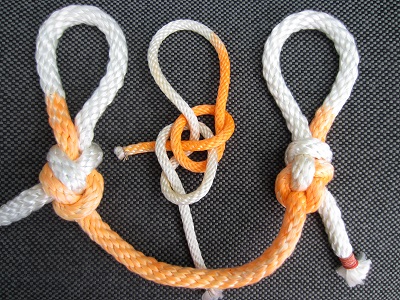
   Here, I rig up three versions of this class of loops with the best way I can.
   All three of those loops have U shape collars a little longer than the "Zeppelin loop". 
   Their nipping loops near the side of the Standing Part side have a more bow-like shape 
   which can push the collar a little more upwards. One has two rope diameters in the nipping loop, 
   the other two have three. Also, as they are tightening, they allow more time for the second 
   overhand knot to tighten up around itself, so the nub becomes more compact, and look more secure. 
    
   For now I can not test it, because the scale of the crane I use is not working properly. 
   In a week I will be at home, and I will see if I have time to build another heavy multiple force device
   that can deliver 1500 lbs. of load.
    
   Just by the look at it, and by pull test by my hand, all three are way better than the "Zeppelin loop". 
   Not that I like this kind of loops, I am just curious and I want to find out how much they can improve, 
   and how heavy the load can it support before they jam. 

   謝謝  alan lee

IMG_0089.JPG

@ eric22
Hi,
I dont know about the loops efficiency; but your presentation is great :smiley:
And exploded version and a closed one on the same image does the trick for me.
Thanks

X., your continued casting of discussions into the realm
of heroic struggles against “opponents” --whom, it can
be seen, you often poke at with obvious barbs intended
to provoke (the most frequent of which might be your
ever-present “false zeppelin loop” decrying)-- became
wearisome long ago. Seeing everything as ad hominem
deprives you of seeing points, alas (right or wrong points).

I am sorry for my angry words, but they were honest
reactions to your continued biased writing; most obvious
was the mis-quoting and not-seeing of Ron’s vs. non-Ron’s
replies : you could tell the latter (and so caught my mistake
on the one quote), but somehow became unable to discern
the former (which is every bit as clear, as I laid out in
bracketing the start & end delimiters of quotations).
And even after I admitted my mistake on the first, you raised
it again as though an undressed wound (while ignoring the
valid quote, pretending it undeterminable).

And then all the imaginative ad hominem construction
of bias & persecution and … --egadz.


Let us return to the piquing point : that assertion that
all eyeknots with an overhand knot base are harder
to untie than the bowline(s). I reject this assertion.
Some have reported that bowlines can jam, and some
have here said the same for the zeppelin loop (by which
name of common usage --following a construction method
that is broadly understood (nevermind finer arguments re
merit of whatever title)), which others believe to be false.
Having recalled that there had been break tests using this
eyeknot, and that the tester found it to be easily untied,
I presented that report. Loading the knot to near rupture
is an ultimate test; it is one test, and of few instances,
but I don’t find chance playing a role to somehow let
just those cases be easy … . We do need to mind that
testing occurs in particular materials and particular
knot-tying and particular loading.

Roo’s suggestion that going over reasonable loading
should be seen as stepping into a new region of use,
and maybe beyond the realm of expectations, strikes
me as worth regarding. Here, again, though, there
are such varieties of “safe working load” or “normal
working conditions” --but we know that they exist,
and that some extreme circumstances might not
be held to count against a knot; that everyday,
normal usage is of interest, and so How does this
knot in this application perform?
is the pertinent
question to answer.

Now, Alan (“eric22”) did not come to an opinion
en vacuo, but had some of his own testing to consider;
he found the ZL to be hard to loosen, if loaded
heavily, at least. Reflecting on this, I got some rope
and tried my own pretty heavy loading, and although
I wasn’t able to replicate the loaded geometry that
Alan’s knots have, I too found that the knot was
less then easily loosened --and could wonder about
e.g. the probably heavier loading that would come
in an FF1 (“fall factor 1” : falling the length of rope
in system --in rockclimbing, it’s possible to fall about
double this, as an extreme) with an adult male’s weight.

So, this left me on diminished island of support
against the challenged assertion! But I am not
wedded to defending the ZL (or allegedly for some
the Divine Z!). And I tried the end-2-end knot
of interlocked overhands that I would favor for
making an eyeknot : the “Ashley’s bend” #1452
(correctly dressed for being easy to untie). THIS
eyeknot is pretty easily loosened, although there
is the potential for the SPart to pull the collar
around it tightly as the SPart strand in high
tension shrinks in diameter (elongating) such
that the collar pinches it and then holds tension
upon relaxing of the SPart, which enlarges
outside of this pinch and has a stopper effect!
–such effect I have found in a bowline, btw.
Still, one has good hope to be able to overcome
this jam, as the collar holds much room for
loosening.

Not at all : it hardly matters what testing delivered
the near-rupture, severe force to the ZL, only that
it was sustained, and yet found to be unjammed.

Second, the test was about [i]the strength[/i] of those knots, not about the [i]easiness to untie[/i] them --which was not [i]measured[/i] with any means. It is true that, to measure it, one would had needed some sophisticated laboratory instruments --but that does not mean that, in the absence of such instruments, one can say anything it happens to cross his mind !
By your logic, we should all be silent --you, first of all in your original assertion, as you have not done this well-instrumented testing of all possible knots ... ! In fact, the general claim is one that can be evaluated with manual effort at untying, where the test is more of a pass/fail one, and not really concerned with matters of degree : "easy" or "hard" (or "jammed/'welded'") are the choices.
Third, "security" was examined in its narrow sense, as something that is related only to slippage. In fact, in the real world, in order to speak about security, in a broader sense, we should also take into account [i]how easy is to tie or to untie a knot[/i], because, in some dangerous situations, time can play a major role.
What matters to one application might not to another. The issue here regards ease of UNtying; of the tester, it was mostly strength & loaded-security (which ought to be pretty obvious on examination alone, for the [i]ZL[/i]).
Fourth, the "most" [i]bowlines[/i] is a joke ! I am sure that the "wise" knot tyer, who replied in such a superficial way, does not know more than a small fraction of the bowline-like knots, and that he had tested not more than a small fraction of this fraction !
And yet he had tested the [i]ZL[/i], and per the choices of easy/hard/jammed made a finding. --without doing the impossible of testing ALLLLL .... !

–dl*

I have not denied THAT ! :slight_smile: I sometimes try to use ( without much success, I have to admit, because I am not used to it… ) the same time-honoured technique of knot tyers : repetition ! I hope that, by repeating over and over again the same thing, I will succeed to implant a seed, at least, of doubt, deep inside the souls of the "Z"L believers - where I have seen that no reasonable argument had ever reached… It is boring, I know - but I think that it is no more boring to others, than the repetition of the "Z"L propaganda is to me - so, we are even. :slight_smile:
What else can I do ? There are dozens of easy to tie and untie PET loops out there, but, all of a sudden, a certain mediocre overhand-knot based loop becomes the bread and circuses of knot tyers, to satisfy their appetite for fast-knot-rumination… And here comes a lamentable 4 (= four ! )-numbers “test” about the strength of the "Z"L, in relation to the fig.8 loop, and the “conclusion” which states the most silly thing I had ever read about the bowlines :
The ZL is stronger and just as secure, if not more so, than most bowline and it’s just as easy to untie.” (sic)
Notice the ridiculous use of the words “more” and “most” - the “most” been more ridiculous than the “more”, indeed.

NOOO ! It is not ! because you NEVER had seen, or admitted, the obvious : that, in Ron s post, where the infamous passage is repeated, the ORDER of the QUOTES is WRONG ! Which tells me that we can not be sure who said what ! The first “QUOOTE”, should hade been a [QUOOTE] ( = start of the quote ) - but, instead, it is a [QUOOTE/] ( NOTICE THE “/” after the word !)(= end of the quote ). ALSO, the second “QUOOTE” should had been a [QUOOTE/](= end of the quote ) - but, instead, it is a [QUOOTE]( = start of the quote ). KnotGod, Why, on earth, had You abandoned me ? :slight_smile:

[/ QUOTE ]
The ZL is stronger or as strong as an F8 and can be untied much easier. The ZL is stronger and just as secure, if not more so, than most bowlines and it’s just as easy to untie.

[ QUOTE ]

The QUOTE is NOT valid, and I had not “pretended” it is undeterminable ! IT IS undeterminable !
Simple common sense would tell you - if you have enough of it…- that is improbable, for Ron, to repeat, for himself, THE SAME EXACT WORDS said by somebody else - which words, also, tell something sooo false !
However, the crux of the matter was not there ! You said that I had hided Ron s quote, on purpose, as a f… liar, ( the "word “lie”, which may mean nothing very important to you, means MUCH to me - and you dared to write it with capital letters, big fonts, and red colour ! ! ! )( not to mention anything about the BS, and the manure pit where it was best for me to put a lid, so I will not miss anything precious :slight_smile: ).
I had not ! I replied in two things, in two separate paragraphs, the one after the other, and I had repeated the rest of Ron s (or whatever else s) quote, word to word, AFTER the first quote - but you failed to notice that ! Instead, you were quick to call me a liar - which was something that makes any ad hominem response by me not only justified, but deserved as well.

( However, I appreciate the fact that you had admitted your words were “angry”, and that you are sorry for this - I will not continue this vendetta any longer ! Peace on Earth ! :))

OK ! And “I” reject the opposite ! ( even if it is not so clear, and uses the “most”, instead of the “all”. I believe that a 100% wrong thing remains too wrong, even if we are only talking about “most” of it…)
So, tell me, WHO is less wrong ? Who rejects a more wrong assertion ? :slight_smile:

WHO ? WHERE ? HOW many tests had they performed ? I hope more than 4 ( = four ) ! :slight_smile:
And WHICH bowlines ? There are dozens of secure bowlines out there - we are speaking about bowlines, in general, of course, and not about THE bowline ( the “common” bowline ).
However, what made me angry, indeed, was the ridiculous word “most” ! If the “tester” had simply said : “the bowline” or “some bowlines”, I would nt had started this vendetta ! :slight_smile:
I had devised what I think is a new secure bowline just a few days ago ( the Ampersand bowline ) - and Alan Lee does the same thing, almost each and every week ! Had Ron included those bowlines in the sample, when he “concluded” that the “Z"L is just as easy to untie as “most” bowlines” ? If yes, then HE is the real Oracle, and you are just a speaker on behalf of him ! :slight_smile: The man does not know yet the bowlines that will be devised, but he can speak about them ! He sees into the future ! I have sooo many things to ask him, other than the easiness or not of untying knots, of course ! :slight_smile:

Compared to WHICH knot ? If he had simply said that he had compared it to the fig.8 knot, which he had also tested, I would nt had challenged his findings. I believe that the fig.8 knot, which uses an even more self-enclosing, more complex, topologically, knot than the overhand knot, is more difficult to be untied than the "Z"L, indeed.
However, he had NOT tested ANY bowline - so, not even FEW, and, of course, not MOST of the bowlines !
If he had performed a decent comparative test between “some”, at least, bowlines, and the "Z"L, I would nt had destroyed the keyboard, by the angry way I type those replies !

OK ! So, I should had said "All but ONE ! " :slight_smile:
My word “all” was not meant to be exclusive, because, as I had said time and again :
"Topology does not determine geometry uniquely".
So, the fact that a knot uses a knot topologically equivalent to the overhand or the fig.8 knot, can not tell EVERYTHING about its geometry ! ( Which geometry, by its turn, is what determines the easiness or not of untying the knot ). My assertion was meant to be read in a general way - otherwise I would had been forced to DESCRIBE the difficult-to-be-untied GEOMETRIES - which is a pretty difficult thing to do ! ( Although, regarding the jamming geometries, I had attempted this, too, and I now believe that I can predict in many, if not “most” cases :), if a certain knot would be easy to untie, or not.)
I would be glad if somebody would test all the “corresponding” eyeknots of the end-to-end knots shown by Miles, for example. Then we would see if most of the eyeknots based on links topologically equivalent to the unknot ( the PET loops ), would be more easy to untie than the eyeknots based on links topologically equivalent to the overhand or the fig.8 knot.
My gut feeling, my present understanding of the rope mechanics, and my experience till now, tells me that, in such a competition, the PET loops will win the overhand and fig.8 knot-based loops hands down ! Am I sure ? Yes - to the degree I am ready to BET on this… :slight_smile: If I will be proven wrong, it will not be my first time - but I am not trying to persuade people about this, by 4-numbers irrelevant tests, or by just remaining silent, or even by hiding, all the loops that may prove me wrong !
It is almost a fashion for supposedly knowledgeable knot tyers, to systematically remain silent about the dozens of fine bends and loops we know, and promote some faux bijoux, like the "Z"L. I, for one, will not buy those BS ! If somebody comes and tells me that he tested a loop corresponding to a certain bend, and he found it as easy to untie as a certain bowline, then I would be the first to take this into account - because, contrary to “most” knot tyers, I was not so lucky to have been offered or found the Holy Grail, either of the bends, or of the loops ! :slight_smile:

Of course, if the test of the easiness to untie was done at near-rupture forces, it would suffice - but we had NOT been told this, had we ? :slight_smile: We do not know in which, exactly, stage of the loading, under which percentage of the MBS, the supposed testing of the easiness-to-untie has been performed. I had mentioned this in my reply to Ron, but I have not received any convincing answer - perhaps because I had not received ANY answer whatsoever ! :slight_smile:
HOWEVER, listen what you say ! “found to be unjammed” (sic) ! WHO told that a knot that is not jammed, is easy to be untied ? Neither Alan Lee, nor me ! A knot can be difficult to be untied - and can be more difficult to be untied than the bowline-like loops (that was my assertion…) - even if it does not jam !

You are quick to try to escape, but I am not soooo slow as you wish to believe ! :slight_smile:
I will repeat it : It was NOT his finding that the "Z"L was “easy-to-untie”(period) that made me angry !

It was that he “concluded”, without ANY test, that " the"Z"L is just as easy to untie as most bowlines ".

He had NOT said in which percentage of the MBS or his rope he tested ( IFF he tested…) that “easiness”.
He had NOT said HOW he tested ( IFF he tested…) that easiness.
He had NOT said that he had tested ( IFF he had tested…) EVEN ONE bowline.
He had NOT said WHICH bowline he had tested ( IFF he had tested any ).
Last, but not least :
He had NOT said WHAT he means by this ridiculous “most bowlines” !

The fact that he can not test ALL bowlines, does not mean that he should not test ANY ! And it also does not mean that, if he had tested one or two ( when, how, which ones, under what load, he fails to report…), he could claim that he had tested “most” !

I rest my case. It was NOT difficult to pulverize such a ridiculous claim, based on 4 irrelevant tests, of course. However, I guess it had been as difficult as it was shown, for you, to defend roo, and his faux bijoux - and it WAS difficult for me, to write thousands of words, in a language I do not know well, trying to defend common sense
If I was the one who had performed those “tests”, and had been so foul to publish them, and so silly to “conclude” such nonsense, based on no knowledge of the bowline-land, and on any testing on any of them, I am sure that you would had decorated me by all those nice, polite words you use, even against much more sound claims… :slight_smile:
In fact, I feel really sad for the poor people that are tying mediocre knots all their lives, and will never feel the joy of a GREAT knot, like the bowline or the Gleipnir… because they will never spent a few hours studying them, and so they will never UNDERSTAND them. If they miss this joy, I, too, do not understand why they are tying knots in the first place…

Hi All,
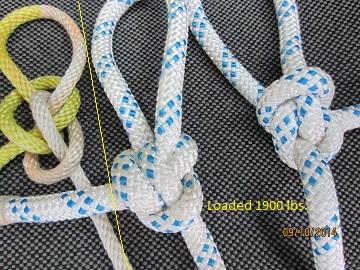
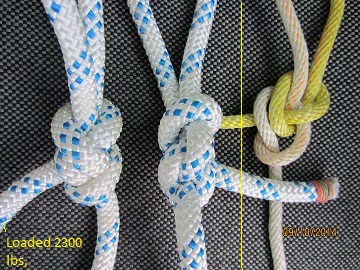
Have some free time and got these 3 double overhand loops tested, loop 1 jam at around 1700 lbs.
loop 2 jam at around 1900 lbs loop 3 jam at around 2300 lbs.
Just to make sure to have more accurate reading, again I carefully tested the Zepplin loop,
for soft rope after loaded 1200 lbs. is manageable to untie and it jam at around 1300 lbs.
for blue water rope after loaded 1400 lbs. also managerble to untie and it jam at arond 1500lbs.

   All 3 loops can support more load and the second overhand knot are more tighter then Zepplin loop. 
   There are no good reason for me to like all theses loops here. For Zepplin loop is the worst [s]worth[/s] one among [s]almost[/s]  all,
   beside the name "Zepplin" really have no much to offer.

   謝謝 alan lee.

loop 2.JPG

loop 3.JPG