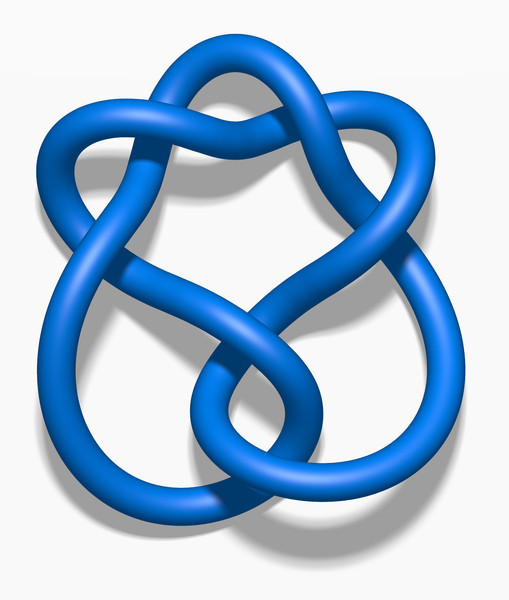
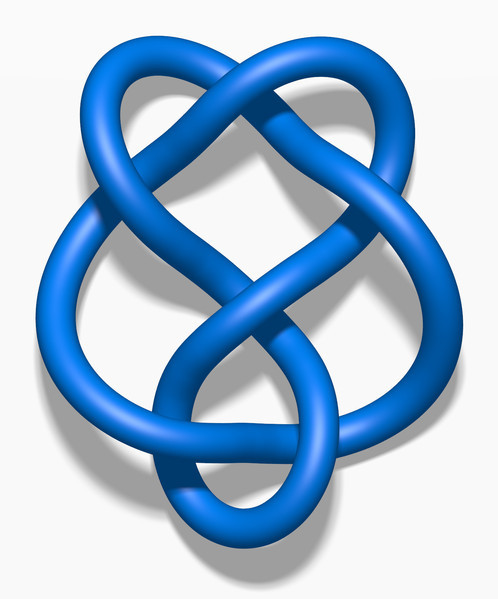
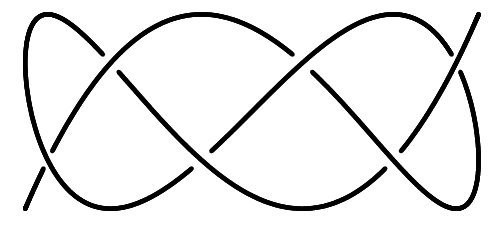
If we look at the tables of Mathematical knots, we see that, where a knot can be “represented” by a symmetric diagram, mathematicians prefer to show it this way - although mathematical knot theory studies the topological, and not the geometrical properties of the knots. However, I noticed that the third knot with six crossings, the 6_3, is always (?) shown in a asymmetric form ( the 6-1 and the 6_2 are always shown in a symmetric form ). On the contrary, with those same knots, the 6_1, 6_2 and 6_3, when viewed as we view them ( i.e., when we “cut” them somewhere, and we represent the two ends of this cut as the two ends of the “open” knot / “stopper” ), the situation is reversed ! The 6-1 and the 6_2 are less symmetric, and the most symmetric is the 6_3. ( See the attached pictures ). I do not understand why this happens, but I thought that it is an example of the different ways the same things can be viewed and represented, if they are examined by different people.
Is it because giving that extra twist of the center
parts will give a false (increased) crossing count?!
Working out topological equivalences is a major problem
–one that earned an IGKT member a Fields Medal (!)
for his contribution. Of the trio of “Fig.9” forms that
I presented elsewhere and recently referred to
(where two are symmetric, and the 3rd is the form
that rockclimbers & cavers have dubbed “Fig.9”),
I’ve long known their equality yet have many times
been greatly frustrated in moving from one to another!!
–yes, in a case where I know that the conversion
is possible : so, finding things where one isn’t so sure,
is just trebly troublesome.
Note that converting a practical knot into a topological
one is non-trivial : e.g., how to do so with the common bowline?! At least, IMO, one connects the two ends;
but it makes a difference as to which way one takes
the tail from between the eye legs --distinct knots
result!
Yet only one ( the third / “red” ) of the three Fig.9 forms, shown in the first post, is symmetric - when the knots are presented this way, i.e., as “stoppers” ( as “knotted” open strings in between two aligned and pointing to opposite directions tensioned ends ). The other two ( the “white” and the “yellow”) can not even be considered as symmetric-to-each-other…
A naive “explanation” is that the parent closed knot ( the 6_3 ) happens to be “almost” symmetric, and that the"cut" is sufficient to restore a complete symmetry, which was somehow hidden / broken within the closed form - but which now is free to manifest itself. On the contrary, when the parent closed knots are completely symmetric right from the start ( as it happens in the 6_1 and 6_2 ), a “cut” can not but destroy the existing perfect symmetry. So, when “cut” and "opened up ", the perfectly symmetric closed knots become asymmetric open “stoppers”- while the “almost” symmetric one is helped to reveal its symmetric nature, which was hidden / broken by the initial closure.
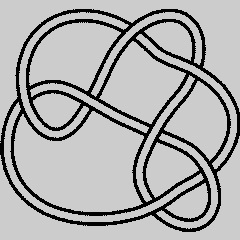
We can test this “explanation” on the only non-symmetric of the 7 knots with 7 crossings - namely, the 7_6 ( see the attached picture ). When “cut” and presented as a “stopper”, does it become symmetric, too - just like the 6_3 “stopper” ( the “red” one) ?
At first I though that it does, but now I am not satisfied by the degree of the manifested symmetry any more- so I have to suppose that the previous naive “explanation”, even if it seemed reasonable in the case of the knots with 6 crossings, it does not work at the next level, the knots with 7 crossings…
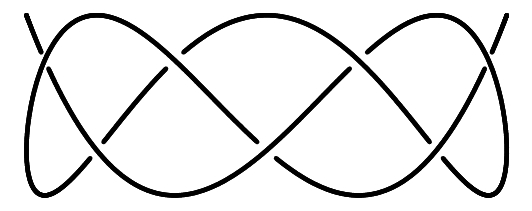
See the reproduced from this page attached pictures of the so-called “Chebychef (tying) diagrams” of the fig.9 knots, which are very useful for the practical knot tyer, as they show the knot in a loose, yet “folded” form.