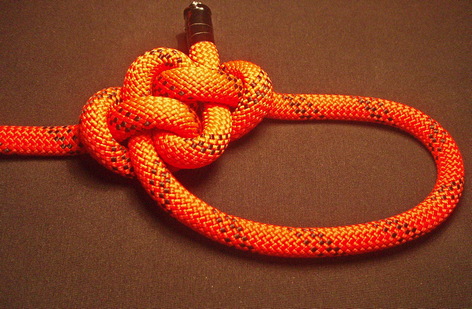
A clove based interlocking jam resistant loopknot

This loopknot is a bit cord hungry, since it requires two synthesized opposing crossing knots, adjusted in a clove configuration, while the “collar structure” (actually the returning eye leg structure, in that the collars are a consequence of the nipping component), is quite simpler, taking the form of a two opposing Us stabilizing system, as it appears in the first image of the loose knot.

The double U-shaped line appears to gear neatly with this clove based nip system, remaining perpendicular to the main axis of loading (SP, on going eye leg), while the middle strand, which is common for both Us, passes through both crossing knots, in a Carrik-like fashion, being the key component that stabilizes and adds balance and symmetry to the structure.

It appears that the structure is locked down, as the curved U-shaped strands of the WE are firmly clamped by the two opposing forces of load in this synthesized crossing knot, clove nip interlocking system, hence it is alleged to be highly jam resistant and retain its form even after high rates of strain during tensile testing.

The ring loading profile is fine, if the knot is cinched well enough, but if we exert considerable pressure on both eye legs (more than usual) at the same time, it will eventually deform. Apparently, it requires to be loaded from the SP for a rock solid, perfectly balanced symmetrical profile, which is normally the usual case.

If the returning eye leg follows the reverse line,exiting from the nipping system this time perpendicular to the SP, a similar knot is created (not illustrated), but it is less stable than the structure presented here.

So, here is the knot in the attached images along with its variant in fourth image.

I love this loop, you mentioned the cord “hungryness” but I think that in this case it is not a drawback; the mass of the structure align nicely and is not an encumbrance by any means.
Nice lightning on photos 2-3-4.
jr.

Hello enhaut

you mentioned the cord "hungryness" but I think that in this case it is not a drawback; the mass of the structure align nicely and is not an encumbrance by any means.

I mentioned the “cord hungryness” because of the doubling of the primary components synthesized in this loopknot. I guess you are right, it is not a drawback or an encumbrance and results to a structure with a nice symmetrical alignment.

However, i am not so sure about the “clove based” descriptor, as the nipping structure is topologically and not geometrically equivalent to the clove structure. A crossing knot based descriptor sounds more appropriate for this case.

Nice lightning on photos 2-3-4.

I am not really famous for my illustration skills but thank you anyway :). The external lighting source is not so good, maybe it is the camera angle or the sharpen/blur function that enhance the lighting in those photos ;).

Thanks for taking the time to view and provide feedback.

If the returning eye leg follows the reverse line,exiting from the nipping system this time perpendicular to the SP, a similar knot is created (not illustrated), but it is less stable than the structure presented here.

It seems that i have misjudged this poor little fellow, with the reverse U or S-shaped collar structure stabilizer, described in this comment, thus it would be unfair to exclude it from this presentation. It did not appear to have the perfect symmetry at first glance, but that does not mean that its stability and functionality are being affected, which makes it as good as the previous instance, or even better, with a more solid ring loading profile.

Now I think that I prefer this second configuration.
My poor attempt at whipping illustrate one of the qualities of your loop. The working end exiting upward facilitates this arrangement. For somebody wanting a permanent reliable loop at hands, it can be useful.
Playing with the “whip” version, I made an interesting discovery; this loop is easily adjustable. You can reduce its seize at any moment without hassle.
Now its time to work on a nice name for this beauty, Crossing knot interlocking loopknot is a bit dry

jr.

image = Loop X :wink: (with bad whipping)

So now we are talking about photo quality. Daylight, must be one of your secret allies i suppose, in conjuction with your fine braided rope which contrasts neatly with the background colour. I really do appreciate the illustration.

My poor attempt at whipping illustrate one of the qualities of your loop. The working end exiting upward facilitates this arrangement. For somebody wanting a permanent reliable loop at hands, it can be useful. Playing with the "whip" version, I made an interesting discovery; this loop is easily adjustable. You can reduce its seize at any moment without hassle.

This is a rather bizarre but very interesting whipping arrangement that i would never have thought to implement on this loop! You claim that is easily adjustable at any moment, even if it requires a two step process (from the returning eye leg). I assume that you don’t mean that this can be done under tension since the gripping power of the reverse crossing knots locking mechanism, is not to be underestimated, which reminds me that i should check, which one of the two structures has better performance, under high strain (in terms of jam resistance and deformation).

Now its time to work on a nice name for this beauty, Crossing knot interlocking loopknot is a bit dry

Fair enough, i tend to use descriptive names, but if you have an inspiration (like your Ouroboros loop and your Wheel house bowline), please do share!! :wink:

Since you liked the nip, you might want to check the following link, where Xarax uses this very nipping structure as a binder, with various tail arrangements. Same idea, different implementation, perfect grip and i really loved Dr. Frankenstein’s throne levitation :wink:

https://igkt.net/sm/index.php?topic=4819.0&fbclid=IwAR3afAJ3qGUPssINAIxuFNAV-TCJ781mOUO_qJQnyIqiszZ2-84_8Qj5ly4

When I was young, my father who grew up in a rural area, taught me how to snare rabbits. For him it was a natural thing to do, for me a valuable lesson. To this day I never put my hands in a tensioned loop out of respect for my sacrificed cousins rabbits.
My command of English is clearly the culprit; I should have written?you can reduce its seize at any moment but when loaded without hassle.

The link you provided is very instructive; I had not read this page at the time of its publication, better late than never.

Marlinspike loop comes to my mind for a name; when looking at the finishing touch of the working end weaving its way through the exit; one can imagine the well-known tool at work.
Of course we already have a Marlinspike Hitch, but in the knotting world it is good practice to mix terms in order to jumbled the mind of the practitioner. But I am sure that better moniker could be found.

“Daylight, must be one of your secret allies i suppose,…”

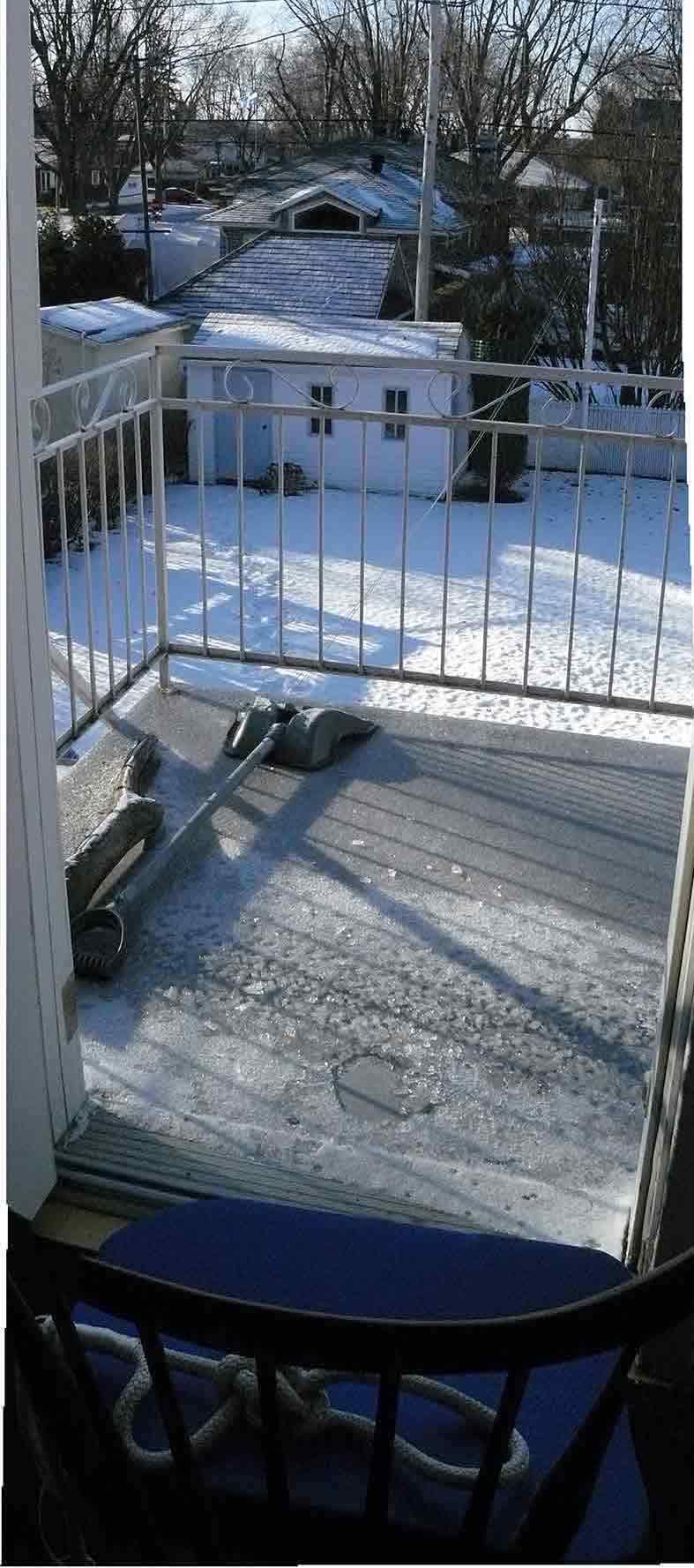
At my latitude, the winter is already in place but the light is great. I have a door facing West. I open it when my set-up is ready; the knot lying on a blue kickboard is placed on a chair with a reflective surface angled behind on the backrest. This reflection creating a diffuse light soften the shadows. A simple recipe for a non-pro photographer.

Say hello to Frankenstein!

jr

image = set-up looking West


Looking-West.jpg

Indeed, marlin spike makes sense with this toggling action of the working end weaving through the central nub, but besides the familiar marlin spike hitch, Alan Lee is already using that moniker for one of his loops, so i guess it is still under consideration.

Thanks for sharing your set up, along with this spectacular scenic view of the snowy landscape. Ideal conditions for working on knotting projects by the fireplace, you should brush up your secret knotting recipes and feed your audience (me included), with some of your classy, sophisticated knotwork.

                                               It's time to get knotty!! :) ;)