Shouldn’t be too hard to solve.
I did this in the wrong order!
Now that I’ve done a search here (after posting) I find this
https://igkt.net/sm/index.php?topic=6810.msg44905#msg44905
which looks like the same hitch, also tied using a loop, but not tied to itself on a bight the way mine is.
Now that I’ve seen the Purcell I see that I need to be clear that I tied this knot without access to the end(s).
Maybe the next clearest description to a video is that it can be tied in a loop tied around a utility pole.
Hello rickan,
I think you meant to say:
“The challenge is to tie this noose hitch without access to either end (ie via TIB method)”.
I conceptualize this type of hitch as a noose (an adjustable ‘eye’) - so I describe it as a ‘noose hitch’.
The hitch is formed upon its own SPart.
You should have a close look at the Purcell.
It is a close analogue of your presentation.
See if you can tie a Purcell without access to either end! (ie TIB method) 
Agent_smith,
I tried to make a Prusik initially, that was the idea I got fooling with the self cow and bull hitches and variations on ABOK 2580, square knot on a bight, and this is what I got instead. I don’t know whether I want to try to prove a Prusik is not possible, but I have a feeling it is. There doesn’t seem to be a way to add loops to the other side. Everting the knot maintains the outer loop and removes the inner one. But I may try some other stuff.
I think you may be interested in the following video by Alan Lee:
https://www.youtube.com/watch?v=cE-ZrKTTa2g
from:
https://igkt.net/sm/index.php?topic=6086.msg40945#msg40945
I’ll watch the video when I have access to decent bandwidth. Thanks roo.
Before I could go to sleep it occurred to me (don’t know why it took so long) that if it can be untied without access to the ends then it can be tied that way so I tied one and untied it w/o access to the ends.
Then I attempted a 3&3 the straight forward way and made such a mess I gave up.
Next I tried to tie one with 3 inner and 1 outer loop the straight forward way and succeeded and then added two more outer loops using the method of my OP. That means my puzzle is no good since there are two ways of doing it.
Then I finally succeeded in making a 3&3 by the straight forward method but it was still a tedious mess.
I’m hoping the video shows how to avoid that mess.
Well now I’ve worked out a way to wind all six of the self Prusik loops individually without access to the end. So no more mess (mostly). Maybe that’s what I’ll find on the video. The inner loops are easy. The trick was figuring out how to wind the first outer loop. For me that was trickier than my OP puzzle. Seems that’s an alternate way to tie the self cow hitch.
I’m glad to have that technique even though I doubt I’ll ever see a use for it.
One of my attempts failed an a way that looked impossible and now I regret I didn’t photograph it. The end inner loop somehow came off only one of the standing parts when I was attempting to wind an outer loop (don’t remember which one). I gave up trying to fix it and started over. That was a trial after I’d already succeeded a time or two.
It now occurs to me that I haven’t been very clear in my descriptions.
When I said winding all six loops individually, I mean winding them directly, in place, onto the standing part.
The “straight forward” method is winding all the loops (say on my fingers) and then everting that onto the standing part as in ABOK 60.
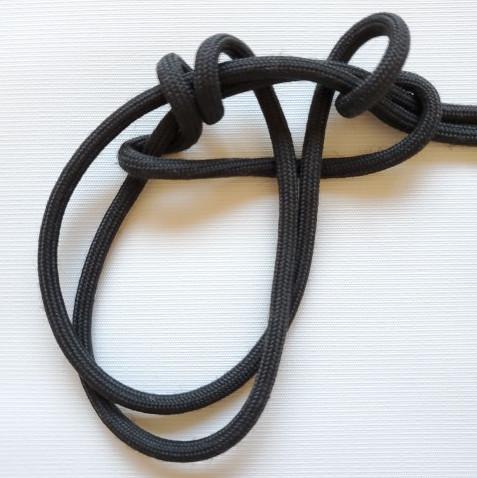
That failure that I mentioned earlier which seemed impossible snuck up on me again and this time I have a photo of it.
And this time I’m going to put more effort into understanding and fixing it.
The Alan Lee video is what I’m calling the straight forward method.
Maybe I’ll make a video of my method of winding the individual loops on the standing part. It’ll be at least a week before I can get it posted.