A New Binding Knot?

Here is what I believe to be an original binding knot. It seems such an obvious design, in retrospect, that I would not be too surprised to find it previously described. In either case, I’d like to advocate for the use of this binding knot, which is easy to tie, easy to remember, and works well in practice.

Naming
I originally thought of calling this the ‘Drawstring Knot’ for obvious reasons. In writing this description I decided to shorten its name to simply the ‘Draw Knot’, to emphasizes how smoothly it draws-up.
An alternative name might be the ‘Double Bind’, since the knot is based on the Clove Hitch, commonly referred to as a Double Hitch.

Purpose
I developed this knot with a specific goal in mind. I wanted a binding knot that could be tied in braided nylon rope that was easy to apply, would draw up easily, and have a ratchet like grip.

Ashley described the Constrictor Knot (#1249) as exhibiting these properties. He also described it as “one of the most difficult of knots to untie and is not suitable for rope unless the purpose is a permanent one.” Although that was true when working with the high-friction natural fiber ropes of Ashley’s day, when I tied the Constrictor Knot in braided nylon the lines slid past each other and the binding came apart.

Description
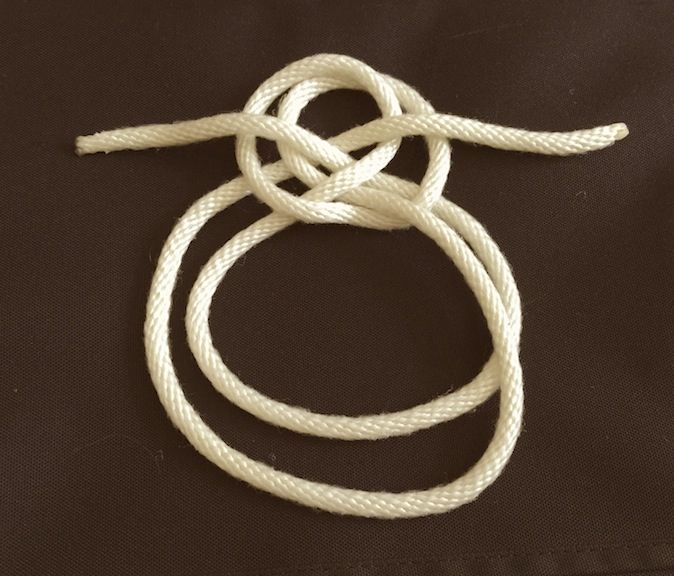
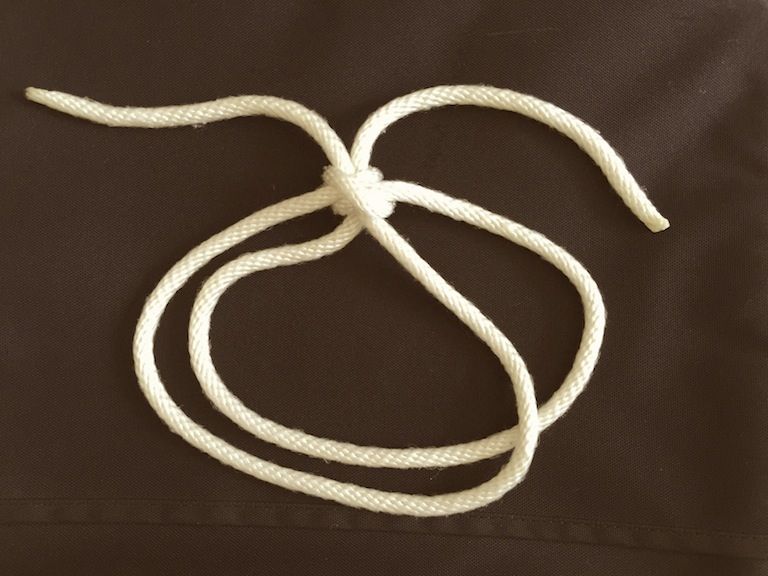
The Draw Knot has two levels of structure: (1) an embedded clove hitch that nips to seal the knot, and (2) the paired coils (interior sliding lines) that surround the bundle to be bound. The paired sliding lines extend from the clove hitch and loop back around in a circle to pass out though the clove hitch. The tension in the interior sliding lines compresses the clove hitch, tightening its nip.

See figure ‘1. Loose Basic Form’ below.

See figure ‘2. Tightened Basic Form’ below.

Self-Similarity: The clove hitch binds the coils that bind the bundle. The dual ‘coils’ of the clove hitch run in opposite directions around the sliding lines they tighten about, much like the dual coils of the sliding lines run in opposite directions around the bundle they tighten about.

Several Ways to Tie the Draw Knot

Tied In the Hand: The Draw Knot is stable when pre-tied and held in the hand. To do so, form a loose clove hitch in the middle of a cord. Lead the two free ends of the clove hitch in opposite directions, circling back to the cove hitch. Pass both free ends out in the same direction through the cove hitch. Then tighten the clove hitch around the two sliding ends. Adjust the circumference of the binding loops so that they can be dropped around the bundle to be bound. Pulling the two free ends in opposite directions closes the binding loop and further tightens the clove hitch about the two free ends.

To open the bind, take hold of both interior sliding lines, up near the clove hitch, and pull them out in opposite directions.

Tied Around a Bundle: The Draw Knot can easily be tied around a bundle. To do so, form a loose clove hitch around the thumb and index finger of your non-dominant hand. Push the loose clove hitch up close to the base of the thumb and index finger so they can open wide. Lead one of the free ends around the bundle and take hold of that end with the thumb and index finger of your non-dominant hand. Run the other free end in the opposite direction around the bundle and again take hold of that line with the thumb and index finger of your non-dominant hand. Pull both running lines out through the clove hitch and work the clove hitch closed around the lines. Then pull the exterior running lines to tighten the bind as desired.

The Draw Knot can also be described as either Two Half Hitches (formed as a clove hitch) or a Buntline Hitch that is ‘passed through twice’. You can loosely form either ‘cloven’ hitch, leaving a long working line and then run that line back around the bundle and rove it out through the clove hitch, in the same direction and parallel with the original ‘standing’ line. (In a Buntline Hitch the turns of the clove hitch progress towards the held object. With Two Half Hitches the turns of the clove hitch progress away from the object. Since the Draw Knot loops both lines from the clove hitch back around the object and out through the clove hitch, it doesn’t matter whether you start with a Buntline or Two Half Hitches; an identical Draw Knot results in either case.)

Tied in the Bight: You should first have a good understanding of the form the knot takes when tied in the hand, because that is the goal you will be working towards. To tie the Draw Knot in the bight, form a clove hitch near the middle of the available line. Push the bights of both lines exiting the hitch back though the clove hitch. (See figure ‘3. In the Bight’ below.) Then carefully turn the clove hitch inside out, adjusting portions to relieve unnecessary twists. Once this is done, arrange the lines directly exiting the clove hitch in opposite directions. The lines from the clove hitch should be formed into a pair of parallel circles running in opposite directions. Both lines exit running out in the same direction through the center of the clove hitch. Tighten the clove hitch and adjust the circumference of the binding loops as desired. Now the binding loops can be dropped around a bundle. Pull the free lines in opposite directions to tighten the bind.

How it Works
Pulling the sliding cords to close the bind applies tension to the clove hitch that in turn makes it nip the two sliding cords where they exit. If the tied bundle was completely rigid and static then the force applied to the sliding ends is lead around 360 degrees to compress the clove hitch. However, most bundles will be flexible and spring outwards when compressed and/or consist of elements that dynamically pull apart. Both of these provide additional forces to tension the clove hitch, on an as needed basis.

The clove hitch tends not to jam as it does in a Buntline Hitch because of the two evenly tensioned lines running through it. However, when the binding is pulled very tight around a bundle that flexes, it can be difficult to get hold of the two interior sliding lines to pull them out. If the bind is worked very tight and needs to be opened quickly, cut the free ends up close to the clove hitch and work the outer loop of the clove hitch over the remaining ends. (Or cut into the clove hitch itself.)

Properties

  • It’s stable when pre-tied and held in the hand.
  • It can easily be tied around a bundle.
  • It can be tied in the bight.
  • It closes and tightens when both free ends are pulled in opposite directions.
  • It does not close further when both free ends are pulled together in the same direction. You can lift a tied bundle by holding the two free ends together in hand. This aspect of its stability makes it easy to work with.
  • The sliding lines move with least resistance when they slide together in the same direction. This contributes to closing (and opening) the binding evenly on both sides.
  • It can bind a bundle as narrow as the cords used to tie the knot.
  • It can be used across an open space, for pulling two objects together.
  • It is very stable as long as a constant tension is applied to pull the loop apart (from the inside). However, it can loosen if the tension is repeatedly released and reapplied, since the clove hitch will not maintain its nip when the applied tension is eased. There are many ways to cease the knot. A fast way to cease the bind is to tie the two free ends into a Flat Overhand Bend, up close to the clove hitch.
  • As a ‘trick knot’ (“To tie up a Houdini” ABoK #2560) it looks like a normal binding knot, so a person unfamiliar the Draw Knot is likely to attempt to loosen the central clove hitch, which is has no loose ends.
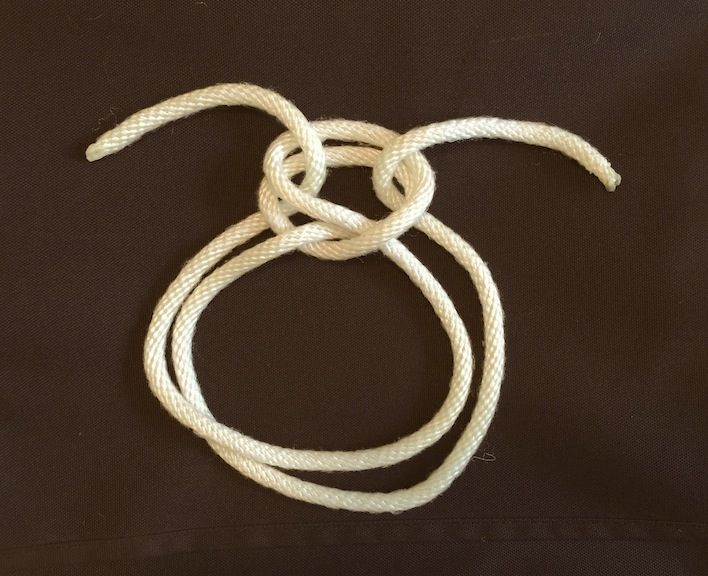
  • A drawback to the Draw Knot is that one can mistakenly pull the running ends back in the wrong direction, making a U-turn around the clove hitch instead of passing straight through it to the other side. (See figure ‘4. U-Turn’ below.) In this case the coils of the bind still close when the two free ends are pulled in opposite directions, but the sliding lines also tend to pull the clove hitch open from within, even while increasing the tension at either end of the clove hitch that would normally close it.

Application
I have tied the Draw Knot in braided nylon rope of different diameters for temporary binds. I’ve also tied the Draw Knot in waxed dental floss to provide a low profile, semi-permanent binding. It served reliably in all cases.

Derivation
The Draw Knot is probably closer to a Double Ring Knot (ABoK #1126, also called the Double Running Knot) than anything else. If you replace the Ring Hitch with a Clove Hitch and run the free lines around in their ‘preferred’ direction before passing them out through the clove hitch, the Draw Knot is formed.

Of course I tried many other closing loops including the Constrictor but it tends to loose its shape when surrounding something as narrow as a pair of cords. The Double Overhand Knot faired better, but it relied on the friction in the knot, rather than seizing down as tension was applied to its ends.

Compared to the Constrictor Knot
The Constrictor Knot is simpler, and more streamlined than the Draw Knot. The clove hitch at the closing of the Draw Knot makes it ‘knobby’. The Draw Knot is designed to hold better in braided nylon and other slippery synthetic fibers. The ends of a Constrictor Knot leave in parallel with the binding coils, while ends of a Draw Knot leave at right angles to the binding coils. I find it easier to remember how to tie the Draw Knot than the Constrictor, when used infrequently.

Compared to the Gleipnir Knot
See: http://igkt.net/sm/index.php?topic=1449.0
The single loop Gleipnir Knot is a very elegant and effective binding. Like the Draw Knot, the Gleipnir has its closing twisted loop (or half hitch) in the middle of the paired coils. Tension applied to by pulling the sliding lines apart is transmitted back around the coils to tighten the closing loop that nips the sliding lines to seal the bind.

The single loop Gleipnir is less stable than the Draw Knot under certain conditions: If the lines are unevenly loaded, such that the adjustable side sees even a little more load, the binding slips. Differential tension is applied to the lines to release the knot. If the free ends are not secured a tug on one of them may unseat the closing loop.

The clove hitch of the Draw Knot has more stability than a single loop. Thus it is tempting to compare the Draw Knot to a double loop Gleipnir, with its loops arranged in a half hitch. It appears to me that the clove hitch nips the sliding lines tighter when they run through at right angles to the outer lines of its hitches, then when the sliding lines run parallel to the outer lines of the clove hitch. (I don’t have either the theory or instrumentation at hand to prove this; it simply feels that way when I pull.)

Like the Gleipnir Knot:
(1) The Draw Knot can be used across a flat surface or in the open air such as when two pipes are separated and the closing loop tied in the middle. It can be used for lifting or for pulling two objects together.
(2) The Draw Knot binding can work loose when subjected to “intermittent slack and tightening such as a shifting load or something blowing in the wind.”
1. Loose Basic Form.jpg

2. Tightened Basic Form.jpg

4. U-Turn.jpg

Essentially, you do more : you show its arguable parent,
the Gleipnir, which was discovered previously by two
of us (if not more, yet to be known), and championed
by one to this forum and then gaining favor. Vice the
simple “turNip” you have a clove hitch; this variation
can be seen as reasonably obvious or natural to explore.
Or maybe a better parent would be the Piwick knot
or bull hitch.

Ashley described the [i]Constrictor Knot[/i] (#1249) as exhibiting these properties. He also described it as "[u]one of the most difficult of knots to untie and is not suitable for rope unless the purpose is a permanent one[/u]." Although that was true ...
... to some extent, and not so much as has been made of it, where the assertion "it must be cut" is parroted; in fact, in many cases, the [i]constrictor[/i] can be worked loose --the tails that make much of the binding lock are after all running pretty straight through the nipping area, and at least with tools (and cutting requires a tool) can often(usually?) be pried & pulled out. In some other cases, where the knot is used as whipping, one might find that time & whatever have loosened the "must-be-cut" knot!
... when working with the high-friction natural fiber ropes of Ashley's day, when I tied ... braided nylon the lines slid past each other and the binding came apart.
But here I must suspect that your binding was of some inappropriate (for the knot) object bundle : against a nice round & solid surface, there should be no such (easy) sliding of lines --the [i]constrictor[/i] isn't nothing!
it doesn't matter whether you start with a [i]Buntline[/i] or [i]Two Half Hitches;[/i] an identical Draw Knot results in either case.)
Although you take the ends around in opposite directions, and so it should matter --at least as far as "identical" is concerned, as there will be the difference in tail direction. (Note that there's interesting difference when using the [i]clove hitch[/i] in the [i]Gleipnir[/i] structure to reeving ends through it one way or the other, where the paired [i]half-hitches[/i] either pull away or towards each other --the latter case seems to make for a tighter hitch (as seen in some commercial-fishing knotting), but perhaps less [i]grip[/i]!?)

–dl*

I believe that the really “new” / original binding knot, was the ( great ) Gleipnir - and all the others ( mid-air binders or “tight hitches” ), based on various other, more complex and possibly more stable and tight nipping structures, are just variations on the same theme.

I would only remind two things :

  1. The two ends of a Gleipnir-like binder / tight hitch should better be “crossed” = twisted around each other, in an “elbow” configuration ( ABoK#35 ). When the nubs of those binders / tight hitches = the nipping structures themselves, are not symmetric, and/or when the possible ways they “sit” on the hard surface of a hitched object, and the ends enter into / exit from them, are not unique, we get even more versions. See, for example, the two versions of the “simple-hitch-a-la-Gleipnir” :

Version A :
http://igkt.net/sm/index.php?topic=2075.msg30227#msg30227
http://igkt.net/sm/index.php?topic=2075.msg30228#msg30228
Version B :
http://igkt.net/sm/index.php?topic=2075.msg30229#msg30229
http://igkt.net/sm/index.php?topic=2075.msg30230#msg30230

Also, the two variations of the Clove-hitch-based similar hitch :

http://igkt.net/sm/index.php?topic=2075.msg36748#msg36748
http://igkt.net/sm/index.php?topic=2075.msg36751#msg36751

  1. However, when those nipping structures are very tight ( as the Clove hitch is, when it is tied around elastic and compressible materials ), it may be better to “cross” the tails, and “lock” the knot more securely, after we have tensioned the wraps :
    http://igkt.net/sm/index.php?topic=4884.msg31968#msg31968

I believe that what you call the bull hitch is what Ashley called the double ring knot (ABoK #1126, also called the double running knot).

It’s more a matter of starting with one part and finishing with the other, versus starting with the other and finishing with the one. - Simply the order in which they are passed around & through.

Sorry, I should have made this clearer!

The fundamental difference between the Draw Knot and the Gleipnir is that:

  • With the Draw Knot the two exiting lines pass together in the same direction out through the closing hitches.
  • While with the Gleipnir family of Knots the two exiting lines pass in opposite directions out through the closing hitch(es).

That is the difference in form that makes such a difference in the functional handling properties of the two different kinds of knot.

You have made it very clear, by your clear text and pictures. My reply was about the Gleipnir ( and about some more stable/tight Gleipnir-like binders and “tight” hitches, based on other, more complex nipping structures - on the Clove hitch, for example ), because the Gleipnir was THE great new, original knot, which changed everything : In my opinion, all the binders and “tight” hitches that came after the Gleipnir ( and because of the arrival of the Gleipnir… ), are but a series of footnotes to the Gleipnir Idea. :slight_smile:
" No one will drive us from the paradise which the Gleipnir created for us ". :slight_smile:
From which side of the nipping structure do the ends enter-into or exit-from, may be important for the balance of a mid-air binder, or for the behaviour of the nub of the hitch during its pre-tensioning by the pulling of its ends against the pole, but, in general, it is only a secondary characteristic.
For hitches where the continuations of the ends both make clock-wise of counter-clockwise turns on the surface of the pole ( for which I use the adjective “Bull”, because they can be considered as enhancements of the Bull hitch ), see :
Bull Clove hitch
http://igkt.net/sm/index.php?topic=4748.0
Bull Overhand hitch
http://igkt.net/sm/index.php?topic=5250.msg34371#msg34371
Bull Pretzel hitch
http://igkt.net/sm/index.php?topic=5250.msg34395#msg34395
http://igkt.net/sm/index.php?topic=5250.msg34410#msg34410
Double Ring hitch ( ABoK#1126, which we could call Bull Cow/Girth hitch ), as you notice :
http://igkt.net/sm/index.php?topic=4748.msg31275#msg31275
http://igkt.net/sm/index.php?topic=4748.msg31771#msg31771

Which is preferable ?
http://igkt.net/sm/index.php?topic=5255

The goal was to provide a binding knot that “draws up easily, has a ratchet like grip and is secure” (ABoK 1249). It is intended to tie bundles that are flexible and spring outwards when compressed and/or consist of elements that dynamically pull apart. It appears that such knots can also serve as ‘mid-air binders’.

The essential single hitch Gleipnir Knot is very elegant and effective, but is known to be unstable when unevenly loaded or when its free ends are tugged in the wrong direction. As you’ve noted, complications may be added to the Gleipnir to make is quite stable and secure.

The basic form of the Draw Knot is inherently stable. It is very easy to form a clove hitch in hand; it is very fast to pull a pair of lines together in the same direction through an open clove hitch; and it is easy for a novice to remember how to do this with little practice. Those properties can come in handy when faced with tying an unwieldy bundle.

I am not arguing that the Draw Knot is fundamentally better than the family of Gleipnir Knots in some absolute or existential sense. I am arguing that it is a distinct knot with its own set of advantages and disadvantages.

Although functionally similar to the Gleipnir, structurally the Draw Knot has much in common with the Double Ring Knot, from which it was derived. Would you argue that a Ring Knot is just a variation of a Clove Hitch? As complication is added to turn a simple knot into a binding knot should we ignore the differences that make them different?

Perspective
If you look at it this way:

                             Closing Knot           Coils Run In                 Lines Exit In
                           ---------------     ------------------------    ------------------

Double Ring Knot : Ring Same Direction Same Direction
Draw Knot : Clove Hitch Opposite Direction Same Direction
Essential Gleipnir : Single Hitch Opposite Direction Opposite Direction
Stablized Gleipnir : Anything Goes Opposite Direction Opposite Direction

You could think that the Draw Knot has as much in common with the Gleipnir as it does with the Double Ring Knot.

But if you sought to classify the knots on this basis:

                           Closing Knot               Coils Run As                     Lines Exit In
                          ---------------     --------------------------      ----------------------

Double Ring Knot : Ring Leaving Closing Knot Same Direction
Draw Knot : Clove Hitch Leaving Closing Knot Same Direction
Essential Gleipnir : Single Hitch Leaving Closing Knot Opposite Direction
Stablized Gleipnir : Anything Goes Leaving Closing Knot Opposite Direction

You could think that the Draw Knot has more in common with the Double Ring Knot then the Gleipnir.

Would anyone like to argue that the Gleipnir is just a variation of the Double Ring Knot?
If not, how can anyone argue that the Draw Knot is just a variation of the Gleipnir?

I do not say that there is no difference in form, I say that there is no difference in structure : A nipping “tube” tied in the middle of the line, and the two Tail Ends immobilized / secured by being tucked through and nipped by this nipping “tube”. This is the essential ingredients of the Gleipnir Idea ! The way the ends are tucked ( through the same side or opposite sides ) is only of secondary importance. It turns out that if/when, as a nipping 'tube", we use a Clove hitch ( which is the first thing one would think of, if he would want to use a inherently more stable and self-locking nipping “tube” than a single or double nipping turn ), and if we tuck the ends through opposite sides, there is a “good” and a “bad” way to do this, because the pull of the ends tend to make the Clove hitch more compact, in the one case, and more elongated in the other - in fact, in the later case, they tend to tear the Clove hitch apart. This is more evident when we use the knot as a mid-air binder and not as a hitch, because the presence of the hard surface of the hitched object prevents the two parts of the Clove hitch to distance themselves from each other too much - as shown in :
http://igkt.net/sm/index.php?topic=2075.msg36751#msg36751
On the contrary, if/when we tuck both ends through the same side, because of the transversal structural symmetry of the Clove hitch, it makes no difference which particular side is the entry and which the exit one of each end.
However, when we use the Clove hitch as nipping “tube” of a Bull-like hitch ( instead of the double coil we use in the ordinary Bull hitch ), there is one functional advantage : When we tension the wraps, and we pull each end against the pole ( perpendicularly to its surface ) the one after the other, the previous pull by the one end does not influence negatively the next pull, by the other end - AND the nub itself of the Clove hitch is not “opened up”, torn apart, and become less able to nip the penetrating lines of the two ends. Those were the advantages of this one-side feeding / loading of the Clove hitch, utilized in the Bull Clove hitch.
In the case of the knot you show, there is no such advantage, because the knot is used as a mid-air binder. Moreover, I claim that the PROPER symmetric feeding / loading of the Clove hitch is preferable, because it enables the “crossing” of the Tail ends, their twisting around each other described in my first reply, which enhances the security of its nipping / immobilizing / self-locking action. Of course, one should tie the knot the PROPER way, because, if he ties it wrongly, he should not be surprized it will not work as expected ! :slight_smile: You say that :

MOST knots work less efficiently, and most of those do not work at all, if their free ends are tugged in the wrong direction ! :slight_smile: :slight_smile:

Let me attempt to draw a parallelism here between the Bull Clove hitch and the knot you show.
Read :
http://igkt.net/sm/index.php?topic=5258
where it is claimed that the Constrictor, the Strangle and the Transom, although different in form, are, essentially, the same knot : their structure are the same, they “work” the same way, only the different angles/orientations of their wraps make them look different.
Cut the four limbs of the Bull Clove hitch, some cms further away from the nub itself, and connect them the “other” way, to get the asymmetric Clove-hitch based mid-air binder you show.

Yet he does :slight_smile: :slight_smile: - and he does also argue that it is not even one of the best / most secures one - as is the symmetric Clove-hitch based one, where the ends are tucked through the proper opposite directions, shown at :
http://igkt.net/sm/index.php?topic=4884.msg31968#msg31968
When he argues that the Constrictor, the Strangle and the Transom are essentially/structurally the same knot, he would nt find it difficult to do the same with the Bull Clove hitch and the knot you show, or with the Bull Clove hitch, the Bull Pretzel hitch and the Double Ring hitch, or with the Bull Clove hitch and the great Gleipnir itself !
Some people prefer to notice and elaborate on the differences of things, some others to try to find out and concentrate on the similarities - it may be only a matter of taste ! :slight_smile: :slight_smile:

P.S. To get things straight, and leave no room to unintentional or intentional misunderstandings / misconceptions which blur the facts, the Gleipnir was invented by ONE, and one only, person :
http://igkt.net/sm/index.php?topic=1449.0
Many people could had invented it, many more would had wished they had invented it, some even imagine they had “introduced” it ( a recent, “new” term, suitable to some practical knot tyer s illusions of grandeur… :slight_smile: ), but the fact is that only ONE person invented it, tried it, used it, and then presented it in this Forum - and changed the not-so-important overall history of the sector of the practical knots that includes binders and hitches, as well as the totally-unimportant personal historiy of a handful of practical knot tyers ( including mine ).

As you stated earlier, I clearly delineated the structural difference. Of course you can redefine the structural definition of the Gleipnir to down play the distinction. If one defies a clove hitch as simply a pair of hitches then there is no difference in form between it and a ring knot; but that?s not the whole story!

It changes the form of the knot. It changes how the knot is tied. And it changes the functional properties of the knot. I do not understand how you can declare these as ?only of secondary importance?. Perhaps, one can love one particular thing so much that everything else is of secondary importance.

That is true for the Gleipnir but not for the Draw Knot.

This makes the Draw Knot more fool proof, an advantage that distinguishes it from the Gleipnir. Thank you for adding to my case.

The Draw Knot was designed serve as a binding knot, not a hitch.

Yes, but that is equally true for the essential one hitch Gleipnir. It does not diminish its beauty or practicality.

Once the Draw Knot is complete, tugging the free ends in any direction will only tighten the bind or have not effect. ? Another advantage for this binder.

Since you can cut a clove hitch and turn it into a ring knot are they essentially the same knot?

The Draw Knot is not a Gleipnir, for it was forged from the gold of the Double Ring Knot. While it courses out through the middle of its closure, the fine Gleipnir flanks and pincers through the sides of its closing hitches.
It is time to free your mind from the Gleipnir as Fenrir is freed from it at Ragnarok. When the dust settles and the Bifrost falls the practical virtues of the Draw Knot will become known to future generations of the tiers of knots.

Had I followed the natural course of elaborating on the essential Gleipnir, I too would have experimented with different arrangements of hitches to better nip and tuck about the passing closing lines. If the Draw Knot were an obvious variation of the Gleipnir you would have seen versions with both free end extending from the central closing hitch, but there were no such cases.

The Draw Knot derives from replacing the ring knot of a Double Ring Knot with a clove hitch to derive a new knot that turns out to exhibit many of the functional properties of the Gleipnir family of knots. This is reminiscent of convergent evolution: the independent evolution of functionally similar features in different lineages. The fundamental structural difference between the Draw Knot & Gleipnir makes this clearly evident.

The Gleipnir was the great liberator of the minds of the knot tyers ( at least of the minds of those knot tyers who utilize their minds - because, to tie a knot, a small portion of parroting is always enough :slight_smile: ). Your variation, as well as the dozens tied by other members in this Forum, would had not existed if the Gleipnir has not been not invented. It has already established its position on the Pantheon of great knots, for the benefit of this and future generations of knot tyers, as you say - not only because of what it is by itself, but mainly because of how it helped us to “see” in a more clear way even well-known ancient knots ( the bowline and the Sheepshank, for example ), and of the many similar binders and hitches it encumbered.

To me, there in no “fundamental” structural difference in all those Gleipnir variations whatsoever - however, evidently, if you wish to see that there is so much, at the very end you will manage to do so ! :slight_smile:
When I had tied the Bull Clove hitch, I thought that it was an evolution of the Bull hitch, exactly as you do now, when you think that the asymmetric Gleipnir variation you show is an evolution of the Double Ring hitch. The same could be said for the Bull Pretzel hitch, which also was tied in the course of a search for another, not Gleipnir-like knot. However, because I have been in this Gleipnir-inspired binders and tight hitches production line for some years now :), I know that this was only a superficial similitude. I would nt have been able to think that the Bull hitch could had been improved by the use of the Clove hitch, if I had not tied the ( symmetric ) Clove-hitch based binder before, and the “simple hitch-a-la-Gleipnir” before that… ( The same is true for Dan Lehman s Gleipnir-like binders, of course, even if I am not so sure that he will/can ever acknowledge that as I do :slight_smile: )
It is perhaps interesting that the creator of the Gleipnir himself though that his knot was a variation of the Constrictor ( ! ! ! ) Noope - he was just lucky and brave enough to visit a previously unchartered territory of the KnotLand, and after he saw the Gleipnir, he wished to “connect” it with some other already established knots, just as a means of an easy orientation into the unknown area.
The great knots, just like the great ideas, are not variations of anything - they may have roots in many different things, but their creation has an element of emergence out of nothing. Less original things are derived from them, they do not converge to them !
People that had NOT understood what a Gleipnir is, will never understand what I am talking about. ( The same happens with the Zeppelin knot, but that is another story ). Even a knot tyer who himself has tied a Bull-Clove-hitch-like hitch ( the much advertised and sold " Estar hitch " ), has never understood that his hitch is different ( and inferior ) from the Bull Clove hitch, why it is different ( and inferior ), and how it works ! He will, for ever, remain with the false impression that it is a development of the Buntline hitch, he will also, for ever, keep tying it in-the-end like a re-tucked Buntline hitch and not as a TIB Clove-hitch based Bull hitch, and he will never understand why it works ( as much as it works… ). It is eye-opening how easily one can miss the essential elements, which are just under his nose, and concentrate on the distant secondary characteristics of everything… Perhaps this is what the “market” demands :slight_smile: : product differentiation, even in the most skin-deep, superficial way (1).
As I said, this attitude is not my cup of tea : I tend to want and try to “see” the essential, primary similarities rather than superficial, secondary differences, and that is why I had replied as I did. It may be only a matter of taste :slight_smile: ( although I doubt it…).

Anyway, long live the asymmetric Clove-hitch based Gleipnir you show ! :slight_smile: :slight_smile:

  1. https://en.wikipedia.org/wiki/Product_differentiation

No, it is exactly the other way around ! It is you who define the structural characteristics of the Gleipnir in a very narrow way - and this exaggerates the distinction you want to “see” so much between the various Gleipnir variations, of course… :slight_smile:

By “form”, you mean the geometric shape of the knot, which is not the only thing, or the most important thing, that determines the structure of the knot, the way the knot “works”. The structure of the knot is based on the ends which are constricted, and immobilized, by a middle-line nipping structure ( be it a double nipping loop, a Clove hitch, a Constrictor, etc…). The way the ends penetrate this nipping structure, the “nipping tube”, is secondary : they may enter and exit through the same side, or not. If they do not disturb the overall balance of the knot in mid-air, there is no structural difference.
Any knot which is somehow different, geometrically, than another, can also ne tied differently - this is no big deal either ! The way a knot is tied ( if it is not veeery easy and quick, or the exact opposite ), is not of much importance in the evaluation of a knot. And you should not forget that any knot can be tied in maaany ways, many more than you can think of !
Now, you have fallen into the trap of your rhetoric in an amusing way, indeed ! :slight_smile: :slight_smile: WHO exactly has more chances to “love one particular thing so much that everything else seems of secondary, only, importance to him” (sic)? You, the proud “father” of a knot, as you believe you are of this particular variation the “virtues” of which "will become known to future generations of the tiers of knots - or me, who is just a humble producer of second-class Gleipnir variations, none of which will ever come close to the greatness of the original knot ?

Noope ! It only means that there is one, only, variation of the Clove-hitch based Gleipnir, which, as a mid-air binder, tends to become too elongated. The asymmetric Clove-hitch variation you show does not, but this is a virtue of the parent knot, of the Gleipnir, which has more than one “good” variations, not of the good variations ! :slight_smile: :slight_smile:

Sorry, you had not understood the similarity with the case of the Constrictor/Strangle?Transom, but that perhaps was my fault. Yes, those three knots are essentially the same knot : two-wrap hitches which “work” because the critical, regarding friction,“crossing”/twisting/embracing of their tails is squeezed under the diagonal riding turn, in between it and the hard surface of the hitched object., so friction is multiplied. Yes, those two hitches, the Bull Clove hitch and the asymmetric Clove-hitch Gleipnir variation you show are essentially the same knot. The two limbs of the Clove hitch can point to the same direction ( as they do in the case of the Bull Clove hitch ), or to opposite directions, as they do in the asymmetric Gleipnir variation you show, but this changes nothing, regarding the structure of the knot. The angle the ends leave a Clove hitch is only of secondary importance. Do you believe that a Clove hitch where this angle is 60 degrees, and one where it is 90 degrees, work differently ? That they have “different functional characteristics” ? That they are a different knot ? :slight_smile: :slight_smile: The Clove hitch is a Clove hitch is a Clove hitch, in both knots - and the ends, since you pay sooo much attention to it, both enter into and exit from the nub through the same side.

That’s simply not the case, since I invented the Draw Knot over twenty years ago, although I published it just yesterday.

I have a great deal of respect for the Gleipnir family of knots. There is a lot to be learnt from it, but please keep learning new things from new and different knots.

If you look at the world through rose-colored glasses then nearly everything looks rose colored.

The Draw Knot is not topologically equivalent to the Gleipnir, and it is not an embellishment to the Gleipnir since nothing is added to the Gleipnir to create the Draw Knot. It has a different form; its tied in a different way; and although it can perform some functions in common with the Gleipnir it has many distinct handling properties.

It is not legitimate to say that two knots have “no ‘fundamental’ structural difference” if only you run the lines through them in different ways!
One could then claim that all knots formed of two hitches are structurally equivalent, but that is simply not the case.

Does the community of knot tyers have any rigorous way of determining if two knots are structurally equivalent, or is it just a matter of opinion?

You really ought to go back to the paragraph you took those words from and consider how seriously it was being presented:

Saying “Noope ! It only means that” does not alter the fact that this makes the Draw Knot more fool proof.

Running the two lines surrounding the bundle in different directions changes how the knot is FORMED around the bundle. This in turn, transforms the Bull Clove HITCH into an effective BINDING knot, with some of the functional qualities found in the Gleipnir family of knots. If this was described before I presented the Draw Knot, please give me a citation to it.

Is your concept of “no ‘fundamental’ structural difference” transitive?

If so, given that:
You are arguing that there is no ‘fundamental’ structural difference between the Draw Knot and the Gleipnir family of knots.
And you are arguing that there is no ‘fundamental’ structural difference between the Draw Knot and the Bull Clove hitch.

Implies that there is no ‘fundamental’ structural difference between the Bull Clove hitch and the Gleipnir family of knots.

I doubt that we can really learn new things from every new and different knot we happen to tie… We can, and we do gain experience, and dexterity, and familiarity with convoluted paths in 3D space with which our brains are not accustomed to deal - but we can not / do not learn new things. I have not learned anything new from the asymmetric Clove-hitch based Gleipnir you show that I had not already known, and I believe I am no exception on this.
The great knots, are the knots that are but the implementation, in its most pure form, of a general knotting idea. Those are the knots that can teach us new things - in just a few days after I think that I had learned something from a common knot, I realize that what I learned was already present, in a much more clear and genuine form, in one of the great knots, but I had not paid the required attention to it. Learn from the masters - and learn from the great knots ! :slight_smile:

Topological equivalence has nothing to do with two practical knots having the same structure, working the same way, playing the same role, doing the same job, etc.

Nothing … except a second nipping loop, connected to the first with the help of the Clove hitch s riding turn ! :slight_smile:
See it the other way : Since something can be subtracted from the knot you show, and what will be left will be the Gleipnir, the Gleipnir is the fundamental knot where this particular variation of the Gleipnir is based.

Completely irrelevant things, regarding the similarity / identity of two knots, the way they “work”, their structural idea.

It can perform ALL the functions a Gleipnir performs - and nothing else ! :slight_smile: :slight_smile:
It may be more tight or stable, as we should had expected from the use of the Clove hitch ( which is a very tight, self-locking knot when it is tied around compressible and elastic materials ), but that remains to be proven experimentally.
However, the “many distinct handling properties”(sic) are just another way for you to tell that you are in love with your brain child, and nothing else, I am afraid.
The symmetric Clove-hitch-based Gleipnir, on which it seems you do not wish to refer, does everything the asymmetric does, and better : because the tails can be twisted around each other, in an ABoK#34 arrangement, and this multiplies the friction forces between them, as we all know since the invention of the Reef family of knots ! :slight_smile:

Strictly speaking, the “ways” are identical, and only one - the directions the ends enter and exit are different, but the way their segment which are encircled into the “nipping tube” are gripped and immobilized, is the same. In a “toggled bend” we were talking about recently, for example, you can pass the toggle from the any one side to the other, without changing the structure of the knot.

No, this “community”, if it exists, has not any such rigorous way to determine the “structural equivalence” of two knots - for the simple reason it has no rigorous way to determine any-thing ! :slight_smile: And it may be the case that it is not even a matter of opinion, but a matter of definition. -
However, speaking about me, I am pretty sure that two knots I see as equivalent, are equivalent ! This knot is an asymmetric Clove-hitch based Gleipnir binder, very similar, and, most probably, inferior, to the symmetric one. It is the exact opposite I am afraid of : two knots that look different to me, but they are nothing but the same thing, into a different package… :slight_smile:

Last thing: A mid-air binder is self-locking, by definition. This means that both ends, the “Standing” and the “Tail” end are immobilized and secured in/by the nub of the binder : precisely this is what characterizes a 'tight hitch" as well . There is no other difference - except the fact that, in some cases, the interaction between the hard surface of the hitched object and the nipping nub of the knot plays some positive role in how tight the nub can become after some pre-tensioning. ( Also, as I have mentioned in passing, the binders utilizing same-direction wraps can be transformed into “Tackled” hitches ).

Now, how the direction the lines of the wraps turn around the object ( both clockwise or counter-clockwise, or the one clockwise and the other counter-clockwise )does not matter in the integrity of the binder. It may alter the way you form the knot in the first place ( although I do not see why this is so important ), but it does not alter the way the knot works. In general, there are two different classes of binders : The binders where the multiple wraps form a single multi-line loop, and the handcuff-type binders, where we have two loops connected in the “middle”, by the nub of the binder.
http://igkt.net/sm/index.php?topic=4821.msg32017#msg32017
In the past, I, too, had tried to make a distinction between binders belonging to the one or the other class, as you do, but I had soon realized that this was an artificial, too narrow and perhaps myopic distinction :
http://igkt.net/sm/index.php?topic=5014
So, I do not blame you when you try to distinguish 50 shades of grey… :slight_smile:

There is not. :slight_smile:

Try to “feel” the knot, as if you were a small creature crawling inside the lines, and “eating” tensile forces as you proceed forward.
All those differences we see are secondary : There is a nipping structure, a whatever nipping structure, tensioned by the two limbs/lines, which, in their turn, and after some binding or hitching action around something, return to the place where they were born, and die there … :slight_smile:
For just another essentially Gleipnir-like binder, see :
http://igkt.net/sm/index.php?topic=4819.0

I guess you were already aware of the connections between the Gleipnir & Bull hitches.
If you look into the Draw Knot, you might find a family of Draw Knots.
You seem to be the exception in terms of being the primary person engaging me in a dialogue. - Thank you for that.

Structurally that simply isn’t true: If you take one of the lines out of the closing clove hitch and don’t reinsert it any where else, you do not get a Gleipnir.

I think that what you mean is that in the way you’ve learned to think about knots you associate your concept of the Draw Knot “with something subtracted” with your notion of the Gleipnir. The way you’ve learned to think about knots clearly has merit because you’ve devised a lot of neat new designs based on it.

The term ‘structure’ is generally synonymous with ‘form’. I think that what you mean here by “their structural idea” is how their form gives rise to their function. But you seem to factor out that different forms may produce some functions in common, mixed in with some other different functions.

You consistently discount whatever distinct handling properties I mention. You seem to be fixated on the ‘mechanics’ of knots.
You do not seem concerned about the ‘user interface’ aspect of knots:

  • How easy it is to tie?
  • How fast it is to tie?
  • How fast & easy it is to tie around awkward or unwieldy bundles?
  • How easy it is for a novice to learn to tie?
  • How memorable it is, when infrequently applied?
    Those aspects have a big impact on the practical application of a binding knot. Ashley did not ignore such properties. How can you, without acknowledging that your concern for what makes a knot ‘practical’ is rather limited.

Strictly speaking if the lines run in different ways, as in: “the directions the ends enter and exit are different” then they are not identical.

Again, you seem to be operating in some higher-level conceptual space were you decide what is similar and then declare that things that you consider as similar to be equivalent. I don’t really trust you to take every relevant factor into account. Every representational system has biases.

Pity. The field would benefit from a well thought out taxonomy. Balancing form, function, practical use, and lineage would be a real chore. It would make one hell of a dissertation topic, but what field today would support such research into organizing the field of practical knots? Is their anything beyond ABoK that comes close to providing a general taxonomy of practical knots?

That makes no sense whatsoever to me.

  • The Double Ring hitch and the Bull Clove hitch are examples where the lines of the wraps turn around the bundle in the same direction. When tied in braided nylon they will not hold when pushed apart from within by the dynamic bundle that they are meant to bind.
  • The Gleipnir and Draw Knot are examples where the lines of the wraps turn around the bundle in opposite directions. When tied in braided nylon they will hold when pushed apart from within by the dynamic bundle that they bind.
  • So how can you claim that the direction the lines of the wraps turn around the object does not matter in the integrity of the binder? What do you mean by: “the integrity of the binder”?

There you go again, readjusting your definition to reinforce your current point of view. Yes, there are good insights in that posting, but its really more of a collection of design principles relating to Gleipnir-like constructs than part of an objective classification scheme.

I cannot interpret your response: “There is not.”
Does it mean: There is not a ‘fundamental’ structural difference between the Bull Clove hitch and the Gleipnir family of knots?
Or does it mean: There is not such an implication?

If you believe that there is no ‘fundamental’ structural difference between the Bull Clove hitch and the Gleipnir family of knots, then you would have to deny that the Gleipnir represented a new knot, since the family of Bull hitches predated it.

If you believe that the Bull Clove hitch and the Gleipnir family of knots are ‘fundamentally’ structurally different, then please note that the Draw Knot is closer in FORM to the Bull Clove hitch than the Gleipnir.