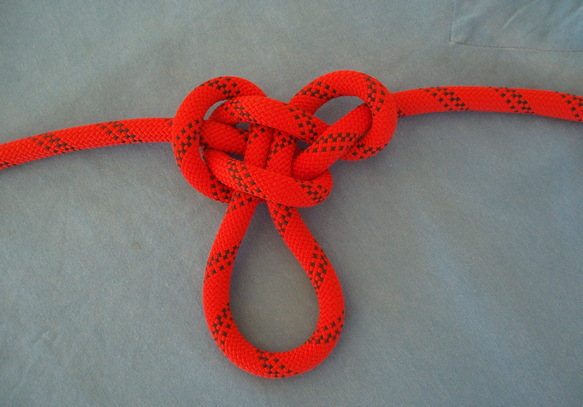
A practical, end of line, design topology of 1053 butterfly(single loop,Spanish)

At first, it was tied as a bowline, following on with the structure demonstrated here, Link : https://igkt.net/sm/index.php?topic=6622.msg45964#msg45964.

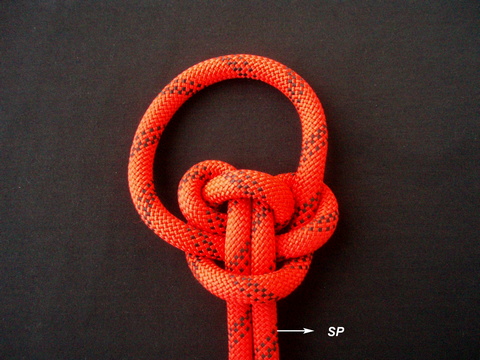
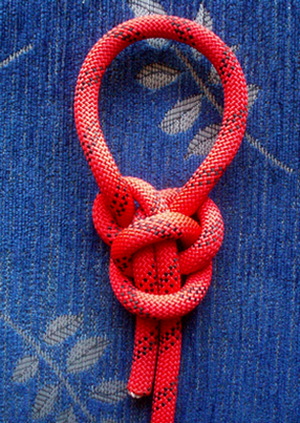
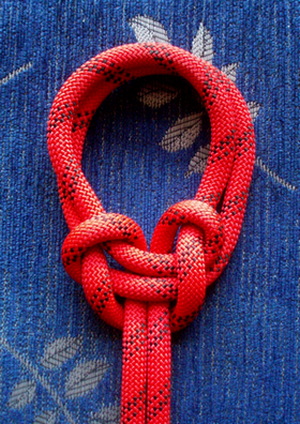
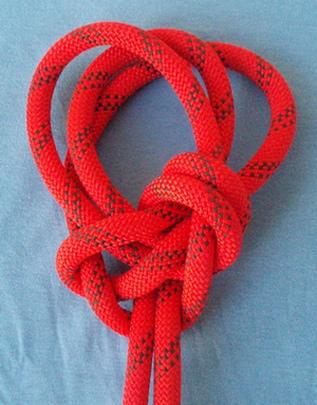
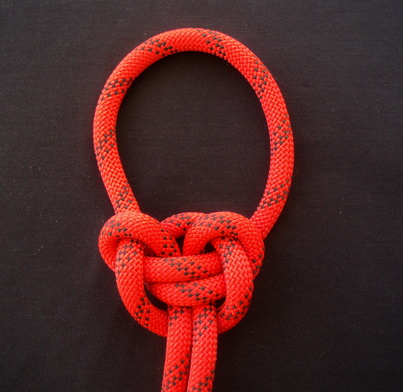
When it caught Xarax’s attention, it surely felt his magic touch, taking the final and more compact geometrical form of enhanced 1051, as shown in the first two images (for the bowline mentioned previously, just cross the two ends to get a more entangled form).

My first reaction was like, " Ok, let’s put the bowline aside for now, and focus on this elevated beauty".

What i surprisingly discovered later, was its topological equivalence with Mobius butterfly’s dressing, as well as with the other, end of line (or midline), butterfly profiles by extension.

The Mobius tresse is not depicted, but it can be easily revealed by pulling the collar, collapsing the eye at the same time and vice versa (first image).

Question 1 Since this is not a beauty contest, is this a more practical, end of line design approach, which may outplace the more conventional but more prone to jamming, end termination butterfly profiles?

From my point of view, it certainly doesn’t lack of stabillity security and compactness, being also rather easy to tie and inspect, with half of butterfly’s complexity and a more pliable nub. One butterfly’s overhand has been overridden from the nipping system, while the other one has been pushed to the last stages of the collar structure level, where less tension is expected.

Well, as a drawback, butterfly’s pseudo symmetry is being lost, along with the EEL ability, (this justifies the first and second depiction, which discriminates the two ends, as i wouldn’t be confident to load it from the tail end), but we end up with a very elegant but a bit bulky knot.

Question 2 Has anyone tied it before, and can we really override the other “not so harmful” butterfly’s overhand, and recover also the EEL quality?

Here comes the best part of this thread …

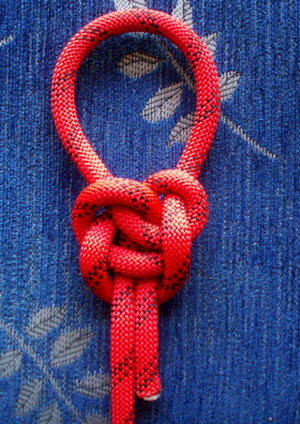
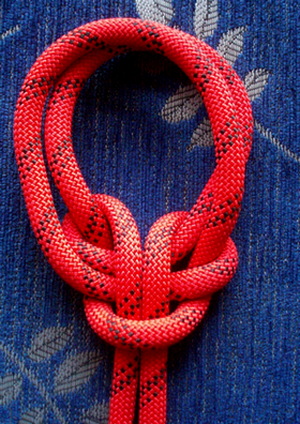
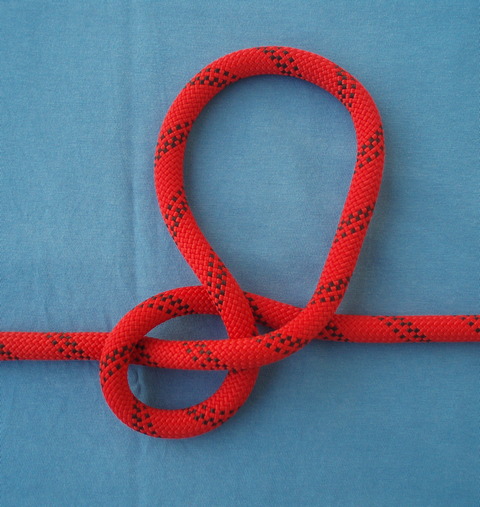
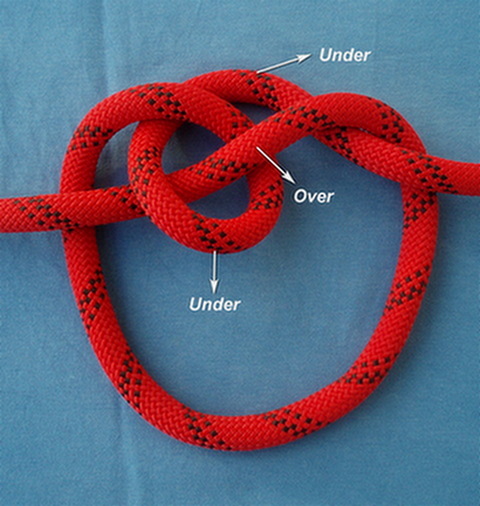
Knotsaver, is authorised as of now, to answer positively to that question, because he developed three years ago, a very stable and powerful Spanish bowline variation, (third, fourth image), so by definition he has tied all single loop, shrunk, derivative states too.

Verily, starting from the first image structure, one may gradually pull the collar and its link/myrtle continuation, to create the second eye of the final, butterfly equivalent, double spanish twisted EEL topology, with this smart transformation.

It appears, that the butterfly’s transfomation sequence, has been enhanced with two additional, decent knots, and what a great transformation video would have made, if only would have caught Mr. Lee’s attention.

Edit note … Thanks to knotsaver again, who has located an older appearence of an all but similar, portuguesse like variation, as far back as in 2016, developed by Alan Lee (second image, Lee’s double knot V2)

Link : https://igkt.net/sm/index.php?topic=5694.msg38738#msg38738
The other, single loop shrunk, derivative, spanish state is formed by collapsing the other Spanish eye. The rightmost end, is designated to be the SPart (first image).

You get a more conventional butterfly scheme py pulling the collar, while pulling the other line (first image), you get a spanish tresse with parallel lines within the nub (third, fourth image), appropriate for anchor systems.


I couldn’t possibly ignore the analog, false butterfly, profile states, giving it some extra credit, where credit’s due and restore its reputation.

It might be good to form the bowline in this case, by adding a second rope diameter into the nipping loop, enhancing its friction.

The result is a multiple state, polymorphic versatile knot.


A false butterfly based bowline mentioned previously, has been attached, in order to add more friction/stability by adding a second rope diameter in the nipping loop, along with the spanish bowline structure, derived from the same previous false butterfly profiles.


A combination of double and spanish bowline techniques at the opening post’s knot (enhanced 1051 collar butterfly
), for a triple eyeknot bowline derivative, with efficient rope usage.


It would be interesting to deviate a little from the thread’s main theme, and investigate how some of the previous, end of line knot structures, reshape their nubs to form the corresponding inline profiles.

For a start, i describe a TIB tying method for a midline derivative of the first structure (enhanced 1051 collared butterfly).

  1. Form a twisted crossing knot (first image).

  2. Flip the crossing knot’s bight under the main line (second imageNote the resemblance with butterfly's tying method, which includes just a flipped crossing knot).

  3. Pass the bight, under the small loop, over the crossing area, under the continuation of the rightmost Spart (second image).

  4. Complete knots in a loose form in third,fourth image.

It appears that the crossing area, firmly secures the eye, and it also appears that one TL profile (loading the knot from simple Spart and the eye), is a quite stable loading option, with the less possible deformation.

However, whatever loading profile is chosen, it usually involves eye tension, hence the overhand is directly activated and possiblly affects the jam resistance.


Thanks tsik_lestat,
Your presentation at reply #5 will distort under heavy ‘BTL’ loading profile (biaxial through loading).

Eye loading appears to be okay in one axial direction but, not so good in the opposite axial direction.
It has similarity to the ‘Cask’ knot - which also distorts under heavy loading.

The #1053 Butterfly does not suffer from this type of distortion in a ‘BTL’ loading profile - because both SParts turn around the central eye legs.
In your latest presentation, the SParts don’t arc around the eye legs - the load pathway is quite unbalanced.

EDIT NOTE:
Can you try to perform a load test on your latest presentation?
You don’t need a load cell…you could try body weight (bounce your body weight on the knot) - or, if you can - use mechanical advantage to generate more force.

Thanks agent_smith for giving it a try, we almost have the same point of view for this structure, although i do not make out any similarity with the cask knot (more symmetry - no overhands).

I’m always on the hunt for the ultimate structure, but a compact and tidy knot scheme, does not always correspond functionally to the perfect knot. Midlines are generally tough to design, because most of its components engage in the loading process.

I need to ask about the practicality of the BTL profile, besides the isolation of a damaged rope section and how it can be tested (i mean, one has to tie eyeknots to anchor both SParts, which brings on more rope strength attenuation).

With respect to load testing, i usually work with small diameter, low MBS, el cheapo ropes, with body weight or mechanichal advantage, in order to approximate “the heavy loading” and get a picture about the knot’s response (see where the knot goes), but i haven’t performed any testing to these structures yet.

However, even if it features some good aspects, this is not the only inline structure, associated with my initial, end of line presentation.

Verily, performing some nub transformations which i find hard to capture, one may alternate between first image’s end of line and inline configurations.

Note, that in this case, i’m confident to claim that these are genuine equivalent knots, because they do not involve eye manipulation.

I believe, this time SParts do arc around both eyelegs for a more balanced load pathway, plus the overhand, takes the form of a crossing knot +nipping turn, which is a better option for the jamming profile.

Nonetheless, besides its better BTL profile, the crossing area appears to multiply the friction, so it needs testing to confirm its jam resistance.

TIB tying method is on its way…


                                                             Bull butterfly hitch

The spanish bowline formation (thanks to Knotsaver), was a smart transformation maneuver to override the second buttefly’s overhand and recover the EEL quality.

Another way to accomplish this, directly from original post’s first image structure, with a couple of extra different pulls, is demonstrated here (apparently i 've added some extra legends/first image).

Firstly, just pull the on going eye leg to collapse the nipping loop and create the first eye/wrap (adjust its size).
The next step is to pull up the other end to create the second eye.

So simple, aesthetic and functional at the same time, with the Mobius tresse that i have chosen to dress it.

  1. Can i use the butterfly moniker to describe the knot?

I believe i can, because the TIB knot structure tied around the two parallel SParts(hitch’s neck) points to butterfly nipping structure(pull the two SPs out of the knot to find out).

Moreover, one can certainly reveal the butterfly knot, by performing some eye manipulation maneuvers to this hitch and vice verca.

  1. Why do i show it in this flat view?

Besides the clear and sharp angle of all rope components (i ,for example, have difficulties to guess all rope routings hiding behind spars and poles), it appears that it is feasible to get two results, which depends on how you are closing the two wraps (like you are closing a book or the opposite way), just before you insert an object through them.

I prefer the closing like a book style, directly from the third image structure, as it keeps the hitching knot around the SPs, solid, with the less possible distortion.

This thread, in its entirety, demonstrates how versatile aTIB knot is, with all these genuine derivative profiles, directly from Queen butterfly.

Can we really exploit TIB eyeknots to develop TIB hitches as well?