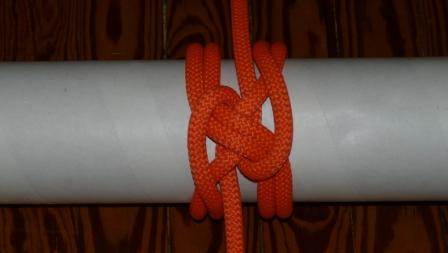
A simple hitch "a la Gleipnir "
Now that really is a surprise.
Time for more playing.
Derek
Very nice. I can put that to good use. Tony
So pretty! I think it should be in the “Fancy and Decorative Knotwork” Forum. LOL
I like this one and am going to put it to work right now.
Thanks
Scott
I’m going to have to give this one a thumbs down. The hitch started rolling for me at higher load.
While the independence re nipping from the bound object is indeed
an nice attribute (or so it seems --it might also be unneeded),
what practical situations do you see for this? (The impromptu decoration
of a hat rack is --as a wife might quickly advise you-- hardly a beneficial function.)
As I pointed out in the Gleipnir OP, the need for effectively long tails
for this knot makes it rather INefficient in material consumption (tails
once drawn tight are unneeded, but there they are --one that leads to
e.g. a spool of material can be cut away efficiently, but not the other).
We can also add one more turn to the nipping loop, turning it into a nipping "tube", in an affort to increase the friction on the working ends/tails. See the attached picture(s).
I, too, thought this (and thought I found this) to be a way to increase
nipping security; but I’m not so sure of that, now. Consider that whatever
added tension is managed to be delivered around the wrapping by hauling
on the ends --one of the other problems with this knot (as well as others)–
gets amortized over the length of material in the “tube” : if there are two
turns, then the Xcm of draw is divided across the turns, instead of being
concentrated in tightening the single turn. (Then come the calculations
of resulting friction with greater pressure vs. greater surface area pressed!)
–dl*
I think this was the knot Xarax posted. A round turn Gleipnir?
How tight you can make it depends on the object and rope you are using. In some conditions it’s possible to make it tighter than even a double constrictor. Thin rope or twine seems to be preferred. Avoid situations where the object might put pressure on the knot (the knot prefers to be “flying”).
To make the knot secure, you should finish it off with either a half hitch or a reef knot, otherwise the knot might become untied if you are pulling one of the legs.
Forget about this one. You have two legs to pull to untie the knot. If you finish the knot off with a half hitch, you’ll only lock one of the legs and are able to untie the Gleipnir by pulling the other leg. Use the reef knot to lock both legs and make the knot secure!
Another use of the “simple hitch, a la Gleipnir” that I have presented in this thread, on friction hitches. See attached pictures, for a modified Well Pipe hitch (ABoK#504), in two slightly different variations, A and B . The same mechanism can be applied to many other similar, but more complex, friction hitches, and climbing hitches as well. This mechanism keeps the whole knot under some tension, so the upper coils do not run the danger of getting loose and release the rest. After the hitch has been tightened, it can be further secured by two half hitches - as in the Well pipe hitch - but on the section of the working end before it reaches the Gleipnir knot.
Warning ! At those pictures, I have not tied and shown how the tail can be secured further.
Thank you knot4u,
I suppose that the ability for this hitch to hold should depend, to a degree, of how much we tighten it by pulling the tail, as well as the standing end. I can not say if it holds much better when we fully tighten it, (as we might expect ), or not. Is it much better to have our coils absolutely perpendicular to the pole s axis, each in a perfect circular shape, or they can be inclined, just a little, in a somehow ellipsoid shape ?
Thank you, knot4u,
Yes, I have replaced the pole with a rope, too. My thoughts are the following:
In the case of a climbing hitch, there are many other things that count in its evaluation, besides its gripping power. The matter is complex, and I am by no means qualified to speak about it. Also, due to the obvious dangers an inappropriate hitch can impose on the climber, I dare make no comments, let alone suggestions, for the use of such a hitch for climbing purposes. But we can speak here about the quality of this hitch,for general use.
My opinion is that no hitch that is based upon nipping wraps around a vertical rope, ( ANY number of such wraps ), can be more secure than a hitch that involves other, more efficient types of friction mechanisms (2). In particular, a : the mechanism that involves rope embraces/twists, ( like the one we have in the Reef family of bends, the Surgeon knot, etc.), and/or b: the mechanism that keeps one “warp yarn” secured into/ in between, the filling/the adjacent “weft yarns”, of the fabric. ( More on this last, but not least, mechanism, in a future thread)(2). My post about the 8-nooses (1), was the result of this ongoing investigation on friction hitches around ropes. The fact that the Gleipnir hitch can tighten the two ends of the coiled rope in a most effective way, can not help beyond a certain point. In this case, where we replace the pole with a rope, the “coil tube” itself can not be sufficiently long - because we can not tighten the two ends of such a soft tube without running the danger of deforming its straight cylindrical shape.
So, I, from my part, have abandoned this class of friction hitches on vertically hang ropes, and I try to device hitches based upon the other friction mechanisms I have hinted above. I suggest that you start a new thread, on climbing hitches and/or “best hitches around a vertically hanged rope” :), for a discussion and comparison of various established and newer solutions to this “ancient” - but always very interesting - knot problem..
Your exposition about the circular-vs-ellipsoid collars was very lucid and helpful for me, indeed. This hitch we are talking about here can be tied in two slightly different variations, the A and the B, shown in the pictures I had posted. Have you tried both of them ? Have you measured any noticeable differences ?
Me too ! ( But with the reverse order… :)) I was talkng about friction hitches around ropes, not vertical poles, on the text cited above.The situation of hitches around ropes is quite different, as I will explain in a future post (1). I am sorry for any misunderstanding due to my wording.
What an astonishing binder the simple hitch is!
As well as binding as well as, if not more tightly than, the constrictor knot, it appears to bind as well on rectangular and other cross sections as on round ones.
I took my own photos because I’m going to have my own web page on this knot, and for unambguous reference. It certainly doesn’t have any superiority in documenting the knot over xarax’s photos.
Is “Gleipner” its name? I would hope for something more memorably idiomatic for what is likely to be an important knot.
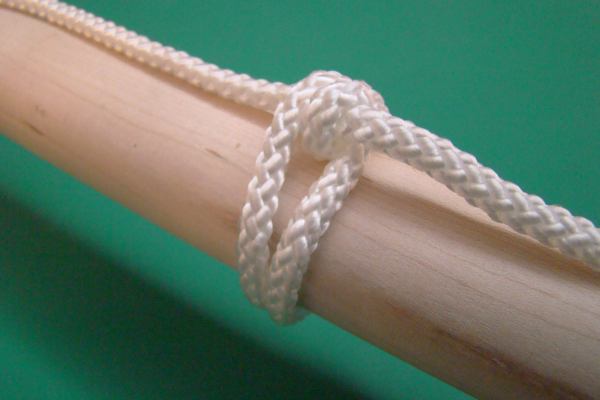
When I first presented this hitch, I used the modest description “a simple hitch a la Gleipnir” on purpose: this hitch is nothing else/more than a more or less obvious application of the Gleipnir knot.
( It was quite a surprise for me that, although I am a great admirer of the Gleipnir binding knot, and I am one of the few people in this forum that I include it in my “10 most useful/interesting knots” list, I did not “discovered” it following this straightforward way ! It was only after I investigated the “bull hitch” for some time, that it suddenly crossed my mind to transform the bull hitch, with its double nipping loop, into the Gleipnir configuration…)
So, I think than only the inventor of the Gleipnir knot should name this hitch, if he wish to do it, and in the way he chooses to do it. The name “Gleipnir hitch” sounds, to my ears, like the most “natural” and unambiguous one, now that the Gleipnir binding knot is established and well known to many people. But it is not my call, only my opinion and my vote…
Before you get too far, you might want to experiment with this on various size combinations of rope and objects. As you do, it’d be good to be tying Constrictor Knots and Slipped Constrictor Knots as points of comparison in the binder category.
And after you do this, it d be good to be tying the “not so simple hitches a la Gleipnir,” presented in the same thread, as points of comparison to the binder category where the Constrictor Knots and the Slipped Constrictot Knots belong. 
I do not see this. (Literally and figuratively.) The Gleipnir seems quite different and not to bind with anything like the ferociousness of the knot in your and my photos. Can you point me to a picture of the Gleipner knot that is like this, or from which this is an obvious derivation. For one thing, I understand the Gleipnir is supposed to be easy to undo, whereas this is quite difficult to undo. I should say, although it may be obvious from some of my other posts, that I have considerable difficulty visualizing knots from verbal descriptions, or understanding any kind of detailed talk about knots that does not make frequent specific reference to pictures.
“Unnamed” seems more like an evolution of the strangle knot than the Gleipnir.
I have attached the photos again – name changed to unnamed.
A simple test: make each around a smooth wooden dowel and try sliding it up and down the dowel. Multiple trials seem to show equal binding strength. “Unnamed” seems to be easier to teach and remember than the constrictor, and seems to be undiminished in its binding strength when made around irregular objects.
“Unnamed” seems more like an evolution of the strangle knot than the Gleipnir.
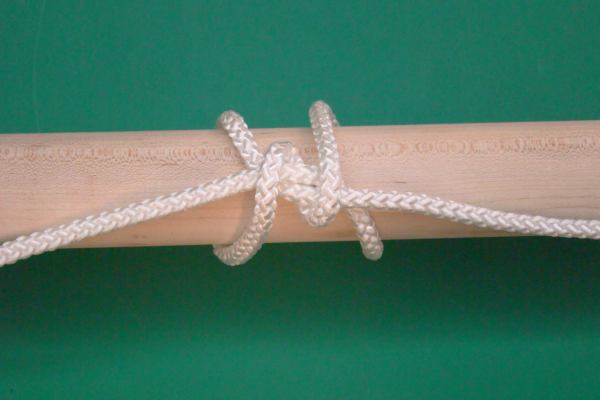
Yes, that was a surprise for me, too. I guess it has something to do with the fact that, in this “simple hitch a la Gleipnir”, the nipping loop is in touch with / is squeezed on the pole s immovable, hard surface. Now it is not only a nipping loop, as in the case of the Gleinir binding knot, but a kind of riding turn as well. So, its gripping power is greater.
The same happens also when we use this mechanism to keep the two ends of the Well Pipe hitch (1) under tension. I would say that, in this later case, the result is even more impressive, because, when the two ends of the Well Pipe hitch are kept under the tension the “simple hitch” can deliver, the effectiveness is “propagated” through out the multiple coils, so that, in a sense, it is multiplied !
Certainly, it should compared more to the Strangler knot than to the Constrictor. What should be compared to the Constrictor is the “not so simple hitch”, also presented in this thread.