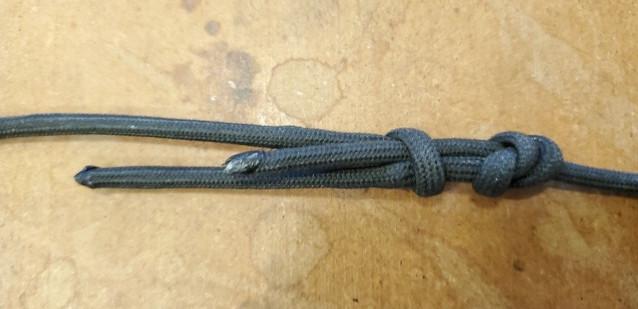
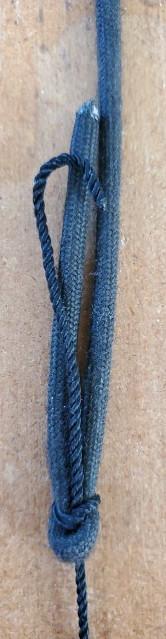
I was perusing the Weaver’s Knots section of the ABOK and came up with this combination of ABOK 276, Ganging Knot, and the trick used for ABOK 500 for binding the ends.
Start by tying the two ends into a loose overhand knot as with ABOK 500.
Then tie a loose overhand knot in one of the ends and bring the other end into the overhand knot, around the standing part and back through the overhand knot. Pull that overhand knot as tight as you can and snug up the other end. This is my bend version of ABOK 276. Now spill the first, still loose overhand knot, slip it into place to bind the ends and work it tight.
I’ve attached only two views of the finished bend because I have such lousy bandwidth (and I’m lazy).
The ABOK does not mention the nifty method of undying the Ganging Knot. Has anyone else discovered it? If you grab the loop and the end of ABOK 276 and yank, the knot spills into a slipped overhand knot. I think this makes a good bar betting trick challenging someone to race you untying the knot. I’ve also discovered (but probably also not originally) a way to secure that knot so that it cannot be spilled in that manner and yet it remains relatively easy to untie. Pull the end back slightly and then poke the end through the resulting loop and work it snug. To untie, pull the end and the standing part in opposite directions to loosen the knot, pull the end out to form the regular Ganging knot and yank it into a slipped overhand knot.