Not true : He mentions, in fact he names it as a hitch, at page 15, along with many other hitches. ( ABoK#60 )
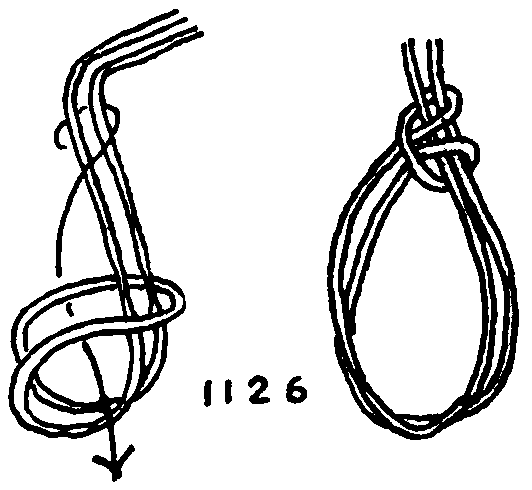
However, and this is the funny thing, it is the ONLY hitch in the page which is NOT shown as a hitch, tied on Ashley s tree ! ( See the attached picture ). So, the most “tight” hitch of all shown in this page, which can be tied in-the-bight and in a glance, is the ONLY one which is not shown tied around an object - and it is also considered being a “loose” hitch, in which " the ends, after passing around another object, are made fast to their own standing parts." ( at : ABoK#48 ). Evidently, Ashley believes that only the “snug” hitches are “tight” hitches, and that all the “nooses” are “loose”. He has not discovered how a very tight “neck” can “lock” both standing parts, the Standing AND the Tail End ( as it happens in the case of the Bull Clove hitch and the ABoK#60=1126 ) - and how much the interaction of this “neck” with the hard surface of the object can enhance its gripping power ( as it happens in the case of the simple-hitch-a-la-Gleipnir ). He only cares about the locking and the security of the Tail End, which he believes should better be immobilized by being squeezed under one or more riding turns, as it happens with the “snug” hitches.
I believe that was a great mistake - but a great knot tyer can do as many great mistakes he wishes, and yet remain a great knot tyer ! 
Hi xarax,
But in the end the Overhand knot (the knot’s nub of the noose) in itself is symmetric, and the symmetric Clove hitch is the knot’s nub of the(quite asymmetric) Bull-Clove hitch!(although maybe I think I have an idea of why you consider this hitch as quite symmetric: http://igkt.net/sm/index.php?topic=4929.msg32346#msg32346 )
I do not understand this: tied in the bight (and in the air), the knot is neither the one nor the other hitch(es) until to the moment when one decides how to apply it to the object that needs to be wrapped..or not?
Anyway:in Italian is said “discover the hot water”,but only now I fully realize that the Bull-Clove hitch is REALLY a development of the simpler Bull hitch!Which in facts appears(has to be dressed) at 0:52 in the video by Knutern( https://www.youtube.com/watch?v=IZHeJWUimB4&feature=youtu.be ). So,in fact, there is also a “Bull hitch way” to build the Bull-Clove hitch.And the Bull hitch itself, is a development of the Girth hitch:in this way, starting from the Girth hitch(a symmetrical start!), is achieved quickly the Bull hitch (for those accustomed!Here a couple of methods: http://notableknotindex.webs.com/bullhitch.html ) ,and from the Bull hitch, just as quickly,is possible to obtain the Bull-Clove hitch(with the backflip visible starting from 1:18 in the video by Knutern.The first method shown on the Notable Knot Index page makes possible that also the Bull-Clove hitch can be used as ring hitch on the bight*:is sufficient that the backflip visible in the video also includes the ring ).
I include(below) some diagrams illustrating the backflip from a Bull hitch which has the same handedness than the one shown on the Notable Knot Index page.
*EDIT:Both the methods illustrated on the Notable Knots Index page make possible that the Bull hitch and the Bull-Clove hitch can be used as ring hitches
Bye!
In what sense ? Even if you can claim that the ( ugly, in its common form ) overhand knot has some obscure symmetry in it, the slipped overhand knot, from which you start, has no symmetry whatsoever. We tie in-the-bight a rather symmetric, balanced, good looking knot, starting from a non-symmetric, and ugly initial configuration… Moreover, the Clove hitch appears only at the very end, like a deus ex machina ! I do not like it. If I had to tie quickly a two-wrap TIB “tight” hitch, able to withstand loading by both ends, and, for some reason, I could nt tie a Locked Cow hitch, I think I would had preferred the ABoK#60 / 1126 instead.
Not ! There is no hitch without the object - in other words, the object ( the spar, in this case ) plays a vital role in the knot - it is, in a sense, a “passive” part of the knot. (2)
Those two hitches are not one-wrap hitches, where the relative position and the orientation of the wrap(s) do not matter. Try to tie the Andalusian hitch, or any other of the “hitching cousins” tied by squarebanksAlaska (1), by rotating /“flipping” their wraps in the same way …
De gustibus non est disputandum:to my eyes the Overhand is not so ugly…and it is (quite)symmetric(below some KM diagrams from my “archive”).(and yes,the slipped Overhand knot is(very much)asymmetric)
Perhaps it is even more true with respect to TIB methods described here, but in general it is always a bit like a puzzle to understand what happens when one performs the steps to realize a loop or a hitch in the bight rather than using the in the end method.
Anyway(In my personal experience) #60/1126 is not always easy(or at least quick) to dress and set it correctly…
But I find that this is actually a kind of confirmation of what I have written!
(and in this regard I have always been in agreement with you(an “old”(and extremely naive and incomplete) explanation:
)
Yes,but “Unfortunately” the hitch(es) in question work(s) with both the orientations of the wraps(I refrain from considering what works best in general or which best meets the expectations of those who have discovered these hitches (but “visually” I prefer the Bull-Clove,compared to the Estar …)).
Still remains the problem that the Clove hitch/deus ex machina appears at the last moment …
In its 8-shaped form, it is very nice knot, just like the fig.8 knot. In its “other” form, it is “other” than nice, i.e. it is but nice - so, what is it ? UGLY !
So, I would better say that, “in its common form”(sic), it is not manifestly symmetric.
If the weight with which you load it is heavy enough, compared to the diameter of the rope, it is self-dressing. If it is not, then yes, it requires some care. However, we use “tight” hitches only when we need to “store” some tension in the wraps, so, presumably, we use them when we pull the end(s) forcefully, against the pole. ( I often use hands AND feet to be sure I had taken out any millimetre of slack I could ). In such cases, the knot is self-dressing.
No, I mean that the knot is not actually tied, its tying is not finished, until=unless you insert the spar in it - or wrap the spar with it. So, as the knot is not finished, it can not be “the one or the other hitch” : it is not either = neither of them. Only when you have “tied” it, when you have made anything that will determine its geometrical form after it will be tightened, only then you can tell what knot it is ( and, sometimes, not even then, because, in physical, not-ideal knots, topology does not determine geometry uniquely ),
Therefore, what you have “tied” in the hand is not a finished knot, which you could compare to another, it is only the first stage of it : and it happens the first stage of tying the Estar knot to be identical to the first stage of tying the Bull Clove hitch. But the final move, where the spar takes its place in the knot, separates the men from the boys !
You could well had rotated the one or both wraps one less or one more 180 degree turn / one more time, the one clockwise and the other counter-clockwise, and form any of the four variations described by dan Lehman in Reply#15 ( and then some…), and only afterwards penetrate them with the spar. Would this mean that all those “knots” would be identical, “until” then ?
That is what I meant in my comment : I was replying to your question : " Is the knot either the one or the other hitch until the moment when…" There is no knot until this moment, at least there is no finished knot. The comment you cite now is 100% right, of course.
So what ? Are they the same knot, because they both work ? ? ?
What you have tied “in-the-hand” is only the first stage of a knot, which happens to be identical for both knots, it is not the finished knot. The finished knot requires the presence of the spar, and it requires a particular position of the spar within it. The fact that the spar can penetrate the unfinished “knot” in more than one ways ( it could had been the case that it could penetrate it in more than two ways ! ), and yet the TWO knots that are tied by those ways, both work, is not a proof of their identity ! It happens many times, the final tuck on a not-yet-finished knot, to generate two or more knots that work - but this does not mean that they were the same knot, until this final tuck ! The insertion of the spar within the two wraps is equivalent to one ( at least ) tuck, so we just can not compare unfinished knots = half tied knots, and tell if they are identical or not.
Our situation is improved - because now we can watch the formation of the Clove hitch out of / on top of the two “parallel” loops around the “neck” of the hitch. One should tie the Clove hitch somehow, and the way it is tied in this sequence of moves is simple, easy and conceptually much more clear than when we start from the slipped overhand knot, IMHO.
Hi.
Have a look at this video: https://www.youtube.com/watch?v=AnBFo58O8u4&feature=youtu.be
I wish I had better light condition here and a better video recorder, but this is what I get from my webcam.
Hi.
I guess this method is simpler. Haven’t tied it by this method more than some times so I cannot tell if this is the way I’ll remember best.
The first way tying was just me cheating - that is I untied the knot, and thereafter I tied it again backwards (after playing a video of the untying in reverse).
However - I assume this isn’t always resulting in the most effective ways to tie a hitch the TIB way. Partly because when watching a reverse video of an untying sequense, the rope makes som moves and twists that is very difficult or near impossible to perform.
Hi xarax,
I’m sorry, I expressed myself badly: the "… or not?"in my reply was just a rhetorical question:I’m aware that “tied in the bight (and in the air), the knot is neither the one nor the other hitch(es) until to the moment when one decides how to apply it to the object that needs to be wrapped(“unless, for example, is not tied in the bight around a ring”,I add now)”.My real question was why you wrote “I first tie the “Estar hitch” ( the one shown by SS369 at Reply#3 ), and then I flip it over, and form the Bull Clove hitch”.
NO! They are not the same knot!They work differently!I agree with you(but,however,in this case,they both work..).
For how it seems to me,the Clove hitch-component appears in the same way and at the same (last) time,either using the Knutern/slipped Overhand-#1048-first-step way,either by using the “Girth + Bull hitch” way.
The advantages of the “Girth + Bull hitch” way are that, with regard to the idea of a way it can evolve the Girth hitch, it is conceptually more correct,and that, from a more practical point of view, makes it possible to use the Bull Clove hitch as a “ring hitch in the bight”,perhaps using a closed circle of rope(which in effect can perhaps be seen as a confirmation of a greater “conceptual correctness” of the use this method,since it is a prerogative both of the Girth hitch and the Bull hitch).
However, when used to wrap an “open” object , I personally find that the Knutern/slipped Overhand etc. way is a bit more quick and intuitive(mostly I find it easier to identify what is the bight that has to be backflipped)and also (this may be caused solely by the way I handle the rope) I have personally found a lower tendency of the rope to twist on itself during the execution of the knot.
Anyway, since you mentioned it in your first post, I attach (below) a series of diagrams illustrating how to get also the “Constrictor Bull hitch”(is just for “the collection”!) by the “Bull hitch way” method.
Bye!
Hi Knutern,and thanks for your last video!
I also often cheat in a similar way(see above,for example!) when I’m trying to figure out how to perform a TIB knot!
Bye!
Beautiful ! I had never tied it in-the-bight, I was satisfied with the thought it could be tied so, some way ( because the Constrictor itself is TIB, just as the Clove ), but I had never actually tied it in any way …
I think that the Constrictor does not jam as easily as the Clove : In order to force it jam, you have to pull the ends harder, because of the added internal friction of the more convoluted knot you have to overcome, until they are squeezed upon each other so hard they are mutually immobilized and “locked”, and so neither of them can slip either way.
Of course, the Constrictor is a tighter knot, when/if it is tied around solid, hard objects, but that is due to the fact that the ends are “locked” more effectively. Around compressible, soft objects ( around the pair of rope ends in these cases ), I think that the wraps of Clove hitch can squeeze each other, and the penetrating pair of rope ends, more tightly than the Constrictor.
I just had one of few moment that I got creative. Why not just tying this knot starting with the Clove Hitch?
It is way easier to remember than earlier recipies, at least I think so.
Video demonstration here:
https://www.youtube.com/watch?v=Wi_ShE1nt_c&feature=youtu.be
I assume the talking and the length of the video makes he audience bored, so I uploaded a short version of the video. No talking.
http://youtu.be/0D2Oh3UqSZs
Yes, you’re probably right. As you can see of the videos I have to “force” this relatively stiff rope so that it get a shape that is to be familiar.
Both light condition and the rope itself could be better, but I didn’t put much work in that, only to get the idea 
Hi Knutern,and great find.
Among the methods proposed so far,this is definitely the easiest to remember.The principle seems to be the same as the method proposed by Ashley for # 1126, I had not really thought of applying it to the Clove Bull hitch!
Personally (but I still have to take confidence!) I pay something after the tying phase because I find myself having in a certain sense to dress up again the Clove hitch component around the standing ends, but again: surely I am not yet manually confident with the method, and in any case the ease to remembering, alone is worth the price.
EDIT:by pulling the legs of the loops adjacent to the Clove component,the Clove component is(or at least:is almost) self-dressing!
Bye!
Here is a short video that shows me tying the Bull clove hitch, the other way (TIB method)
Same stiff ugly rope 
The much simpler ( and, I would dare to argue, much more intuitively clear ) method shown at :
https://www.youtube.com/watch?v=0D2Oh3UqSZs&feature=youtu.be
is also TIB ! As Luca has noticed, it is, essentially, an implementation of the method shown by Ashley at ABoK#1126 - which is the one of the three somewhat “similar” TIB “tight” hitches-nooses we have, able to be loaded by both ends, or by any one end (1). The difference is that in the one you start from the Bull hitch, and in the other you start from the Clove hitch - and you transform both of them into the Bull Clove hitch.
The same method (ABOK #1126) can be used to tie the Bull Constrictor hitch, cited above. (I apologize if I’m writing something already written).
I do not like this Bull Constrictor hitch very much… I believe it is too convoluted, and, probably because of that, it can not be tightened very hard and become more effective than the ( much simpler and smaller in size/volume ) Bull Clove hitch. Such a bulky knot, with all those twisted segments, tied around two penetrating parallel lines, does not look very good to me. Moreover, I do not believe that we can exploit the tightness of the Constrictor, when we tie it around an object of a relatively small diameter : there is too much tension “wasted” within its own twists, and unable to reach to the surface of the hitched “object”, the two penetrating lines.