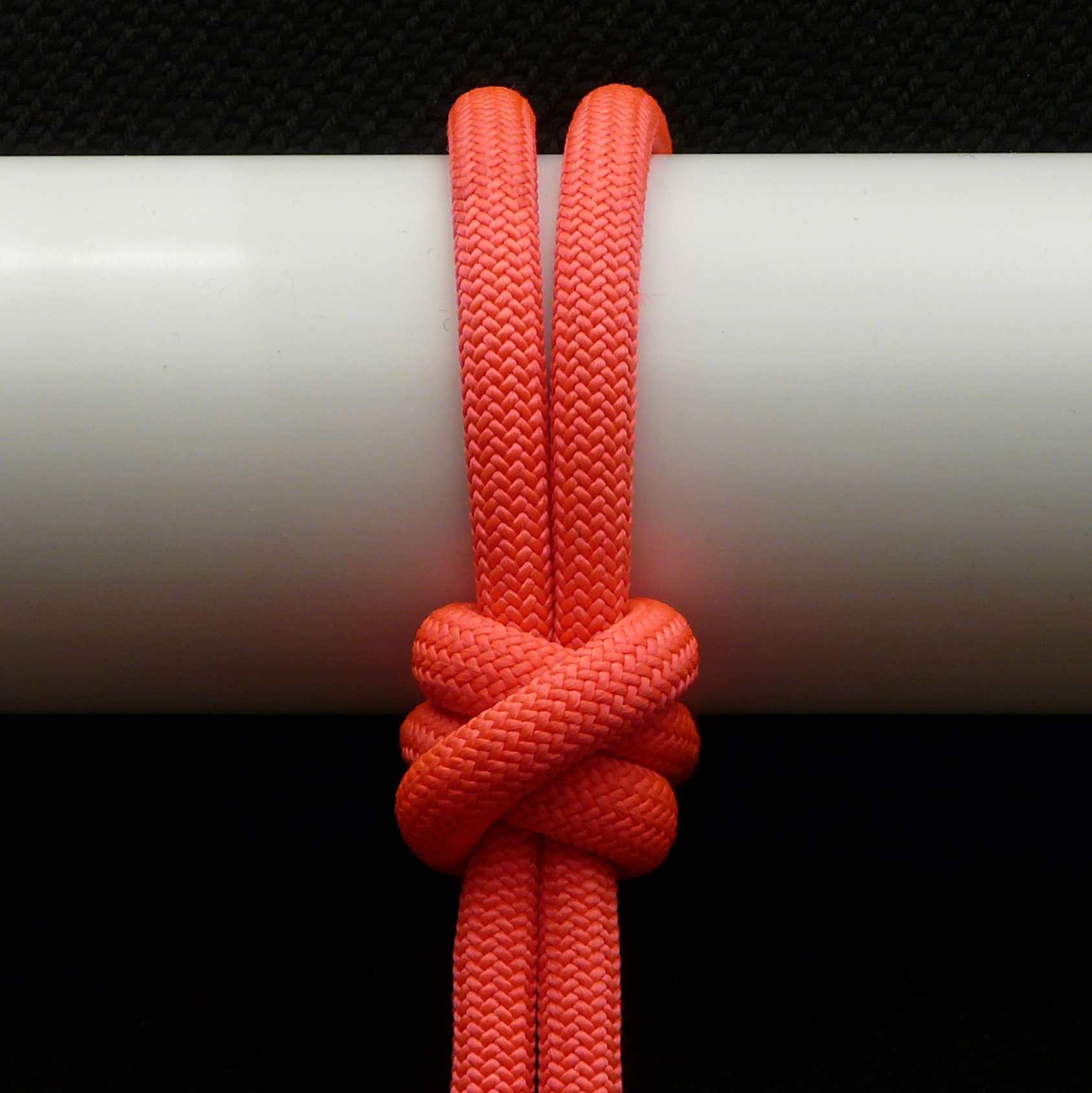
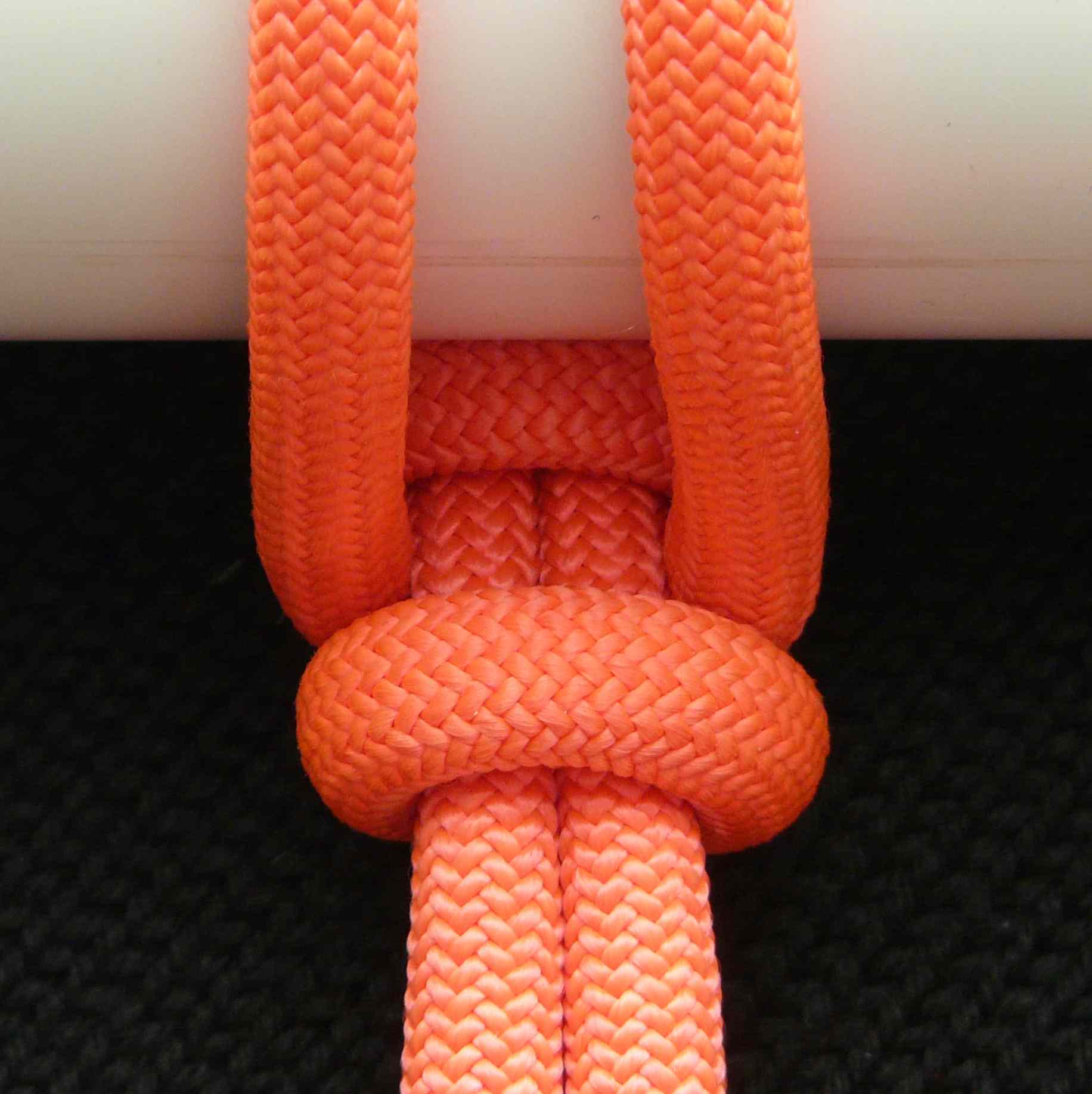
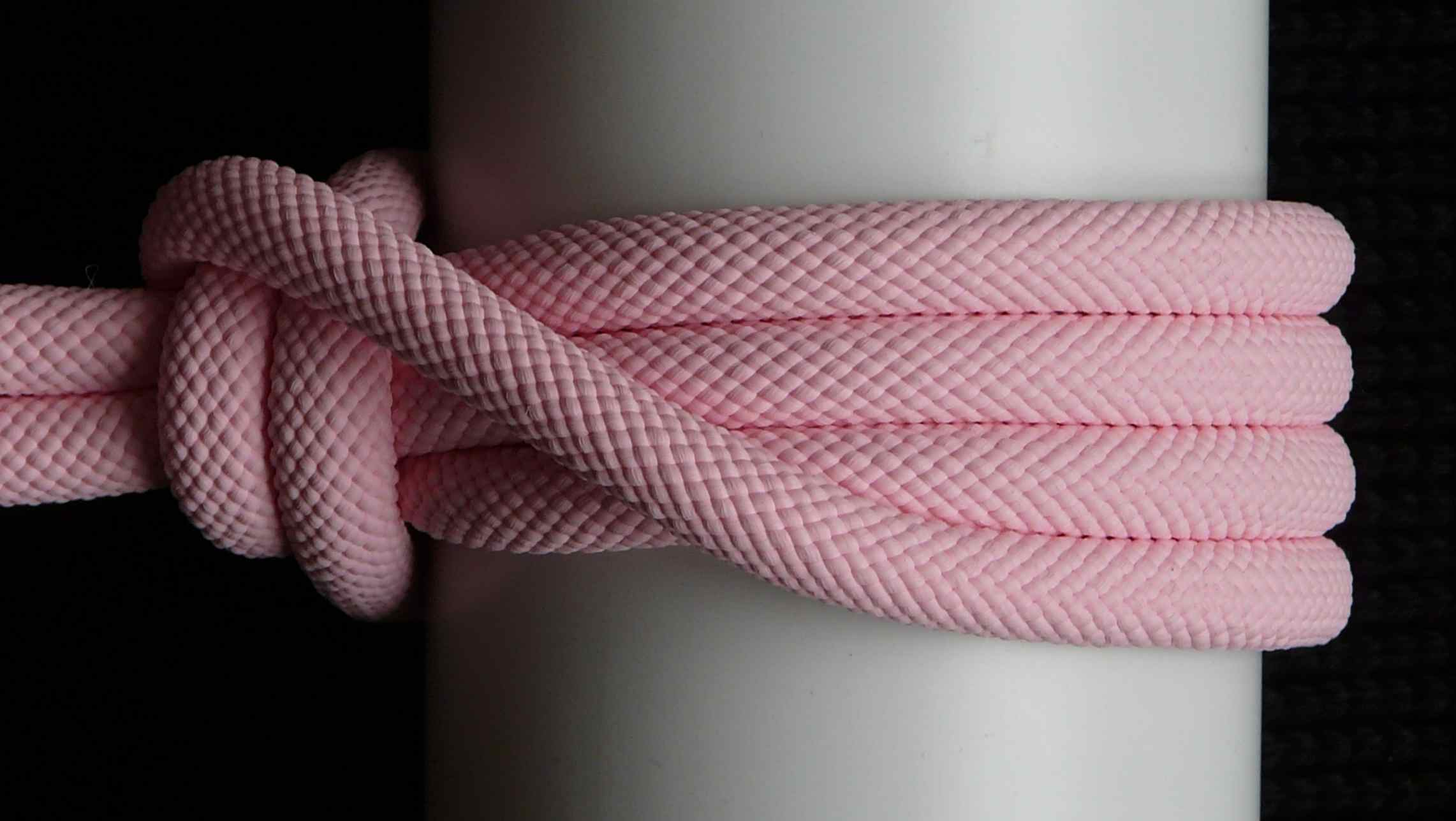
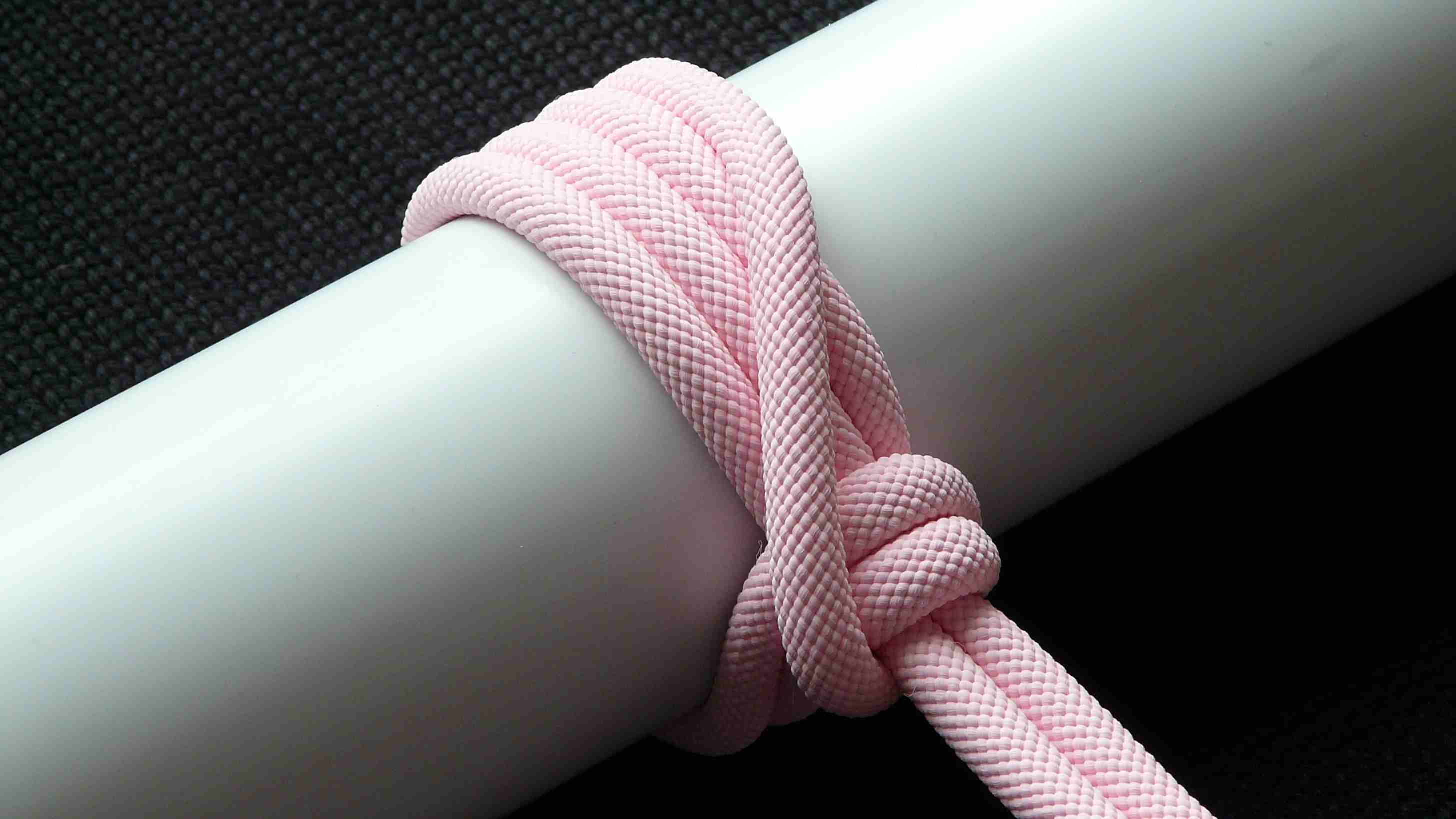
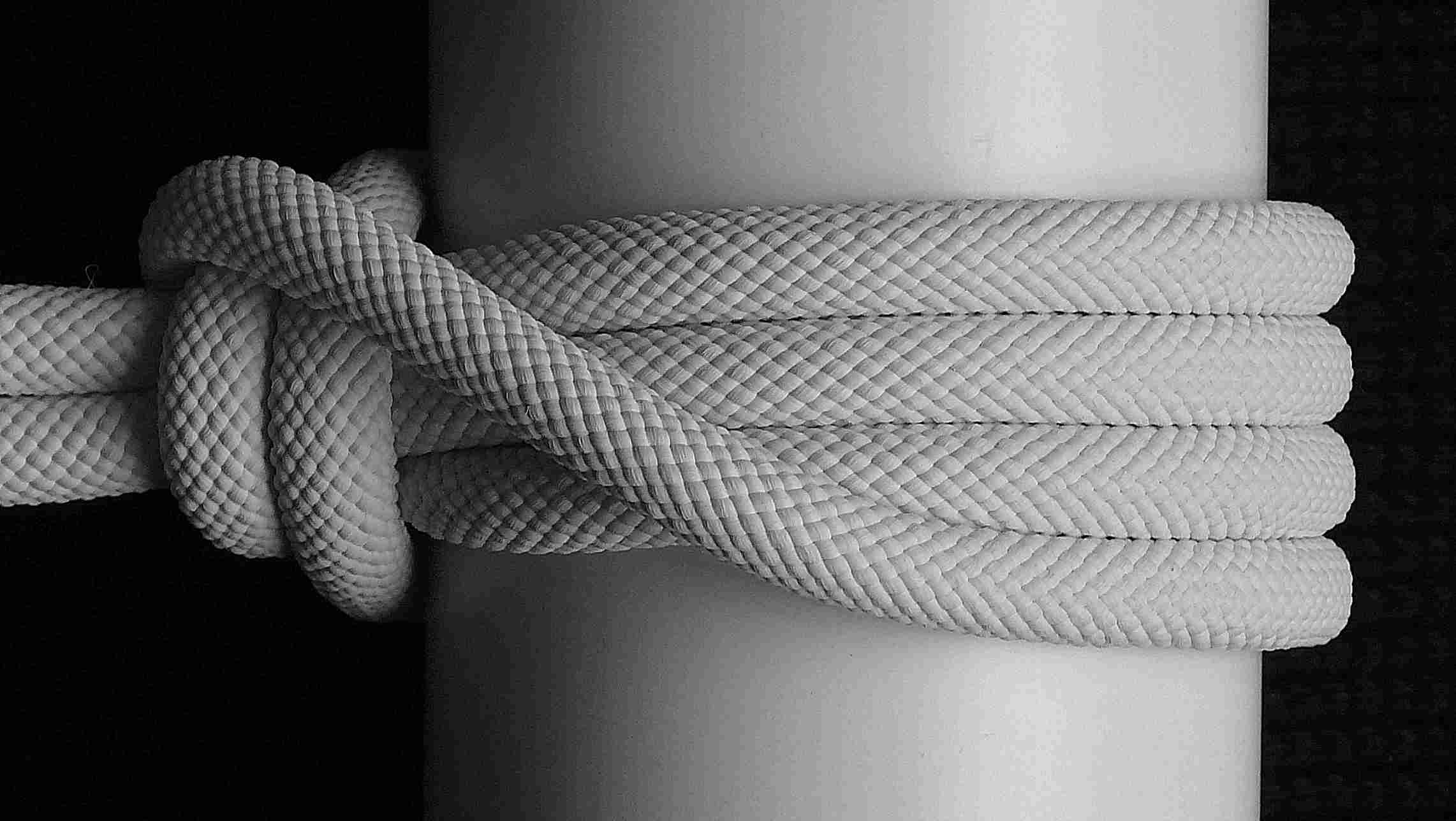
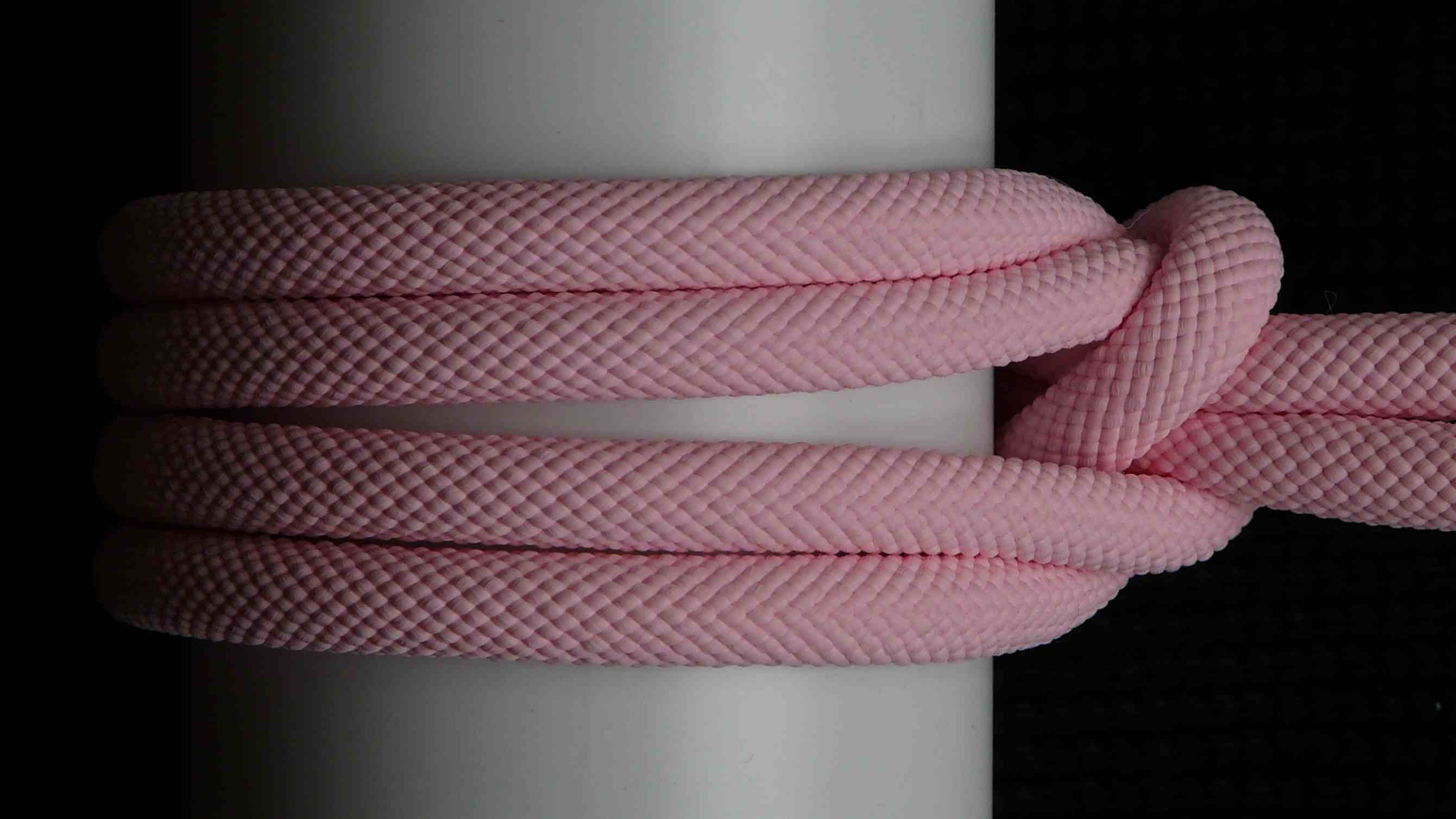
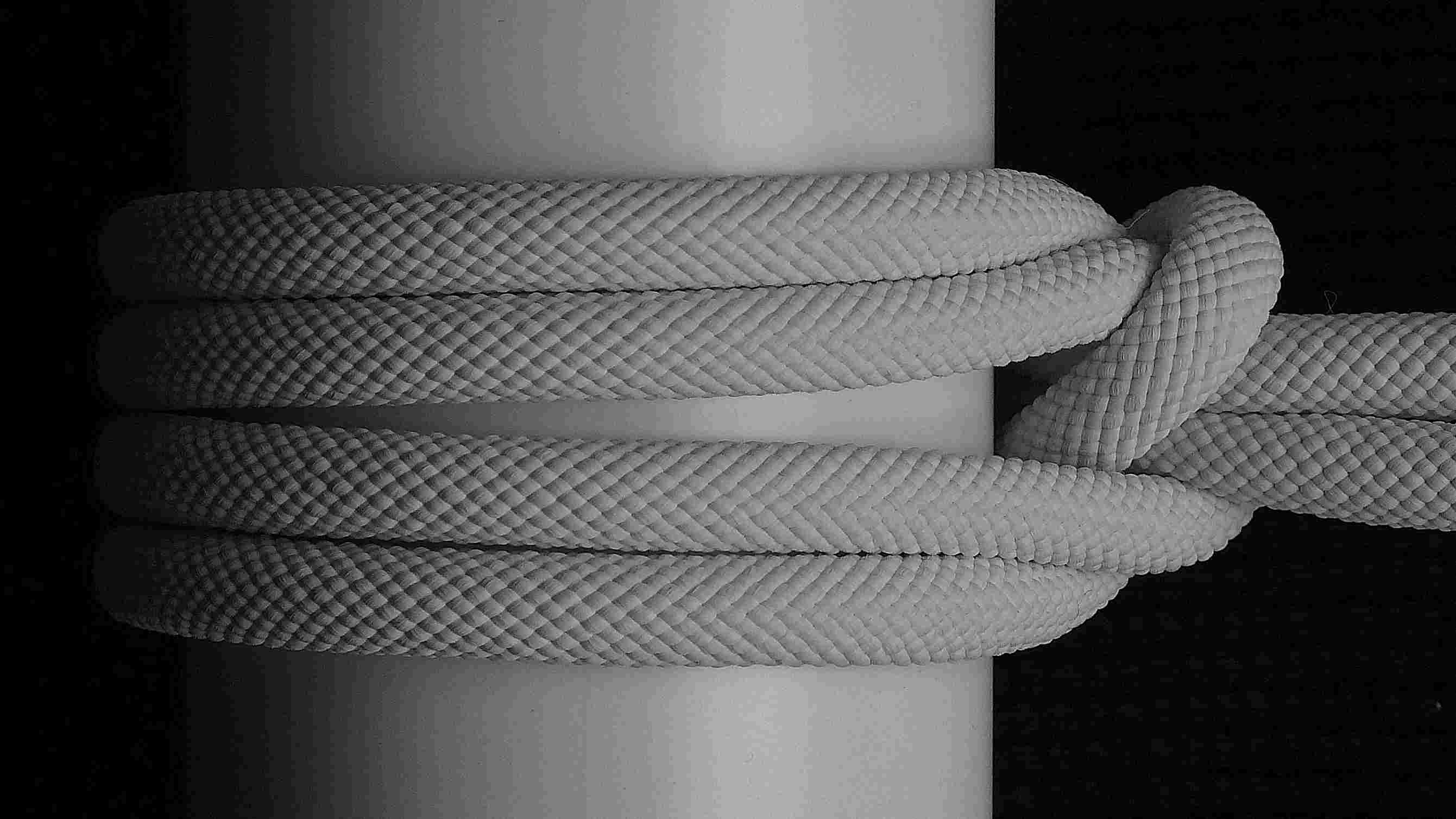
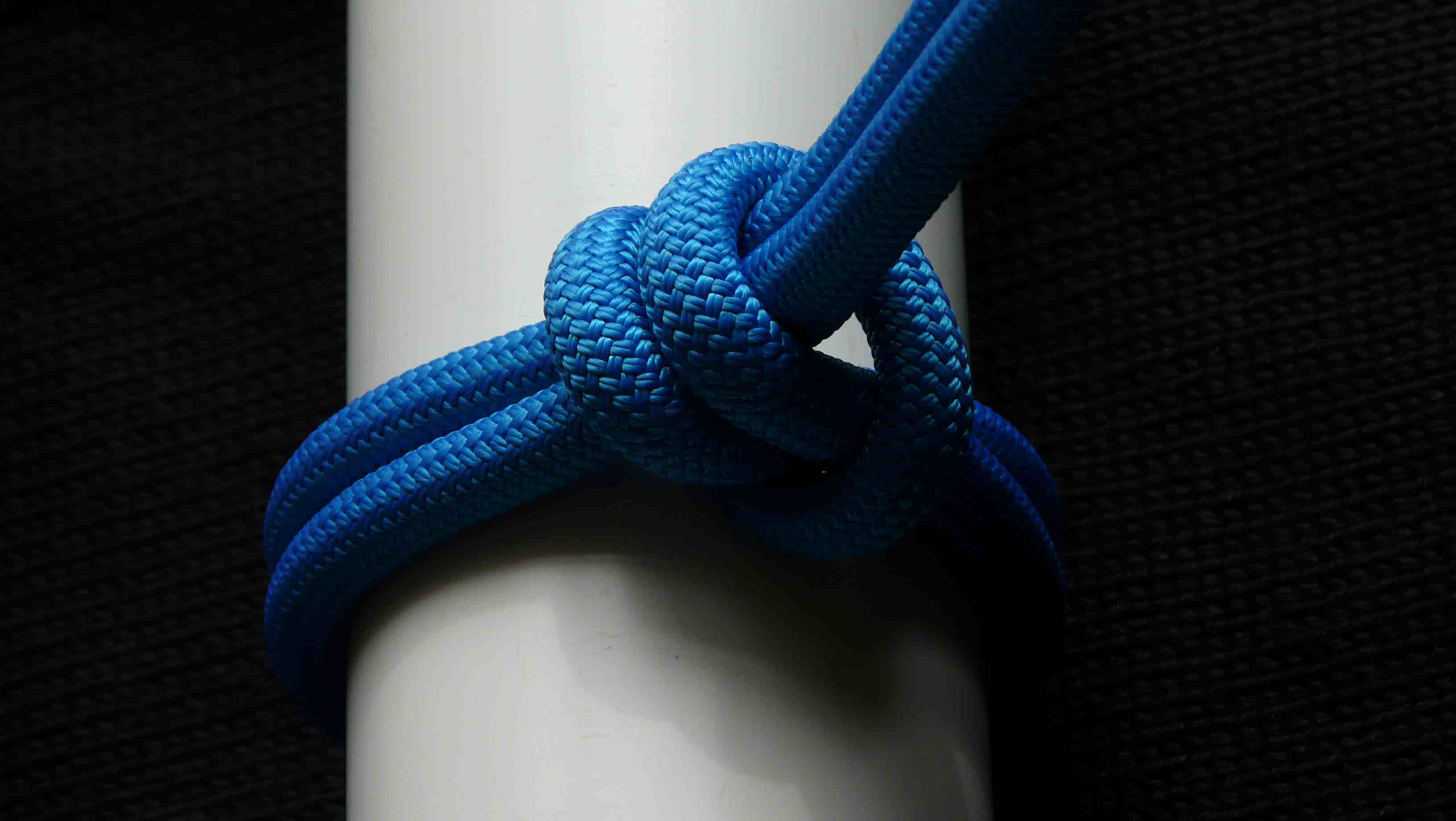
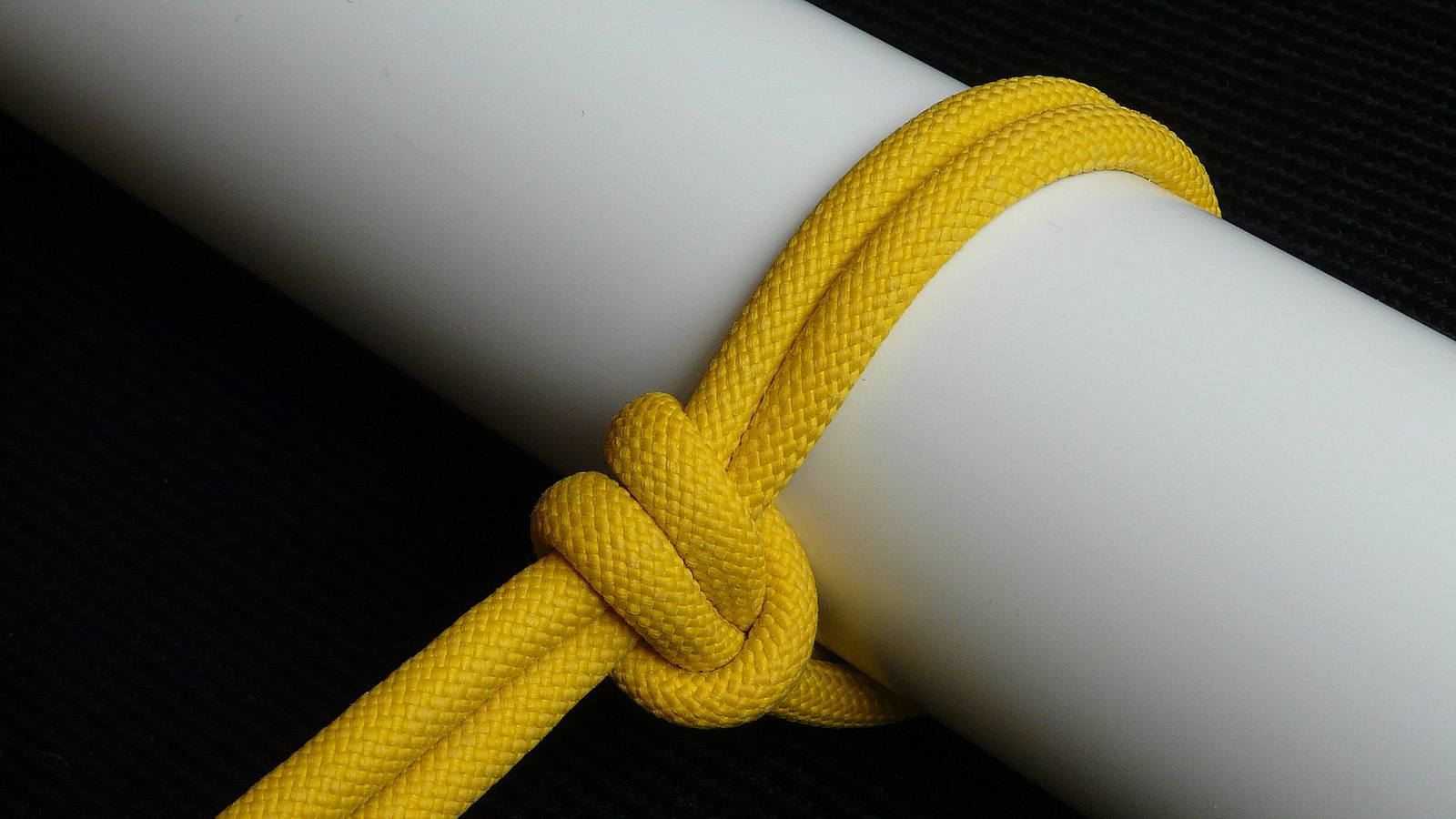
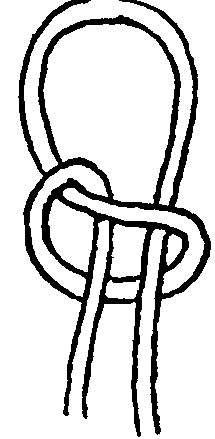
A variation of the Bull hitch.

Trying to "lock’ the Cow hitch, I stumbled on this very simple idea : what will happen if we replace the one-and-a-half turn around the neck of the Bull hitch, with a Clove hitch? When I tried to use the Clove hitch as a nipping structure for an inversed Buntline, Eskimo-like loop (1), I had seen that it jams very tightly (2)- so I thought that I could take advantage of this, and utilize the Clove hitch instead of the ( crossed or not ) nipping loop of the ordinary Bull hitch (3). The resulting hitch, shown at the attached picture, seems to validate this idea. As we pull the ends, the Clove-hitch-made neck closes into itself and chokes the penetrating lines, so any tension inserted by them into the wraps remains firmly and permanently “locked” in there.
( Note : Instead of the Clove hitch, we can also use the Constrictor, course, which also jams if it is tied around ropes (4)).

  1. http://igkt.net/sm/index.php?topic=4332
  2. http://igkt.net/sm/index.php?topic=4347
  3. http://igkt.net/sm/index.php?topic=2166
  4. http://igkt.net/sm/index.php?topic=4507.msg28775#msg28775

Bull-Clove hitch ( bottom view ).JPG

I know it’s not your goal, but: pretty. :slight_smile:

Thanks. Evidently, you are the only one you saw those pictures and paid some attention to them… :slight_smile: ( 2 clicks - the one was mine s ! ). However, I decided to post some new ones, a little sharper ( as sharp as my old zoom bridge camera could allow… When / if there will be some audience larger than the minimum one, I will buy a new camera, with a decent sharp lens and a better autofocus ).
As one ( you… :)) can see, the two legs of the Clove hitch approach the surface of the pole being parallel to each other, and their grip on the “lock” is almost perfectly balanced. ( Regarding this, it helps if we pull the one end after the other, alternatively, and also if we push the “neck” towards the surface of the pole, so the Clove hitch “lock” would remain as tightly closed around itself as possible). On the contrary, in the Bull and in the Bull X hitch, the “lock” is not so tight, not so symmetric, and of course, not so pretty :).


Bull-Clove hitch ( top view ) (2).JPG

Bull-Clove hitch ( bottom view ) (2).JPG

Nice Xarax!
And tie-able in the bight too.

I would not put too much into worrying/commenting on how many times a picture is view (clicked on to view that is). I have viewed them right after you loaded them and and sometimes it just does not leave the info.(?)
But they do show up very well in small (un-clicked) form.

If you tie it in the bight and reverse the loops, it makes for and interesting hitch as well.
Thanks.

SS

I haven’t thought that ! :slight_smile: However, I find the reversed form not tight enough, not symmetric enough, and not pretty enough ! :slight_smile:
I did not mention the fact that the Bull-Clove hitch is TIB, because I though that, as it is based on the Clove hitch, it should have been expected to be so. For the moment, I tie it in-the-end, mostly - I would need some time to master the technique of tying it in-the-bight quickly and without thinking how to do it, so the wraps cross each other in the right way … :slight_smile:

A TIB, 4-wrap variation of the Bull hitch, which utilizes the mechanical advantage offered by the zig-zag-shaped paths of the lines of the parent Cow hitch ( a potentially very tight hitch, because both its ends can be pulled against the pole), and the “locking” efficiency offered by the opposing-tensioned-bights mechanism of the TackleClamp hitch.
Both free ends pass in between one double-line bight, which pulls them towards the one side, and one single line bight, which pulls them towards the other. The combined choking action of those two bights works like a rope-made ratchet mechanism : any amount of tension which happens to be induced into the wraps of the hitch initially, during a pre-tensioning phase, can not but remain firmly “locked” within them for ever, even if the free ends are not tensioned any more. We can say that the double-line bight offers the mechanical advantage ( just as the single-line bight used to do in the parent Cow hitch ), and the single line bight offers the counter-acting half part of the locking mechanism, on the one hand, and the additional friction of its two wraps, on the other.
This tight hitch/binder can be formed in a split second ( I am sure that Alan Lee can wrap and tighten it around the accessible end of a pole in the blink of the eye… :)), and my first “laboratory” tests indicate that it is as tight as the same-number-of-wraps Double Cow hitch. (1)

  1. http://igkt.net/sm/index.php?topic=4035.msg24345#msg24345

( top view ).JPG

( top left view ).JPG

( top view )(B&W).JPG


( bottom view ).JPG

( bottom view )(B&W).JPG

It is always preferable to have the Standing and Tail Ends of a tight hitch be perpendicular to the axis AND to the surface of the pole, so we can pre-tighten the hitch harder by pulling those ends against the pole, without deforming the “locking” mechanism of them in any way - a disadvantage of the Constrictor, for example, and, although in a much lesser degree, of the Strangle as well. This optimum orientation of the ends of the hitching knot relatively to the hitched object happens in the case of the Bull X hitch ( and of the other hitches shown in (1)), and in the case of the Bull hitch which is based on a Clove-hitch tight “neck”, presented in this thread. In the first post of the thread, I have mentioned that we can also use, as a tight “neck”, the Constrictor, which is also able to choke the penetrating ends hard, and so keep any tension induced during a pre-tensioning phase firmly “locked” inside the wraps.
The X ( X = crossed ) double nipping collar, the Clove and the Constrictor “necks” are obviously TIB, so we can form the tight Bull hitches based on them as nooses in the middle of the rope, and then insert the accessible end of the pole through their wraps - or vice versa. I have forgotten to mention that we can also use, as a “neck”, the Cow/Girth hitch, which is also TIB, and can be formed even more easily and quickly than the Clove and the Constrictor. However, when used as a “neck” of a tight Bull hitch, with its axis perpendicular to the axis and the surface of the pole, it is twisted 90 degrees, and the consequence of this is a somewhat less symmetric configuration : each of the two ends is now nipped by the encircling “neck” in slightly different way than its pair. This might considered as a disadvantage - and it is not my cup of tea, either - but the hitch itself, as a whole, is very tight, despite this asymmetry. Moreover, the easiness and quickness of forming it in the middle of a line is a great advantage, which should not be underestimated.
We have seen this Cow/Girth “neck” - based Bull hitch, as a noose : it is the Double Ring or Double Running knot, shown by Ashley at ABoK#1126. He does not mention it as a hitch, and he does not comment in its TIB advantage, perhaps because he believes it is obvious to all people - while it might be not so. In the middle of the line, and where the one end of the pole is accessible, it is perhaps the most easy and tight two-wrap tight hitch one can tie in a fraction of a second.

  1. http://igkt.net/sm/index.php?topic=2166.0

Bull hitch ( Cow, Girth neck )(3).JPG

This knot has been bouncing around a couple of sailing forums under the name “Estar”. Some refer to it as a modified buntline hitch due to the method of tying, which starts with a buntline, but ends up with a clove hitched collared bull hitch. http://www.bethandevans.com/pdf/modifiedbuntline.pdf

Note: when pulling on just one standing end, the one you choose seems to makes a difference in the load it can sustain before breaking.

estar bounced around this Forum, too ! :slight_smile:

http://igkt.net/sm/index.php?topic=4756.msg30713#msg30713

However, it was/is not “this knot”, I am afraid. The “rope part” of the knot is, topologically only, the same, but the whole knot, geometrically, is different - because the way it is wrapped around the pole is different. Topology does not determine geometry uniquely - and there are many cases where two topologically identical knots are geometrically very different. Of course, if we take into account that, in this case, the “pole part” of the knot is, in a way, a part of the knot nevertheless, because the knot is a hitch, then the difference between the two knots becomes more evident. ( By starting from the Bull Clove hitch and “reversing the bights”, i.e. SS369 has tied the estar hitch, at Reply#3 ).
It not a [i]“tight hitch”/i : in the estar the two limbs of the nub do not encircle the pair of parallel and adjacent ends as much as they do in the Bull Clove hitch - moreover, they pull the diagonal element away from the pair of ends, while, in the Bull Clove hitch, it is the diagonal element that pushes them towards the pair of ends. So when the load is released, the grip around the pole is released, too. Also, there is no difference, in the Bull Clove hitch, in the loading pattern of the ends : any of them can be the Standing End, and any of them can be the Tail End : the Clove hitch “locking” nub, as it is positioned in relation to the pole, it is (almost) symmetric, regarding this matter. Tie both hitches on the same material, around the same pole, tighten them, and you will see and understand the difference in no time.
I do not know how the Bull Clove hitch behaves when tied on Dyneema - it may well behave worse than the estar. However, on ordinary material, the Bull Clove hitch is not even comparable - because it utilizes the tendency of the Clove hitch to clinch tightly, and jam, when tied around a “compressible” material, while the estar does not use its 8-shaped nub like this at all.

For two other one-wrap Buntline-like hitches, see (2). For the best 2-wrap “tight” hitch, see the “Locked Cow hitch” (3)-(4).

  1. http://igkt.net/sm/index.php?topic=4155.0
  2. http://igkt.net/sm/index.php?topic=4454.0
  3. http://igkt.net/sm/index.php?topic=4035.msg24785#msg24785
  4. http://igkt.net/sm/index.php?topic=4441.msg28170#msg28170

Hi John,

Nice observation there.

Do you have any thoughts as to why one end should be stronger than the other?

The amount of tension that can be induced and locked, during a pre-tightening phase, into the wraps of the Double Ring hitch ( ABoK#1126, qua hitch ), is incredible (1). Pulling the ends one by one against the pole, using hands and feet, as a rower, one can tie this very tight hitch / binder, very easily and quickly, in-hand and in-the-bight. I think that its annoying asymmetry, as it lies on its ear on the surface of the pole, is beneficial to its tightness nevertheless, because I have seen that the double nipping loop of an equally tightened common Bull hitch can not lock so tightly. However, I think that the Bull Clove hitch presented in this thread is even more tight, but it can not be tied so quickly, because, in order to be oriented properly and “close” ( jam ) tightly around the penetrating ends, the Clove nipping/locking “neck” requires some more careful dressing.

  1. http://igkt.net/sm/index.php?topic=4748.msg31275#msg31275

Double Ring hitch ( ABoK#1126).JPG

Nice,
It’s agreable to see an ABOK in the flesh!
Easy to tie, it grips well indeed.
I like the photo from the book as “how-to-do”
Your presentations, as usual, are irreproachable.
ths.

I think I know what you’re saying : that it
resembles the bull hitch but vice that knot’s
simple round turn is a clove hitch.
Now, I’m intrigued like Derek to understand
your further remark about “pulling on just
one … end”!? I would think that it would
be better to load the other end from what
EStar does, so that the first-loaded main
structure is the “two half-hitches” aspect
and not “buntline” --that force flow more
around the object, near & more-at-right-angle
into the SPart vs. the buntline’s taking force
out farther away and slightly more acutely
into the SPart (at least, for relatively small-dia.
objects, I’d favor it thus)!? But maybe that
“more-at-right-angle” loading delivers more
deflection & pressure on the SPart and leads
to a weaker structure.

–dl*

I have seen the pictures the author himself of the “Estar hitch” has provided - which I reproduce here ( the complete set of them, labelled bunt1, bunt2 and bunt3 ) from his very informative and interesting site :
http://www.bethandevans.com/load.htm

Now, I can tell what the confusion is - which, unfortunately, the author of the “Estar hitch” never realized, or never wished to clarify :
There are TWO ways one can drive the Tail End of a finished Buntline hitch around the pole, and re-tuck it through its two “holes” ( the Buntline hitch is “8” shaped, so it has two “holes” ).
The first is what the attached original pictures show : this way does NOT lead to the Bull Clove hitch presented in this thread. So, if we try to follow the vague, incomplete instructions offered by the author, and attempt to understand what he says by seeing the original pictures provided by him, we end up with another hitch, which is NOT the Bull Clove hitch. It is the hitch shown by SS369 at Reply#3 :
http://igkt.net/sm/index.php?topic=4748.msg30678#msg30678
The second way, which is NOT shown in those pictures, is to drive the Tail end around the pole FROM THE OTHER SIDE of the Buntline hitch from what is shown by the author, after making a 180 degrees additional turn around the Standing End. THAT way does generates the Bull Clove hitch, because it does complete the Clove hitch, as it should, and then re-tucks it through its two “holes” ( the two wraps of the Clove hitch can also be considered as two “holes” ).
WHICH is the “Estar hitch” ? KnotGod knows ! :slight_smile: I have repeatedly asked the author for a clarification, but he never bothered to reply to my posts or messages…
Let us go to the “animated” site which is a-la-mode nowadays, and see if we can enlighten ourselves. First, the “Estar hitch” animation appears only as a window of the Buntline hitch. Second, what the animated .GIF file clearly shows, is NOT the Bull Clove hitch, but the hitch shown by SS369 at Reply#3. See the fourth attached picture, or visit :
http://www.animatedknots.com/buntline/index.php?LogoImage=LogoGrog.jpg&Website=www.animatedknots.com#EStar

Now, one may wonder ( or not… ), why such experienced knot tyers as Derek Smith and Dan Lehman had not paid any attention to this simple, obvious fact, and instead preferred to ignore my own presentation, my pictures and my post at Reply#9… After all those years in this Forum, my theory has evolved, and it is now this : Knot tyers are those people who tie only their own knots, and snub all others ( other knot-tyers, and, oftentimes, other knots ! ) :). Well, there are exceptions in this rule, but it makes no harm to novice knot tyers to have this theory in the back of their mind, when they present a “new” knot…

Wow, that X. character sure can kick up a lot of
chatter, new or old.
Whatever my oversights prior,
I see that there are at least these two differences
available in the subject hitches:

  1. the clove hitch can be loaded qua
    two half-hitches, which hasn’t been tested
    (with tucked tail, i.e.), or qua buntline ;
    and
  2. the crossing part of the clove hitch can be
    viewable OVER the ends when we look at it
    with ends coming OVER the hitched spar,
    or it can be on the other side --in the former case,
    one has the SPart/Tail reaching to wrap around
    the straight parts AND THEN go through this
    crossing part after,
    and in the other case they push through the crossing
    part as they reach to wrap.

AND the 2 diff.s above can be combined for 4 versions
(simply : 2 variations and then on them 2 ends to load).

–dl*

Perhaps the ( indirect, and slooow, as always… :)) route I had followed, can shed some more light on the origins of this issue :
I had tried to figure out a very tight, self-locking “neck”, tighter than the double, crossed or not nipping loop used in the Bull and Bull X hitches, so that both ends, the “Standing End” and the “Tail End” ( those names do not have much meaning here, of course…), can be immobilized by its nip around them - and so both wraps, the direct continuation of the “Standing End” and the direct continuation of the “Tail End”, could retain and accumulate any tensile forces happened to be inserted into them during the pre-tightening or the tightening phase. In other words, I had tried to turn the humble Cow hitch into a “tight” hitch, able to withstand a lengthwise pull ( to a satisfactory, considered its small size/required rope-length, degree ) in a different, more symmetrical way than the way used in the “Locked Cow hitch”.
The reminiscence of the Clove hitch been jammed around a segment of a rope ( see (1), and read my attempted explanation / theory about its behaviour, in relation to the expected, more “normal” behaviour of the Girth hitch ), was all that was needed to help me complete this small step - but the result was a very easy to tie, TIB and secure “tight” hitch, which could / should had been tied centuries ago ! :slight_smile: It turns out that the primordial Clove hitch, when it is tied around the “soft”, compressible surface of one or more segments of a rope, is a much more interesting knot than when it is tied around the “hard”, incompressible surface of a spar ! Anyway, I was looking for a very tight, almost jamming “neck”, and the Clove hitch was the first and simplest such thing that, sooner or later, should had crossed any knot tyer s mind.
Now, I guess that Estar followed a completely different route - and so the fact that he did not tied the same hitch should not come as a surprize. He started from the most reliable one-wrap hitch he knew, the Buntline hitch, and then he tried to re-tuck it in some way, to add bells and whistles, curves and turns into the Standing Part s path, in order to increase friction, and immobilize it, so he could get a more secure hitch ,reliable even if it is tied on a very slippery materials. He was interested in preventing the slippage of the Tail End of a Buntline hitch, not in preventing the slippage of the Standing End of a Cow hitch, as I was. Different purposes, different means, different ends, as it should had been anticipated.

  1. http://igkt.net/sm/index.php?topic=4347
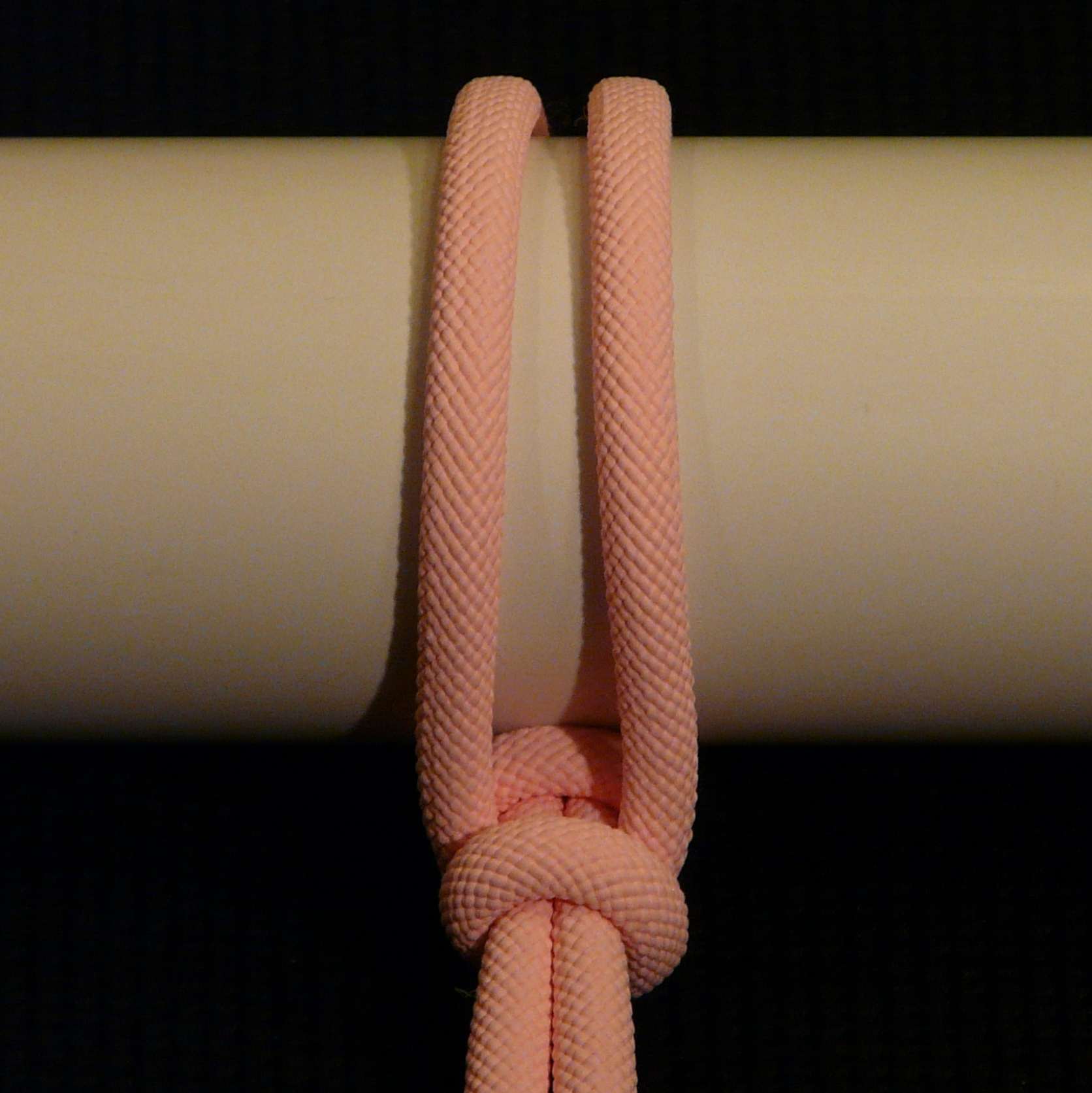
Thanks for sharing guys. I liked the looks of the Bull-Clove hitch :smiley:

Also, after some tries I managed to tie it at the bight too:
https://www.youtube.com/watch?v=IZHeJWUimB4&feature=youtu.be

If a TIB method is difficult to memorize, learn, remember and execute, it is almost useless… There are knots that can be tied in-the-bight much easier and quicker than in-the-end - but even if this can not be achieved, we should not go to the other end ! I mean, we would never choose to tie a particular knot because it is TIB, although to tie it in-the-bight is considerably more complicated than to tie it in-the-end - as it is the case with your method. I bet there are “simpler” TIB methods for this knot, but I do not know what a “simple” tying method is ! :slight_smile: ( I doubt whether we can define, in an objective way, “simplicity”, even for the shape / structure of each different knot - therefore something that involves so many subjective and accidental elements, depending on the experience, dexterity, memory, etc., of each different knot tyer, will probably remain impossible, for ever. )

Hello Knutern,

A very good TIB hitch by xarax,and a very good TIB method by you,in my personal experience(as noted by xarax,these things are individual matters)!
In your video you act slowly, which makes things very easy to understand,thank you.
Maybe it’s just a bit laborious only to get what is shown at 00:28,but after all,it can be seen as an Overhand noose dressed in a particular shape;in ABoK,Ashley illustrates,about #1048,how to get quickly this figure:simply make an Overhand noose and then capsize the knot’nub as shown in the first pic(below);the result,in the second pic,is identical to what you show at 00:28,is just viewed from the opposite side.In this way everything should be done easier and in a more intuitive way, and I personally find that the rest of your method is also easy and intuitive (it’s easy, IMO,after the haltering of the noose’s loop, to identify which are the two bights that communicate directly with the standing ends, and the bight which must be back-flipped).
So, I think that(despite the opinion of xarax, the deviser of this hitch), at least after a bit of exercise, fundamentally the method that you show us has the opportunity to compete in speed and ease with the in-the-end method.

                                                                                                                              Bye!

ABoK#1048after-first-step.gif