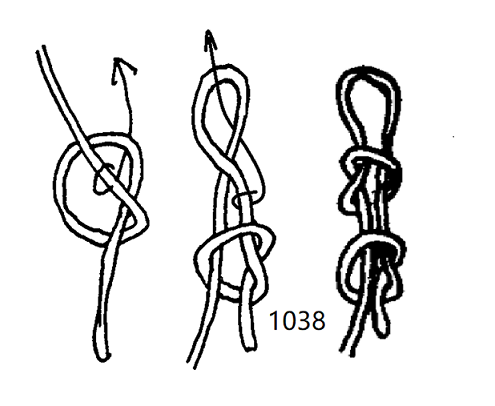
I have the original 1944 Pub version of ABOK. Recently I have noticed an inconsistency in ABOK 1038 (p 189 in my edition) The Picture labeled 1038 consists of four diagrams. The second one, showing the tandem overhand knots, can NOT be reproduced from tying it as shown in the 4th diagram. I have been tying this knot for years finding it easier to tie than ABOK 1053 (butterfly loop or lineman’s loop). I can NOT find any internet description of this knot. Grog’s Animated knots does not have it. Have not researched the largely defunct Knots on the Web (Peter Suber) in a while to see if it is there. Most research including Wikipedia assume the 2nd diagram can be produced from the 4th! Also as most know there is a plethora of names associated with it. GIven ABOK 1039 and following - by implication - it would seem “Englishman’s Knot” would be a logical choice, but most descriptions on the WEB have lead to something like diagram two (tandem overhand knots) Anybody else out there have any insight into this quandary?!
I think the first diagram is misplaced. Diagrams 2 and 3 make more sense as the last steps of 1037, not 1038. Move the first diagram over to the third position (2 and 3 are now the second and last step of 1037, and 1 is the first of 1038) and the series makes more sense. ABoK does have some printing/edit errors.
I can tie it to produce the overhand knots; one OHK has to pass through the other.
I prefer ABOK 1053
I’ve felt your pain, but I continued and also
got the indicated result; and all four images
belong to #1038. [ <–‘below’ => ‘belong’ (edit)]
What one needs to do, upon getting the seemingly
impossible-to-be-right interlocked OHs is fold back
that one nearer to the eye to the away position
(i.e., it’s the tail’s OH to be pulled into the SPart’s
on loading --what I call a “pull-together” structure).
.:. So, it’s a matter of some significant dressing.
(And these images appear elsewhere in the book
–one place, IIRC (w/o notes, now, alas).)
–dl*
I should follow-up by saying that I just had similar
failureS trying to get to the like knot done though
with Fig.8 halves. I didn’t succeed.
–dl*
Gentlemen!
I have seen the light! Dan is absolutley correct. I was born in 1952 and have been tying knots since at least 8 years old and probably discovered ABOK at about the age of 10 years. My dad having served in the Navy just after WW2 taught me some of the basics and I continued to pursue knots mostly through books checked out from the Waco, TX public library. Over the next almost 60 years, I have probably tied every knot in the book - except the fancy decorative ones - at least once and many multiple times. AND YET - in my ‘current’ memory - I have never tied this one correctly!
I always tied it to the point of pulling the bight through the overlapping parts as shown in the last figure and when ‘properly’ worked it would come within one crossing of being identical with the “butterfly loop” (aka "alpine butterfly, yada yada yada) Evidently I just STOPPED there and did not keep reading. And as Dan has said so well you should simply take that “half hitch” at the top and lower it over the overhand loop below it!
What is ironic is that I have actually tied that knot many times on my own and quite recently while simply “fooling” around examining the structure of various loops formed entirely in a bight while recovering from recent back surgery. As Yogi once said ‘You can see a lot by looking’ and maybe I should learn to read all over again!
Another mystery to my mind in the text was the #387 is really a page number not a reference to a singular knot diagram! There the "story’ about the ‘True-Lovers Knot’ occurs. And more wording that my mind stumbled over was that I somehow associated the sentence that starts with “Middle a cord …” with the story of the true-lovers knot. And then in sequel the part that I still think is confusing - “Twist the two center parts one half turn…” In my mind that instruction simply does not fit! There is NO twisting at that point! You simply overlay the right hand bight over the left hand bight (after having already ‘turned down the bight’)
And in my attempts at doing this twisting I often created 1042 - The Figure-Eight Englishman’s loop.
In all my shenanigans and twists and turns I never quite made it to that sentence that started with “Pull the knot that is formed in the right leg down …” Perhaps if it had been more specific and said pull down the ‘Half hitch’ or one more intermittent diagram had showed that step..?
Yes and 1057 - “Bowline on the bight” is one I also enjoy and is actually one my dad first showed me about 60 years ago! Wow to think I perhaps have missed all this for this loooong is quite stunning. I was even once a member of IGKT in my much younger years.
THANKS again for your wonderful observations!!!
You have seen more than the light :: I cannot find
any ‘#387’ in the text associated with #1038, which
I think is what is being discussed. Where exactly is
this peculiar-to-be-a-page# (agreed, if so!) ?
Now, Search finds that #2466’s text does indeed
refer to “page” “387” --I’m surprised (at page ref.s).
–dl*
Here is the text transcribed from my copy of ABoK bottom of p188
(I have jpg images, but are too large to attach without some work!)
1038: The Englishman’s, Fisherman’s, and Angler’s Loop, or The True-
Lover’s Knot. There is a story that goes along with this knot that is
given with Knot #387. Middle a cord, and turn down a bight. Twist
the two center parts one half turn and draw the …
(continue on top of p189)
bottom part of the original bight up through the two legs, as indicated
by the arrow at the right. Pull the knot that is formed in the right leg
down below the knot in the other leg, and draw all snug. Although
tied by anglers for leader loops, the knot is so bulky that it makes
considerable commotion in the water. Number 1017 will be found for
the purpose.
BTW, found this YouTube video on ABOK 1038 via the alanleeknots channel (Nov 8, 2020) titled:
“Fishman’s loop Abok #1038, #1039.” https://youtu.be/ui1uaAHIrxs?t=10
His stuff is really quite elegant! His twisting from the bight turned down position seems to actually match the text description from ABoK 1944 edition. The figures from ABoK-1038 don’t seem to match the text - especially the twisting a half turn.
It is almost as if Mr. Ashley meant to put two different descriptions on how to tye the knot and did not quite finish!
SORRY about that! No actually your videos were very elegant! I do enjoy multiple ways to tie knots. I was just looking for the simplest way. And I have found a way which just casts half hitches over a bight to produce both 1038 and 1039.
And I have found a way which just casts half hitches over a bight to produce both 1038 and 1039.You casts half hitches over a bight to make the last overhand knot. Good for you. You do found another way to tie the knot. I have two photos here, this is common practice, I do all the time to my knots, I call it clockwise and anticlockwise twist. Third and forth photos, is another friendly way to tie these knots, also have a very clear picture to select 1038 (clockwise and anticlockwise overhand knot)or 1039.(both clockwise overhand knot) I have to said Ashley tying method here is the quicker way. 謝謝 alanleeknots
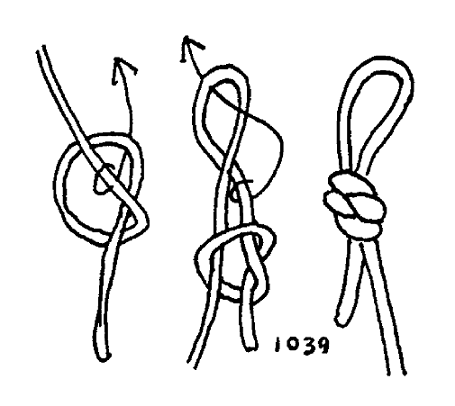
Okay, interesting :: we have corrected/not versions, then.
(I have two at home, which I suppose should differ vs. each other.)
I refer to an on-line PDF copy which has “given with Knot #2420”.
(knot #387 is unrelatedly wrong as being related).
(cf. The Ashley Book Of Knots : Clifford W Ashley : Free Download, Borrow, and Streaming : Internet Archive
Thanks,
–dl*
Good stuff! Your videos and my desire to draw knots has inspired me to renew my learning of inkscape. I have been learning - a life time project - LaTeX also to write math and do nice markup in general. I have done a little TikZ within to do figures, but decided that is probably a steeper learning curve!