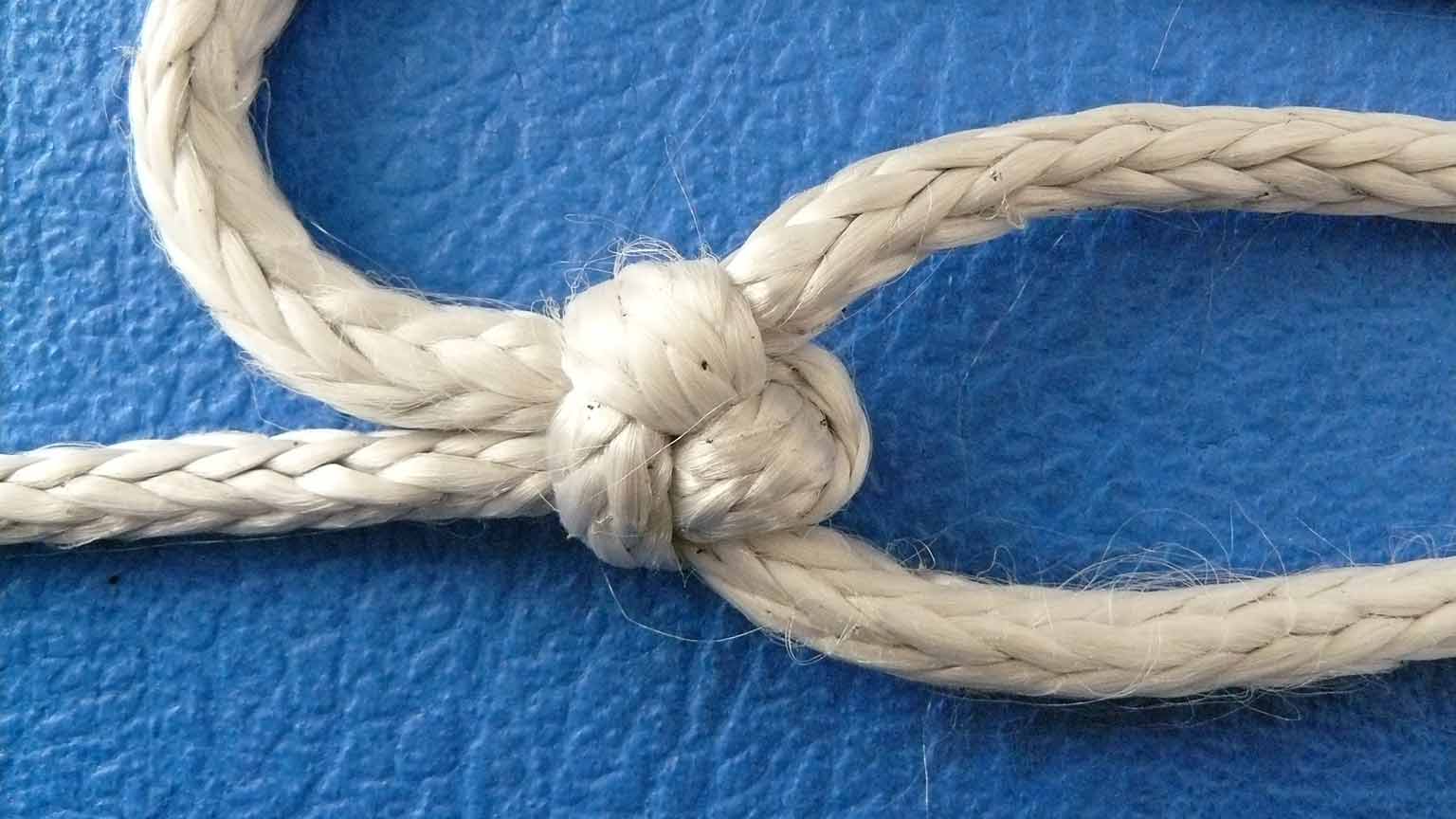
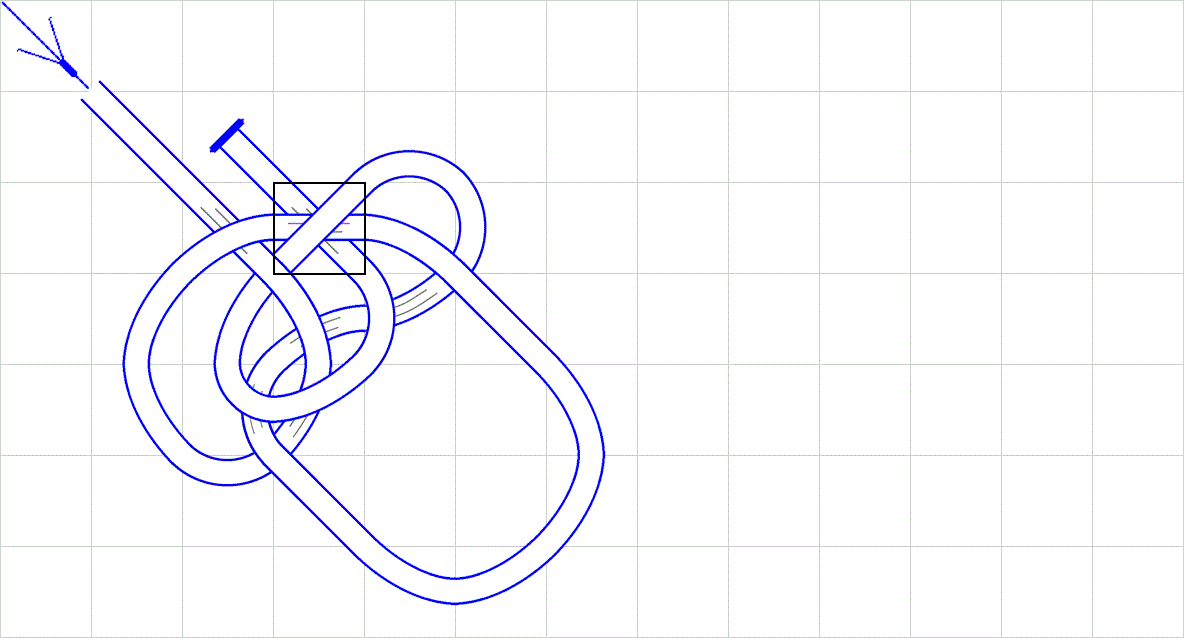
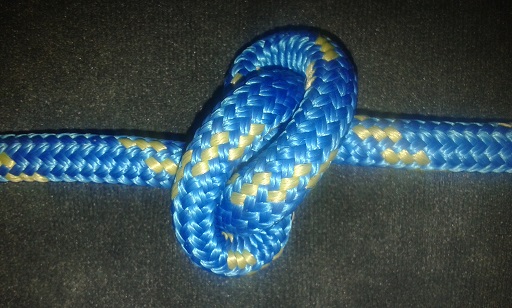
Abok 1424 may fonction also as a PET loop.
First picture;
In rough or stiff material it’s very easy to undo.
I think it must be always tensioned in order to be safe.
On the plus side I suspect that this configuration is excellent for “ring loading”.
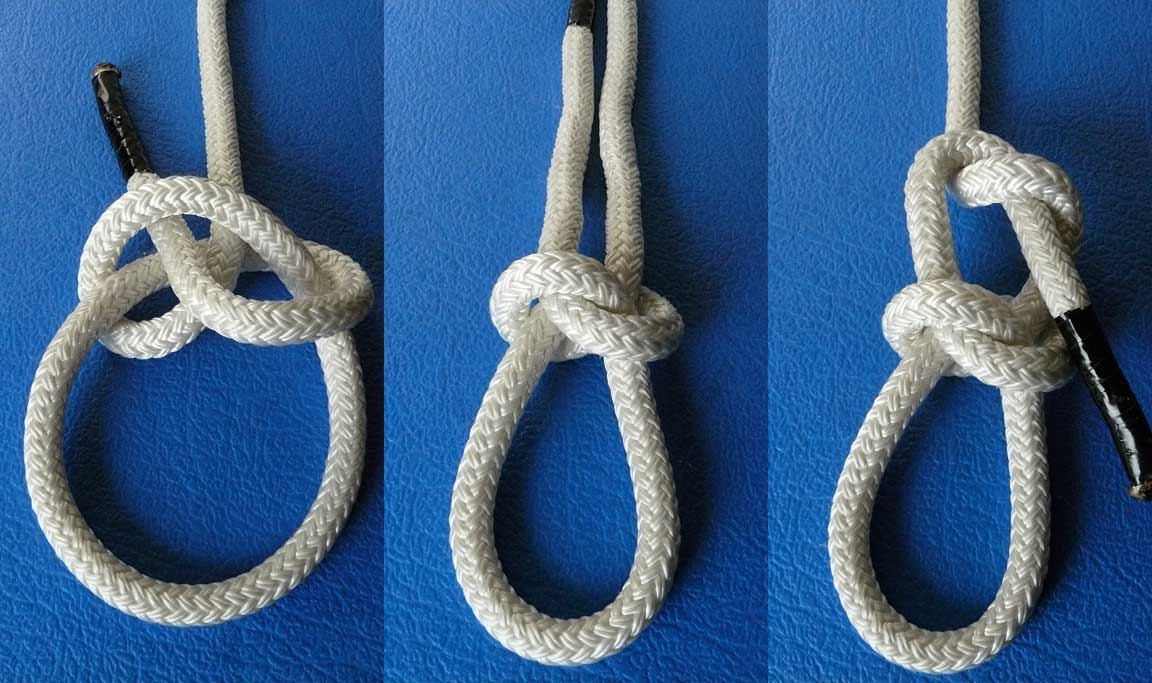
Second picture;
In hollow Dyneema it stay put after a tight dressing, I did a “marlin spike” test on both legs; no slippage at my human scale factor :
Making of ABOK_1424 here; http://igkt.net/sm/index.php?topic=5039.msg33260#msg33260
Note(yes, I know you’ve noticed) that the loop you show us is loaded from the one that corresponds to one of the tail ends of #1424: If you do one untucking of one of the tail ends of #1424 you get the left-handed Sheet bend #1432, but if you do one untucking of the tail end of the loop you show us you get “a loop version” of the Sami/Lapp knot ( http://davidmdelaney.com/Lapp-knot/Lapp-knot.html ), which has the hitching link with the roles standing end/tail end inversed with respect to #1432,compared to the bight that forms the other link.
I think that maybe this loop is the most beautiful result to look at,that one can get from any one retucking of any of the four versions of the Inuit/Eskimo Bowline!( it seems that only two versions of the Inuit/Eskimo Bowline can be retucked by the tail in order to get as result a loop with the knot’s nub symmetric(EDIT:After a few trials I do not think so, obviously this loop has just the only possible symmetric shape of the knot’nub obtainable in this way among the the four versions!)
The human scale factor may be useful to see how begins to behave in general the knot that is being tested, but not to test if it slips tied with ropes in Dyneema.
Luca,
I prefer the abok_1024 route over the eskimo one (which I was not aware of until you pointed this out) to arrive at this loop for one reason; there is no retucking involve, the tricorn shape appears in one shot at the end of the process.
By chance, I had to try only two form of retuck-eskimo in order to arrive at the same result.
Concerning this;
but not to test if it slips tied with ropes in Dyneema.
In my view if a knot slips at a low level load (human scale) in Dyneema there is no need to test it further, but it's not the case with abok_1024 loop; it calls for heavy loading tests, maybe a rich benefactor will come up with new data.
Dyneema enable me to see more quickly if a knot is sound, it's a excellent probing tool.
You seem to allude to a “lanyard method”, which you use to tie this loop, but if so,then you use both the ends(the future tail end+the future standing end) as working ends, which has no practical value with respect to how is usually built an end-line loop/hitch, ie using only the future tail end as working end,leaving dormant the standing end(which can be tens of meters long!),method which in this case inevitably forces to arrive at the “Eskimo step” before the last tuck.
With regard to the tests with Dyneema I will not say anything else because in the end is you that have the material in your hands (I also have a piece of Dyneema rope, but not “bare”),and you know what you want to consider during your tests(and, as you know,also my tests are not exactly orthodox…).
After some"empirical attempt", I think that this loop is the only one with the knot’s nub symmetric that one can get from one simple retucking through the collar among the four forms of the Inuit/Eskimo Bowline,but maybe I could be wrong!
The Irish bowline here( http://igkt.net/sm/index.php?topic=4468.msg28415#msg28415 ), matches the loop presented in this thread;the showed method is a trick-way(or tricky…(EDIT: after having become familiar I must say that actually this method seems not tricky at all!)) to achieve it, but does not seem valid to build the loop around a handle without openings,or accessible openings.
but if so,then you use both the ends(the future tail end+the future standing end) as working ends,
I used the same method as the one described in the link of my first post;
the last “overhand-elbow” is trace with the tag end around the standing part (pre-“wheel house”) then it is embedded through the central opening of the “wheel house” and tighten by the pulling of both loop’s legs.
Except for the last past, the sequence of tying is similar to any pet loop.
I can propose some pictures if this is not clear .
Yes, I think I have figured out how you execute this loop(in effect,reading in your post “#1024 route”,I thought of something similar to the first image attached below).In the second pic are some diagrams that illustrate how is obtanaible the base for the loop starting from the original Wheel House,reversing one of the links.I personally find that using this method it is not comfortable that,as you mention,at the last step the standing end in some way become an active part and change position in order to interweave himself with the tail end.
Luca,
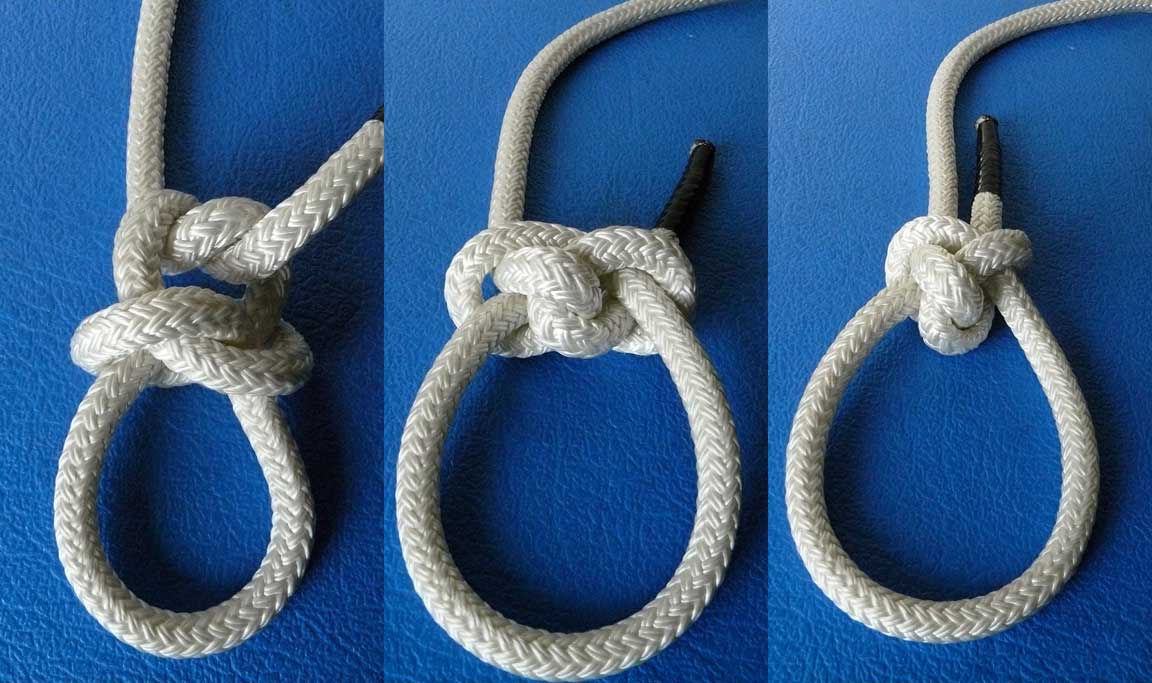
Here are some pictures that I believe will clarify my method of tying the abok_1424 as a loop.
Considering it I tough of giving this loop a nickname;
“Jaws”
An illustration of the mecanism that gives its strength to loop’s resolution.
I joint a picture showing 2 possible routes to achieve the loop.
Forget the first pic at reply #7,with which I just wanted to illustrate the doubt that I had expressed in reply #3,doubt that you have clarified in reply # 6:the third diagram in the second pic at reply #7 is geometrically represented in a different way,but is the same(symmetrical) as the first and second steps in your first pic above.In your photos the “partially reversed Wheel House” is capsized in a(more comfortable)Granny/Grief shape(the jaws,I guess).
I think that in your third pic you want to show the difference in geometric appearance of the structure visible by following your method and following the Eskimo-way method (?).
I personally do not see it that way,please,consider the loads in the second pic at reply #7.
But I personally have doubts even about this:that it is true that this loop is loaded at 100% by the one that corresponds to one of the tail ends of ABoK #1424, which corresponds to one of the standing parts of the inversed of #1424,but is equally true that what in this loop(the tail end) corresponds to the standing part of the other link of the inversed #1424,is 0% loaded.
If we consider the “ABoK #1424 as pet eyeknot” here( http://igkt.net/sm/index.php?topic=4452.msg28227#msg28227 ) as the real loop version of #1424,I would say that the Irish Bowline, if is not the loop version of #1424,is not even the loop version of the inversed of #1424, but rather a loop version of a partially inversion of #1424 (?).
The “corresponding” to a bend loop should have, as Standing End, the one Standing End of the parent bend, AND at least one of its other two limbs ( = one of its two eye legs ) should also correspond to the other Standing End of the parent bend. So, if the Standing End of the loop corresponds to one Tail End of the parent bend, the loop is the corresponding loop of the reversed bend.
Now, you may ask what is happening when, although the Standing End of the loop corresponds to the Standing End of the parent bend, the two eye legs of the loop correspond to the two Tail Ends of the parent bend - or, by the opposite side of the same token, when, although the Standing End of the loop corresponds to one Tail End of the parent bend ( so, to the Standing End of the “reversed” bend ), the two eye legs correspond to the two Standing Ends of the parent bend ( so, to the two Tail Ends of the reversed bend ).
Well, then I would say that the loop corresponds to a third bend, where the one link belongs to the “normal” and the other link to the “reversed” bend, i.e., to an asymmetric bend ( because we were talking about symmetric bends until now ).
Luca,
If you look at the third picture of reply #8 (2_solutions) you will see the correct abok_1424 pattern at the far right. I did represented the other pattern (left) in the making off; Xarax was spot on about it.
In your photos the "partially reversed Wheel House" is capsized in a(more comfortable)Granny/Grief shape(the jaws,I guess).
It is a clever way to consider it.
How about; Toohtless Granny ate an elbow and spit up a stopper?
In the picture side by side; at right; abok_1424 pattern, at left; the reverse.
Last edit;“eskimo_1424_complete” this eskimo if retuck should lead to 1424 pattern
and eskimo leading to the reverse pattern.
In the “1424-ontheright” pic above are represented simply two symmetrical to each other forms of the Irish Bowline,and please note that the reverse of the Irish Bowline(100% loaded tail end+0% loaded standing end) is another identical(not symmetrical) Irish Bowline.
Consider also that the Inuit/Eskimo Bowline in your second pic is the 1(b) version,which do not lead to the Irish Bowline by the retucking through the collar.The Inuit/Eskimo Bowline in your third pic is “neutral” (nor the 1(a) version(which is the version that potentially leads to the Irish Bowline),nor the 1(b) version,because by the pic can not be determined if the tail will come out passing over or under the second leg of the loop(which apparently seems a subtlety, but that determines two results that have two distinct topologies)).
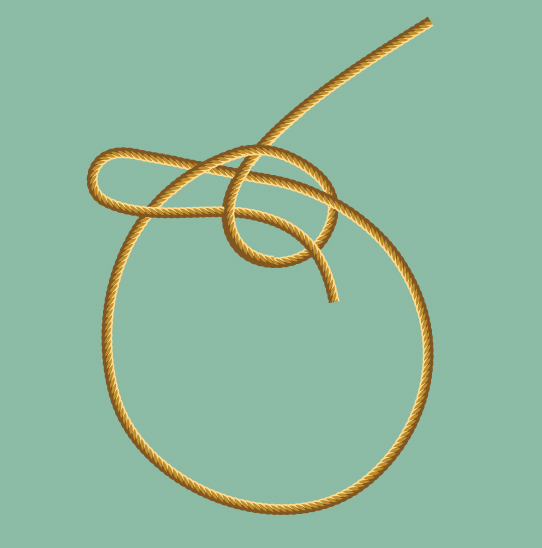
Below a diagram(in red) of the 1(b) version and a diagram(in blue) of the 1(a) version,the one good for obtain the Irish Bowline.
Luca,
I have completed the drawing in order to show you the correct path.
Both of these “to be retuck eskimo bowline” ( I prefer this term ) conduct to the picture I have shown;
In the picture side by side; at right; abok_1424 pattern, at left; the reverse.
Tying and retucking your two example leads to the same final result;
It's the loop at the left in the image; " 1424-ontheright "
No, you show only the beginning of the correct path, but in fact you leave open(at least)four possibilities:
(I take as a reference the dressing of your diagram)
The tail end passes over the first leg of the loop,and over the second leg of the collar;result:1(b)Eskimo.(…Well,yes,obviously)
2)The tail end passes over the first leg of the loop(and at this step the knot has the topology of the 1(b)Eskimo),and under the second leg of the collar;result:a loop that can be considered as the result of a one retucking of the 1(b)Eskimo,which is not the Irish Bowline.
3)The tail passes under the first leg of the loop,and over the second leg of the collar;result:1(a)Eskimo.
4)The tail passes under the first leg of the loop(and at this step the knot has the topology of the 1(a)Eskimo),and under the second leg of the collar;result:a loop that can be considered as the result of a one retucking of the 1(a)Eskimo,which is the Irish Bowline.
The impression that one can get the Irish Bowline by one retuck of the 1(b)Eskimo is misleading, because as soon as the tail passes through the loop’s eye (which in fact forms part of the topology of the knot: imagine to shorten the eye more and more, until the moment in which the portion of the rope of which is formed adheres to the rest of the knot’s nub)the toplogy changes,and the 1(b) becomes the 1(a),and only after this forced passage is ready to become the Irish Bowline with one retuck.(Although I can understand that, from the practical side, it may not be entirely incorrect to speak of “a retuck of 1(b)” in the case that you have presented … in effect we are in the “Pratical Knots” section!)
The knot on the left and the knot on the right in your pic,are the same knot,not two different knots,but the two symmetrical forms of the same knot(but not symmetrically disposed respect to one another in your photo).
enhaut,on second thought,perhaps you’re right:given the dressing of the 1(b) Eskimo that you show,now I think that can be said that also in this case one can get the Irish Bowline with a “technically one tuck” through the legs of the collar:the “passing “under” the first leg of the loop”,occurs consequentially in this unique retuck(at the same time, or even after)!
Luca,
I have shown the 2 eskimos only because you lead me to think that this was I way to “begin the formation of the knot” I tought it was correct and I had not to show the rest of the process because we already know what to achieve in that regard. (your Pic = "Ashley#looped.gif)
The two loop side by side (Pic = “1424_ontheright”) are symetric indeed (what kind of symetry? I dont know) and I have decided of an arrangement where the tags end are at the right of the S part in order to see more clearly the diffence in their structure.
You also have put a new light on what can be considered the formation of the whole structure;
I never saw the Granny, you did
From now on I will always see this loop that way; an overhand-elbow plus a Granny formation acting together to produce the 1424 pattern.
The Granny spit a stopper “joke” was in relation to;
Reply #8 Pic = “first_steps” last frame (far right) and Pic = “Last steps” where you can see the overhand-elbow being absorb by the Granny formation.
But it’s just me you can consider it the way you like