Hi all,
I find this little knot >ABOK 1426 twofold overhand bend< very attractive being small and symmetrical. I wonder why it hasn’t gotten much attention in here as far as my searching goes?
What’s some opinions on it?
Anyone have any real life experience using it as a loaded bend?
It looks to be a Mathew walker tied with opposing working ends.
Scott
I use it, quite frequently even, but only in work where the asthetic aspect is much more important than the safety factors.
It does distort under a heavy load, at least in the string I use, and can become less than completely reliable as I see it.
I have not tested it, but having the two overhand knots changing position enough that the one does not completely cover the other anymore makes me less than certain about knot.
But for lanyards I love it.
I also use a loop version, again where looks are important and heavy loads not to be expected.
Willeke
Scott, how much did you test this? On my first serious pull of this bend, it became jammed. I’d leave it as a decorative-only bend, along with most of its neighbors in that particular section of the book.
Hello Roo,
I have done zero serious testing and I know it will jam tighter than I can undo, but I was wondering if the jamming makes it a strong bend and is it anymore suitable than lets say the double fishermans? Of which can jam pretty well also.
Jamming aside, do you think the forces within the knot make it less suitable for a cordellete or another permanently tied use?
It being so symmetrical leads me to believe the the stresses will at least be semi-balanced.
It can also, in setting, extend from an axis-wise compact knot to something elongated,
in which jamming isn’t such a risk.
but I was wondering if the jamming makes it a strong bend and is it anymore suitable than lets say the double fishermans? Of which can jam pretty well also. Jamming aside, do you think the forces within the knot make it less suitable for a cordellete or another permanently tied use?
NB: A cordelette isn’t necessarily wanting a permanent joint–for the material can be put to
uses other than the paradigm 3-armed anchor structure. Indeed, this paradigm structure
in fact is arguably better left WITHOUT a joining knot, where the free ends emerge beside
the (now just) two eyes from the “powerpoint” knot which brings together the three arms!
(This amounts to a sort of finesse re knotting; it’s a nice one.)
–dl*
Jamming does not make a knot strong, nor does it make it secure. If you are using a knot for a critical purpose, and you’re worried about low knot strength percentages causing failure, then your rope size is not nearly sufficient for the task. If an accidental overhand knot or any tight-radius curvature occurs, you should want your rope to handle it easily and not even come close to failure. Further reading:
Thanks Roo, your page is informative.
So should I gather from these responses that the #1426 is not any good for a bend even with sufficient rope size? I won’t hold anyone responsible for my using it if there is Any merit.
Dan your description of the “powerpoint” knot reads interesting, but I am challenged to picture it in my mind. Anyway you could draw it or direct me to a picture of it?
Much appreciated.
Scott
One thing that I noticed about the bend that drew my attention was how much it slithered as I applied increasing force on it. Even if I thought that I’d only mildly strain the rope such that jamming might not occur, that slithering action would dissuade me from using it. I’m not going to try to reproduce it now for confirmation, as I’d just as soon not try to extricate that bend from my rope again. 
Roo,
I am unsure what slithering action you refer to. I see movement in the knot as it gets tighter, but the movement to me is not so far different from other bends as they approach terminal “slithering”.
I don’t want to be responsible for another piece of unusable cord (-.-) so I will do what little testing I can on my own.
Thanks,
Scott
Well, now, what were YOU picturing (intending) when you cited the cordelette?
To my reading, it is a name used in French I think partly to designate small cordage,
but is of vogue in the rockclimbing world to mean a thinner cord (5mm hi-mod, or
6-7mm nylon) that is paradigmaticly arranged as a closed loop formed into a 3-armed
anchor, with an arm-joining, “powerpoint” knot–usually an Overhand–that essentially
produces a trio of long eyes (anchor “arms”) and trio of small eyes (to be attached to).
–dl*
I sincerely apologize for my misspelled word and my inabiliity to picture the "powerpoint’ knot. What is obvious to one is not always to another, perspective and all that.
I actually do know what the term means, having used the anchor, even if it was incorrectly typed. And now I have learned that the “powerpoint” knot could actually be an overhand knot as well in what is a balancing anchor. Perhaps I could have said using the 1426 in a Prusik cord or anchor line or slings or to join to ends of cord or rope and that would have been better.
Regardless of all that, it was the merits of the knot I was asking about for use in such an application or one that is strained a bit.
Thanks,
Scott
I think that you’re still not getting part of this: now that we’re clear on “cordelette”
(which one can see (mis)spelled variously), I must emphasize that I was never in
doubt about where you intended the #1426 to be,
but you must please understand that in this climbing use I am saying that no such joint
need be made–the ends can be left UNtied (as a non-existent 3rd clip-in, small eye!
–which “finesse” buys one some slight bit of material and knotting efficiency; all of those
long/short eyes are free of knots, but there is just one fewer small eye (two untied ends).
As for the knot in question, I just don’t see any compelling reason to use it.
One might consider substituting the Reever Bend vice Single/Double Fisherman’s knot.
–dl*
Hi Dan,
I think the point is that you of course knew where the knot would be in the ill used nomenclature proceeding this, but I would like to get back to the original post somehow.
I wanted, and still do, to know more about the little knot and as to whether there were any more opinions in this forum as to the #1426’s virtues as a bend.
As for the balancing anchor, I would not use an untested knot.
But we are here to discuss these things as I thought the Guild forum was the place for these kinds of inquiries.
Thank you for the two suggestions.
Scott
I find it difficult to set thet knot such that it retains the sort of (MIS-)illustrated
compactness shown by Ashley,
rather, it inevitably in this firm 8mm kernmantle rope lengthens into what could
be described aptly as a mis-tied SmitHunter’s bend (which one should prefer,
esp. in its better version).
Now, with a good deal of stressing (maybe 300#?), that rope w/knot shows
further distortion, and noticeable torsion in the SParts, and some further movement.
So, it doesn’t find favor w/me.
And esp. when just across to the prior page, bottom, there is 1425 (no “a”) !
–dl*
Hi, I use my tying method to tie the ABOK#1426, and found that it resmebles the Hunter’s Bend ABOK#1425A. The #1426 is with its’ ends crossing whick is unsecure. The ends crossing in the HB are good. I think ABOK#1425A is a variation of ABOK#1426. The variation by Xarax’s is difference too. See below thread.
http://igkt.net/sm/index.php?topic=4561.msg29537#msg29537
yChan

Hi dear all, base on the characteristics of the ABOK#1426, I beleive the Rigger’s Bend #1425A was a modification bend from #1426. Comments are welcome.
yChan
Indeed… The current designation of #1425A for Riggers bend could have been (instead) #1426A!
With only a minor re-positioning of one tail (changing where one tail feeds through the structure) you do end up with Phil D Smith’s Riggers bend.
So I think that what you say has merit.
It is also possible to surmise that Phil Smith might have accidentally tied Riggers bend while fiddling with #1426…and he had a Eureka moment  Although there is no history reported about how Phil Smith was inspired to create his bend or how he came up with the idea. I think the creative spark/inspiration can give us clues to how some knots were discovered (even if it was by accident or through just ‘tinkering’ with ideas).
Mark G
Yes, I agree the Rigger’s Bend (Hunter’s Bend) should be coded as #1426A, for it is a modification of #1426, and also by the reason that #1425A is completely different from #1425 Ashley’s Bend.
yChan
Here are photos for the outlook of these two bends.
yChan
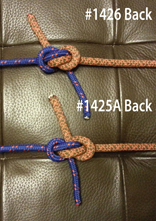
Hi siriuso,
if we talk about tying methods, to my mind the 1425A is close to #1452 too.
In my (old) italian edition of the ABoK there isn’t a 1425A and when I knew the Hunter’s Bend I drew its diagram as #1452bis.
Why?
(if you want you can stop and think about it, if you already don’t know it, or you can go ahead  )
)
They differ “only” in the exit of the tails: I mean the Ashley’s Bend (#1452) and
the Hunter’s Bend are composed by 2 like-handed loops, the WorkingEnds of
the second loop enters from the same side of the other WE but the 2 ends
exit from the same side in Ashley’s and from the opposite sides in
Hunter’s!
Please try tying these 8 bends (perhaps you already have done this):
start from a first loop, then tie another loop entering in the first in
- 2 possible ways (the WE of the second loop enters from the same side of
the WE of the first loop or from the opposite side)
then tie - 2 possible different handed loops then consider
- 2 possible ways the WE/tails exit from the central part of the 2 loops
(you can see also
http://igkt.net/sm/index.php?topic=3204.msg19380#msg19380 )
However I don’t understand too why the Hunter’s Bend was named #1425A,
#1425 is the reverse of the false Zeppelin X (X=crossed tails),
(maybe I was able by changing some crossing to obtain a reverse Hunter’s Bend but now I don’t remember how :-\ )
Ciao,
s.
p.s. Perhaps Ashley didn’t like bends with ends exiting from opposite sides…there are only a few of them in ABoK and often they are for using with twine!?