If you believe you have invented a new knot, please post photos/descriptions for further assessment. If the claim is disproven, the thread will move to a more appropriate board.
Hey there, not sure if this is the correct place to post this?
The attached images are of a knot which ‘self-tied’ into the tail of a 10 meter rope I was, perhaps vigorously(?), coiling and which I’d never encountered before. I felt it had an elegant symmetry and simplicity that appealed.
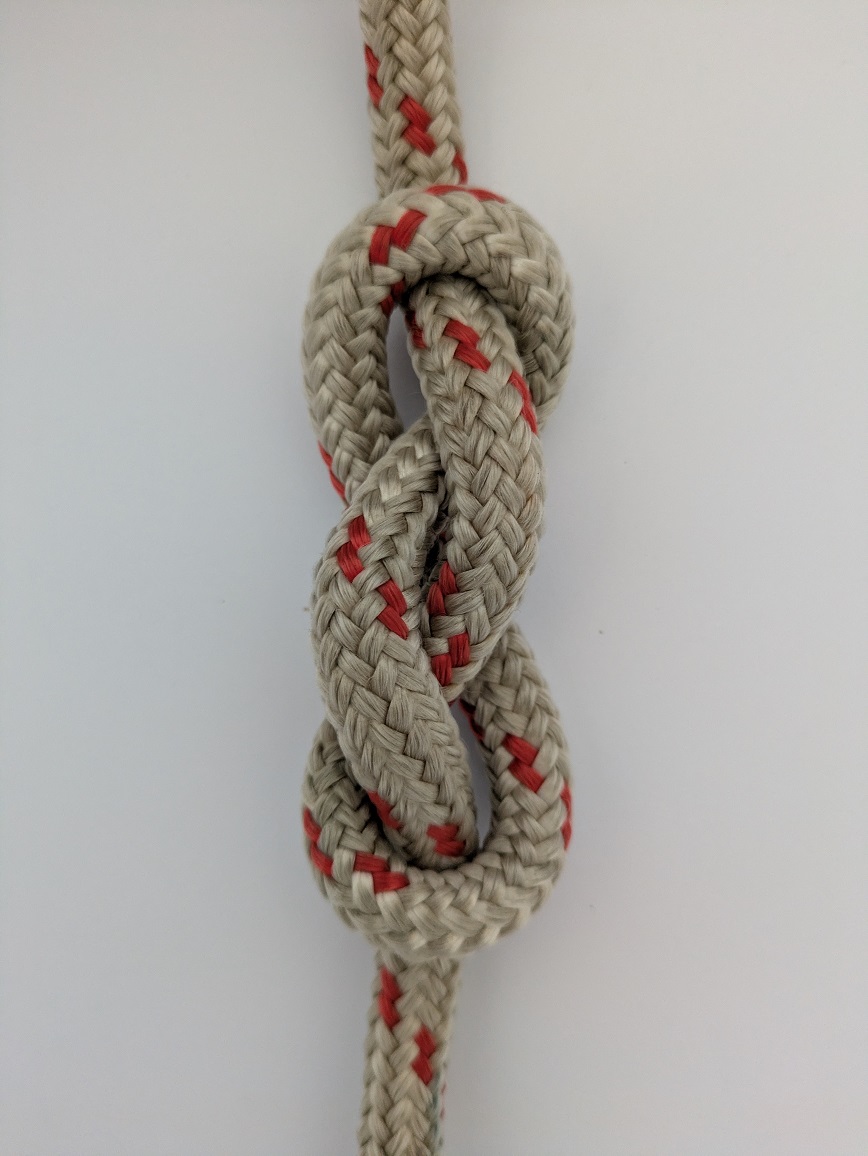
(Oops! I unwittingly attempted to upload six images and was blocked by the system. I have left the ‘Loose Front’ view above - as it is perhaps the most explanatory as a singular image - but have also a ‘Loose Rear’ view, a tightly gathered ‘Final Lay Front’ and ‘Final Lay Rear’, plus two diagrams I’ve drawn showing the simplest means of tying it that I’ve so far worked out.
To attain ‘Final Lay’, please simply pull upon both standing and running ends, whilst encouraging the top and bottom loops to come together at the center of the knot.)
Further examination revealed that it bore similarities to both a Figure Eight Knot and a Barrel Knot - so for now I’ve termed it the Bastard Child. However I don’t for a minute think that it is previously unknown or unnamed, and I wondered if perhaps any of the IGKT Forum readers recognized it at all please?
I do feel it might make a very fine stopper knot, with perhaps firmer ‘seating’ in application than a Figure Eight, however I’m not especially familiar with the Barrel Knot, which may perhaps be it’s superior? Anyway, I do think it’s rather lovely and adore the fact it came into being of its own accord.
Any comments or feedback most graciously accepted with thanks!
1 Like
What you show is a Strangle knot, which is a form
of a double overhand’s topology. E.g., with a bit of
nugding, you can tranform your knot’s state into
an Anchor Bend. (Both of these, I should note, can
be as you’ve shown devoid of any object, or as hitches
(the Strangle qua binder, better) to an object. (I’ve
seen the Anchor Bend qua stopper in many conch
pots & other commercial-fishing rigging.)
–dl*
==== *
Hey Dan,
Thanks so much for that feedback. There’s definitely some knots in your reply that I’ll have to look into. You mention (and I know the terminology can get used with abandon) that ‘mine’ could tumble into a Anchor Bend, but I always associate ‘bends’ as ‘joining’ knots and I couldn’t quite see how that would work - but I’ll definitely have a play. Plus it does certainly seem to me to share some similarities with a Hunters Bend. I had also played with ‘mine’ briefly as a hitch, though I felt it looked a little too close to a Constrictor for comfort!
I can also see I’ll have to ask you about the knots I observed (I have a photo somewhere that I can post) on the ropework around a spherical glass net float - simply beautiful.
Many thanks again for some starting points in tracking it down more - the topology, as you mention, is worthy of some play to find other config’s!
Best, Phinix
that ‘mine’ could tumble into a Anchor Bend, but I always associate ‘bends’ as ‘joining’ knots and I couldn’t quite see how that would work
But “bend” is a confused knotting term :: Dana, e.g., (and at 1841? is an
old source --also an intelligent one) has the verb meaning essentially
“make fast to” but the noun he limits to joining ends --an unhelpful
contrast. SO, I move to using “joint” for end-2-end knots (and see
“junction”/“jonction”? used elsewhere, a supporting use).
Tie the Strangle around a rigid object and then you can
re-dress it to the non-symmetric Anchor Hitch form
–though both such forms (and the Anchor one loaded
from either end, though asymmetric) occur as stoppers
out In The Wild (away from the half-imaginary world of
knots books).
it looked a little too close to a Constrictor for comfort!
What’s your discomfort in this?
Neither is well suited qua hitch, but can work.
BTW, your query is right in thi New-Knots Category,
but not as a Reply to the Category top thread,
but as its own new one within this category.
–dl*
====*