Been experimenting with bowlines and ended up with one I haven’t seen anywhere. Appears to be very sturdy and its not too complicated. Could be handy if you need easy loop adjustments (one loop gets bigger and the other smaller). Thought I’d share it to see what you think of it. I apologise if this knot is already known and used but I haven’t seen it yet. Please educate me if it’s already known.
It is essentially untested (as far as I know) so please use it with caution!
Step 1 Start as you would with a normal bowline. Make the first loop and pass through it as you would normally but don’t “go around the tree”. Start to form your two loops as shown.
Step 2 After forming the two main loops, pass the working end through the knot loop again in the normal direction. Leave enough slack for completing the bowline and adding the yosemite finish.
Step 3 Complete the bowline and make sure you pass through the extra loop as shown to come out under the two right hand loop strands.
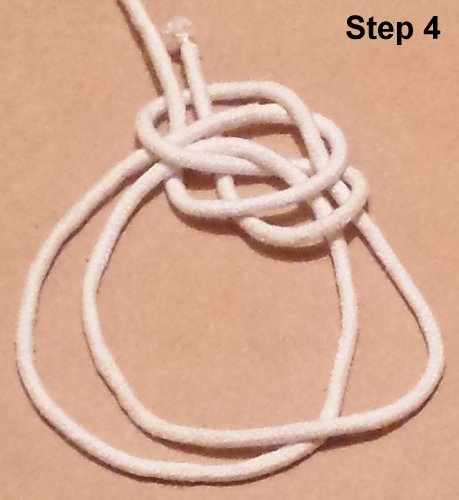
Step 4 Add the yosemite finish which is essentially a figure 8 made in the working end (Make the knot slack enough so you can cleary and definitely confirm this figure 8 and its not as intimidating as people make out). From step 3, come up over and left of the two right hand loop strands then down through the centre of the big loops, up and through next to the standing end to complete the yosemite figure 8.
Tighten the standing part and loop first then the working end. Tighten down the knot and make it as snug and neat as you can. Like many knots it’s best to tighten it in stages to make sure it stays neat and properly constructed.
Continued below due to attachment restrictions per post.
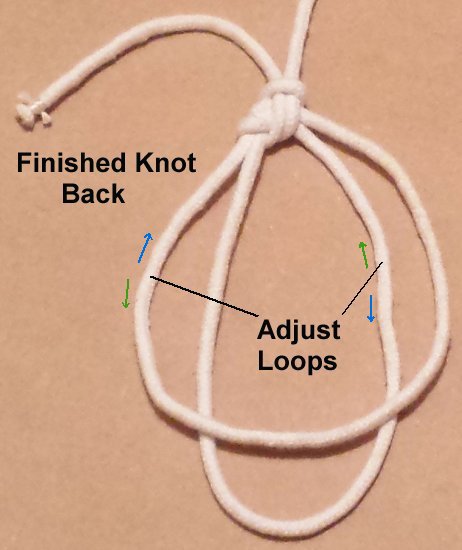
You can adjust the two main loops by using the lower left and upper right strands as shown when looking at the front of the knot. Should always be these two if the knot is tied and tightened correctly and the opposite on the back of the knot. I know step 4 picture shows a different order but as the knot is tightened those two loop strands on the right will naturally swap over each other.
I’ve tied this with 6mm cotton braided sash cord (cotton core), 1/8" paracord and 1/4" blue polypropylene rope (a staple of many industries). With natural materials and high friction the loops will be easy to adjust after tightening the knot but harder or perhaps impossible to adjust after any considerable strain is applied. I can still adjust it after pulling as hard as I can but haven’t put any real weight on it. Cotton sash cord isn’t the strongest of stuff anyway.
With paracord and blue polypropylene and less friction the loops are easy to adjust after pulling on it hard, but may jam with heavy strain. Perhaps best to get the loop sizes set before putting any heavy strain on either or both of them. Very easy to adjust initially though.
With all materials though this knot appears (so far with my own pulling strength) to lock either loop under strain, even with the other unloaded. The loop adjustment may slip with higher strain if one loop has no load at all, I’m not sure yet, but the knot cannot come undone if it does slip. Will just extend one loop and close the other. Possible shock loading resulting however.
Please do share your thoughts and experiences if you try this one out.
Edit:-
After more experimenting I’m finding this knot to be particularly good in 1/8" paracord. Tightens down very nicely to form a good looking compact knot and locks either loop with 100% load on one loop and 0% on the other. I put almost my body weight on it and it didn’t slip but I could still adjust the loops afterwards. I reckon at close to maximum load if you don’t exceed 75%/25% load split between the loops it should not slip at all.
You can add extra loops to this bowline (like the Portuguese) and with each additional loop added, the knot’s loop locking tendency will decrease. I tried with 3 loops and it was good. I reckon 4 might be the maximum you’d want to use. Beyond that it becomes messy and impractical.
The knot described is usually known as a Portuguese bowline. The number of loops can be increased to form a more comfortable lifeline around the waist.
It is very similar but not actually the same. I’ve attached a photo of a Portuguese bowline (as illustrated in Ashley’s, page 193 #1072) at the same stage as my “Step 2” and you can see the differences - the second loop doesn’t pass through the small bowline loop, it just sits over it. Also in my version above the working end doesn’t pass through that loop at that point.
Edit: After experimenting with both versions I’ve found that the Portuguese is much easier to adjust with natural materials after strain has been applied. When this knot was used for its intended purpose only natural materials were available so it suited their purposes well. It will auto adjust as weight is placed on the loops which is just what you want if its round your waist. The version I posted tends to lock easily with natural materials so would not have been much use to them for what they were doing.
Interesting because Ashley’s version is used when multiple loops are required eg to place around the waist and soften the feel of a single rope yet commonly the 2 loops are shown passing through the nipping loop - a simple bowline with another turn made rather than the method shown by Ashley.
That said I am not sure of the advantage of having independently adjustable loops which are used separately. The ‘bunnies ears’ knot is used when two anchor points are required in case one fails (I am sure there are others too) but it would help if you could give an example of a practical application of the knot you propose.
Sweeney
Edit: I have just noticed that a 2 loop bowline with both turns passing through the nipping loop is called a French Bowline in Knots, Splices and Fancy Work. This is also the case on a couple of websites after a quick look. Naming knots is the way madness lies!
Nice sleuthing there Sweeney. Found it now and it is indeed a French bowline. Good to put a name to it. I Haven’t got that particular book and although I searched extensively online for “bowline” it never threw up any mention of the French version. As soon as I typed in “French bowline” however, there it was. You’d think the word “bowline” on its own should return results for every kind of bowline. That’s internet search engines for you though.
As for a practical use, my version with the Yosemite finish which captures the extra loop has demonstrated a very good locking ability in natural, high friction materials. I could put almost my body weight on one loop alone with the 6mm cotton sash cord. So long as you recognise the potential for slippage, as both loops communicate directly, and don’t subject it to heavy loads or a hugely imbalanced load split, it could be handy in some circumstances.
I’ve had some varying results with blue polypropylene and paracord though. If the knot is made up very tightly and had load on it to really firm it up, it will lock individual loops quite well but not reliably so. The amount of lock or slip varies a lot in synthetic materials so not to be relied upon. Again, could be useful in some circumstances?
Amazing how many bowlines there are. I’m still finding new versions out there and just happened across the Japanese today. A decorative knot but still a bowline.
Alan Lee and Xarax were and are keen tyers of Bowlines and indeed many other interesting knots.
Xarax is not posting on this forum anymore but his work lives on… many of Alan Lee’s creations are fine examples of what people can achieve.
A lot of people contributed to the Bowlines paper (still freely available on the PACI website)… and in the process of the long development history of that paper, a few remarkable discoveries were made.