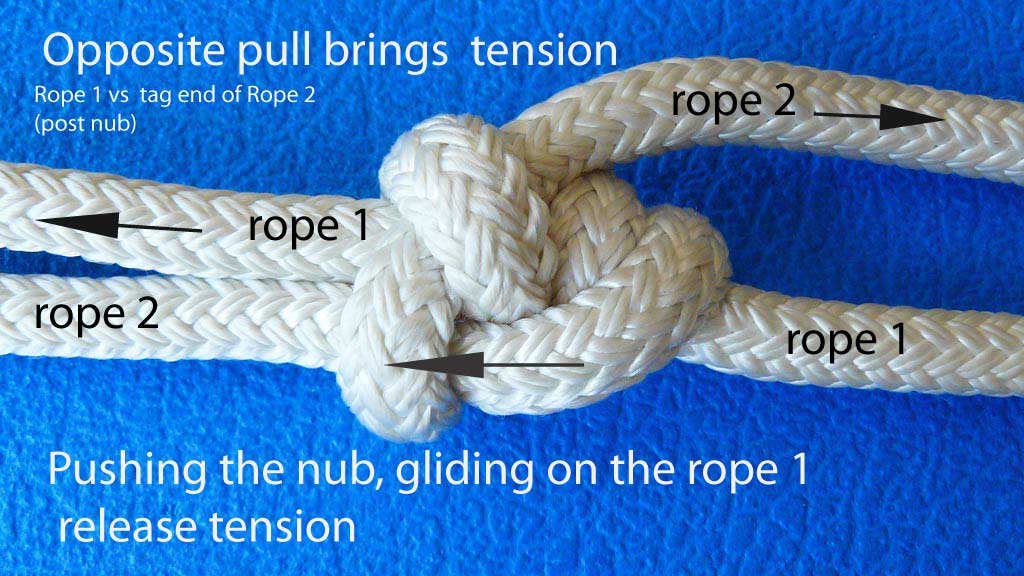
adjustable grip bend

I probably should have asked earlier, but how much length of rope in terms of diameters of rope are we permitted to use? In other words, measure how far the first rope overlaps the second rope, and divide by the rope diameter.

I’m not sure if a single small loop acting as a pulley simulator would use too much rope for your preferred solution.

Ok so I tried a bunch of things with 5/16" diameter double braid rope and here is what I found

The locked double cow hitch doesn’t work for this application at all! It’s hard to tie, hard to dress, hard to set, and then slips pretty easily for an inline pull. I tied the cow hitch two ways: in the bight, and thread the end. Both ways take a while to tie, take even longer to set, and then they don’t do the job very well [gotham burns, joker gets the poor girl]

[modified 5/8/15: Xarax informed me that I misunderstood what he suggested the locked double cow hitch for… he never asserted it was good a a gripping hitch for an in line pull, so no wonder it didn’t work so well when I tried it that way.]

I tried a single rigger’s hitch. Much quicker to tie, much quicker to dress, and doesn’t slip as easy as the LDCH… but it did slip. Tying with an extra wrap (a la the camel hitch) was better, but still didn’t hold well enough for batman! I tried two back to back rigger’s hitches, and the system improved a lot (ashley’s “adjustable bend” 1472 but with ABOK 1735 instead of 1734) but it still slipped a little when I bounced on it. And I think the OP was hoping for a “single nub knot” solution.

Then I tried Blake’s Hitch

http://www.animatedknots.com/blakes/

The true “Batman Bend” has arrived :slight_smile: Blake’s Hitch did the best of all, by far. It’s quick to tie and set (not quite as quick as a rigger’s hitch) easy to take tension with, and then doesn’t slip at all! I couldn’t get it to slip one bit, I even put my full body weight on it an bounced! I tied the “basic” two wraps over two wraps version… more wraps (two over three, three over three, etc.) and the Blake’s Hitch would perform even better.

Then I tried it in some tiny 3/16" hollow braid string I had on hand, and same behavior, no slipping, easy sliding to take tension. And as an added bonus, it doesn’t jam. Very easy to loosen up by “thumbing the bridge”

Roo. I think you called it first, you’re link lead to the blake’s hitch, even if you didn’t use the name.

In my comic book the Joker was trying to ruin gotham with two ropes of the same diameter, but it wouldn’t matter if they were different sizes. Batman would blake’s hitch the smaller onto the larger, and Gotham would still be saved.

I tried the Blake’s hitch in 11mm static kernmantle as the “batman bend” and it worked great on that as well. (I used the 5/3 version, two coils on top-around only the hitchee rope, and three coils on the bottom-around the hitchee rope and the tucked tail)

[I modified this post from what I originally posted]

You are taking this too seriously. (Hint, look up Gotham city on a map. :wink: ) As I said, I will not give numerical specifications nor certify when those specs have been met. The question is one of principle and some solutions will be better than others. I’m afraid I haven’t had time keep up with all the replies so far, maybe soon. Xarax was right in describing that the ideal solution uses a single nub. I’m not looking for the most mechanical advantage possible in spite of the valid arguments for why it might help an aspiring super-hero, just a minimalistic bend/mid-air binder than can be tightened/tensioned relatively well/easily.
It seems to me the structure must have, as most tension-adjustable knots do, some moment arms. The two standing ends cannot naturally point at the center of the knot but must be offset in opposing directions creating a torque around the knot that kinks the rope. Maybe it is possible to increase this torque by increasing the natural parallel separation of the two ropes. The tails, when pulled, should counter that torque, straightening the knot and somehow removing friction when they do it, allowing one to pull the tails to tension the ropes. There could be other ways, maybe, but this is what I envision I guess and it’s kind of what the AGH does do. I’m certainly interested in things that do it better, and yes I also found xarax’s simple double half hitch quite interesting, even if it had some significant strikes against it. I don’t imagine it will qualify as a “practical” knot for many people.

xarax

t works far better than the climbing hitches, which need to "bent" locally the main line I little bit, in order to hold. If they can not, because the line is very tensioned,..

Xarax I think you are a little off track. This is the kind of thinking one should have for a taut-line hitch or adjustable grip hitch used in the usual way where the knot is tied from a tail onto a tensioned main-line. That is NOT what we are doing.

We are tying the knot from one tensioned main line to another where there are no tensioned tails. It is not hard to bend the tensioned rope at the knot, because one end of that tensioned rope is not tensioned at all. The rope is not tensioned THROUGH the knot. It is only tensioned TO the knot where it transfers 100% of its tension to the other rope. There is no through going tension trying to straighten either rope through the knot. The only path which is pulled straight is the path from one rope to the other. If the knot has a moment arm, each rope WILL turn at the knot, no matter how much tension is applied to it. Oddly enough, this is why the tautline hitch actually doesn’t work in this situation (not without two of them). It seems to gain friction by torquing against the tail. When the tail is let loose, so is the grip.

I talked about increasing torque, but we also want that torque to translate well to kink. I think you need a structure like this:
|
|
|
|
| |
X |YYY|X
X |YYY|X
X |YYY|X
| |
|
|
|

The X’s should form a hard sharp cornerd barrier so when the knot is pulled the line must kink hard around them. Th YY’s should be wide to increase torque, pulling the tails will counter the torque, straighten the knot, and tug the ropes through, but this is far oversimplified I think. This picture doesn’t look perfectly like an AGH because, well it’s basically impossible, but it looks much like one. A real solution can probably not be symmetric like my picture because one side must be used to tie all the X’s and Y’s. Both ropes don’t need to slide for it to work either though. If there is an obvious improvement point for the AGH, it is probably the exit angle of the working end tail, maybe retucking it back to the other side could help. A sort of double agh.

Xarax: I believe I understood Tex’s intention of his original post:

You've [Batman] got to tie these two ropes into one AND pull them tight, and do it fast, to stop Gotham City from crumbling into oblivion. There's not enough time nor rope for a trucker's hitch.

I originally thought that a Rigger’s hitch would do the job, but in playing with it, I found it not quite up to Batman’s needs. It is better than a rolling hitch, but not enough to thwart the Joker. Then I tried Blake’s hitch, and found that it does exactly what Batman (and Tex) need: join the two ropes and pull them tight fast.

My apologies if pulling a trusted and widely know knot out of my utility belt is not creative or obscure enough of a solution for your comic book :wink: In my comic book, Batman pulling a 2nd rope out of his utility belt and tying a rat tail stopper unfortunately leaves Gotham and the girl it evil grip of the Joker. I agree with Tex, that you’ve gone a little off track, with your talk of rat tailed stoppers, and locked double cow hitches.

I’ll play with the Prohaska hitch again. It has a structure similar to an AGH, better, end placement, less moment arm, a bit harder to tie, just requires playing with it. I really don’t like calling it Blake’s just because it might be easier to say, which I think is the real reason it’s called that.

Xarax, I didn’t exactly try to follow the upperside/lowerside directions, but I don’t have to, because I already know your point (specifically and in general terms). These knots were not designed to be used this way. Ideally we’d like to just tug the tails to tighten and that’s not how these knots work. I tried to re-rig an AGH to be better suited (it already works pretty well), but all attempts in the end require tucking the tail through the part of the knot taking the most tension from the tying rope, which ends up locking up the knot every way I tried to do it. When it doesn’t lock up the front end, the tension usually passes through to back end and locks up anyway.

So… I’ve tried to cook up a couple of new knots. One seemed really like it was working great the first 4 times I tried it, but now not as great so maybe there is a dressing issue, or I don’t know. This particular one, has both standing ends emerging from almost the same point, the tying rope tail also emerges from the same place, and the through-rope tail emerges on the other side of the knot which is mostly helical as with many of these (which almost tells you how to tie it). This forces the through rope tail to stick out at 90 degrees when the knot is tensioned but pulling both tails lets you straighten it out and slide it. The concept is pretty good, but apparently it needs work or investigation still. I might resolve it.

There are other layouts that can be explored for this, and basically I think they just aren’t represented by the existing tensioning knots.

Still, the AGH really does decently. I’m having trouble being as convinced about the Prohaska but I haven’t met my requisite 12 ties with it.

@Tex
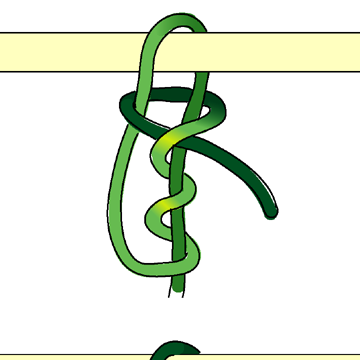
I grabed this Adjustable grip hitch sometime ago on the web.
I dont know the name of this thing.
Did some trials in the spirit asked for the task.
It worked.
So the ends of 2 ropes joined with a bend who can act as a “tensioner” too.
Picture 1 = the Adjustable grip hitch as a loop
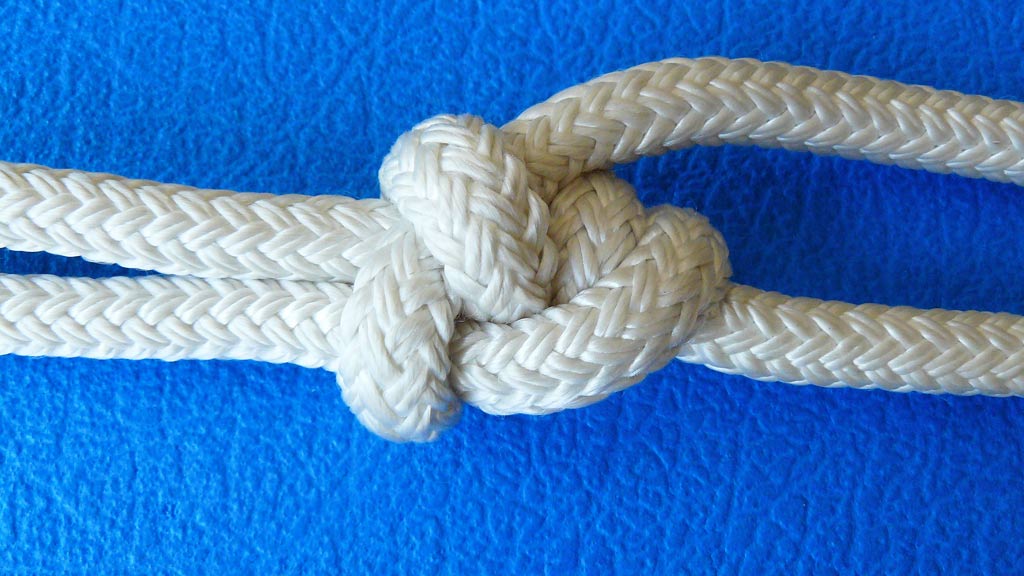
Picture 2 = the Adjustable grip bend
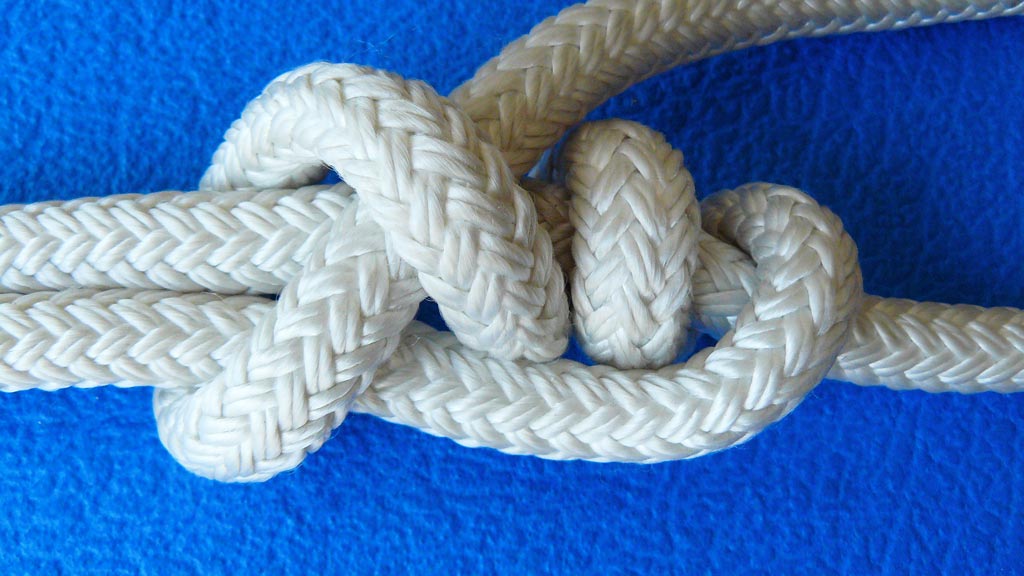
Picture 3 = the Adjustable grip bend loose form


Adjustable_grip_hitch_knot.png

Unk_1.jpg

Unk_2_loose.jpg

Yes enhaut, this was the point of my first post, and still probably my favorite established solution. It is nice to have some pictures to go with it. I think I’m tying it with one more twist, but this is pretty standard variation.

oh, and the name of it, if you’re asking, I can’t quite tell, is …
the…

Adjustable Grip Hitch.

It’s kind of confusing. It’s like a car model named car.

So aparently I haven’t been clear.

enhaut’s knot is what I’ve been talking about this whole time, and NO, not two of them, and no, no loops. You just tie one of them, like a bend, as shown.

It works surprisingly well xarax. You should try it. The tautline (rolling) hitch cannot work this way. It fails badly. It MUST have two, one in each rope, OR must have one tied around a loop so that both eye legs of the knot are tensioned. The AGH works impressively well WITHOUT the outgoing eye leg (the tail of the trough-going rope when used as a bend/binder) under tension. That (discovery?) was the whole point of my first post, well, that and opening the door for other suggestions of course.

enhuat’s 3’d picture is all there is to show.

The bottom rope goes off to the left. The top rope goes off to the right.
One rope goes off to the bottom left with a tail to the top right. The other rope goes off to the bottom right with a tail to the top left.

This is exactly what I (and he) tied, and it works, quite decently. There are two remaining tails, one up and right in the picture and one going off to the left on the top. You pull them away from each other to tug on their respective ropes and tension the lines. That’s it. There is no more picture to show. The thing holds tension impressively. Its biggest weakness is not tightening as well as it could because the knot doesn’t straighten as well as it could when tugged.

As you mentioned before, this is surely dependent on the rope used. I’m just using lousy mason line.

Xarax,

If by part you mean knot part of the knot. Ok. I’m talking about exactly what you see in that picture. I don’t care if you call it a bend or a binder or a hitch or tensioner or jello pudding. There are two lines in that picture. Imagine they are two separate ropes. That’s it. The top one is tensioned from the right. The bottom one is tensioned from the left.

What I’m saying is, you can tension these two lines together with this and it will hold them together darn well. After you’ve tensioned, you no doubt have enough line to tie a stopper knot behind it too.

Try tying it this way xarax before talking about what you think should happen.

No, the tugging doesn’t provide ideal unlocking, and I don’t know, on grippy enough rope maybe it’s not unlocked at all, but it’s much less locked than when you aren’t pulling the tails.

Of course tugging tends to tighten the knot down around the through rope. Obvously it’s not as unlocked as an unweighted prusik, but with a straight line path, the through rope can still slide easily enough. You can intentionally tighten up the knot by tugging perpindicular, and afterward, you will still be able to slide it, yes, with some significant friction.

The “locking” I’ve been talking about though is just kinking the whole path and how that changes when tensioned by the two lines, or when tensioned by whatever “handles” you can create (one of which needing to be the tail of the through line)

There is an initial point where the knot tightens down significantly obviously, but what I’m saying is even after that, then it works in a pull to unlock, stop to lock mode.

Yes, probably if tension became MUCH higher (using winch or something) it would close down even more, but I would bet, that with a rope with this level of friction, the friction would increase, but in proportion to the tension. If the friction is always 30 percent of the tension, then you always have to pull at 130%, but never more. So long as you can pull harder, then you can still tension more. The knot only becomes more locked if the FRACTION of friction relative to tension becomes higher. To my hands, after the truly initial pre-tightening, I just don’t feel that happening. I will always get 70% of the tension I put it, or maybe it’s only 50% but whatever it is, that’s what I can get. It will always unlock that well.

Oh, and yes, the knot I’ve been working on does resist tightening down to some extent, sometimes too much, so that the hard barriers needed for stop-lock, don’t work if not dressed and pre-tightened well.

No you don’t get it. If you did you would be asking:

How exactly DID you tension those lines?

, because I did. And I then untensioned it, slid the knot around the rope by pushing the nub itself just to play with it. Twisted it directly to feel it lock and unlock, and then went back to using the same already tightened knot again to re-tighten the line in the same way.

AND, last but not least, HOW ON EARTH can you manage to "lock" the hitch exactly when the tension in the two lines is what you want it to be ?

Well which locking. The knot tightening locking I already explained, both what I see and why I think it works that way.

The line tiwsting lock is a different mechanism. The knot presents a straighter path with tensioned by the ropes than when pulled by the tails. You stop pulling and it locks. I’ll gladly admit it’s less clear with the AGH than with some and it ends up being a combination of the first kind of friction (which stays under control as explained) with the second kind, which turns on and off when you want.

These types of knots are very subtle. There are MANY little things going on and I’ve been fighting with and learning about several of them in trying to build a better one. I might not manage to build a better one, but I do think a better one exists.

Well Xarax you lost me at “this is not a bend”
If I cut a loop I obtain a bend no?
First picture = cutting a loop
Second picture = tensioning process
Sorry if I was not clear enough the first time
Ps
Second thoughs ; In that case since the rope 1 does nothing more than receiving a hitch maybe it’s not a bend…


Steps_Unk_1.jpg

Man do you have to take everything so literally? The word expedience really seems lost on you. At a very fundamental level there is to first order a proportional connection. Yes, many things change that. It doesn’t matter. The point is that you cannot simply argue by words that this thing must have some tension limit on every rope. It locked on your rope before you wanted it to.

On mine it locked a bit before I “wanted it to” just because yes, there is some loss, but not because more strength wouldn’t have tensioned it more. It seems clear to me that more strength would have tensioned it more, but apparently the winch quip also didn’t make it past your literal filter.

If it was locked do to tightening, then either a) the tightening is elastic and releases when you quit pulling or b) I shouldn’t be able to slide the knot looser, but I could, or c) there is a wedge mechanism in this knot that makes it the anti-batman knot.

A) is the only one that makes any sense but I won’t comment further about that until you confirm.

I only know what happens on my rope, not yours.