Hello mobius, I have added more key stroking content to my post at reply #14.
Would be good if you could also consider changing the title of this thread from ‘Knot wars’ to ‘Load testing of various Bowline structures’ (or something with a more scientific bent).
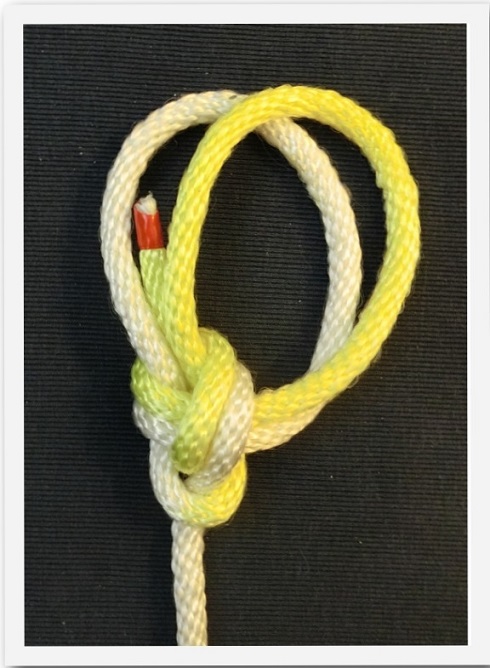
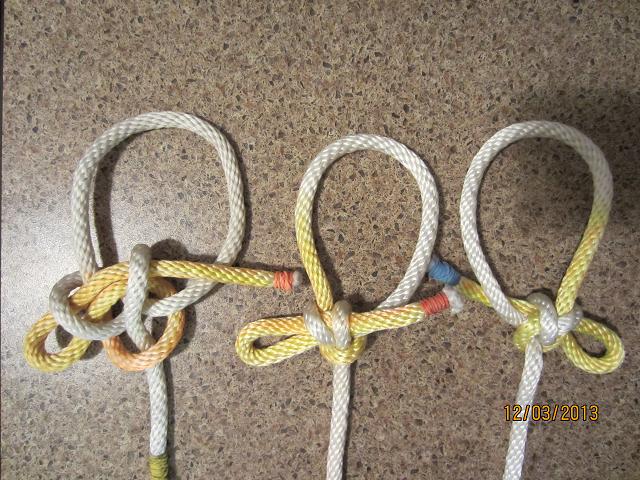
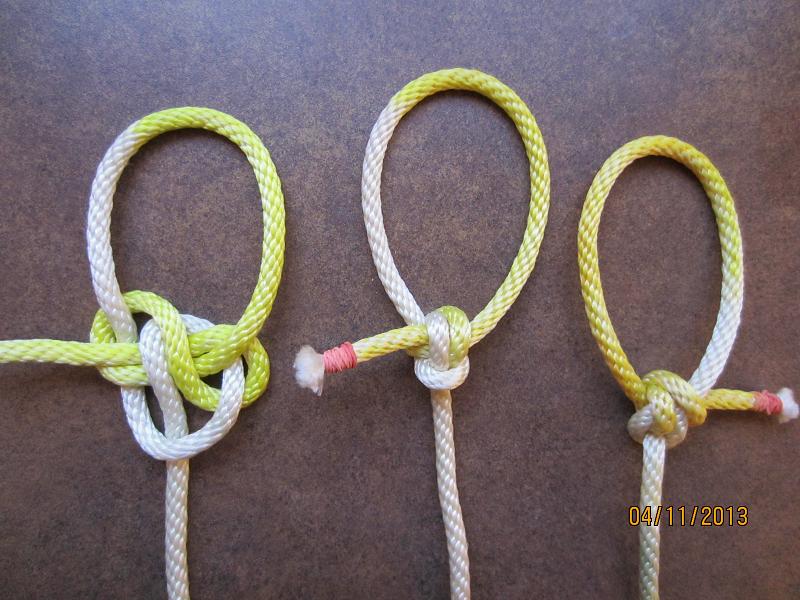
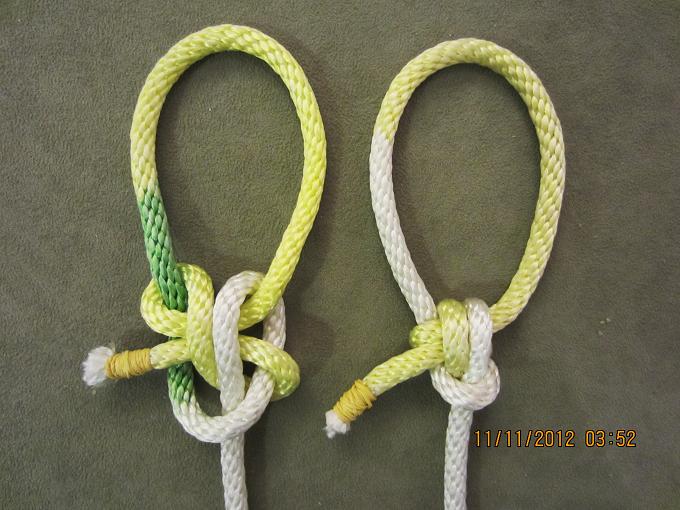
1. You must be joking ! It is more secure than it should ( meaning, this convoluted collar structure is an overkill ).
2. Perhaps. ( Although “jamming” is a very vague concept - I prefer the simple “difficult to untie”, which is enough ! We want bowlines easy to untie - otherwise we do not need bowlines at all ! )
When you see a “closed” knot tied on the Standing Part before, or even after the eye ( for example, an overhand knot, a fig.8 knot, etc - here the knot tied on the returning eyeleg is even worse ! ), you should be cautious… Under really heavy loading, even the returning eye leg will be pulled hard, and the knot tied on its continuation, the “collar structure”, may “close” around itself too tightly.
Now, there is a basic distinction we should make here : This “closed” knot can be tied before or after the tip of the “higher” collar, and this makes a great difference. If it is tied before the tip of this collar, it will absorb the full tension coming from the returning eyeleg ( that is, about 50% of the total load ), and then it will become difficult to untie, that is for sure. However, if it is tied after the tip of the “higher” collar, as it happens here, the situation may be less dangerous. At the U-turn of the collar, the direct continuation of the returning eyeleg “uploads” a significant portion of the tension which runs through it ( because of the capstan effect - the collar is not a pulley, it can not revolve freely around the Standing End ! ), so the tension which “comes down” is much less that the tension which was “going up”. With less tension, there is less danger of a too tight closing of the “collar structure”.
Alan Lee has tied many bowline-like eyeknots with overhand knots or fig.8 knots tied on the returning eyeleg ( on the Standing Part after the eye ) - but, on most of them, they are tied after the “higher” first collar, so there is less danger of them being “closed” around themselves too tightly. Myself, I prefer to follow the rule of thumb, and avoid ANY such knot - so the eyeknots I now tie are PET-2, and they are less prone to jamming / untying difficulties.
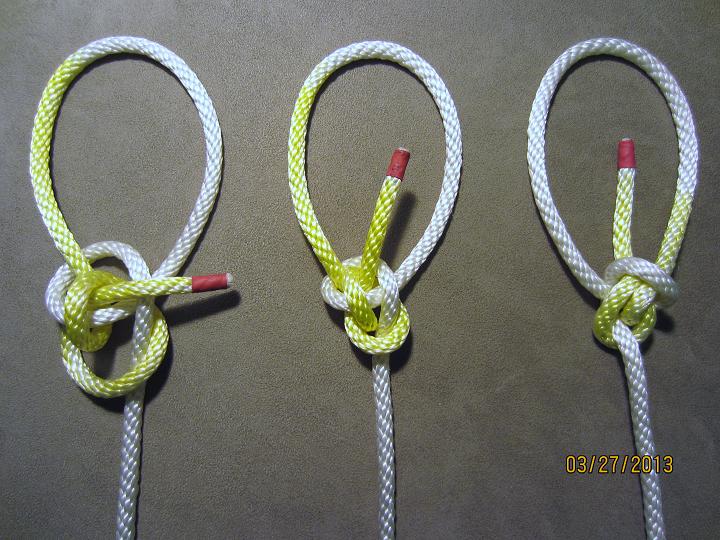
3. I do not understand what you mean by this “unintended misuse”… This eyeknot is meant to be loaded mainly as a bowline ( that is, from the “yellow” end - the nipping loop is the yellow one ). If it will be loaded by the other, “blue” end, its “blue” “nipping structure” will be too complex, and its “yellow” “collar structure” will be too simple !
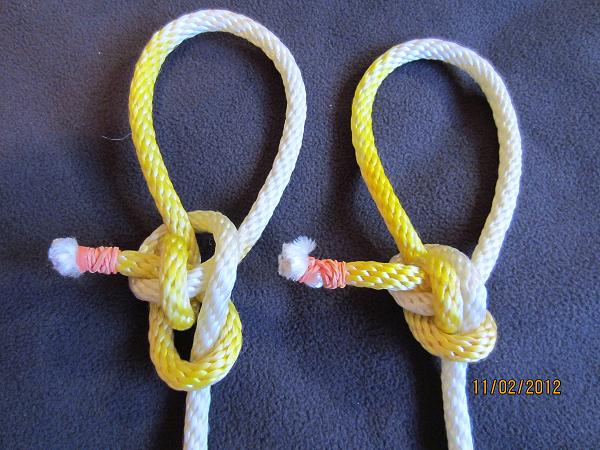
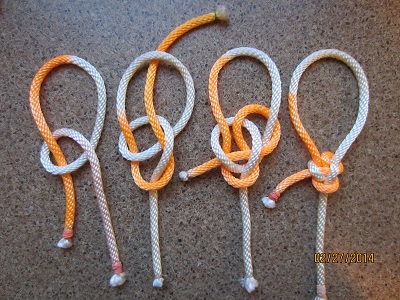
HOWEVER, there IS the issue of unintended dressing ! This eyknot can be dressed in a number of different ways, just as it happens with all the “retraced” knots which have parts traced with double lines - the fig.8 bend and fig.8 loop included. In other words, this knot is not self-dressing in one and the optimum way - and, judging from the fact that generations of climbers had not even suspected how many different dressings the fig.8 loop they use can have :), I think that we should not expect that the average knot tyer would be able to distinguish, and to care, about the different dressings of this knot either. A badly / not-uniformly dressed knot can not be inspected easily, and can even become less strong than a properly dressed one - I think that the twistings and the other irregularities of the flow of the double line, especially around turns, will become the weak links of the nub.
Read what, by coincidence, I had written just a few hours ago ;
I don’t hear any alarm bells. But your judgement concerns me.
In my “whirlings” I’ve loaded the Tresse Bowline in a range of cord sizes, in some cases by as much as ~750 lbs. and all were untied using only fingers. Loosen up that collar just a bit and you’ll have both security and easy enough untying. As for ease of untying, nothing beats #1010. But it’s nature is of the proverbial two-edged sword.
And I echo Alpineer’s alarm at the “SS” setting of the bowline!
I don’t see why my judgement is in question. I tie/use my knots my way, you yours.
There have been knots that I test and explore that I have snugged very tightly and some not so tightly. It sometimes depends on the material of what I am tying. That is what I deem necessary to evaluate some constructs. My comment to mobius was to snug his test specimens to a consistent point.
[quote]
As for the above quote: It was an honest appraisal using two different media that I have that show different aspects. The hard Titan cord shows off many knot’s lack of security and the nylon shows the level of untie-ability.
A range of cord or rope sizes can influence attributes, but in my opinion, the material and construction design influences knot performance more.
Your honesty and integrity were never in doubt by me, SS.
Of course, all aspects of material nature - including dimensions - determine a knot’s performance. But do they explain per se the use of pliers and spike to untie the knot in your case?
!! This looks like an excellent variation :
it has a “proper collar” (per X);
it has an “end-binding” (per DL);
it is TiB (per X);
and it Yosemites the tail out the collar (per A_S! : ).
.:. 3.5 for 3.5 ! ;D
Now, to describe the TIB alternative to the “YoBowl” that
I’ve mentioned, see the returning tail (into turNip of the right
image (which presents the better face to show!) connecting to the
other side of the collar-bight (which makes it like “right-handed” bwl),
and then coming back out of the nip into the final tuck as shown
–bypassing/leaving-off the “end-binding” loop around the right side,
around the crossing-point of the nipping loop. One thus has a simple overhand component formed by the tail instead of the fig.8
done by the YoBowl, and the tail will be in a position to be drawn
upon by the S.Part after tension flows over the tail-side eye leg.
(It is also EEL, qua overhand-based eyeknot pulling this
indicated tail, and still TIB. Of the easy four such knots (varying
the way the collar is made/turned), I think that this described one is
best --most sure of holding orientation, and giving good curvature.)
But this concern is more for real loading than for
what will likely generate knot strength --standard
slow-rate loading. (Dave Merchant opined that such
heat aspects made the strengths of esp. the slow-pull
strong fig.9 not so much stronger than an overhand
eyeknot when dynamically loaded.)
But I don’t think that the difference here is like that.
For the common bowline, the tail can act like a roller
bearing upon the draw of the S.Part --moving by rotation
with the heavily loaded S.Part between that and the other
side of the collar bight (eye leg), and I think that that
might give the knot durability over cyclical loading;
but it wouldn’t matter so much in slow, break-teast loading,
IMO. I would like to see the tail set back away from its usual
spot vis-a-vis this rotation, such that the S.Part’s draw would
rotate it to where it normally begins; I think that having the
hard-stressed S.Part bear into a relatively unstressed and
hence more compressible tail might be helpful (vs bearing
against a tensioned eye leg). And so my urging for that
“other variation of Yosemite finish”, though there the tail
part will be more held in that “back away” position, not
moving (but taking the fuller pressure of the S.Part vs.
putting that upon the eye leg).
Also, there has to be enough friction to reduce the force
on the eye leg of the turNip by 50% over the S.Part,
else --as has been seen in Dyneema and a double-turNip(!)–
the eye will collapse by feeding out through this turn
–having say a reduction to only 65% and so opposed on
the other eye leg by 35%. But a sharper turn gives more
resistance-to-bending (additional to friction) ?!
As for the “SS setting”, I recall distinctly the sever bend
you put into the S.Part in one image, and that would put
lots of pressure upon the turNip’s crossing point, before
force flows around the loop; that worried me. (Yes, it would
defeat capsizing!)
As for jamming, that will come with elastic ropes when the
diameter diminished so much and parts close around, and
then on tension release the outside-of-constrictions parts
become swollen large and cannot slip back into the knot!
YMMV.
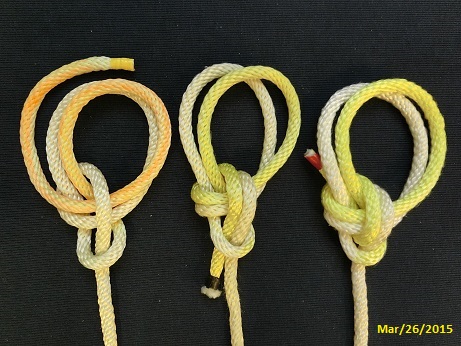
There’s also an interesting #1010 version of the Alpineer Bowline where the working end crosses over the collar’s root before plunging into the turNip, continuing around the turNip’s crossing part and plunging back into the turNip in the same direction before exiting through the collar. In this case a Fig. 9 on the working end engages the turNip.
We might also look to other knots, such as the fig.8 eyeknot
in which we don’t see 3 diameters and yet have --sometimes,
at least(!)-- great strength, and wonder then at how the 3dia
comes to be so needed!? (I have some idea that the F8 gets
strength from the turning of eyeleg parts around the S.Part
as it enters the knot, taking away some of the importance
of the ultimate U-turn’s sharpness; although, in the push
comes to shove competition the S.Part’s 100% nipping
might overwhelm the twinned 50% of those legs!?
One might test some rather comical, 5-6diameter? knot
just to so greatly emphasize that aspect, to see if it makes
a difference. Then, again, one might consider some of
the test results for the bowline and ask How much more
strength is left to get?! --some figures e.g. go to 80%.
. . . mysteries . . . ???
Have you got a photo of the above knot with it tied loosely?
I am getting ready to take some more photos of your ingenious knot creations - and I have limited time - so just want to make it easier if I can quickly find all the info here in one place (yes, I am being lazy).
If you cant find it Alan - I know Luca is one of the worlds best blood hounds as he can sniff out any obscure piece of information from miles away
I will change the thread to your suggested name, though I am not sure how ‘scientific’ I can actually do trials though. It might take more than a couple of weeks to try and get material and methodology as good as I can for a home trialling situation.
One thing that occurred to me was that I often hear rope fibres start to break prior to complete knot failure. If I stopped the test at that juncture I could potentially mark the entry points into the nub carefully, cut the nub apart carefully and see where the rupture actually started. Was it the inside of the curve, or the outside of the curve, and where on the curve rupture actually started. This idea sounds alright in theory, but doing so in practice might prove really difficult.
If I stopped the test at that juncture I could potentially mark the entry points into the nub carefully, cut the nub apart carefully and see where the rupture actually started.
Hello mobius,
Might have to defer to the ‘big guns’ of the IGKT for a clear-cut answer to that question. It might actually be an engineering question - so perhaps Derek Smith could weigh in (although Derek ‘the dunny man’ has been absent from this forum for some time I think?).
My spider senses tell me that cutting open a compressed knot structure will immediately release tension and therefore alter what you are seeing. Also, stopping the test before knot failure might also alter the heat flow/friction contribution to knot rupture.
" Lee Eskimo 8 bowline (A)" can’t support heavy load, and will jam, I think we should abundone this loop.
Hi Mark I have one more loop posted in Reply #55 please have a look.
(Edit date june-9-2015)
After the trials by Alan Lee, I came to believe that this bowline will become difficult to untie after heavy loading, and I had abandoned it. The “link” around the rim of the nipping loop “closes” around itself too tightly - and this may happen in all “Link bowlines” .
Heavy loading, in what material? I don’t climb on what appears - in his images - to be soft laid frictive trolley cord, a material that would challenge many a knot’s untiability. My particular interest in this knot is as a secure harness tie-in. As is the case with any knot, extreme differences in the cordage material can change a knot’s performance characteristics.
What I use to all “heavy”, I guess that it should be a significant percentage of the MBS of the knot, or even of the line - say, 25%, 33,3%, or 50%. We have to define what we mean by this term - and it would be great if we could establish some benchmark loading percentages, and test our ropes in all of them.
My own experience comes from kernmantle ropes, like those used in climbing, canyoning and rescue. I prefer them because they are stiff ( so they do not like sharp turns, and this makes me, too, to tie knots with wide, smooth curves ), they are not very compressible ( so they can not be flattened too much, and fill the voids in between the segments within the knot, turning it into a compact, massive and rigid ball which can not be un-knotted easily ), and they can retain an almost circular cross section ( so the contact area between two adjacent segments is not very extended ). I think that, in such material, the properties of the “knot” itself ( the geometry ) will manifest themselves more clearly, and the properties of the particular rope ( the material ) will play a secondary only role. I also tie knots in marine ropes, but I do not judge them by how they behave there - marine ropes are usually braided, and softer ( and less slippery ) than kernmantle ropes.
Alan Lee has tried this bowline on such a climbing rope : http://igkt.net/sm/index.php?topic=4851.0
He is much more creative in tying eyeknots, and experienced in trying them, than me - so, when he is not satisfied, I, too, am not !
And yet when he reports that a Zeppelin Loop can be untied after taking twice (!) the safe working load of the rope, you apparently don’t believe him (or anyone else, for that matter):
 ( meaning, this convoluted collar structure is an overkill ).
 ).
).