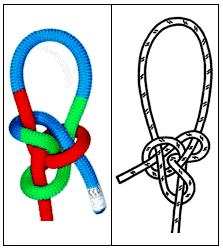
Adjustable Loops

EDIT: This thread underwent a number of name changes. It is much more about adjustable loops than anything else in it’s present form

To immediately dispel the notion that some might think that I am primarily interested in a bowline’s strength, I am not. I actually think security aspects like: non-slippage, verification, post-eye-tiable (PET), ease of tying, and a knot’s non-jamming ability, far out weigh pure strength considerations.

This idea is just something interesting (and hopefully fun :slight_smile: ) to do that I thought I might offer the forum. One notion to explore would be that a knot with a 3 diameter turNip is better strength wise than a bowline that has 2 diameters in the turNip.

Note that this exercise is about theory meeting practice. We all read things at this site that sound great in theory, or look good when you see an image, however what about the reality of it? Sometimes a 'theoretical" knot just does not live up to expectations, and vice-versa, a very good knot gets a “not acceptable” rating for a spurious “theoretical” reason. I, like most I expect, think about things theoretically and go from there. Unlike most, I have some trialling resources at hand, so theory can also meet practice.

My ego demands of me I try the two bowlines I have shown you recently: The B&B Bowline and the Mobius “Eskimo” Bowline. Other bowlines I personally like and would like to trial are the:

Ampersand Bowline (xarax)
EBDB Bowline (Dan Lehman)
EBSB Bowline (Mark Gommers)

These three came to mind immediately, however I would really like to add some preferences from Scott, Alan, roo, alpineer, Tex, enhaut… you get the idea… anyone or all :slight_smile:

So this doesn’t get too big a project for me, I consider about 8 x 2 diameter and 8 x 3 diameter knots will be enough. The 2’s can battle it out and so can the 3’s. Then I will battle the best of the 2’s with best of the 3’s. I will also actually do some strength trials (in terms of kg loadings) of the two finalists, just so we can see how much strength difference we are actually talking about (if any).

This is not supposed to be a definitive test, just an interesting trial. We can discuss what knots make the trial and what doesn’t. I will have a bit of time in a week or two to start.

Cheers,

mobius

Edit: changed the name from “knot wars” to ‘Load testing of various Bowline structures’

Hi All,
Mobuis I like your idea, Once a while I do the tug of war tests. what I found a lots of time Standard bowline is the winner.
3 diameter turNip have to be perfect condition to wine the standard bowline. how smooth the curve, which part of rope was
underneath the region of highest stress point of the nipping loop, how loose or tight you dress the knot, this is just some of
them, I am sure there are more other factor can effect the out come that I don’t know.
Good luck anyway.

     謝謝  alan lee.

(3D = 3 diameter, 2D = 2 diameter)

Interesting already, thank you Alan. I have never actually strength tested a standard Bowline. Maybe I should be adding some classic knots to the mix like the Right Hand Bowline (2D) and a version of the “Eskimo” Bowline (the most well known one, 2D).

What else should I try, the “Yosemite” Bowline perhaps? Scott’s Locked Bowline?

I was thinking of dressing all knots I trial in their perceived best form. Most of the time that will be a snug nub I suppose, however I will dress a knot as best I can in the way it is supposed to be.

Cheers,

mobius.

Good day mobius.

Nice undertaking! And thanks ahead of time.
Of course test some of the standards against some of the newbies.
Please test the Simple locked standard bowline (Scott"s), though I don’t think an increase of strength will be forthcoming.
Throw a Composite braided bowline in there too, if you’d like.
I have done a number of tug of war pulls before, pitting some of these using a one ton come-along, but with no measuring of tension facility.
The condition that needs to be standard, imo, is that the dressing of these should be snug - minimum space between parts.
I am of the opinion that 3D will lose the strength competition.

Looking forward to the results of your trials.

SS

Except the Bowline’s Collar!!! I’m serious! It’s not necessary. You really should appreciate this point SS. If you pull the the Collar tight up against the nub of some particular secured Bowlines you may have trouble loosening the knot after hard loading. Leaving a little room to flip the Collar back will not compromise security and will ensure easy untying of the knot.

Hi mobius. I have three offerings for you to trial… two are 3D Bowlines and the other is what I call the Tresse Bowline. I’ll send links or images later.

Why?
(Let’s have some explained theory out there!)

And I echo Alpineer’s alarm at the “SS” setting of the bowline ! ::slight_smile:

–dl*

Sure, images/links would be great. Showing me how to tie it is one thing, and not leaving me guessing on how someone wants it trialled is another :slight_smile:

Some knots, you just look at them and know how to tie. Others you look at and really struggle to know how to tie (some knots interlace back and forward so much that they are ‘Carrick’ like and are really hard to follow. Help me out with images/best dressings if you can please :slight_smile:

Cheers,

mobius

Indeed, I have read a lot of theory saying 3D is better than 2D. That sounds reasonable, however is it? Some are suggesting otherwise, so I thought I would trial a few knots to see whether theory is supported, or not.

@Dan: I always liked your EBDB (simple, elegant, verifiable), is there something else you would like me to trial?

Cheers,

mobius

One needs to be careful, here : it could be that
what fails to live up to expectations isn’t --in detail–
the theory but the knot-behavior. E.g., consider
Bruce Smith’s dismissal of theories of stronger/weaker
versions of the fig.8 eyeknot : he explains that upon
heavy loading, the apparently broader curve of the one
will in fact push its way to be as tight as the other
–which doesn’t refute the broader-is-stronger theory,
but shows (if correct (and I challenge his knot tying!))
that the knot fails to hold true to the theory.

Alan Lee points to the same thing, in asserting that one
must see how well the various knots settle with force.

To this end, then, we should urge that you take photos of
the knots under stress, hoping that you can do that in
safety with a fairly accurate guesstimate of some 40%
tensile load which should be well shy of rupture, and
yet be a point beyond which little change in knot geometry
occurs --things just get a little tighter and … BANG!

So this doesn't get too big a project for me, I consider about 8 x 2 diameter and 8 x 3 diameter knots will be enough. The 2's can battle it out and so can the 3's. Then I will battle the best of the 2's with best of the 3's. I will also actually do some strength trials (in terms of kg loadings) of the two finalists, just so we can see how much strength difference we are actually talking about (if any).
It might be usefully clever to set up the test with eyeknotted specimens anticipating the break at one end, and enabling the surviving knot, with the long connective span, to be tied to some other survivor (now we'll need a very strong end-2-end knot :: [i]blood knot, grapevine, twin fig.8 [/i]? Alternatively, one might simply tie off the broken end with the same-as-survivor eyeknot, and then get a test of "pre-loaded vs. new", perhaps of some help!?

So, you say you have some testing gear :: what do you
have? --what sort of device, what material(s)?!

When sent off a precious few (7) eyeknots to be tested
in Dyneema, I sewed into the line at pertinent points
some marker threads, for I figured that test values would
mean less (and the ranking loosely implied by them)
than learning where rupture occurred (insofar as my
marker threads could show that).

–dl*

The general theory is that a more gradual curve of
the material is kinder to it, and spreads the friction
over a greater area, and so on; the particular/specific
part is that nipping 3dia in fact does this; but Alan points
out that particular geometry might not be so favorable
–consider if those 3 diameters are aligned w/axis of load,
so effectively the turn is 1dia.
THIS IS WHY WE NEED TO SEE THE ACTUAL GEOMETRY,
not a static image made prior to load, or a diagram of the
supposedly tied knot!!

Some are suggesting otherwise, so I thought ...
What I ASKED (of Scott) and all should think is [i]Why ... not?[/i] Let's explain this counter-theory!
[s]@[/s] Dan: I always liked your EBDB (simple, elegant, verifiable), is there something else you would like me to trial?
I'll want to see the draft list of candidates, and then try to make any improvements to the set, looking for things that might not be present in the current selection. (E.g., the [i]Yosemite bwl.[/i] really offers nothing that I can see to the common one, re strength-enhancement (though I've read one author's assertions that he tested it in A-vs-B testing vs. the [i]fig.8[/i] and it (always?) won; but he also asserted that the usual break-testing and returned force values (which show the contrary result --[i]fig.8[/i] well stronger--, are not proper testing :: I cannot understand that, at all --the knots get force, and if indeed one goes to a higher load in the test device, than it should be the survivor in A-vs-B testing! .:. something's smelling funny with these assertions!) AH, but to the point : I want my alternative to the [i]YoBowl[/i] tested, as it takes the tail around the other way, counter the S.Part's draw, and so will test whether that draw and positioning of the tail matters!

–dl*

There were a lot of good points raised, however I will answer this one now:

Synthetic Braids

Donaghys range of multi purpose synthetic braids are strong, lightweight and abrasion resistant. They are suited to a wide variety of general purpose applications.

[b]Smooth (16 plait)[/b] & textured (8 plait) options
Hard wearing HT polyester fibre in supple plait construction
Highly resistant to stretch, abrasion, UV degradation and discolouration
Excellent knotting and untying properties</blockquote>

I chose this braid because I hoped it would mimic (somewhat) the qualities exhibited by a professional style ‘static’ rope. All I can offer is, after having just purchased some good 11mm Kernmantle (Arborist/Abseiling/Rescue) rope, that it does have things in common with larger diameter ropes of quality. One thing is that it is very stiff (stiffer than the Kernmantle I have); secondly, it appears to hold its circular x-section well under load; thirdly when I tie it and cinch the nub I do end up with something that looks like I had tied it in Kernmantle (except smaller).

A trial is a trial, and these will be home ones, so far from scientifically controlled. I have purchased a crane scale and can test up to 300kg with it. The braid I chose has a breakload of 200kg (according to the fact sheet). For what it is worth, I have learned a lot about knots through having trialled them. The braid I am using is not ‘soft’ and forgiving of a poor knot. Quite the opposite I believe, I have to be diligent in dressing and cinching even a good knot. Some knots ‘look’ good in theory and do not live up to it from what I have trialled. Ignore what findings I give (some have) or take them as sign of promise, or perhaps one of caution.

Cheers,

mobius

I am not invited to give suggestions (and really there is not any reason for it, I am only passive observer). But, I should like to include Double Bight Bowline (= Prohaska bwl = Janus bwl, one variant) in the “war”.
Thx, regards
ZZ


Dbl Bight Bwl.gif

Everyone is invited to make suggestions :slight_smile:

One notion to explore would be that a knot with a 3 diameter turNip is better strength wise than a bowline that has 2 diameters in the turNip.

This holds interest to me but only if it has some scientific rigor in the test method and if it an prove certain hypothesis. If it does, then it would be of interest to include results in the ‘Bowlines analysis’ paper.

There have been many knot testers before you…and I would go so far as to say that in excess of 90% of cases - the results are near worthless (this comment might open me up to attack). The problem - in my view - is that the testers failed to establish robust test parameters - and then simply did knot A Vs knot B test and declared winners based on that short-sighted data.

I would support a test of the following parameters.

First test to establish baseline parameters - unkotted rope strength and then ABoK #1010 (Note: for unknotted rope test, you must fix each end with a ‘tensionless hitch’ containing at least 6 turns)
Identical knot specimens tied in both ends of the rope (so you have a survivor knot specimen to study and photograph)
Bearing point (BP) of eye to bearing point (BP) of eye length is always constant (eye of the knot to the opposite eye of the knot) - 500mm
Insert colored marker threads into the knots at strategic positions - photograph in pre-stressed state and then post failure state
Always use same rope type/model - don’t change rope during testing
Always ensure the ‘eye’ of each knot is identical in size (same dimensions) - report size pre and post test
Always ensure that the same amount of tail is present in both knot specimens (eg 50mm tail) - report length pre and post test
Always ensure that both knots specimens at either end begin with identical dressing (ie cinched to same tension and form) - or as near to ‘identical’ as you can achieve
Take a photo of a knot specimen in its pre-loaded state - close up against a pure white background - and then indicate each of the dimensions - and these dimensions must always be identical for each test - eg eye size, tail length, eg for #1010, indicate tail length and eye dimensions.
I would suggest that you use a rope diameter of at least 8.0mm - but preferably larger diameter (although this will of course require much higher forces to cause failure). I am not in favour of using very thin cord as the rates of change in the dimensions of the nipping helix structure in thin cord is too small. I urge you to invest in thicker diameter cordage. Also, I urge you to to use kernmantel type cord - that is - cord used in climbing/abseiling/rescue applications. It will be more economical to purchase say 8.0mm cord in bulk on a spool (50m/100m).
Please report if the knot specimen jams (or is jam resistant) - if it jams, please report the threshold at which jamming commences (ie at what tension force does jamming occur?)

Sequence:

  1. #1010 (500mm BP to BP) - single helix nipping structure (only 2 rope diameters inside captured inside single helix nipping structure)
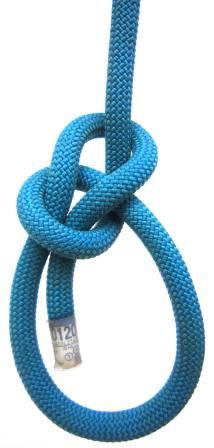
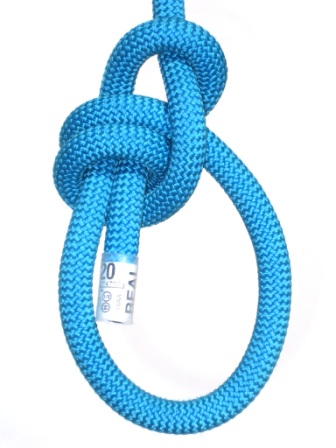
  2. #1010 (500mm BP to BP) - single helix nipping structure - with tail inserted back through nipping structure to create 3 rope diameters (see photo) - could be as per the photo below or perhaps Heinz Prohaska ‘Double bight Bowline’
  3. #1013 (500mm BP to BP) - double helix nipping structure
  4. #1013 (500mm BP to BP) - double helix nipping structure - with Alan Lee’s lock (tail inserted back through nipping structure to create 3 rope diameters)

In my view, this structured testing will help to identify what effect adding an extra rope diameter into the structure will have. Also, it will be interesting to compare a single helix nipping structure against a double helix nipping structure. This means that your testing will be a case of 'Single helix Bowline with 2 rope diameters Versus Double helix Bowline with 2 rope diameters and then move on to the Bowlines that have 3 rope diameters captured within the nipping helix structure (instead of simply Knot A versus Knot B type mentality).

Make sure you eat plenty of carrots before attempting to sew Dan Lehman’s notorious little marker threads in to the knot specimens. Also, be sure to chant his name while doing the needle work

Note: Please take your photos against a pure white background - and ensure no shadows are cast. If you do that, I will then be able to work with the images to bring them up to a high quality for you. But, if you don’t shoot against a pure white background - there will be nothing I can do… It will also be helpful if you use a rope with a uniform color - for example, I like to work with Blue as it is easy for me to manipulate the saturation and tone curve because obviously blue is one of the primary RGB colors.

After obtaining these data points, you could then try testing different nipping structures - such as those based on a ‘crossing hitch’ (ie munter hitch). Eg Crossing hitch nipping structure versus standard #1010 single helix nipping structure.

If you can capture all of this data, it will be of immense value :slight_smile:

Mark G

Edited: with additional important test parameters (eg tail length identical on both knot specimens - as this will provide insight into how this length changes as load increases to failure… and the eye of each knot must be of the same dimensions)


Bowline_ABoK-1010_Rear.JPG

Bowline_single-helix_3-rope-diameters_1010.JPG.png

Double-helix_Nipping-structure_1013.jpg

Thanks Mark,

There are a lot of good points made and good suggestions.

To start with, I would have to find a different braid to use, my current one is stiff and white. Sewing markers into this 3mm braid would require a lot more than carrots :wink: Also, I am actually quite happy with the characteristics of the braid I am using (stiff, smooth, holds it cross-section), I would want to find the same type of braid, except not in white.

The methodology you suggest is possible, though this project suddenly got a lot larger if I go that way. I will consider everything you indicated.

Cheers,

mobius

Hi mobius, here’s one of my knot offerings (photo credits agent_smith)…let’s call it Alpineer’s Bowline for identification purposes.

http://igkt.net/sm/index.php?action=dlattach;topic=1202.0;attach=4797;image

http://igkt.net/sm/index.php?action=dlattach;topic=1202.0;attach=4795;image

Methinks the rumor of difficulty is greatly exaggerated!
One merely needs to get the marker beneath some of
the mantle yarns, perhaps making a 2-3-tuck marking;
this can’t be onerous! --NOT going through the center
and all. If testing w/equals on each end, like marking
should give information from survivor re loser; otherwise,
photo of in-tension knots will help indicate what’s what
in position.

Well, re-reading more closely, “3mm” does present difficulty.
On the white thread, though, it offers an easier method : SHARPIE!
(yeah, there’s some aspect of claiming that the marking itself has
effected damage; I think one can avoid such charges by marking
safe areas, and if the rupture comes elsewhere, well then … !)

(While tapered/conical, carrots will not be adequate qua needles. ;D )

–dl*

First: The 3D encirclement I suspect and have seen involves more movement under load. Hence the increase of friction and heat. As the load increases and the tighter parts get they are moving and abrading each other, inside and outer fibers. All that movement has to produce destructive forces. I don’t believe that the available surface areas will allow dissipation fast enough, instead act like heat sinks and thus accumulate heat to the point of melting a strand and then another.
This may not be as much with natural fibers.

Second: I don’t agree with Alpineers’ alarm sounding. I have not advocated some “super snugging” as you have been worried about in the past. I do think a firm snugging of all the parts is important, to limit the nub parts movements under loads. A #1010 bowline with its collar snug is less inclined to capsize, imo. Snugging the collar has never been an undo challenge to untie, even after pulling a wooden bridge or crane lifted bundles with a bowline. Just flex the collar and voila! Easy peasy.

I believe that 3D can improve security with the potential for reduction of overall strength.

SS

http://igkt.net/sm/index.php?action=dlattach;topic=4687.0;attach=12734;image
http://igkt.net/sm/index.php?topic=4687.0

I’m cautious about this knot due certain security, jamming or unintended misuse with unintended consequences which I’ve not yet pondered, though it might make an interesting candidate for trialling. There’s at least 4 distinct loading configurations. I’ll defer to xarax to recommend one.