True. I was talking about the first, which does not depend on the size of the rope.
However, obviously a knot tied on a rope of a larger size, can be more easily untied than the same knot, tied on a smaller size, even if both are loaded by the same percentage of its MBS - simply because the size of human fingers, and their strength, does not vary so much :). So, let us examine/define the easiness of untiability of a knot when it is tied on ropes of some standard sizes, say, 1/2, 3/8 and 1/4 inch.
“<this_knot> thus materialized / embodied”.

But I think I’ll have a much easier time describing
“<this_material>” than your side of that bargain! :
(Though, I had mused about your take on it and seeing
knots modeled as biological entities and then asking
Where can they live? as a measure of media!?
Can the OzM_knot live in nylon mono. fishline?)
One thing that might be worth doing --depending upon
the test apparatus, evaluation-- is making this knot
(what I called “Janus” for the like faces in opposite
directions) a quadruple-bight one --i.e., in the spirit
of “one good turn deserves another” but more to the
point of questioning if more diameters through the
turNip begets strength, take the tail back’n’forth
one more time, stuffing 5 diameters. NOT that this
would be a practical knot, but simply to answer the
question about a more gradual curvature giving greater
strength. BUT, in your testing, would we be able to
have confidence in a (single?) result?
–dl*
I had searched for the proper verbs, among many synonyms - and I had chosen those two ( “embodied” / materialized" ), because I had found that they are used more often than the others to denote incarnations of ( Platonic ) ideas.
What is a wheel ? An embodied / materialized circumference of the circle - a mathematical idea, which “exists” even in a completely annihilated world without any matter left !
In at least Ada programming language, the term used
for making some particulars of a “generic” subprogram
is “instantiation”.
Now, a wheel vs. circle I think stands at an easy-to-figure
remove from instantiations of “knot”, as both of the
former are round --just a question of simple imperfection
of the material thing; but re knot, the geometry of it
–its angles and so on (even not looking to further material
aspects of compression)-- are not so well specified by any
ideal, for the ideal doesn’t consider what is though essential
for knot (yes? no?) : force & tension. (Or one has
some infinity of those ideals to match whatever turns up,
and this sort of thinking gets one nowhere, IMO!
(E.g., does The Bowline (ideal) have a turNip that contains
<what degree …?> deflection of the S.Part & eye leg?
(esp. if SS’d  ). A real one might start out that way,
and through loading, come to actually has ever so slight
a gap at this point, wanting to open the helix.)
–dl*
In the the “Ideal” knots I am talking about, there are no “forces” or “tensions” : the knots shrink only because their ropelength is minimized. This pure geometrical condition is enough to force them become as compact as possible ( without any compression of the “body” or change of the circular cross section of the rope ).
Unfortunately, mathematicians have not calculated/simulated our “open” knots in their computers. For “closed” knots and links, they have made much progress. See :
http://www.jasoncantarella.com/wordpress/software/ridgerunner/
Hi all,
Please don’t forget to give me images (or links to images) for the knots you would like me to trial. I am a ‘visual’ learner, so the more you can give me to see, the better. As a new knot tyer, it doesn’t take much to give me tying problems. Expanded views really help, along with advice on particular issues/preferences with regard to dressing the knot prior to load.
If I am not confident I know exactly how a knot you propose is tied and dressed properly, then potentially the trialling of my circumspect version of ‘your knot’ is a waste of time.
I am going to spend some time shortly and go through this thread and list the knots I feel comfortable tying properly. If the knot you proposed isn’t on that list, you can probably guess why 
Help me out out much as possible please.
Cheers,
mobius
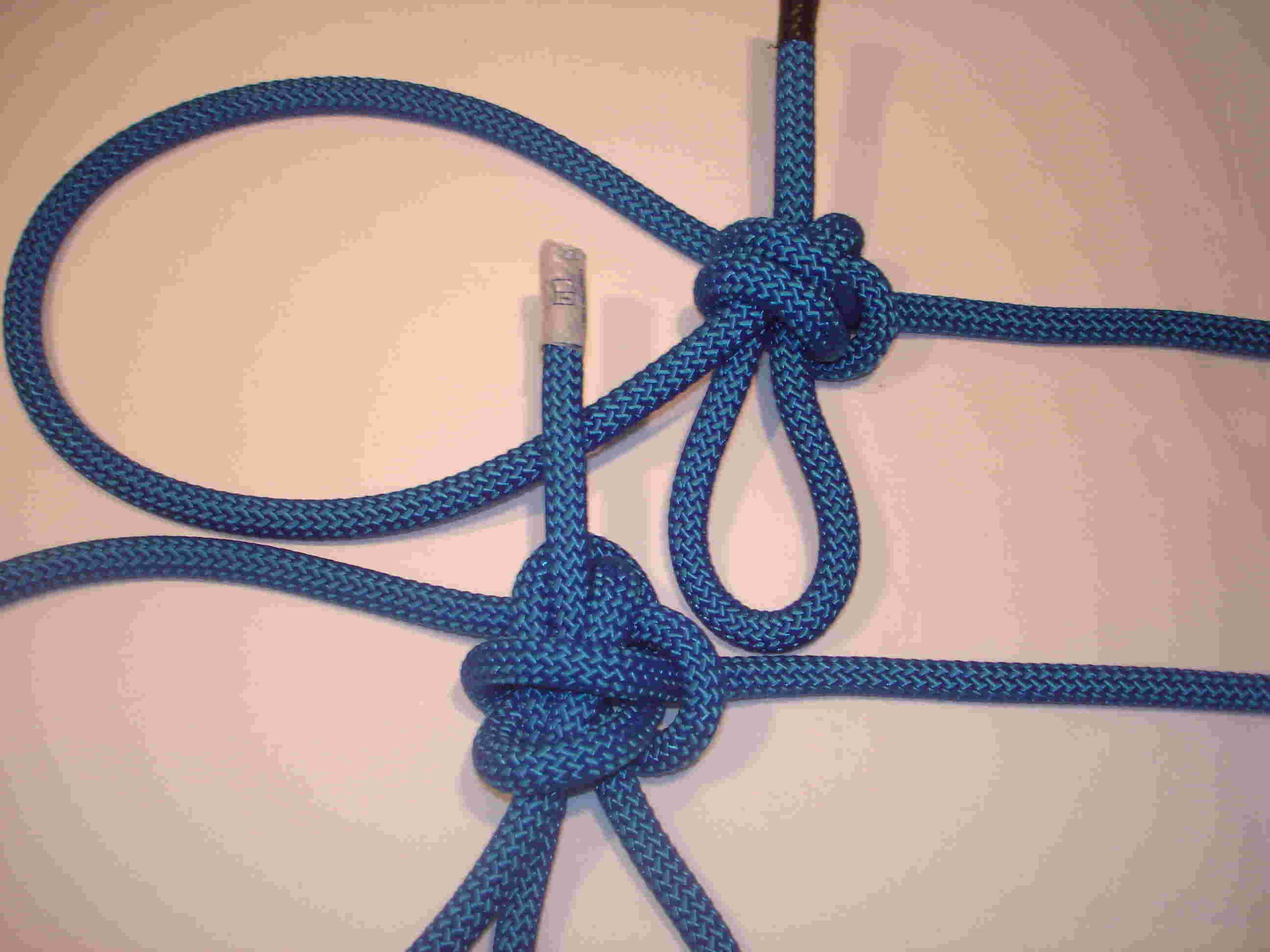
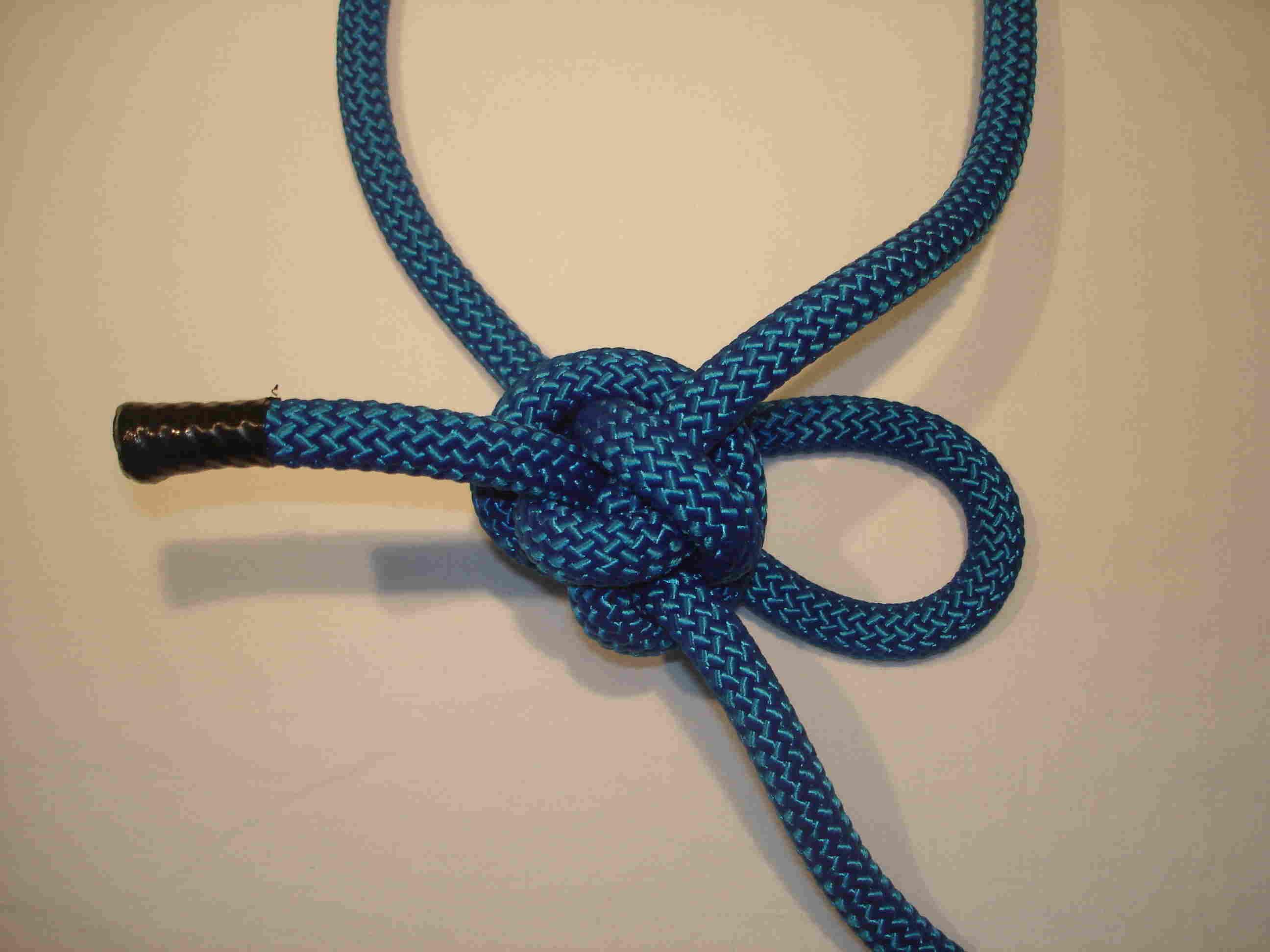
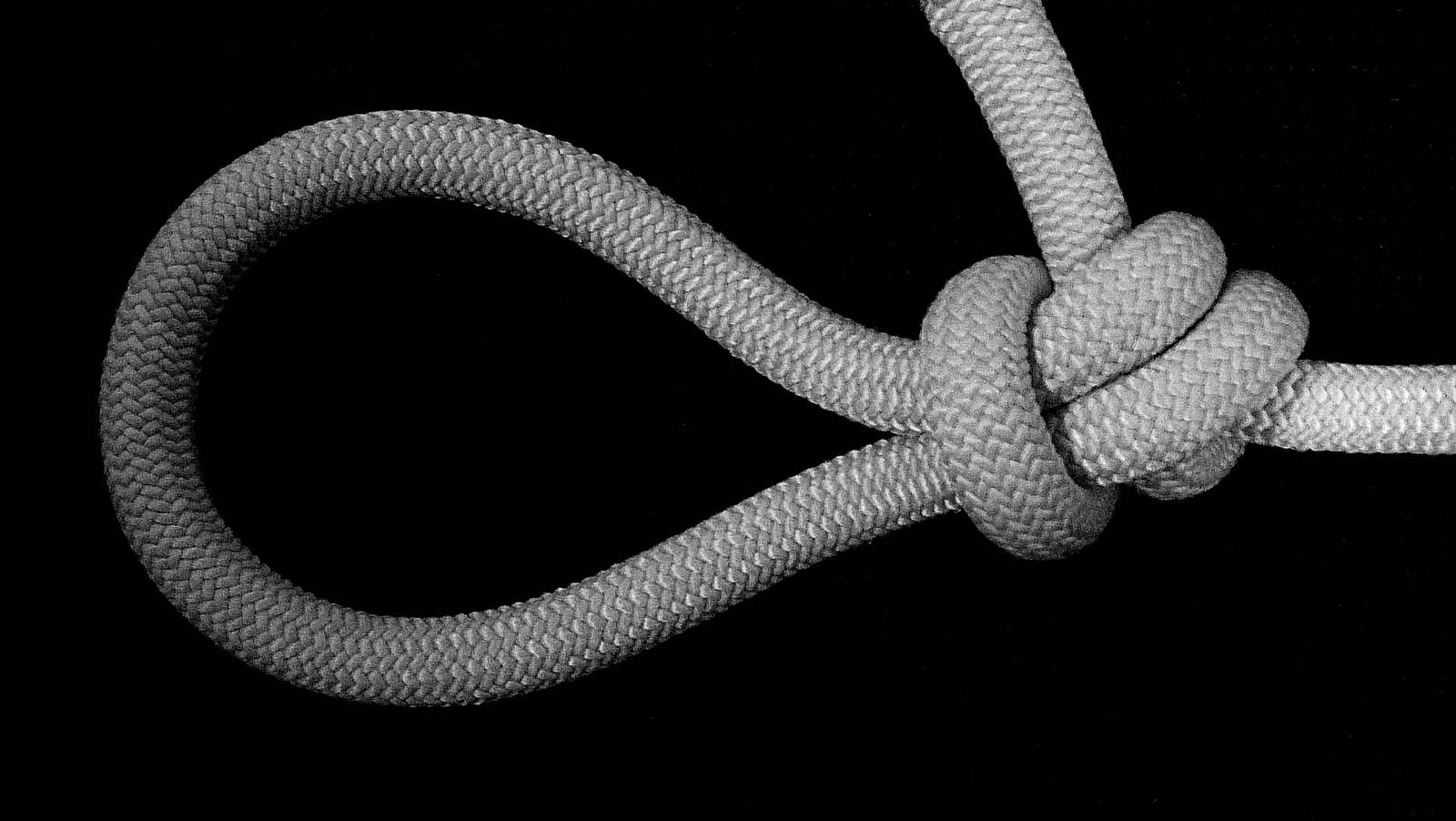
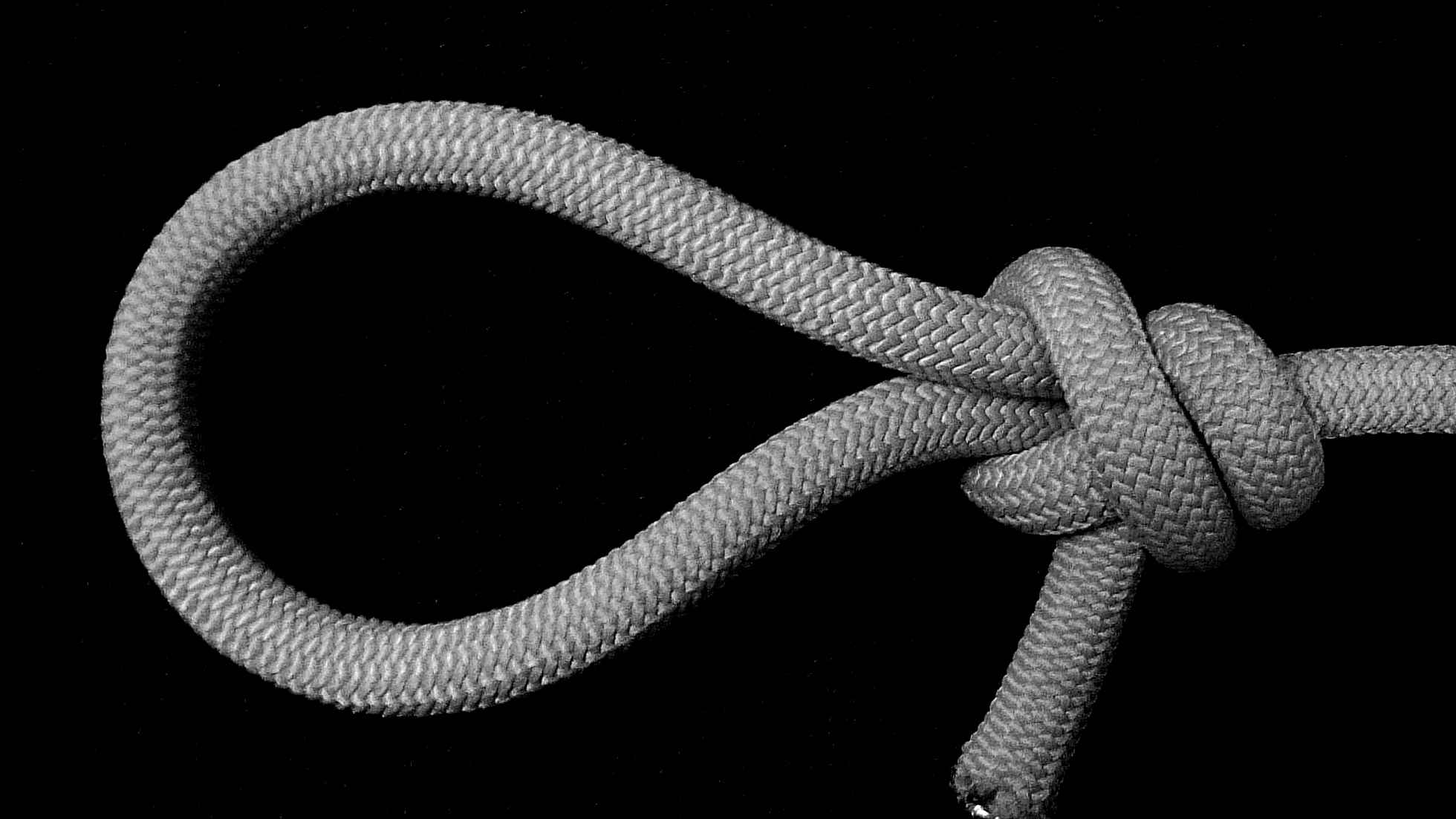
I did not set out to make the exploding loop (shown below) with 5 diameters (Image 2), however it ended up that way after what I suspect might be the best dressing for the knot. An exploding loop is not a bowline, or can it be? The knot shown below certainly has a turNip and the tail does form a bight held in place by the turNip. I cannot say I am comfortable calling the knot I show a bowline though.
NOT that this would be a practical knot, but simply to answer the question about a more gradual curvature giving greater strength. BUT, in your testing, would we be able to have confidence in a (single?) result?–dl*
====
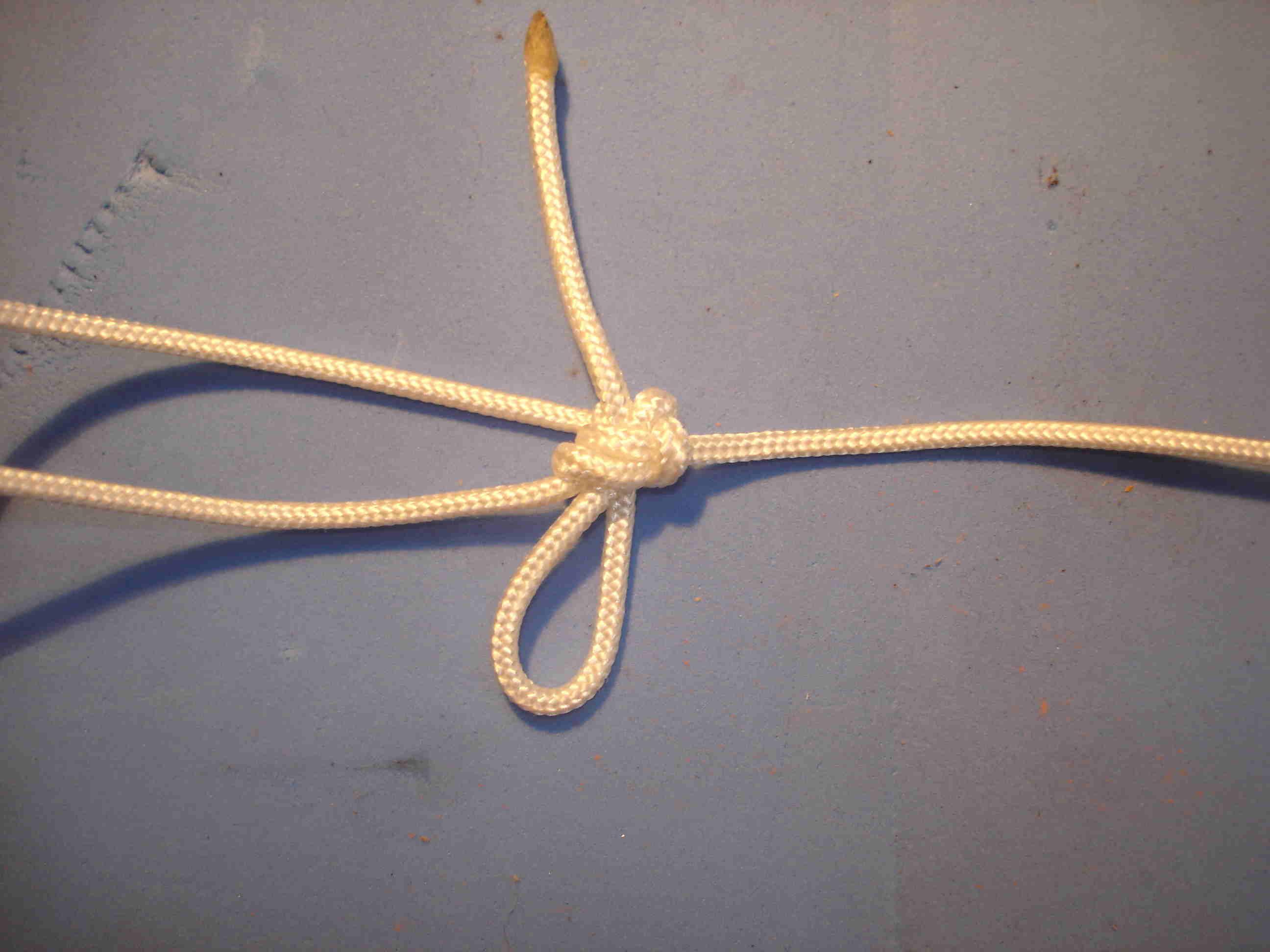
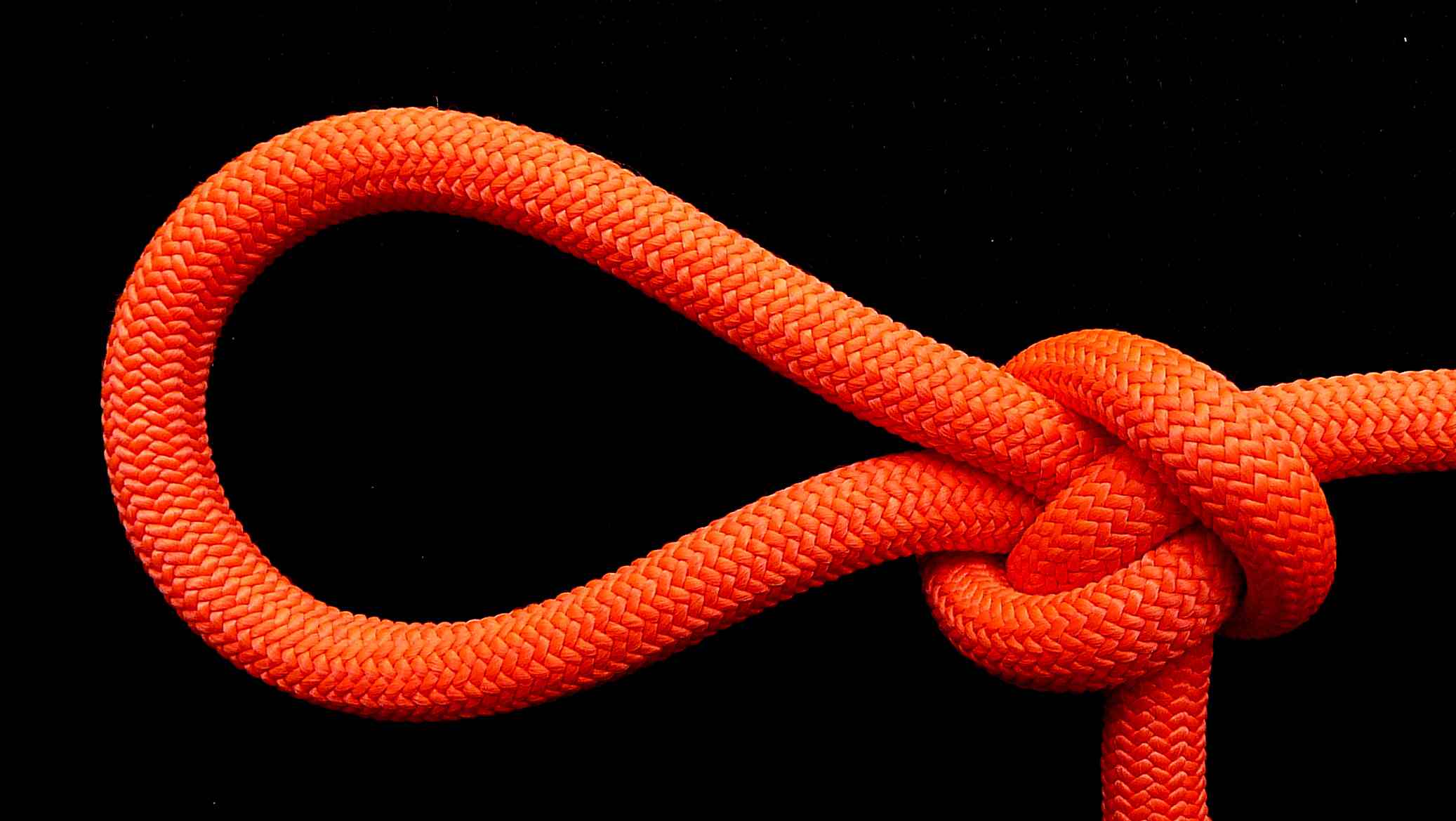
As a exploding loop this one might be practical. I find it easy to tie, untie after load and it appears secure after a preliminary trial. The images below show the knot did not collapse under load and the tail bight appeared to remain intact and in place. Some of these “L shaped” knots fold in half under load, this one does not. Image 3 is the knot I trialled prior to load and Image 4 is the same knot after a load of 130kg. Image 4 shows some compression of the nub, however all knots change somewhat under load and the nub geometry is still recognisable.
The knot fulfills some of the ‘acronym soup’ stuff as well: It is PET (post eye tiable) and TIB (tiable in the bight).
Another version of this knot, after a simple dressing change, has a 3 diameter turNip. It is a simpler looking knot, however I have not trialled this version yet.
Cheers,
mobius
Edit: Link also also shows the 3 diameter version
Link: https://docs.google.com/presentation/d/1VuospIgtPj5aG2DJIDFQGEHC0TWEYMrz8GSjaJlbPSg/edit?usp=sharing
I hope that you don’t feel obligated to find a practical
reason for the knot tested : again, my point was to test
the theory about gradual turns, and so adding diameters
to a common practical knot, which addition should largely
preserve the character of the knot but just vary it by giving
those extra diameters, serves this purpose best, IMO.
–rather than finding some basis for another knot and
then it would be a debatable matter whether any observed
difference was attributable to the diameters alone or to
some other different aspect!
In a similar tact, it might make sense to test a knot that
has been unusually hard set by some device --i.e., in a way
impractical–, so as to achieve a state that might shed some
light on knot workings. (And consider that fishing knots
are usually given prescribed settings that would require
such special devices to be effected in “rope”, in forces
equivalent for rope!) And it’s not that I’d expect the
result of some such testing to be “Thou shalt forever
use the SS-SuperSnugger-Model-108 on thine knots”,
but insight that such conditions matter. (At present,
we have the issue about setting a fig.8 that is
oriented with S.Part going to the far end, bearing
into its twin part vs. pulling away from it (what its
twin would were it so loaded), being set by loading
the tail --that twin part-- so as to make it unable
to be simply pushed aside, without consuming much
force from the S.Part, and maybe that offloading
makes for added strength?! Now, in this case, I would
hope that such setting was practical, doable with manual
force.)
–dl*
I felt no obligation, I just happened to be playing around with ‘L shaped’ exploding loops and with this particular knot I thought “5 diameters, that’s interesting” and remembered your comment
I understand that we do not particularly need 4, 5 etc… diameter turNips. The knot I showed just happened to have a large one when I dressed it a certain way (probably the best way after more reflection on it). As it turns out, it would be easy to test a 4 diameter and a 3 diameter, devolved version, of the 5 diameter exploding one I show, simply by untucking the tail. The knot’s character would be preserved I think, have a look at it yourself and see if you agree.
The devolved 3 diameter case isn’t exactly secure, however I suspect it would hold well enough for a trial, if I treated it carefully.
Cheers,
mobius
Hi xarax,
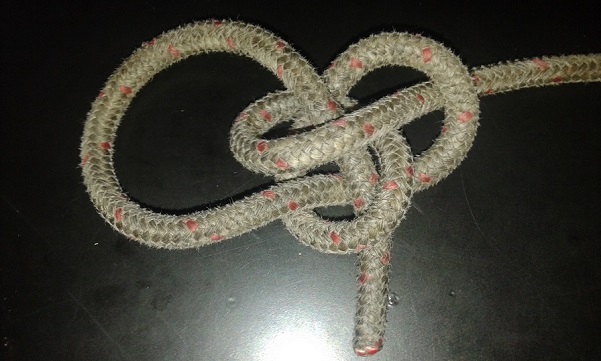
By your description I think that you,in the first image posted by Alan at reply #56, maybe saw the loop in the image below(sorry for my beloved dirty old rope..) .In fact the image of the finished knot may be a bit ambiguous with regard of how it is built,but Alan edited his post( http://igkt.net/sm/index.php?topic=5383.msg36083#msg36083 )with new images showing that the knot is actually a fixed loop with a collar structure.
Bye!
In a way, Alan Lee “stabilized” the Girth hitch-based adjustable loop, as I had stabilized the Clove-hitch based one…
When I had tied and tried those loops (1), I was looking for a TIB knot -(*) that is probably why I had missed them then…
(*) Oh, my KnotGod ! This IS TIB - although its Standing Part before the eye is not ( so, it is not PET ). Thank you Luca !
So, I should had said " I was looking for a PET and TIB knot...".
The somehow-adjustable loop, based on a fig.8 knot tied on the Standing Part before the eye shown at (2), is also not-PEt, but TIB.
Now, I do not remember any more which knot I saw ! I wrote that Alan s Lee loop was not TIB, so, even if I had seen another knot, most probably I had NOT seen the knot you show ! You can pass the Standing Part s first curve “over” or “under” the first segment of the nub it meets. The two knots are, regarding their general shape, their nipping / gripping power and their mid-air stability, pretty much the came - however, only the one turns into a TIB knot ( which its the one you probably show - we will be sure, the moment you remove the dirt from this rope ! ) I do not know if Alan Lee has tied or shown the TIB variation - you should clarify this matter with him. For me, and for the time being, this TIB adjustable loop is called Luca s TIB adjustable loop, I am afraid…
P.S. I had thought that the adjustable loop Luca had shown was the TIB one he shows in his next post - the dirt on the ropes, and the out-of-focus picture, and my poor sight, all contributed in the tying of this knot, but the primum movens of the whole sequence of things was Luca himself.
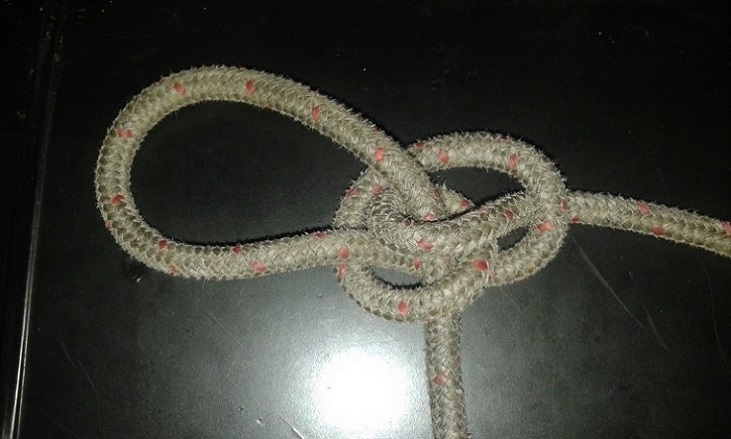
And I am afraid that the so-called “Luca s TIB adjustable loop” shown above is not TIB…  the first curve of the standing part pass “under all” in the image above(and yes,is not so clear,but at the moment I have available only the beloved dirty old rope);once removed the tail from the knot’s nub,remains a Fig. 9 equivalent tied on the standing part.
So,now I am curious of the “Xarax TIB adjustable loop”…
I have thought that the TIB variation of the so-called “Luca s TIB adjustable loop” was the one(not so stable) shown below(first pic;in the second pic I have capsized the knot in the fashion of the loop that you have shown):
You were right again ( as ever ! ). I had mixed some files in my computer, and I had labelled wrong knots, with correct names, and vice versa !
It can capsize either in the variation you show, or in ABoK#1045.
Your variation can be considered as a Blackwall hitch tied within an overhand knot. For a similar idea, see :
http://igkt.net/sm/index.php?topic=4736.0
I am not so sure that your original Luca s adjustable TIB loop, before it capsizes in the forms we show, is so unstable… We have to see how it will behave under heavy loading.
So, here are the pictures of the Luca s adjustable TIB loop.
It may be a little more convoluted than minimum, and so some of its nipping / gripping power may be “wasted” inside the nub s turns, and not utilized directly to immobilize the penetrating line. We have to test all those adjustable loops, and see. However, it may be not as unstable as you think - because, with small-sized nubs, it is relatively difficult for a riding turn to slide over or under another, and settle in position significantly different that the one it was meant to. With small things, even small steps are big !
Hi All,
I didn’t tie Luca s adjustable PET loop, I like this one is more solid, I think it will jam on heavy load, I prefer the tail tuck it on the
other side, will make a longer collar and may support little more load,
     The third picture, this one is more complicated to tie, but two nice collar,
     I think this one
     will do well.   Tomorrow I going to test these loop here, and give you the result.
    謝謝  alan lee
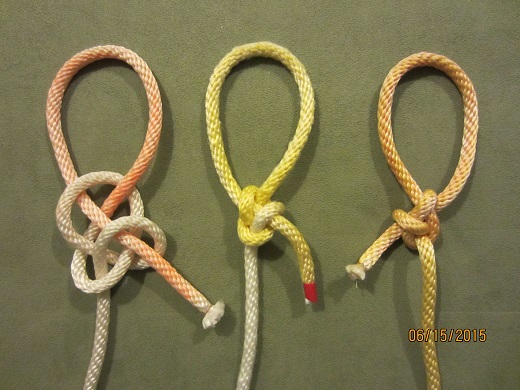
Noope ! Still the same problem- which you will never solve, if you do not understand it : Do NOT tie convoluted nubs when you want them to be as tight as possible / to nip/grip a tensioned penetrating line so much that they can immobilize it.
In adjustable lops, simplicity is a functional property, it is almost a condition for their very existence ! It matters not only because, when the nub of an adjustable loop knot is as simple/less convoluted as possible, the knot can be tied and untied easily, it does not consume material without reason, it can easily be learned and remembered, and it can easily be inspected. It matters because it makes the nub tighter, and more secure ! Otherwise, a portion of the tension induced from the nipping/gripping structure will be “wasted” within its own turns, and there will remain less tension to directly immobilise the line.
Now, the other thing you should remember ( in fact, the first thing one should realize, and keep in his mind ever since ), is the ANGLE of the L-shaped “handle”, the angle at the returning eyeleg s first curve/deflexion : It should be as close to 90, at least, degrees, as possible ! Otherwise the returning eyeleg will run the danger to SLIDE, and be dragged out of the nub. In both those loops you show in your post ( especially in the first…), this angle is too big/wide. See this angle in Luca s adjaastable TIB loop : it is 90 degrees sharp !
You tell it because you see the overhand knot tied on the Standing Part before the eye - and you are right, of course.
However, it may be GOOD for an adjustable loop to jam ! Or, it may be not so bad, as to be less secure and safe - because adjustable loops are NEVER 100% secure and safe : they will slip before they break. By jamming, it will become a safe and secure eyeknot, although it consumes a very small, only, amount of material ( because of the absence of the “collar structure” ).
I can imagine emergency situations where we want to tie an adjustable loop, as quickly as possible, which will become as secure and safe as possible when it will be loaded, and during the time it will remain loaded, and you do not bother with what will happen later, when you will not need it any more. When the task to hold something in/with the loop has been accomplished, and the loading is not applied any more, you may even cut off the whole end of the line where you had tied the loop ! Ropes are not so expensive any more… The immediate need/demand for a secure, safe loop, NOW, may be much more important from the demand of retaining the original length of the rope, LATER …
In short, I believe that, for very secure and safe adjustable loops, jamming may be an acceptable risk, and, perhaps, when the load is really heavy, it may even be desirable !