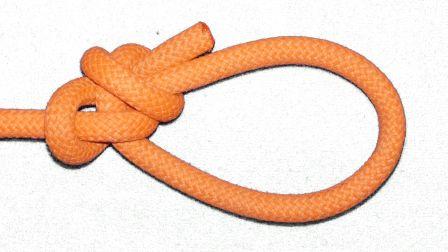
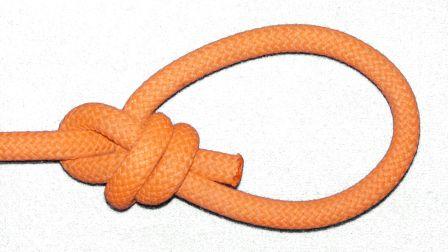
Yes, but to provide an indication/“proof” that a certain definition of the bowline is correct, I have tied many other loops, where there were only some essential elements of THE bowline present, or where some essential elements were missing. Those loops were practical knots, and the indication/“proof” that an ellement is essential or not, or that an essential element is needed/indispesible or not, was provided on grounds of practicality. Only a practical loop could prove or dispove somethingabout the parent knot, THE bowline, so practicality was sought, and examined, and used, and explored. This involvment of practicality in the course of the definition discussion is another reason this thread should remain in the “practical Knots” section.
I think that the local symmetry of this special - but “middle”, not “limit”- case of the 120-degrees-loaded-3-limbs knot - where we can not see the global configuration, i.e. we are not allowed to look ouside the image frame - is the most importand thing, that should decide if the common bowline and the eskimo bowline should be placed within the same category, or not. But not as eye loops ! As midline bends, because that is the only thing we are allowed to use, the local characteristics. We do not see the eye! So, we first decide about the midline bend, and then we extend our knowledge aquired there to the loop that uses this bend as a base.
That is a general method : Local symmetries ought to decide what is the essential element, so local symmetries are more basic. Global symmetries can not exist without the local ones , so they are only secondary. One can debate this, of course…
Thank you ! Yet another reason, and a hard one !, the thread containing this knot should stay in the “Practical Knots” section! You didnt tell this to the “voters” before they cast their “vote”/opinion !
Not at all : the thrust, the point, is definitional (and your way
of including/excluding was, after all, but one of the ideas for
classification that were advanced (and more might await our
finding)).
[quote="Dan_Lehman post:20, topic:4154"]
-it implies knowledge outside of the image frame presented !
[/quote]
I think that the [u][i]local[/i][/u] symmetry of this special - but "middle", not "limit"- case of the 120-degrees-loaded-3-limbs knot - where we can not see the global configuration, i.e. we are not allowed to look ouside the image frame - is the most importand thing, that should decide if the common bowline and the eskimo bowline should be placed within the same category, or not. But not as eye loops ! As midline bends, because that is the only thing we are allowed to use, the local characteristics. We do not see the eye! So, we first decide about the midline bend, and then we extend our knowledge aquired there to the loop that uses this bend as a base.
That is a general method : Local symmetries ought to decide what is the essential element, so local symmetries are more basic. Global symmetries can not exist without the local ones , so they are only secondary. One can debate this, of course... :)
I disagree with this (at my current point of inchoate thinking).
At issue is What is aknot? --and I submit that when one
makes such changes in loading one changes the knot. But this,
again, goes right back to this fundamental question. How many
pages did Russell & Whitehead expend on simple arithmetic?
The very physical aspects of the knotted structure change
with the angles, with the loading, and so on; so I don’t
accept at this time that such manipulations of knots will
show essential properties.
[quote="Dan_Lehman post:20, topic:4154"]
Certainly the knot shown (or, one of the possibilities of the shown structure, AND at such angles!) is practical; it can be seen in the lobster-pot bridles of some commercial fisherman --who prefer to tie what we might tend to call an [i]"Eskimo bowline"[/i] between two
short circular slings. (I just came across one photographer's photo of such pots in Maine, USA !)
[/quote]
Thank you ! Yet another reason, and a hard one !, the thread containing this knot should stay in the "Practical Knots" section! You didnt tell [i]this[/i] to the "voters" before they cast their "vote"/opinion !
I think that you’re serious here?! I told no one ANYthing; nor did I have anything
to do with there BEING a vote; I merely voted --once,
(not being from Chicago), unweighted by anything.
OK ! I will put it differently, to make it less easy for you ! Let us say we just want to talk about a knot, that some believe it is a Practical knot, and some not. Talking about this knot, and trying to prove their point, some use ideas that they think they reveals its practicality, some use ideas that explore its structure, and some use ideas that have to do with its function. Nobody is talking about a specific application, or use of this knot, may be because they do not care about it, or may be because they have not yet discovered the already published article in another site, where an application or use for this knot is explicitly stated.
Where are we going to put this thread ? Are we going to solve this problem by counting our opinions ? What is an outcome that we should respect ? A 1-0 outcome would be decisive ? A 563-562 one ?
My first point is that symmetry, if it exist, reveals something that is most fundamental : there is some physical truth behind each symmetry( May be you already know that there is a general theorem in physics about this fact )
My second point is that local symmetries are more fundamental than global ones. If you see a symmetry in one small area of a knot, this is a more important fact than a symmetry in a larger area. Local properties help us explore the real essence of a physical object more than global properties. This is what people have done to this day to the physical objects they want to understand, with great success. They brake the object into pieces, and they examine those pieces !
I mean that something that a participant knows, might not be yet known to the others. They will learn it later, in the course of the discussion. What are we going to do then ? Are we going to move a thread back and forth, as the informed and knowledgeable participant reveals its information and knowledge one by one ?
This is not the case it issue : we were tasked to make a classification
of knots, given the seed of thebowline --which is a conceptual task.
It was not a task to determine whether such knot was “practical” (we accept that it is).
A work on a conceptual task about a practical knot, should belong to a thread that states, explicitly, that is about Practical knots ! Do you want a division of the Practical knots section into one “Applications/Uses of the Practical Knots” sub-section, and into one “Concepts of the Practical Knots” sub-section ? I will agree with this division. In the second sub-section, we could agree to move most, if not al,l of the threads that now are in the so-erroneously-called “Knot Theory” section, and some of the threads that are now in the “Practical Knots” section, and would be misplaced if they are in the “Applications/Uses of the Practical Knots” sub-section.
In the original post I see comments about trying to discover, about trying to improve or change knot structures, about knot mechanics and the relation of structure to performance, and questioning about the effectiveness of a particular knot mechanics strategy. To my way of thinking, there is little doubt that this thread belongs in the Knot Theory board. This topic might generate additional discussion and information appropriate to spin off as a new thread in the Practical Knot board, but, the original post is poorly placed in my opinion.
I have repeated some testing of the double crossed-coils bowline presented earlier, in the “theoretical” discussion about the bowline (1). It seems to me that this bowline is much safer than the common bowline, as regards any tendancy of the later to collapse when tied on certain materials, and under heavy loading.
I have now tested this double, crossed coils nipping loop in the case of the midspan bend (2) Its greater stability proved to be beneficial in that case, too.