Are those practical knots, or not ?

As some pictures of knots, posted initially in the "Theoretical " :slight_smile: bowline discussion thread, were deleted by a forced-mistaken-desperate action by me, I re-post the ones that were fortunately saved here, just in case somebody would be interested in them. ( Not much interest was stirred last time, I am afraid…)
I was not driven to those knots by randomly tying bowlines ! I had thought that if, somehow, we manage to discover a complex TIB nipping loop, tied on the standing part of an end-of-line loop, that happens to be more stable than the common bowline nipping loop, we could use IT as our nipping loop, so that the “proper” collar will now serve almost exclusively the purpose to secure the tail - and not to stabilize this nipping loop. A collar that has only one main purpose, and is loaded accordingly, is probably better / more effectively used in this purpose. Its strength is not “wasted” in the purpose of stabilizing the nipping loop, a task that this new, more stable nipping loop might achieve by its own.
Does this strategy has a point ? I am not sure, of course, about it, not at all! It might be better to have all the separate parts of a knot tangled/interlocked together, so that each one of them can be loaded and bear that load more or less, depending of each other loading.
I hope that this thread will not have the sad fate of the other one, and be removed by the Web-administrators after X replies, or Y “length”, or Z days/weeks/months/years…Of course, I can not trust them that something like this will not happen AGAIN, can I ? :slight_smile: I only wish/hope that the next time a “vote” is cast. the number of votes would be larger than 6…


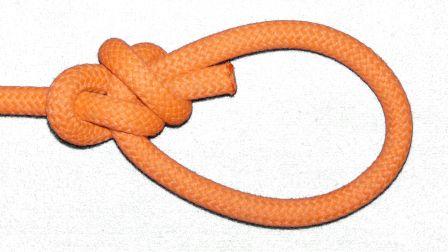
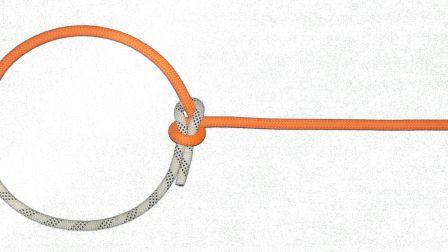
to be, or not to be - a bowline (back view).jpg

2


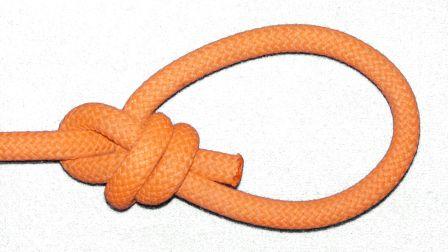
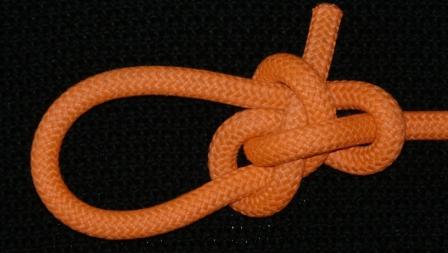
Double,crossed coils (common, right hand) bowline (front view).jpg

Double,crossed coils (common, right hand) bowline (back view).jpg

3


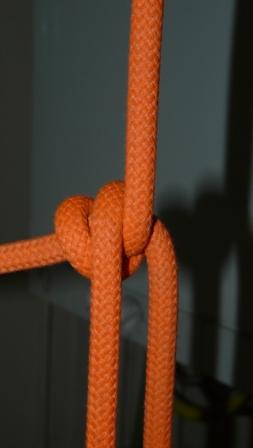
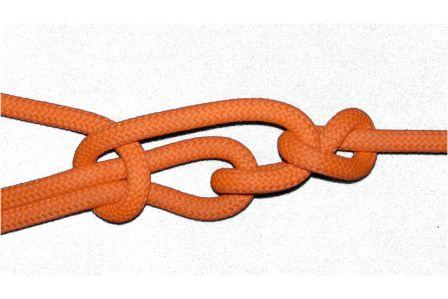
loaded, un-collared, double, crossed-coils loop (back view).JPG

4


Bowline 1.JPG

5


Eskimo bowline.jpg

Fontus bowline (front view).JPG

6 Also, a picturte of Janus (to whoever it might concern…) :slight_smile:
That is all, folks :slight_smile:
( I hope it was not too much of a heavy “Theory” here, was it ? )


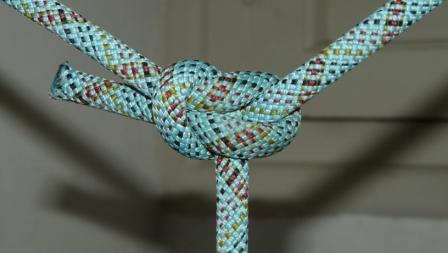
the Derek Smith 50% bowline (detal).jpg

Janus.gif

Are those practical knots, or not ?

Don’t know. But let’s say that 75% of them are practical, and the others are of theoretical interest. Then what?

Then I was obliged/right to post them in this section, and not on the so-called (erronously) “Knot Theory”(?) section…And,because I have not seen them anywhere, ( and neither did you, I suppose…), I was obliged/right to post them, and not keep them, selfishly, in my computer for myself..
I had not done anything else/different, had I ? :).

Xarax, that other long thread about the Bowline definitely belongs in the Knot Theory forum. For whatever reason, you place a stigma on the Knot Theory forum. I’m not sure why. Almost everything you post fits squarely within the purpose of the Knot Theory forum, which is “For those who want to get the knot between their teeth and shake it apart, either figuratively, or binarily.” Are you ashamed or something? Or do you just want to be in the forum with more activity? (I’m assuming Practical Knots has more activity.)

I personally would prefer to see the Practical Knots described explicitly as “Knots Discussed within the Context of Applications.” I would think such a label is obviously implied within the word “Practical”, but maybe it’s not so obvious (?).

Thank you, knot4u,

First, there is not a Theoretical knots forum, because there is not, and can be not such thing as a “Theoretical Knot” ! :slight_smile: Even the knots studied by mathematics, within Knot Theory, are not “theoretical knots”, they are abstract mathematical structures, like the sets, the numbers, the shapes, the groups, the tranformations, etc, of mathematics. Is there a Theoretical Set ? A Theoretical Number ? Do not confuse theory, which is one thing, with its constructs, which is another.
What you erroneously describe as a “Theoretical knot”, should be better described as a “practical knot, discussed within the context of its structure, its form, its funcion” - or something like this- and not witin the context of a specific aplication or use.( We are assuming we speak about practical knots here, and not decorative knots. For decorative knots, use and application should better be defined in other terms.)

I do not place any stigma on the “Knot Theory and Computing” Forum ! I say that it should be named correctly, as “Theory of Practical Knots”, or something like that, because “Knot Theory” is something else, as you know. I believe that, unfortunately, there is not any viable theory of Practical knots at the moment, but I would be glad if there will be one, and I would be happy to follow its development as close as I can. I am more interested in such a theory, than in any application or use of Practical knots, because I believe that the tools themselves are more important than the things they help us to do. That is the meaning of OUR title, as “Homo Faber”, isnt it ? ( Even if it is now known that other animmals use tools too, and some make those tools, using materials occuring in their natural environment.)

Assuming that you mean the “Theory of Practical Knots” forum, do you believe that the end-of-line loops shown in this thread should be posted there ? If yes, why ? Please elaborate a little more on this, because I believe that a “new” knot that is simple enough - and not a decorative one- AND it is meant to be / could eventually be, a practical knot, should be posted in the Practical Knots forum. Ar you telling me that those end-of-line loops are decorative knts, or that they willnever be of any practical interest ? Ar you sure about it ? If yes, how do you know in advance which knots would eventually be proven to be of practical use, and which not ?

Do you thnk I am, or I should be ? If yes, it would be an interesting phenmenon, a man being a selfish mazochist, who is shamed for himself but wants things done HIS way ! :slight_smile: Are you as good as a psychologist as a knot tyer ?

When I feel lonely, I try to find a girl friend. I suggest you do the same…It works ! :slight_smile:

That distinction would be fine for me. From the one hand, a section about “Practical Knots, discussed within the Context of Aplications”, and from the other a section about “Practical knots discussed within the Context of their Structure, Form, Function”. Do you agree on this ?

P.S. knot4u, let us, please, not be drawn into a new quarel here ! :slight_smile: Please do try to ignore any comments of mine that you think they are only rhetoric, and reply to the questions on subjects you think are worth of further examination. I will try to do the same next time, and I beg you to forgive any ill-chosen humourous comments by me. I have already one knot tyer to deal with, It is not wise tactically for me to open a new, second front ! :slight_smile:
Hei xarax!

I just miss some description of what practical problems your knots are going to solve. What’s the advantage with the specific knot. Why should I use your specific end loop instead of the bowline, double dragon, overhand loop etc.?

Perhaps another question might be why not use some alternative knot? - you never know how well it will perform until you put it to work..

This little creation makes me smile

http://igkt.net/sm/index.php?action=dlattach;topic=3550.0;attach=5750;image

Somewhere I will use it and it will create some eyebrow raising.

Derek

Hi Hungrir,

Any practical knotting problem has more than one solutions, cab be solved using with more than one knots. It is very difficult to prove that one solution/knot is the optimum for a specific aplixcation. Do not forget that, even if the problem is well defined, and the rope material to be used is decided in advance, the knot tyer is always different ! So, knots that can be easily and securely tied by one knot tyer, because of the dexterity, knowledge and experience he has, might seem defficult to tie, or even be tied wrongly and dangerously, by another knot tyer.
Let me say that the secific knot is more secure, and/or is more strong than the bowline. Would you use it becuse I am saying so ? No, of course not. You use what you already know, what you use more often, and is proven to satisfy your needs. Does this mean that you do not want to learnany new knots, you do not want to try different solutions ? If that is the case- what is the case with the mjority of knot users indeed- then you are right, you should not bother to learn but a handful of knots in your life. You are a knot user, an average person that just wants his job done.
My posts are not adressed to the average person, but to the knot tyer. A knot tyer knows that there are more ways to skin a cat, and enjoys the different possibilities, In short, he is curious about knots, any knots, and he wishes to learn as many interesting knots as he can. That need of the knots tyers makes me explore the Knotland, and I feel obliged to report my findings in this forum, as soon as I happen to aquire them, so other knot tyers will satisfy the same need.
I have recently bought, in a Sotheby s book auction, from the grand children of Ashley, his handwritten personal diary, where he descibes some knots he would publish in the next, second edition of ABoK, had he be gven the chance. ( Unfortunately, he died just a few years after the first edition.) The knots presented in this tread are just copies of this diary ! Are you interested in those knots a little more now ? I think that you do. :slight_smile: Would you ask the same question to Ashley, if he was alive, as the questions you asked me about the knots in this thread, that I have copied from his lost-and-found diary ? I doubt it. Because we all are taught to follow rules, to repeat things created by others, to parrot things written in sacred books, by prophets, to search for already known recipes . That is not a bad thing, provided that it is not the only thing it is ! :slight_smile: Fortunately, Ashley was a knot tyer, not an average knot user.
Assuming that you are a man, and you have the most beutiful wife, who adores you, who is the last year Miss-World, a Nobel prize winner, and a billioner. Would any man in your position stop to look, just look, any other woman that happens to pass by ? If you are a man, you might answer yes…because we are f… liars. If you are a woman - and women know men better than men know themselves - you will answer no. Well, I look at other knots, even if I have the bowline ! :slight_smile: And I suggest you do the same, too. It does not make life longer, unfortunately, but much more interesting, and it is a pity if one misses that opportunity.

…is a creation by Korgan, in a now deleted post ( I am not the only one in this forum that is doing desparate things… :)) He calls it “the Niptruck”. See the last saved picture of the Niptruck, at (1)
I have though of the same thing when, I have tried to figure out a bowline-like loop, where the two legs of the collar are absolutely parallel to each other and to a segment of the standing part. This loop/binder makes the sentence “The bowline is a Gleipnir with a (“proper”) collar” much more transparent.

  1. http://igkt.net/sm/index.php?topic=1870.msg17914#msg17914

See here:
http://igkt.net/sm/index.php?topic=3556.msg20288#msg20288

If you claim that your knot has some advantages compared to the knots I’m using, then it will catch my interest. I might not use it just because you said so, but I will try the knot to see if it is as good as you claim it to be :wink: Secure, quick, simple to tie and untie, then you do have a replacement for the Bowline - and that will motivate me indeed to try your knot.

Would you ask the same question to Ashley, if he was alive, as the questions you asked me about the knots in this thread, that I have copied from his lost-and-found diary ? I doubt it.
It doesn't matter who is presenting the knot. When learning a new knot, I always ask myself what benefits does this knot have, where and how I am going to use it. Can I think of any practical problems where this knot will make a good solution? If it isn't clear, I would ask Ashley the same question as I asked you.

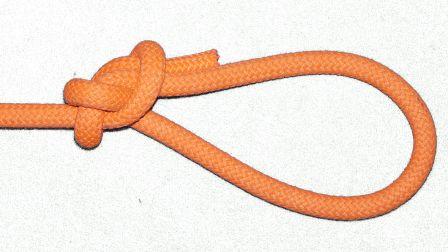
If you take a look at the Overhand loop, Figure Eight Loop, Bowline, Eskimo Bowline and Zeppelin loop, they are all end loops. But each knot has different strengths and weaknesses, which will make each knot more suitable for certain tasks than others. Examples: A bowline is a good working knot, because it’s fast and easy to tie and untie. Figure eight is a good knot where security is important, because the knot is both secure and easy to control. The eskimo bowline is a good option if the loop is going to be stretched wide.

All knots have advantages and disadvantages compared to others. Also, the specific material, and the specific knot tyer, can make a difference. I can not caim that a specific knot has only advantages compared to any other knot. If you do not tie the knot by yourself, with your hands and your material, and if you do not repeat this tying a sufficient number of times, you can not know if it would have been interesting for you. or not.
Traveler, there are no paths. Paths are made by walking.
Knot tyer, there are no interesting or not-interesting knots that you have not tied. Knots are made and evaluated by tying.

There will never be a replacement the bowline - or the overhand knot ! :slight_smile: That does not mean that we should not be interested in any other end-of-line loop !

Every good knot has advantages compared to others :wink: I just want you to point some of them out when presenting a new knot. :slight_smile:

My dear Hrungrir, you show me the Himalayas, the Everest and the K2, and you tell me to climb on higher peaks, or not climb at all… :slight_smile:

The difference / divide here is that you are focusing on the
knot as something maybe to be used (and hence “practical”),
but in the contentious issue re defining “bowlines” the point
is to deliberate over definitions , and not practicality per se.
And definitions/conceptions do have some sense, theory-like, of
able-to-be-tested=ness, in that one can try applying & working with
such conceptions --human-imposed divisions/groupings-- and see
how well they do. E.g., does omitting a specification for some
“proper collar” --like omitting Euclid’s axiom re parallel lines intersecting–
result in a grouping that is unhelpful (too inclusive, not selective?).

Of the images above, of particular theoretical interest IMO is the
120deg-angled <what_knot_is_this?!!> orientaiton of the i bowline[/i] :
to me, that is a paradigm case to consider in how one conceives of
“loop (eye) knot”. For one might (maybe should) think of it as
a knot of a single PoFM (piece of flexible material) with two limbs
opposing 1 limb and the 4th free (= untensioned) --in distinction
from a “net-knot”, where all limbs are tensioned (but, angles…?).
Actually, the “single PoFM” is perhaps a bad conception --it implies
knowledge outside of the image frame presented ! (where one sees
only one termination (the untensioned tail), and is left to presume/guess
(or, by some other definitional plan, maybe specify knot per loading)
what limbs connect to what. Which leads to the interesting question
undermining one commonplace/natural sense of “loop knots” --that
they in fact contain a “loop” (eye) : perhaps that is only some
possible condition of a knot structure which should be said to be
of TWO PoFM --we can trace TWO connections of limb to limb
in our knot-image frame; we can discuss what possibilities exist
for outer connections, or maybe that is beyond the immediate
conceptional needs?

So we can / should question whether a knot so loaded at 120deg
angles IS a (proper?) “eye knot”; our canonical eyeknot form might
require effectively aligned axes of tension for two legs opposing
(in tension) a “SPart”.

And all such interesting, challenging deliberations are to my mind
welcome under a title “theory”, but that can be amended in some
way (“philosophy” I think might be more apt) and maybe it is best
that “Computing” be separated, to be a forum rich in coded ways
to knotting practical or decorative.


Certainly the knot shown (or, one of the possibilities of the shown
structure, AND at such angles!) is practical; it can be seen in the
lobster-pot bridles of some commercial fisherman --who prefer to
tie what we might tend to call an “Eskimo bowline” between two
short circular slings. (I just came across one photographer’s photo
of such pots in Maine, USA !) The slings --with end-2-end joints of
fisherman knots, so far as I can tell (the usual)-- are girth-hitched
to the pot corners, and one (likely a bit longer) ties a sheet bend
with the “tail” used to attach the “snood”/“gangion” line to,
hence loading all (twin?) limbs --which is six strands of rope
(2 qua bight making “proper collar”, 2 qua a single unit to tie
through this collar and be loaded on their (2) bight end).

–dl*