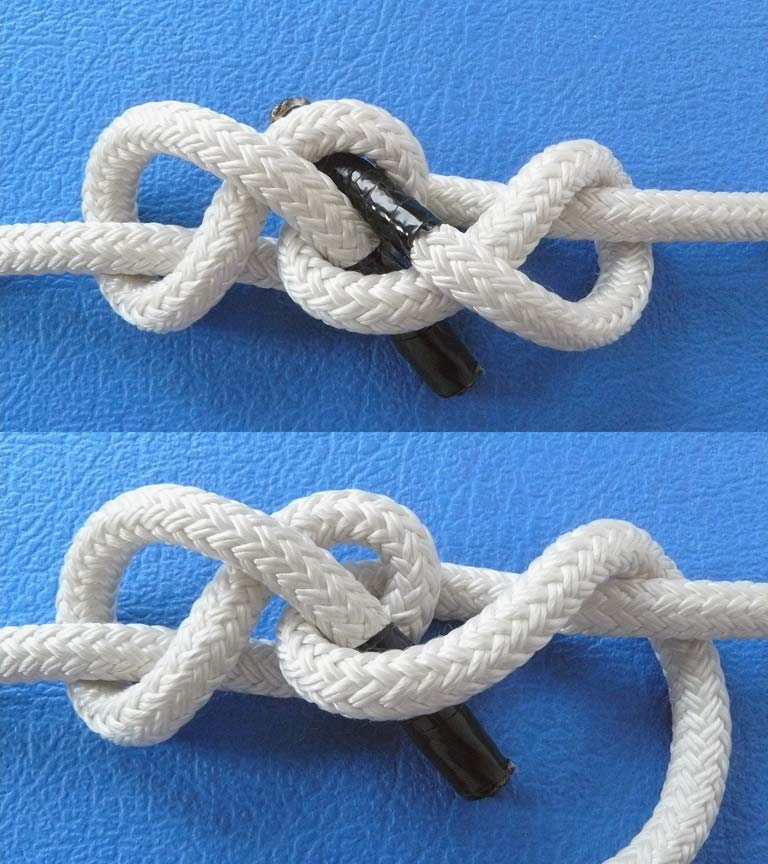
Taken from “The knot bible” Bloomsbury Publishing Pic (2013),here is the Broach bend.
" Another Harry Asher special, this knot is clealy inspired by the approach of the Zeppelin bend… except that is uses interlocking figure -eights instead of overhand knots…"
Maybe this bend is already shown under a different name somewhere in this forum?
In the second set of pictures I show an other way to finish the bend; both ends in central void are being crushed by the ‘jaw’ of the structure. A featured I tend to easily fall for.
In that case I think it would be preferable to work with long enough tags end.
Pictures = Broach bend
Broach bend making of
Broach bend modify
Broach bend jaws
Maybe this bend is already shown under a different name somewhere in this forum?
Now we have two different set of photos for this bend, we dont lose nothing. It's a plus.
Considering that I proposed a different finish (bad or good, not the point) it's another plus.
Methinks that H. Asher’s inspiration likely came
from some of C. Ashley’s interlocked-overhands
knots, and not from the not-so-interocked Z.!
(And these knots have that “jaws” aspect you
find worthwhile --quite! Using fig.8 vice overhand
structures is a simple variance that can be applied
throughout the set.)
What does the author have to offer readers
about the (infamous/dubious) poldo tackle ?!
What does the author have to offer readers
about the (infamous/dubious) poldo tackle ?!
Since you asked;
" It?s hard to imagine how this knot works until you tie it, and then you
realise how ingenious it really is. Use it in place of the ubiquitous bungee
cord as an adjustable and quickly released tensioner, eg to lash down a
liferaft on deck. Apparently named after Italian sailing instructor Poldo
Izzo, it?s been in use since the 18th century or earlier "
The author recommend a bowline or an angler’s loop to create the “pulley”.
I will present the Broach loop taken from that book too, unless Xarax had already done that.
This Broach loop have a good selling tag too;
" The broach loop is one possible answer, and it is arguably at least as strong
and secure as its better-known rival. An alternative for ultra-slippery ropes. "
I agree.
Let me make this simple, almost naive distinction, which may nevertheless correspond to something really fundamental.
Considering that the most important feature of an end-to-end knot, a bend, is how the first curves of each link are joined together ( because those parts are the only ones still bearing the 100% of the tensile forces coming through the Standing Ends, before being absorbed by friction inside the whole nub ), there are three broad classes of bends :
The bends where the first curves are “hooked” to each other, forming two interlinked bights, so they become topologically linked : if we manage to secure the continuations of the second legs of such hooked bights, so they will not run the danger to slip through the link, we get a secure join. Those bends belong to the more numerous class, probably because the way the two ropes are joined is the most “straightforward”, so most people find it easier to understand how they work, so they prefer them from bends belonging to the other two classes which work in less obvious ways. In the “hooked halves” bends, one just takes the two Working Ends of each rope and makes each one of them turn around the other, and then he further makes tucks and half hitches, trying to interweave them more, so they will not slip. However, the fist and most important step has already been made, just from the very start : The two first curves have been already hooked to each other, and so they have been linked.
The bends where the first curve of each link turns around the Standing End of the other, before the Working Ends are further interweaved to their own line. If we see each link separately, we just see a stopper knot tied on the end of its line. If we see both of them at the same time, we see that the Standing End of the one stopper penetrates the nub of the other stopper. In the “sliding halves” bends, one takes the Working End of each link and makes it turn around the Standing End of the other link, and then he further interweaves this Working End, trying to tie it into a secure stopper, so its Tail End will not slip through it. However, the two lines have already been linked to each other, the moment the fist curve of the first would-further-tied-into-a-stopper knot turns around the Standing End of the second. The simplest bend in this “Fisherman s-knot-like” class is the Double Harness bend ( and the Tumbling Thief bend, but this is not so evident in its case ). The most used, however, is the Fisherman s knot, because, if heavily loaded, it can be untied more easily than the DHB.
Last, but not least, is the class of bends which are the most easily untied of all, because of their unique structure : the Zeppelin-bend-like, “hinged halves” bends, of which I have written already too many posts… In those bends the first curves of each link are neither hooked to each other, nor they turn around the Standing Ends of the other link. Instead, they form two unhooked, unlinked bights, placed parallel to each other, and then they wait to be linked at a later time, by the Working Ends passing through them, as rope-made pins joining the two knuckles of the two leaves of a hinge. One takes the two Working Ends and forms two adjacent but not hooked to each other bights, and then he further secures them - without forgetting, at some point of the weaving of the nub, to make them pass through the initially formed bights, of course :), so those bights become attached to each other ( although they are not hooked = topologically linked to each other ). The simplest bend in this class is the Zeppelin bend, of course ( but some knot tyers will never become able to understand this, I am afraid…).
Asher s Broach Bend is a strange hybrid between the “hooked halves” and the “hinged halves” bends - but as the two links would had been and would had remained linked to each other even if the Tail Ends would had followed a different path, and had not gone through the two bights formed by the first curves ( because they have already been hooked to each other, right from the start ), I believe it belongs more to a sub-class of the first, “hooked halves” class of bends, which includes all the common interlinked overhand knot bends, except the Zeppelin bend.