Bends Charts

“Easy”?! The mind boggles at comprehending SOOOO many
more knots!! (worse :: working through their Tangles!)
Yes, thank you very much, as we see the forest and all the trees!

(-;

ps : In, hmmm, one file (New & Neat-Like group)
you have #1425A but it’s not that, but REVERSED #1425A.

And the “Sheepshank-like Bends” IMO are better named
(this class, i.e.) “Shared-Eye Joints”, as the loading
on each knotted half is that of an Eye Knot.
(It’s a quick huge class :: I counted some 300 EKs
illustrated by me over some few years, and realized
that they can be joined for 45_150 distinct such
“shared-eye joints”! (E.g, have a BWL on one side
and an Angler’s loop on the other; BWL on one side
and Fig.8 on opposite; … and so on & on & on.
(I’m not going to separately illustrate the 45_150,
but I have done each of the component EKs.)

(And you might want to add to the one traditional one
–showing the BWLs-- the case where the Tails are returned
through the other nipping loop --putting 3 diameters in each
nipping loop.)

pps : And, please, do not tell Mark about these,
or he’ll take you to task for having a chirality dearth! (((-:
There would be opportunities to derive corresponding eye knots from many of these end-to-end joining knots (‘bends’).
And indeed, this might yield some interesting stable eye knots.
The body of work would benefit from a searchable index - at the moment, it is not a simple exercise to try to find particular knots.

I also note some duplication - for which I am unsure if its intentional or not?
Eg
'Neat and new crossed bend ’ and ‘Neat and new bend’ are both duplicated.

I am unclear about the presentation and naming of the ‘Southern Zeppelin bend’?
This isn’t a new discovery and does not warrant the creation of a new name.
Zeppelin bends are created from superposed loops of opposite chirality.
There can only be S/Z or Z/S geometries.

Crossing the tails is simply a variation to an already existing structure.

Hi All,

I cannot post/reply any post in these two days. And was told to report to Admin.

I will fry to post later.

yChan

Hi Alan, Dan and all,

Thanks to Alan for your support, I like your work too.

In the file (New & Neat-like group)
I am sure #1425A is right in its group. Yours so called REVERSED#1425A is better known to me as Neat & New Crossed B Bend as found in this forum. They are both in this group. #1426 and New Crossed B Bend are updated into this group.

Thanks to Dan for his comments and proposed “Shared-Eye Joints” group. I still prefer the name “Sheepshank-like Bends”. The bends in this group have the appearance of the knot Sheepshank.

We know from a bend (parent bend), we Can find a lot of corresponding loop knots while a new bend is born. I just focus on new bends discovery and tying methods.

Dan, will you show me some bends as you suggested to be included in a new group showing the BWLs.

Neat & New Bend, Neat & New Crossed A Bend and Neat & New Crossed B Bend are bends with the same structure and some with different tails crossings.

The Southern Zeppelin Bend is found mentioned on page 19 of the book “A New System of Knotting” by Harry Asher. I do not find any earlier information about this bend. The names Southern and Eastern indicate two different placements of tails crossings different from their parent Zeppelin Bend, but not relate to any chirality of this loops form.

There are 5 types of this opposite tails placements. The Parallel (Side-By-Side), Stacking Over, Stacking Under, S Twist and Z Twist.

Bends from the same parent with different tails crossings, some people may name them with X1, X2, A, B, etc. Some may name them with names as they wished, such as parent bend ABOK#1425, and its tails variant bends Oblique Bend (B17) and Snug Bend (B11).

Nomenclature in knotting is interesting, IMO, no straight rules, but thinking of the creators. I love it.

Happy Knotting
yChan

The notional concept of an ‘eastern’ and a ‘southern’ Zeppelin is meaningless (unless there is a properly defined reference frame).
In order to use such terms, there would have to be defined reference frame for the knot tyer - so that the 2 cords can be oriented spatially and then the tying manoeuvres performed within the defined reference frame.
Because the Zeppelin consists of 2 opposite chirality superposed loops - one can also have Z+S or S+Z (its still a Zeppelin bend).
Its the same concept with most other knots.. eg a #1010 Bowline can be shown with S or Z chirality… its still a ‘Bowline’.

We need to understand that at the time these knots were first tied/published, chirality was not well understood (it was a new evolving concept), and the way a Zeppelin bend was published tended to be Z/S, and I haven’t seen authors showing both chiralities (ie showing Z/S and S/Z - same goes for the Riggers bend - it was only shown in one chiral orientation). Asher took things a step further in his ‘Alternative knot book’ (1989) - and at page 57 he made a very clear declaration that “any loop knot can be transformed into the corresponding bend” (I think a better way to understand this is the other way around… any bend has corresponding eye knots (although not all will be stable (eg Reef/Square knot does not have any stable corresponding eye knots).

The tail crossings are simply a variation to the parent bend.
On page 59 of that book - Asher publishes the ‘Easter Zeppelin bend’.
He does not make any absolute declaration that it is a distinct and new species compared to the original Zeppelin bend.
The eastern reference (again) is meaningless - it could also have been ‘western’.

The same tail crossing technique can be performed with Riggers bend (#1425A) - its still a Riggers bend but with the tails crossed (its a variation of the parent bend).
Crossing the tails does not mean the creation of a brand new knot species.
I think of it as human DNA - but with a genetic variation… like a person born with an extra digit on their hand/foot. Despite their genetic abnormality, the person is still belonging to the human species.

It does appear that you are attempting to publish almost every conceivable way of uniting 2 ropes (ie ‘bends’) - and so for absolute completeness, including tail crossings is understanable.
If I were in your position, I would treat the ‘X’ versions as a ‘child’ of the parent bend.
So you would have say the Riggers bend (#1425A) as the parent - and then the Riggers X listed as a ‘child’ bend (because they are very closely related, and derived from the parent).
Same with the Zeppelin bend, there would be the X (child versions).

I am updating my technical papers (Knot Bio’s) on the Riggers and Zeppelin bends and will do just that… identifying as follows:
Riggers bend S/S + child X versions
Riggers bend Z/Z + child X versions
Zeppelin bend S/Z + child X versions
Zeppelin bend Z/S + child X versions

The Butterfly bend can also be tied with tails crossed - again, these are child ‘X’ versions.
In fact Wright and Magowan (1928) published it as the ‘X’ version.

But as you’ve severely re-dressed it,
it plainly is NOT #1425A --just as an Anchor
Bend
isn’t a Strangle knot, though they can
be dressed one into the other.
(Dressing and in-load transformations have a way of
confounding classification!)

Yours so called REVERSED#1425A is better known to me ...
Ooops, I stand corrected. (I'd just assumed that that was the case --or so it appeared on a quick tying?)
The same tail crossing technique can be performed with Riggers bend (#1425A) --its still a [i]Riggers bend[/i] but with the tails crossed (its a variation of the parent bend).
Or vice versa --there is nothing inherent in the knotting to consider one of these a [i]parent [/i]to the other. It might have been the case of discovery order for some knot tyer --who might have herself been deemed originator; but purely in terms of relations I don't see the distinction as implicit in the knots.

–dl*

Hi all,

I concur with Dan that there is nothing inherent to the knotting to consider one of these a parent to the other, It might have been the case of discovery order tor some knot tyer.

Cases were found to ABOK#1426 which was mentioned in Ashley’s book. This bend is with the tails crossing of the later found Rigger’ s Bend (later included in Ashley’s book as ABOK1425A). You will see that #1426 appeared earlier than #1425A. This order of discovery is the child born fist than its parent. IMO, most inventors will not or in no concern or by any aids to find out its root, but name mush be given to the new born. It happened also to the family of ABOK#1453, Shake Hands Bend and Shake Hands -X Bend. #1453 (the child) has born first.
ABOK#1453 (with tails crossing)
Shake Hands Bend (with tails crossing)
Shake Hand -X Bend (without tails crossing)

Happy Knotting
yChan

yChan,
Obviously its your technical paper and you have the unrestricted right to do as you wish.
I’ve pointed out various issues over the past few years - but I realised you are quite resistant to any feedback that does not align with your ideological views.
For instance - I’ve mentioned several times that your work could benefit from a proper searchable index.

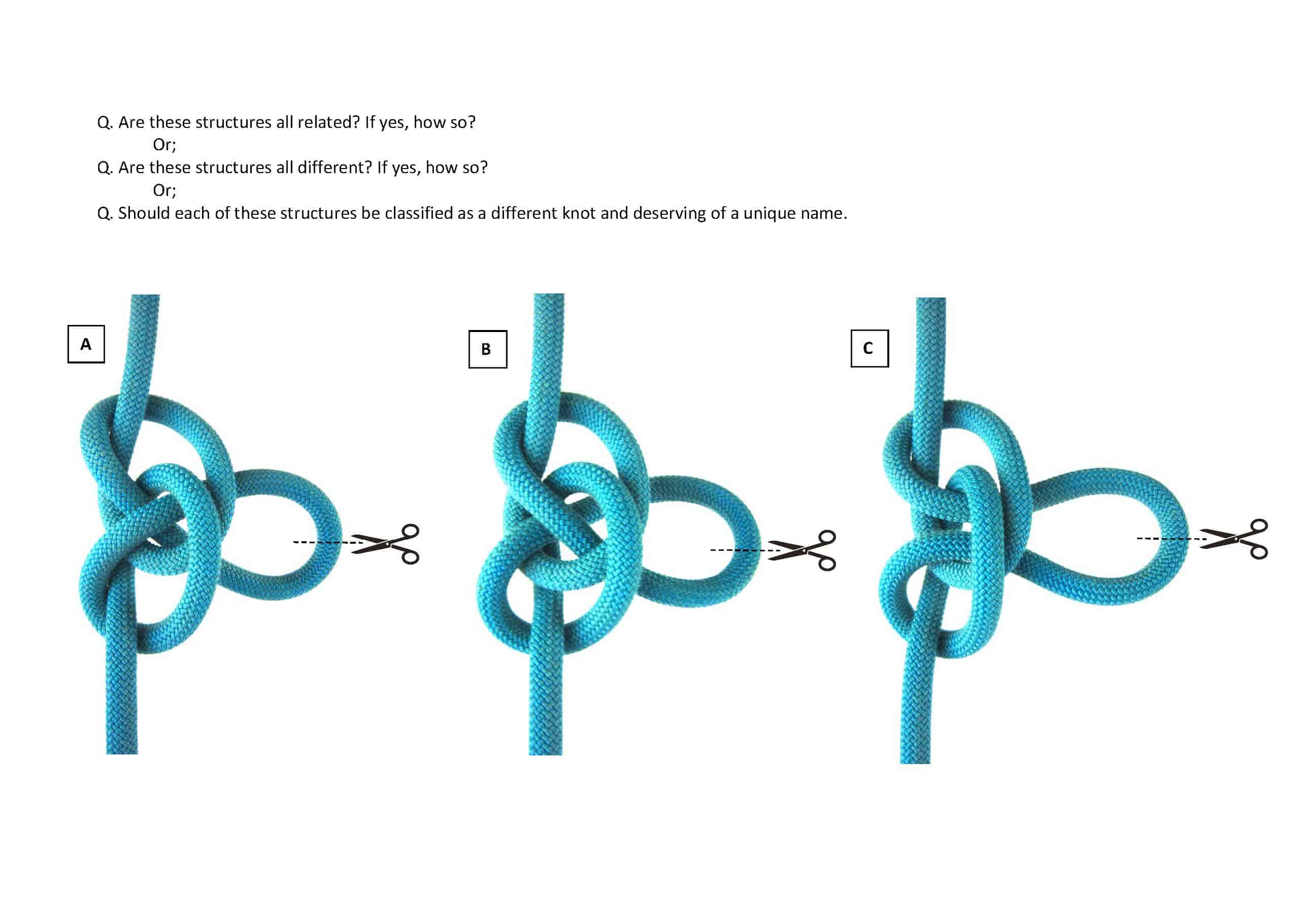
I will make a final comment for you to ponder - specifically in terms of a tail crossing within an ‘end-to-end joining knot’ (refer to attached image).
I did use the terms ‘parent’ and ‘child’ - and these were simply attempts to draw attention to the fact that there is a geometric relationship between certain knot structures.
You can also think of these knots as being related in terms of: '‘Genus’, and ‘Species’:
A. Butterfly - Z twist
B. Butterfly - S twist
C. Butterfly - No twist (#1053)

Its not really a question of which came first - its a question of geometric relationships.
In terms of the attached images of 'Butterfly eye knots… they are all related - and are all from the same ‘Genus’.
It can be argued that image ‘C’ (#1053) is the logical base structure - eg, it can be conceptualised as the ‘parent’.
The other structures are all ‘cousins’ - they are related - one has a Z twist and the other has an S twist.


Butterfly_geometries-min.jpg

In which we see that --by some counting, at least–
“C” has one fewer crossing (of the Eye Legs<=> Tails with each other).

<argh!!!> There are I think intractable problems in working out
classification schemes. One must ask What is the purpose (of a
scheme) --what can it do for us?! (I find myself hitting dead ends
or contradictions or overwhelming variables.)-:

–dl*

Hi Mark,

I have put up cases of some bends families which are existing for decades. I see that their geometric relationships or genus were not being aware of and thus the names were not align with the structure or align with you. As I have mentioned in the early threads, there were limited of information at that time, less information/reference can be reached. IMO, by now you can obtain some useful aid in one of my knotting folder “Bends Classed By Starts”. I always try to get the bends in family/genus. I tabulate what I found. I respect everyone, especially the making of the existing names of knots/bends known to us for decades.

I have tried this kind of indexing as a whole before, not only pin point to some basic pathing. I realized your suggestion/applications will accomplish a bit only, but not the whole indexing. I understand that your indexing are only indicating the type of placements of the exited Working Ends after tucking through the central hole of the two loops. By this, will you give us a few examples of your indexing on some known families? Then how are you going on for the rest. Will you give us more and more examples?

Upon your query and proposal, should we now get a new start with you and some clever members to explore on it.

Happy Knotting
yChan

yChan,

I am posting this info in good faith.
If you implement each of these recommendations, your work will be significantly enhanced/improved - and potentially rival the work of Roger Miles and even Ashley.

In my view, here is what you need to do to get your work into a form that is more user friendly.

  1. Number all of your knots (1, 2, 3, 4, 5 ,6 and so on - like Ashley has done).
    This will make referencing your work much easier… you could say for example knot #38 is ‘xyz’

  2. Organise all of your ‘bends’ into geometric categories as follows:
    Overhand + Overhand (examples include: Butterfly bend, Zeppelin bend, Riggers bend, etc)
    F8 + F8 (example is #1411 F8 bend, etc)
    F8 + Overhand (example is ‘Lehman 8’ bend)
    U fold (bight) + half hitch (example is Sheet bend)
    U fold + U fold (example is Reef/Square knots/bends)
    Crossing hitch + Crossing hitch (example is Carrick bend)
    Crossing hitch + Overhand knot
    Crossing hitch + Loop (example is ‘Tugboat bend’)
    Interpenetrating strangles (example is #1415 Double Fishermans)

and so on…

  1. Create a searchable index
    Note: And this is where the numbering system will make it much easier to find a specific knot (like Ashley has done).
    At present, it is almost impossible for the general public to find a specific knot - or to reference your work (because finding stuff is tedious).

  2. Ensure all images are like those in your ‘About bends’ folder (no more images taken on your couch/sofa)

  3. Ensure that your specify chirality with all images (eg if you have an image of a riggers bend, specify if it is S/S or Z/Z)

  4. Get a faster storage cloud server (the load times for your current folders are painfully slow - for example I lose patience and give up).
    Note: This is not as critical as the other points above - but would make browsing through your folders a more user friendly experience.

Note: I don't think you need to publish every knots mirror opposite version - perhaps only a select few where it aids understanding.

As long as the reader can understand that you are only portraying one chiral form.

Hi Mark,

Thanks for your comments. In reply to your thread above.

  1. I have once disagreed your proposal to have my bends all in numbers before. The reason why I would not do that because I am now doing it in alphabetical order. New comer (new or known bends) can be easily get in line. Once the bends were found not new, they would be deleted from the line and backed to their old names. Ifffff I get them with numbers as you suggested, there will be a big crisis. People can easily access to the information by the knot names and no need through some numbers and find the knots. And bear in mind, I suppose new comers are welcome to be included in my folders.

  2. Your suggestion is good for listing out the components of a bend. It is an easy job for everyone. Interested readers should have their own notes. I have just finished one chart for [Bends of Crossing Knot + Crossing Knot] a few months ago pending for re-checking. The chart will be released on the coming month.

  3. IMO, the numbering system applied to my folder will be overdone. See reasons above. To my knowledge, the so arranged in Ashley’s book ABOK are:
    a) The numbering is for the sketches, nothing related to the names of the knots, unless they had no names. We the readers use the number e.g.ABOK#xxxx for identification/referring only.
    b) The names of knots shown in the index pages are in alphabetical order, and listed with pages numbers. Hence these various pages show the sketch numbers (same knot has different numbers in different pages because the numbers represent the sketches drawn in different applications/chapters).
    c) The total numbered sketches are not actual numbers of knots. There are many cases of one knot possesses more than one number.
    d) In Roger Miles’ book - e.g. Diamond Bend (B7). the numbering (B7) is for his four types classifications of bends. If there happens to be another knot with the same name. We usually distinguish them by adding (B7).

  4. Photos can always tell more, sketches can not. I took no good photos because I did them in a simple way. I can work much better on this if I want to. To me the content is essential, brief and clear. Though I am a retired designer, I do not chase/favor for perfection, because it is an illusion, we always be demandable.

  5. The photos tell.

  6. Will it cost money to buy/fire the service. It is now free for me to use.

Reply to your note
My reply : They are good for left-handed persons to tie the knot/bend. Do not neglect the usual public. Sometimes you will tie the mirror version, thus it is a handy note for verification.

Mark, I cannot do anything for you, but your comments/suggestions give me the chance to express myself. Thanks.

Happy Happy Knotting
yChan

Happy knotting yChan!

Is there a list of the covered knots in some file?
–which could have, per knot, the file(s) in which
the knot was variously treated (per tying start)?!

–dl*

Hi Dan,

In my knotting folders there are “List of My Other Tying Methods of Knots” and “List of New Bends” in which the names of bends are included in these lists. Their tying methods are well included under each bend, e.g. "OTGriefKnotop(1) to (34). The folder “Bends Classed By Starts” are bends listed under their “Start Method”.

Happy Knotting
yChan

I don’t see these folders, in quick check of URLinks in this
thread, and of what turns up for some of those links --which
mostly end with a “…Flow” folder.
Trying to back up in an URL to where some general listing
of folders might be runs into Google wanting me to have
forsworn allegiance to their fealty and have a username … . (no!)

Can you give the URLs here
–“all of my bends”… or whatever.
(It would be nice to have ONE folder listing all the knots.)

)-:

Dan:

Is there a list of the covered knots in some file?
and;
(It would be nice to have ONE folder listing all the knots.)
Is it possible to interpret that you are asking for a searchable index? Yes/No? If 'yes', yChan has indicated that he has no intention of making a searchable index (like an index in your average technical/science book).

Hi Dan,

Here are my 6 knotting folders. There are pdf files inside the folders. Please try to find what you want.

“Bends Classed By Starts”
https://drive.google.com/drive/folders/1kGG0h_0QQ2eIxhEquySzNBUC0O9li1dv?usp=drive_link

“My New Bends”
https://drive.google.com/drive/folders/118JW083wRZ52FlhlAjF-lUvAdCpiE9fB?usp=drive_link

“My Other Tying Methods of Some Known Knots”
https://drive.google.com/drive/folders/1C8vtR72jJp9NjHiOR_qA9336We11Jt4g?usp=drive_link

“About Bends”
https://drive.google.com/drive/folders/1L-SkqQE2eXG4PudMYCn7ik2DdMPVusUk?usp=drive_link

“Bends Grouped By Appearances”
https://drive.google.com/drive/folders/1faTyhTmENVEApc_OKZlGXyQgWv4pCTk8?usp=drive_link

“My New Knots”
https://drive.google.com/drive/folders/12Z4bBbLrCJw3dEzems9QOvp_G4hgBKJP?usp=drive_link

Happy Knotting
yChan

This looks like something in the right direction
–for 132 + 132 + 84 = 348 knots,
ample fodder for browsing!!

Now, on to this (“bends” => “knots”)

"My New Knots" https://drive.google.com/drive/folders/12Z4bBbLrCJw3dEzems9QOvp_G4hgBKJP?usp=drive_link

Hmmm, OT YiaLoop looks maybe to be a strong one.

thanks,
–dl*

Hi all,

Bend Charts 022s are added.

“About Bends”
https://drive.google.com/drive/folders/1L-SkqQE2eXG4PudMYCn7ik2DdMPVusUk?usp=sharing

This folder is updated.

“Bends Grouped By Appearances”
https://drive.google.com/drive/folders/1faTyhTmENVEApc_OKZlGXyQgWv4pCTk8?usp=share_link

Happy Knotting
yChan