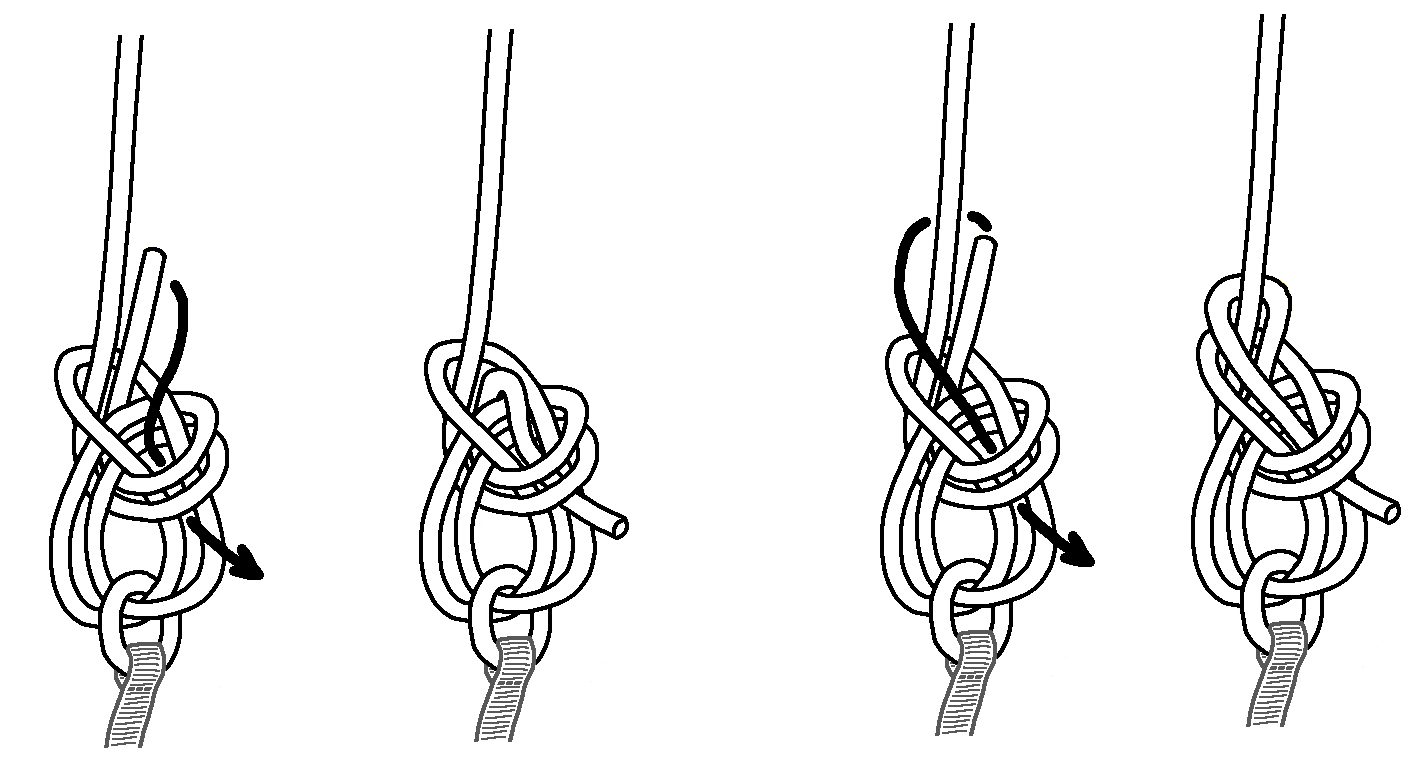
Best Dressing for BoaB (#1082 images)

I’ve often found myself trying to figure out how best to dress
the BoaBight. Now, I’ve found a dressing that gives both of
the (potential? --use of the EK isn’t specified) S.Parts 3 diameters
of material to surround --better rounding, heat sink effect?!

Referring to ABoK #1082’s finished-knot image (center),
the dressing I now favor will have that image’s
LEFT S.Part shifted up-over-rightwards to then
lie parallel with its twin; we might see this S.Part
as “exterior” --outside of the other.
NO OTHER CHANGES to #1082 state but this.
(Note that the BWL Analysis paper has the collar
at a different arrangement to the above --it needs
a twist. The lower eye (to viewer) & upper eye will be
held in those places at entry/exit by draw of the S.Parts)

Loading this shifted S.Part will, so far as I’ve
done some loading (300# in 10.5 rope),
NOT SLIP when the directly connected eye
to this S.Part is UNloaded --that will be adequately
nipped & held.
In sharp contrast to the reverse, loading the other
S.Part when its directly connected eye is UNloaded
–slips readily, with mere manual force !! BEWARE.

–dl*
==== *

Sorry it took me so long to study this. I now agree with Dan as to the desirability for his rearrangement of the standing part.

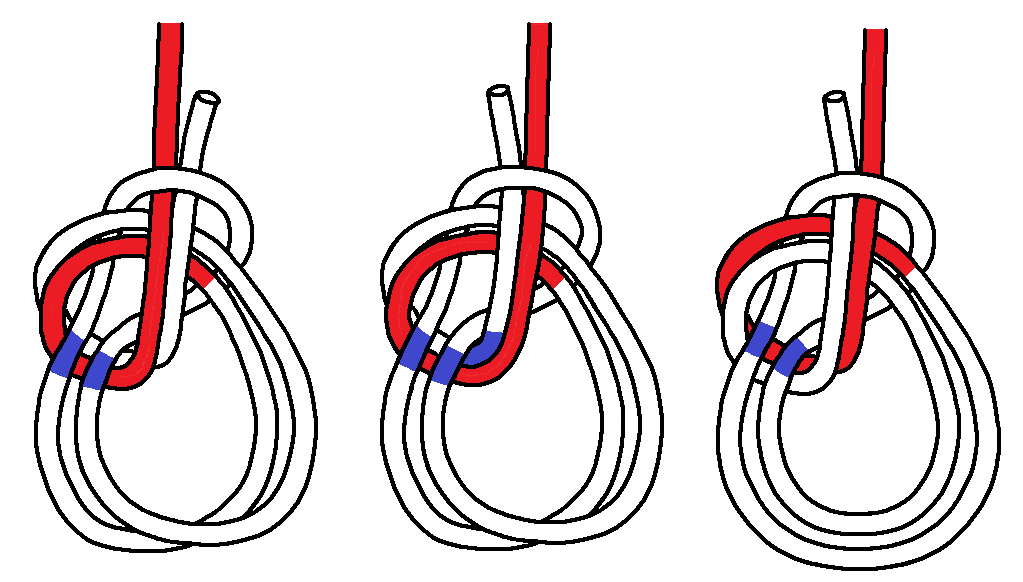
I don't think I had really looked at what happens when you take [ABoK #1082] and decide that only one of the standing parts in that diagram will be the sole standing part, and the other becomes the free end. In other words, what you want when you use a Bowline on the Bight as an end eye knot.

The first diagram above shows how if you pick the part labeled red as the standing part in #1082 to be the standing part of an end eye knot, you get the primary nipping loop (also in red) with 2 rope diameters inside it (in blue). The second diagram above is Dan's suggestion for a rearrangement to get effectively 3 rope diameters inside this primary nipping loop (with all the tension on the red rope). In Mark Gommer's Bowline Analysis, he picks a different rope from #1082 to be the standing part of an end eye knot. This is the third diagram above, where you should also note that he has arranged it differently at the bottom (with one loop inside the other, and smaller).

Again, I like Dan's suggestion. Since some climbers tie a rethreaded Bowline on the Bight as their tie-in knot, they should consider using Dan's rearrangement.

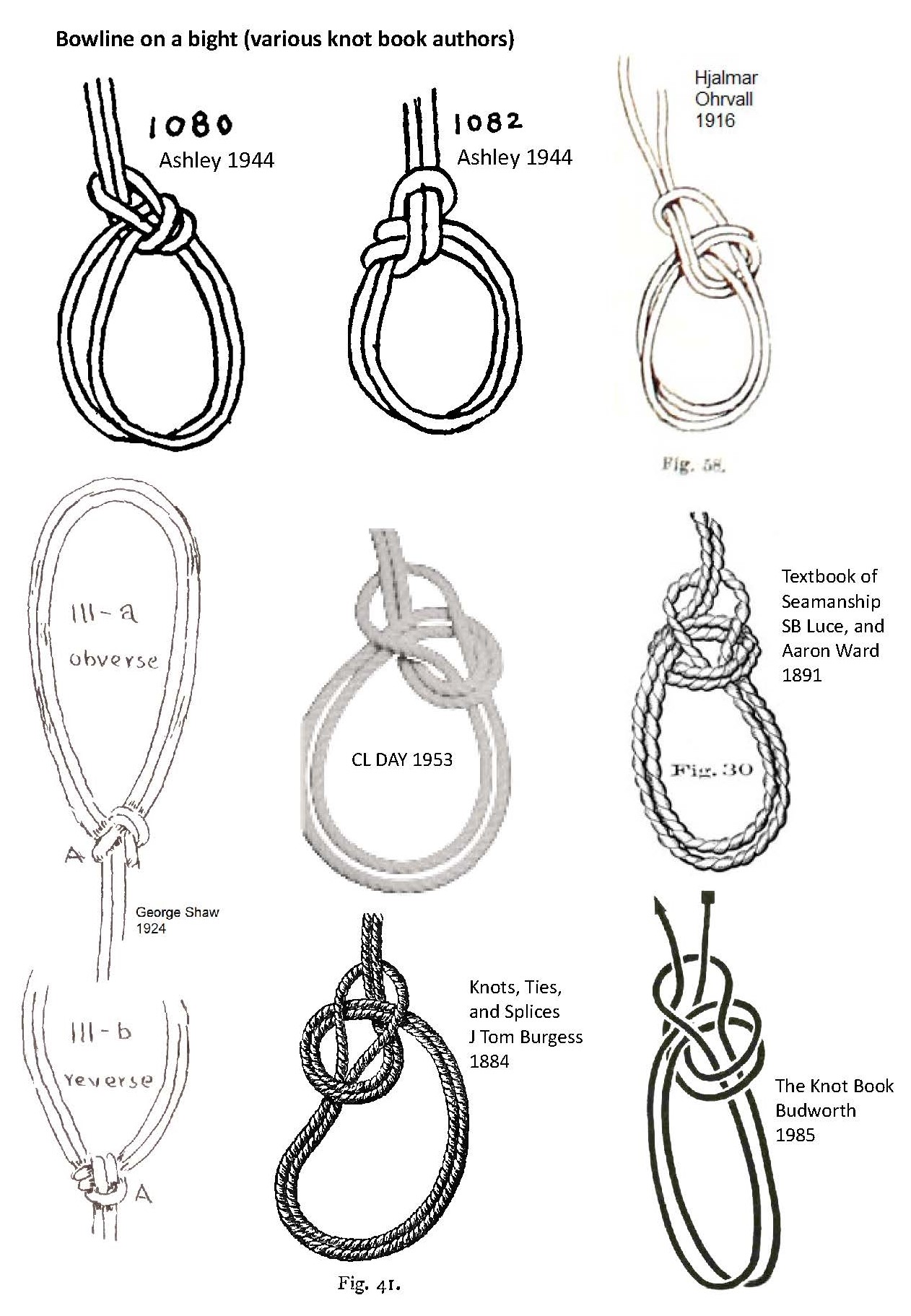
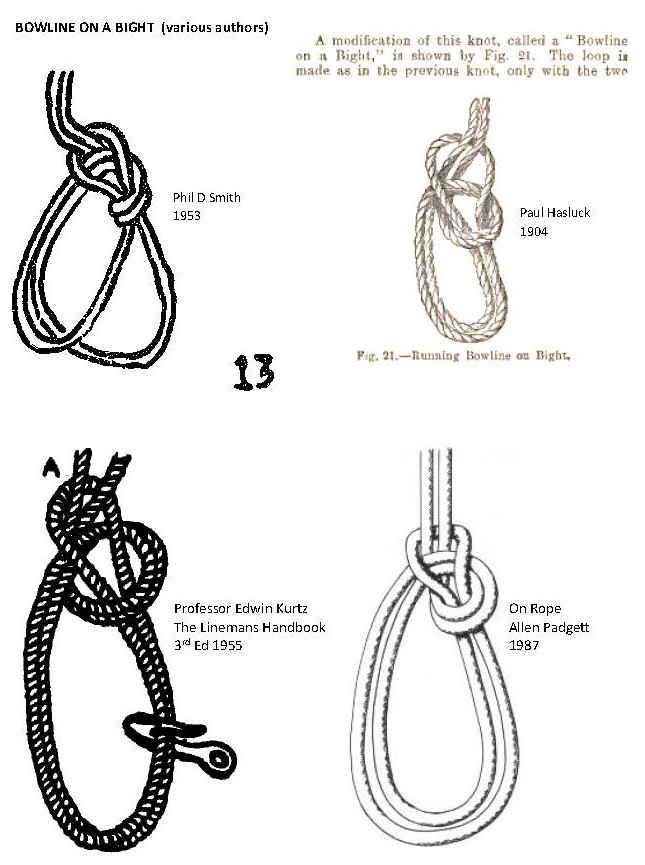
Here's a collection of 'Bowlines on-a-bight' from various authors spanning a century of time.

Notice anything? Budworth is the only author to show one active S.Part (the other is de-activated).

All other historical authors show 2 active S.Parts. Note: George Shaw illustration is difficult to determine with 100% certainty. I think his intention was to show 2 active S.Parts.

In terms of the geometric orientation of the single active S.Part - I think Budworth's choice is not from a loading point of view - rather from an artists illustration point of view.

I would note that Dan holds Cyrus L Day in high esteem. CL Day shows 2 active S.Parts (as do most historical authors). I would agree that CL Day is certainly one of the more reliable authors - and infinitely better than Graumont and Hensel's 'encyclpaedia of knots'!

The point of Dan's post (I believe) is with regard to intentionally having only 1 active S.Part.

Commentary (related)

I would also draw readers of this reply post to the Figure 8 eye knot (Ashley #1047) - where Dan had on many previous occasions pointed to a (quote) "strong form" versus "weak form" - which has been debunked. The affect of the orientation of a single active S.Part on an F8 eye knot is resistance to jamming. This is not to disparage, but rather show that in other knots, the relative position of the S.Part has no effect on MBS - but does affect jamming.

EDIT: I am also unsure of the intent of Hjalmar Ohrvall. I would surmise his intention was to show 2 active S.Parts. But, his illustration could lead a person to think he intended to show the knot with only 1 active S.Part.

What you show is that (most) knots-book authors
show what has been shown before --and that they
might well be clueless as to how that actual knot
was employed. (For Hasluck, note that citing
Haslope's Work serial will give same info at an
earlier date --1891 & -2.

I wouldn't say that my conjecture has been debunked,
as it yet wants full exploration; but at least in the
readily done tyings & little-bit-of-Dressing&Settings
test cases, there's no real evidence for support.
What I'd like to see
--as a way to understand the knot mechanics--
is some of the e.g. Richard Delaney's hard-set Fig.8 EKs
w/interior (my one-time "weak") dressing then given
exterior ("strong") loading. The basis of my assertion
is that the exterior strand will gain cushioning from
bearing upon the interior twin before they make their
turn around the eye legs.
Such setting MIGHT show this conjecture to have
merit; though still it might be something affecting
only our understanding and not expected to matter
for practice --both because the difference is likely
not great, and other factors such as ease of untying
have greater value.

To this we might also bring up a conjecture --and
it's central to my BoaB point-- that 3 vs. mere 2 dia.
of rope in the mass that the S.Part turn around and
bears into will increase strength. To this, there is
rather contrary evidence from the testing of the
Fig.8 "Bunny Ears" twin-eye knot :: it's hard to see
how that knot canNOT be giving some noticeable
--and we'd hope beneficially effective-- rope mass
in the S.Part turn, but ... I've seen even lower and
otherwise roughly equal strength found. Well,
maybe there is dressing to improve (I have found
rather different versions of this that look nice
--if looking at knots is the game! :slight_smile:

??? How on earth do the results of testing the F8 EK
show about other knots?!

--dl*
====*

In this end-knot case, there's a maybe better
completion 'a la what's been called "Lee's Lock"
as used for the YoBowl (Yosemite Bwl).

Coincidence here, but at this moment
(well, actually a few moments ago as of this msg.),
I've just discovered and put to ink another twin-eye
Bwl (NSE & EEL, with half a PET --i.e., for one S.Part)!

The general idea came to me as "don't see the BoaB
and #1074/1882 as pushing out the general ..."
Take-Any-EK-and-tuck-eye-into-knot-then-...BackFlip"!
So, I used the John Smith Bwl as my base and then
... did the tuck-through-&-BackFlip.
.:. Seems to give a more stable-upon-various-loadings
eye knot, not having the slippage issue that the BoaB
has if only 1 S.Part & 1 eye (vs. the other eye) is loaded.

--dl*
====*

In relation to F8 'strong' form v 'weak' form:

Too long - don't read unless your name is Dan Lehman :slight_smile:

I'll make a few remarks based on my personal observations and extensive experience in the use of knots employed in life critical applications (eg climbing, abseiling, canyoning, etc)..

  1. The notional concept of knot MBS (strength) is largely irrelevant. The idea of choosing a knot based on some perceived strength advantage is flawed (eg F8 v Bowline arguments). In modern human rated synthetic ropes, even if a particular knot causes a reduction in MBS yield by 50% - there is still ample margin of safety - it is not a 'show-stopper'. The humble simple overhand eye knot is 'strong' enough.

  2. The idea of having 3 rope diameters inside the nipping loop of 'Bowlines' is sound - but the primary benefit is not due to a measurably significant boost in MBS yield. The benefit is padding - it lessens the sharpness of the bend radius of the nipping loop - and promotes elastic deformation rather than plastic deformation.

Rope fibres when subjected to very tight bending/curve radius are microscopically being torn apart in one cross-sectional plane, while also being compressed in that same cross-sectional plane (ie unequal loading effects within a cross-sectional plane).

Extrusion is also occurring during loading. Rope material is 'extruded' out from the knot core via s-t-r-e-t-c-h-i-n-g. The knot core compresses - which tightly squeezes rope segments. At the same time, a pull is being exerted on the S.Part - which is being drawn out from the knot core. As load continues to increase, a threshold is reached where eventually the struggle is lost - and plastic deformation occurs. (Note: Ideally, we want the rope fibres to remain within the elastic deformation range).

This has the effect of accelerating 'wear and tear'. And so padding out the interior of the nipping loop should delay compression and extrusion sufficiently to lessen wear effects over time. Note that modern rock climbers are taking multiple free-falls in one extended climbing session - their rope is being subjected to repeated shock loading events.

(Note: One can also relate to pulleys - where the sheave diameter has a measurable effect on efficiency).

A secondary benefit of padding out the nipping loop is an increase in the mass of rope material within the knot core. This creates a larger 'heat sink'.

We know that under loading, the localised temperature of the knot core increases - we can see this in real time with thermal imagery. The movement of rope fibres against neighbouring rope fibres while being compressed causes friction - which results in heat build-up. In all knot break tests that I have done (which is considerable) - I always see evidence of melting/fusing of rope fibres. And so having a larger heat sink helps to disperse heat via conduction and radiation across a larger mass of rope.

Essentially, all knots create a localised stress concentration in the rope. The effects of heat build-up, unequal cross-sectional loading of fibres, and extrusion of rope material all combine to deteriorate a rope. The degree of deterioration is proportional to load - which in turn is affected by the properties of the knot.

With regard to Dan's 'strong' v 'weak' form of an F8 eye knot:

The relative position of the S.Part within an F8 eye knot has a noticeable effect on core compression - which results in jamming. In a side-by-side "pull-it-till-it-breaks" test, we don't see a statistically significant difference in yield. What we do see is a noticeable difference in jamming.

The Double F8 eye knot (aka 'Bunny ears' F8) has a larger mass of rope material in the knot core. This provides a larger heat sink. Bend radius of rope segments are padded out more. In theory, we should see some measurable difference in the MBS yield of single eye F8 versus a double eye F8 - but this difference is not relevant to the average rock climber. That is, the percentage difference in MBS between F8 'A' versus F8 'B' is not the overriding safety concern. Tangible benefits of Double Eye F8 is in regard to anchoring options. Jamming threshold will be different - and long term wear and tear will be different.

Over time, repeated compression and extrusion will deteriorate the rope fibres. And I think testing ought to be designed to measure the effect of long term repeated compression and extrusion of rope fibres - using various samples of rope subjected to such loadings.

Note that in rock climbing, the portion of rope that is subjected to stress concentrations is predominantly in close proximity to an end. Climbers tie their rope into their harness - and so the knot is located in the same general position each time the rope is used. Some climbers flip/turn their rope around - so as to spread the 'wear and tear' to the opposite end. Note that some don't - and don't even care.

I think a test could be designed to subject a rope to repeated loadings using one particular knot species - lets say 500 cycles of repeated shock loading to 'condition' the rope.

Then test that sample of rope in a straight line pull versus a U turn pull (to simulate a carabiner bend radius).

The long term 'internet' arguments over F8 eye knots versus 'Bowlines' are largely non-sensical in my view. The theme lines spewed by ill informed commentators generally revolve around:

  1. Ease of checking during so-called 'partner checks' (the familiarity argument)

  2. Knot security - alleging that 'Bowlines' unravel and "you're gonna die"

  3. Ease of tying - the argument being that F8 is 'easier to remember and tie' - and "you're gonna die" if you attempt to tie a 'Bowline'.

All of these arguments are subjective (not objective).
Disregarding the whole lotta off-topic text,
I'll reiterate my point re the BunnyEars F8 ::
that in fact we have tests --nevermind "theoretical"--
of this vs. single-eye F8 and some show a weaker
knot, overall let's call it equal. It isn't a point to ask
whether the climber cares; the point is that the
conjectures re diameters surrounded by the S.Part's
high-loaded turn aren't living up to conjectured expectations!

As for the single-eye F8 case of Interior -vs- exterior
loading, that at least allows that a good testing of the
conjecture hasn't been fully made --i.e., having the knot
set really hard via Interior loading AND THEN seeing if
Exterior loading earns the "strong form" moniker.
(I fully accept that whatever the result, the easier
untying of the Interior loading will be preferred.)

--dl*
====*

It depends on precisely what you mean by "whether the climber cares".

I can comment that nobody really buys into the Knot 'A' versus Knot 'B' strength differential argument anymore. That ship has sailed for the majority.

The tired arguments that I still see - particularly in relation to F8 v 'Bowline' is in relation to: "You're gonna die because your partner wont be able to check your Bowline " Or; "Your Bowline will unravel - and you're gonna die."

Various claims are constantly spewed along these lines...

As for...

My contention is that the case to be made for increasing the radius of the nipping loop(or other tight radii within a knot core) is with regard to promoting elastic deformation - and delaying plastic deformation. Padding out the nipping loop of a Bowline should have a benefit in this regard. The increased mass/volume of rope within the core also acts like a heat sink.

Repeated heavy loading is more likely than not to cause 'harm' to the rope. The harm can manifest in itself in different ways - eg heat glazing of rope fibres, fuzzy outer sheath fibres (resulting from microscopic tearing/shearing), and alteration of shape (or combinations of these).

...

Pull tests of hand tied knot test samples always have variations - even when tied by the same person. Subtle variations trigger different responses. Load measuring equipment may not detect any statistically significant variance - if that's what the tester is looking for.

Probably more meaningful to examine response to load within a different paradigm... such as thermal imagery, and detection of extrusion via control point (reference frame) markers on the rope. I would surmise that we would see evidence of accumulated damage at the microscopic level - eg by looking at the sheath and core fibres through high magnification (before and after image comparison).

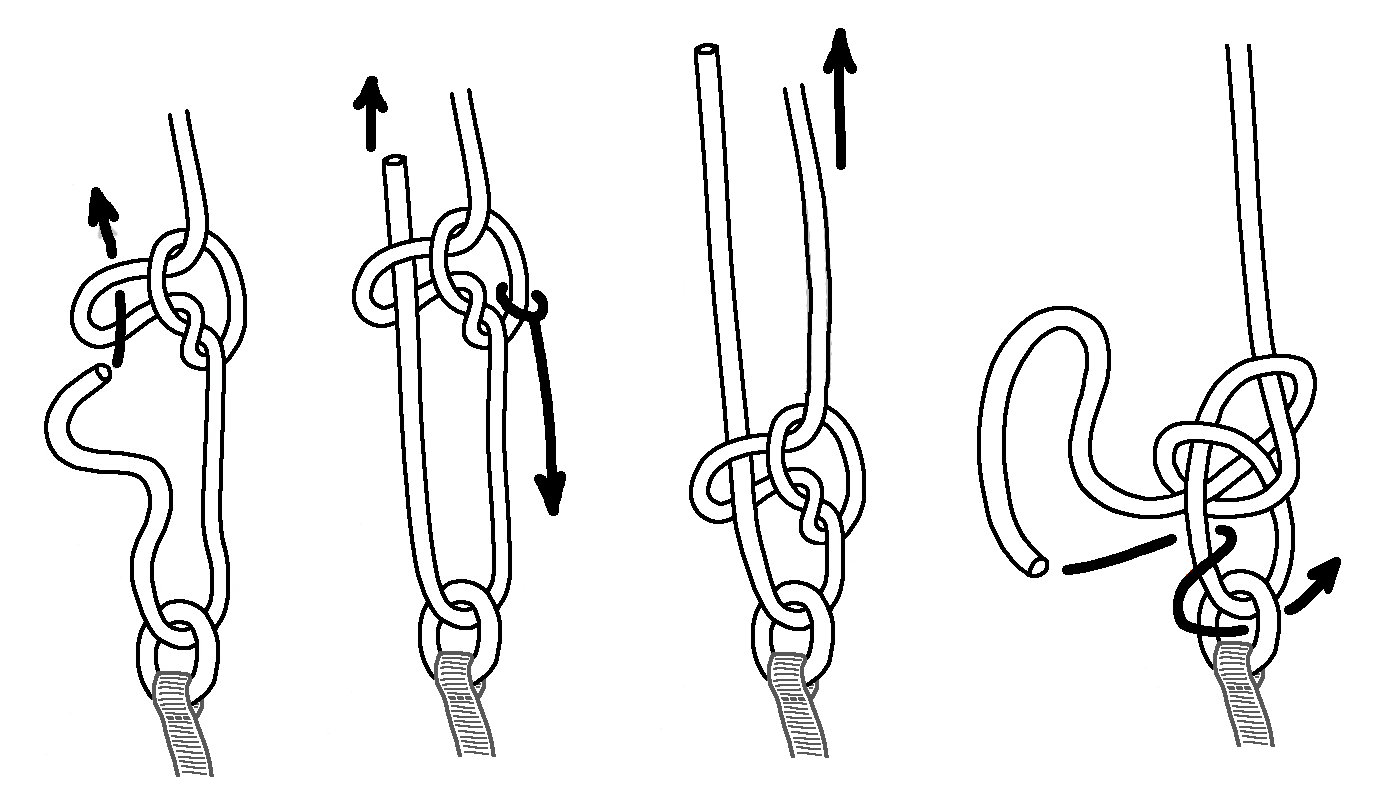
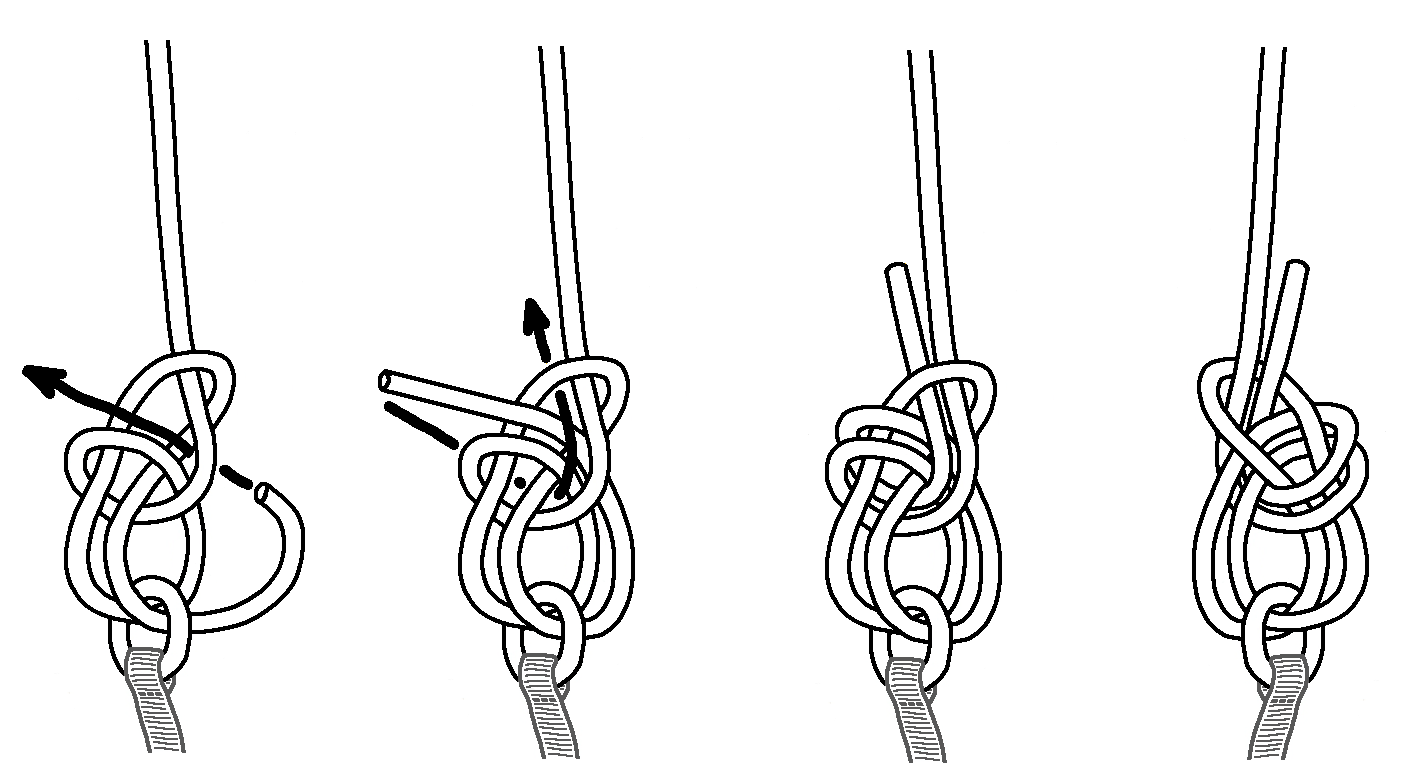
I will let Dan and Mark argue about life-critical applications. I just find the Bowline on the Bight interesting as an end eye knot. Here is a way to tie the Bowline on the Bight as a Threaded Knot through or around something. It uses the Spilled Noose Method for tying the original Bowline so that a long free end can be pulled through.

You can then add (as Dan suggests) the lock Lee puts on a Yosemite Bowline, or you can add something like the tuck that Harry Butler suggested, also for a Yosemite Bowline. These both give us four rope diameters in the primary nipping loop.