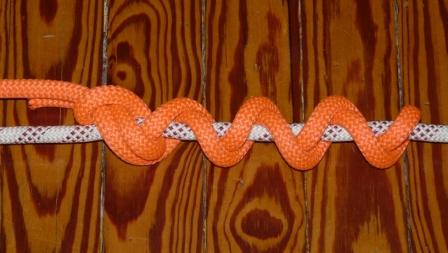
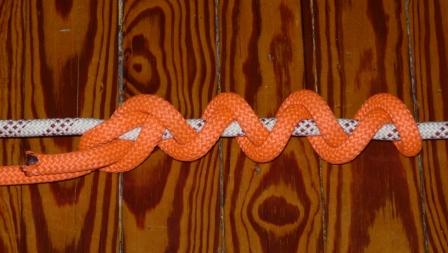
What is the point for Best gripping hitch around a tensioned rope. ?
I.e., what sort of circumstances does this envision,
and might it be really about the same rope-problem
as tying to some other rigid object? --pointing to the
qualifier “tensioned”, which I take to deny the object-rope’s
ability to bend or “dog-leg” and thereby aid gripping.
Another key factor is relative size & nature of cordage
and hitched object --the KC hitch being one favoring
considerable difference in diameters, cordage being smaller.
Not to expect “scientific testing” or anything, but it would
help to know what sort of testing/stressing has been put
to the knots put out for consideration --seems reasonable
to demand of the OP at least SOME sort of testing to at
least find the structure working in some minimal case.
E.g., I’d be surprised if the OP’s knots of criss-crossed,
alternating over/under of strands, hitch gripped at all,
in the materials shown (firm, slick, climbing kernmantle)
–for it is roughly a KC hitch, which needs diameter difference
to gain purchase. Giving this sort of structure (but I tied off
the ends w/a bolwine, for loading) a quick test in old, fuzzed
dynamic 11mm rope around somewhat thinner and much
slicker PMI <Won’t-Bend> caving rope, it seems to grip
but with a pulley for loading, I see slippage begin --and
my object rope wasn’t anchored in tension, even, so did
bend in sympathy to the hitch’s gripping.
The “B hitch” is what Gary Storrick has called a “hitch series”
–repeated half-hitches/turns of alternating handedness-- ;
he believes that with the addition of further hitches, this
should grip on most anything. That might depend upon
the non-gripping coming from slipping and not from the
cordage being too stiff to turn around the object and bite
(barring some setting that secures the structure until a tight
bite is achieved).
Scott says “I just tried this affair out” and that sounds
too singular for the plurality of ideas put forward already!?
In Xarax’s bottom-shown structure that comprises a strangle
anchor with then interlocked, opp.-handed half-hitch turns,
and then the seemingly neat "cloverhand" final component,
I’d think that the 2nd component is of no use at gripping,
and the series should be of the cloverhands (my name for
a structure that can appear to be a clove hitch except that
the ends are on opposite side of each other in passing under
the overwrap, and topologically this makes an overhand ).
A risk in the cloverhand is jamming; but it seems a good way
to give more material for a stiff rope to grip, and to gain effect
in that way.
One tactic I’ve played with for getting more grip of stiff cordage
is lessening the helix angle of turns --not sure though that this
is ultimately (vs “seemingly”) successful. So, where one hitch
might take a single strand and wrap it around an object, the
revision would do this with two strands (though perhaps only
one will bear load, to grip), and thereby opens the helix angle,
and makes resistance to the bending a little less !?
One partial answer to my question of the point of this challenge
is to emply a hitching structure in an adjustable-eye knot, such
as the Midshipman’s hitch : there, you see, the structure’s S.Part
(I regard the knot to be what is hitched to this, and overall
we have a noose-hitch) will be loaded into and out from this
knot --out from, as one eye leg–, and so be more tensioned
than in some other cases (but less tensioned than an entirely
separate line such as a shroud, or a mooring line being hauled
tighter by a capstan, looking to be off-loaded onto some
<ack, what’s the term here for this structure ? ______?>
other line, maybe to tie the bitter end to bitts, the release
the line onto that anchorage).
–dl*