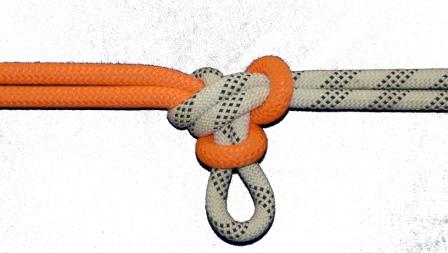
How do you connect two bights, when you do not have access to any of the four ends ? We suppose here that all ends are parallel and -equally- loaded, and we are not interested in double line bends. The problem with this bend, is that most of the many possible suitable knots seem to be very bulky.
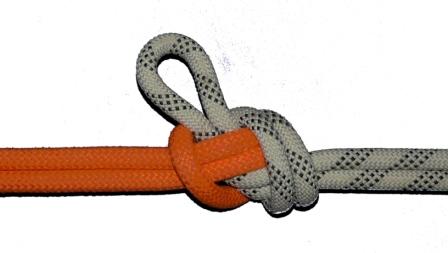
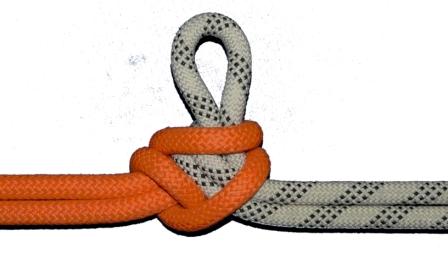
See the attached pictures, for two possible simple solutions.
Hi xarax,
it seems to me that load(s) / need(s) are going to have a very important role and influence in this discussion. Add to that the fact that the loads may even be dissimilar.
Tying what you’ve offered shows to me that if the load, etc., is favoring one or the other, in most of the combinations I tried, that it can have dire knot consequences.
The simple sheet bend with bighted ropes is the simplest I know with the least bulking. But if the parts of the knot, loaded and not shown casts a whole lot of guessing.
So I can’t just “suppose here that all ends are parallel and -equally- loaded, and we are not interested in double line bends.”
I am having some difficulty thinking of a personal use scenario.
(-.-)
I agree, and that is why I have explicitly stated the equal-loads condition. It would be great to have bends that can withstand even uneven loading, but I have not figured out how this can be achieved, while we retain the requirement of a non-bulky knot.
Imagine you just want to tie two ropes together, and you double the lines to be on the safe side regarding strength. Then, you are left with two bights, and you would be glad if you could connect those bights in a more clever and economical way, than just tie a whatever double-line bend. That was the origin of this problem. You do not have two double lines only, you have two bights, and so it would be nice if you were able to exploit this particular fact, and somehow utilize the bights to connect those two double lines together in an economical, not-bulky way.
It seems that if one were to seek some sort of symmetry to equalize loading, using the bight ends ,then that in of itself would contribute to the bulking up of the knot, so far as I am able to visualize right now.
I am stuck with the Midspan Sheet Bend at this moment as the simplest in regards to the two-as-one rope criteria you stated. Oh well.
True. That is exactly why I have used two dissimilar knotted structures on each of the two ends. We can make the first as simple as possible ( the one tied with the “orange” rope ), and see what we can do with the second (the one tied with the “white” rope).
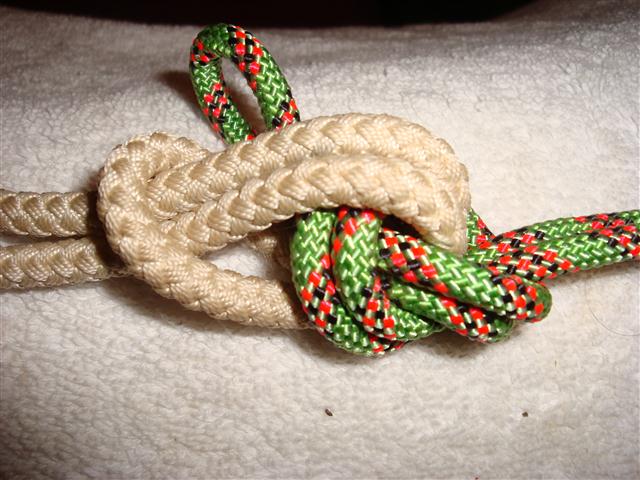
Just gave a go. I tied a girth hitch mid-air, then tied an overhand through the two coils and tucked the bight end of the overhand into the same space.
Pulling on any opposed (across the knot) lines the knot holds well in hand and foot loaded conditions. Same side liner, well that is another story.
Easy untying.
So, you are telling me that, on the “orange” link of the second (B) bend, you have replaced the one simple bight opening, with the two girth hitch openings, in an effort to reduce further any communication between the two “orange” ends - is that correct ?
On the first bend, I have also used the (one opening of a) girth hitch, to further secure the bight end of the “white” link. However, I thought that the structure of the “white” sheet bend there would be adequate to absorb a somewhat uneven loading of its two 'white" ends, so I have not used the bulkier overhand knot .
( A picture of your solution would not be completely redundant, I believe ! )
Hi xarax,
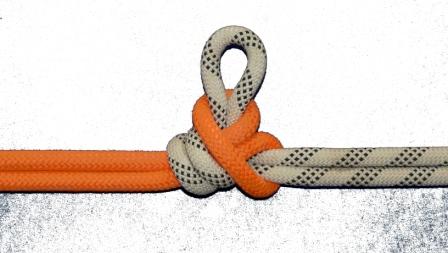
to complete the occasion for redundancy’s sake here is a graphic.
I believe that this has some merit for a bend consisting of dissimilar sized ropes too.
Have not fiddled with which rope should be which part of the knot that will work best.
I have just tried the suggestion by SS369 but with a Bull hitch rather than a girth hitch followed by a Bull hitch with the right hand rope reeved as a sheet bend. This adds bulk but may not add enough security to make the extra bulk worthwhile.
Not sure which bit was not clear - a Bull hitch can be tied on the bight by putting a twist in the single loop of the girth hitch and taking it back over the two double loops. The sheet bend tuck uses a doubled rope. Or am I missing the point?
Barry
PS (edit) Perhaps it’s not clear that I tied 2 knots using a Bull hitch - first time the right hand rope was as set out by SS369, the second time reeving a doubled rope through the 2 loops of the Bull hitch as a sheet bend. Sorry if that was confusing.
Interesting exploration Barry, thanks for jumping in.
Did you find any advantages using the bull hitch instead of the girth hitch?
I tied it with the same cordage I used in the photo and I only found one observed difference. One coil of the bull hitch when the affair was dressed and faired is at an angle and not laying alongside the other. Not sure if this will or could promote capsizing or not.
For the sake of clarity, I am primarily loading all lines the same in their respective pairs. Individually loaded will be another story altogether.
Please try it with the overhand part captured, not a sheet bend.
I edited my post realising the original was not clear at the same time as your later post. I did try the overhand knot first and my feeling was that the bull hitch might hold tight better than the girth hitch ie it was unlikely to loosen if shaken about whilst not under tension. Seems to hold pretty well. Using the sheet bend was an afterthought as I was wondering if used on single lines this might improve the security of the sheet bend (different thread).
Hi SS369,
to complete the redundacies, just for this occasion, here is another dressing of the knot you have described verbally. Pictures do not cost much nowdays !
I might be responsible for “long” discussions about knots, but I always try to take pictures of knots, too… Is the bend shown in the attached pictures the one you are talking about ? I like the "tube"made by the four parallel coils, and I do not find it too bulky. It is a nice, balanced knot.
Good question, but a very difficult one to answer without detailed tests, I am afraid. In general, the problem we are encountering here is this : we do not only wish to tie two bends together, but we wish to tie bends around other bends, hoping that the outer shell of the one link will squeeze the inner core of the other - and that this pressure will help secure the bight end of the later even more…In the case with the overhand inner knot, the particular way the outer simple bight, girth hitch or bull hitch will surround this knot might not be significant - because the overhand knot is very tight and secure a knot by itself. However, in the case of the sheet bend inner knot, the situation is more complicated. The sheet bend of the one link needs all the additional squeeze it can get from the outer shell of the other link, because it is less secure than the overhand knot. Moreover, the sheet bend must be surrounded by the constricting shell in a way that will keep it in a correct form - so that the standing part squeezes the tail as effectively as possible.
Who will test all those different solutions with his slippery ropes, and report his findings to us ?
 loading, but I have not figured out how this can be achieved, while we retain the requirement of a non-bulky knot.
 here is a graphic.