                  Hi All,
                           Videos for Easy locked and Super locked Bowline.
                            See alanleeknots.  Thanks/
Hi Alan, it’s been a while since we’ve seen a simple, yet effective lock for 1010, like this one, in the forum.
Very smart to push a returning bight leg, through the nipping loop, wrap around the loop, then feed the working end through this very bight and down through the collar, forming an unknotted, shaped eight, returning structure.
But is there a merit coming out of this bight tucking?
Absolutely, since it adds three rope diameters inside the nip, and it is not at risk of being sucked through the nipping structure, because the final toggle locks down the bight and the whole knot structure.
I believe it has a taste of the simplicity of Scott’s locked technique! I noticed that the cowboy variant is not TIB, but there is a way to make it TIB.
The first impression is very promising, i’ m waiting to see its response to heavy strain in order to qualify it as a secure, jam proof, configuration!
What’s the link to this?
I think Alan would allow me to add a pointer to his work.
Link 1 : https://www.youtube.com/watch?v=f5Gq-qHycZk&t=128s
All of these are interesting! The very first Locking Bowline that I learned was in a Canadian Fieldbook for Scouting dated 1990. I have never seen it anywhere else so I will add diagrams below. It adds an extra wrap around the crossing part of the nipping loop at the beginning of #1034 1/2. Then later when I learned about the End Bound Double Bowline (EBDB) and the End Bound Single Bowline (EBSB), I saw that they also did an extra wrap around the crossing part of the nipping loop when they got to that point in #1013 or #1010. Thus, I have a slight preference for your Easy Lock ABoK #1034 1/2 (Version 2) {Link 2 above} where the locking takes place at this same location. But all seem to have merit.
Keep up the creative work!
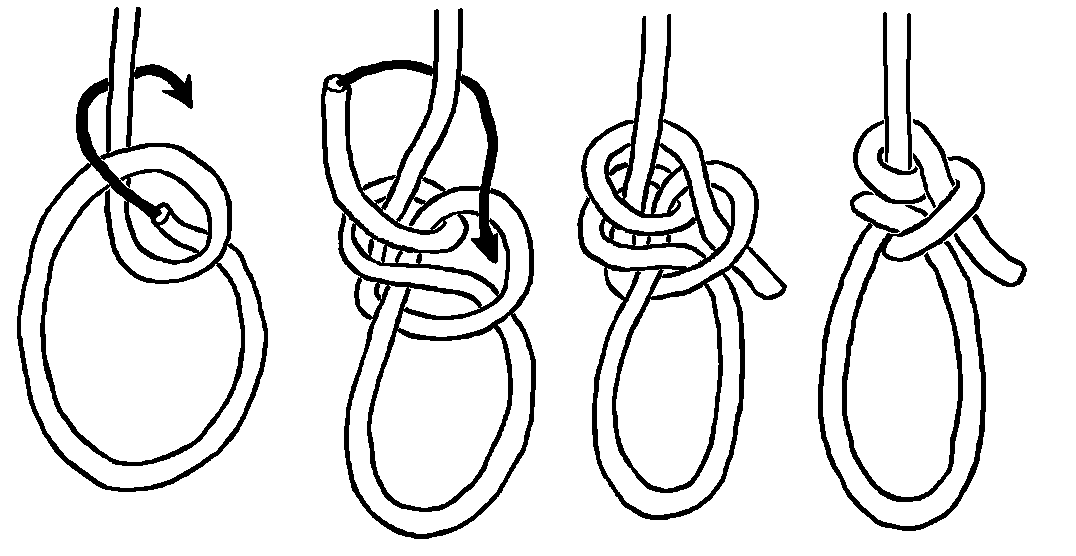
Four years ago, knotsaver sent me his knot, at that time no quite understand this knot,
and I totally forgot about it.
Till knotsaver remind me then I know so called Super Locked #1010 has tie by knotsaver long before me.
Here have to congratulation to knotsaver your have created a great knot well done.
There are many variations we can create form this class knot.
I noticed that the cowboy variant is not TIB, but there is a way to make it TIB
I know there is a cowboy variant is TIB. just wonder if we have the same tying method ?
Thanks.
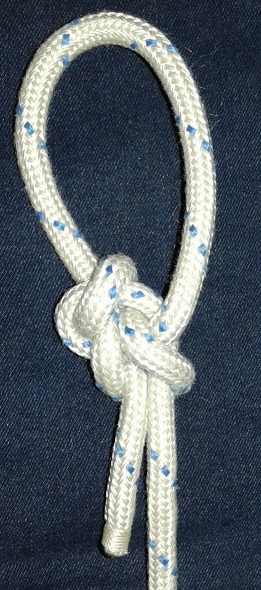
Indeed, capturing nipping loop’s crossing point, usually offers more stability, but the other techniques are quite decent as well.
Without absolutely no intention of overshadowing Alan Lee’s, knotsaver’s, 1010, remarkable, locking techniques, i’d like to imbue this demonstration with another 1010 locking technique of the same concept , i developed when i tied these prototypes.
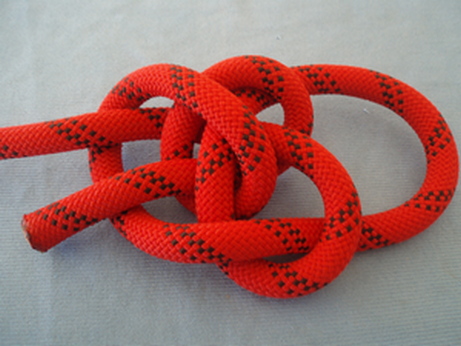
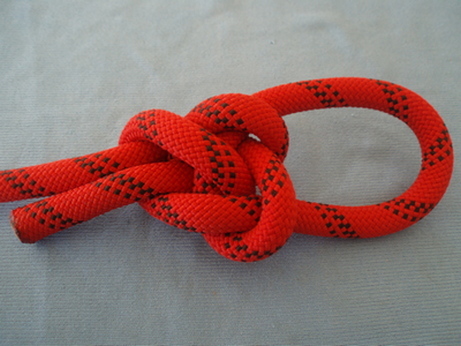
According to the attached images, the working end forms a bight after second visit up through the nipping loop, then it is tucked under Spart, under the on going eye leg and finally back through the bight and the collar.
It is this last maneuver that locks down the bight and structure, with no overhands at the returning knotting, and three levels of security to firmly restrain the tug end.
If the collar is shrinked, the Angler’s loop shows up out of nowhere, which might help in developing a TIB tying method.
The knot of course is tiable in the bight.
Alan,
I did notice that in all but one of your examples, when you start with a regular Bowline or Cowboy Bowline, you cross over the adjacent leg of the eye before re-inserting the free end back into the nipping loop. Do you have some reason for not doing this in the Easy Lock #1010 (version 2) {Link 2 above}?
Here is what it would look like if you did.
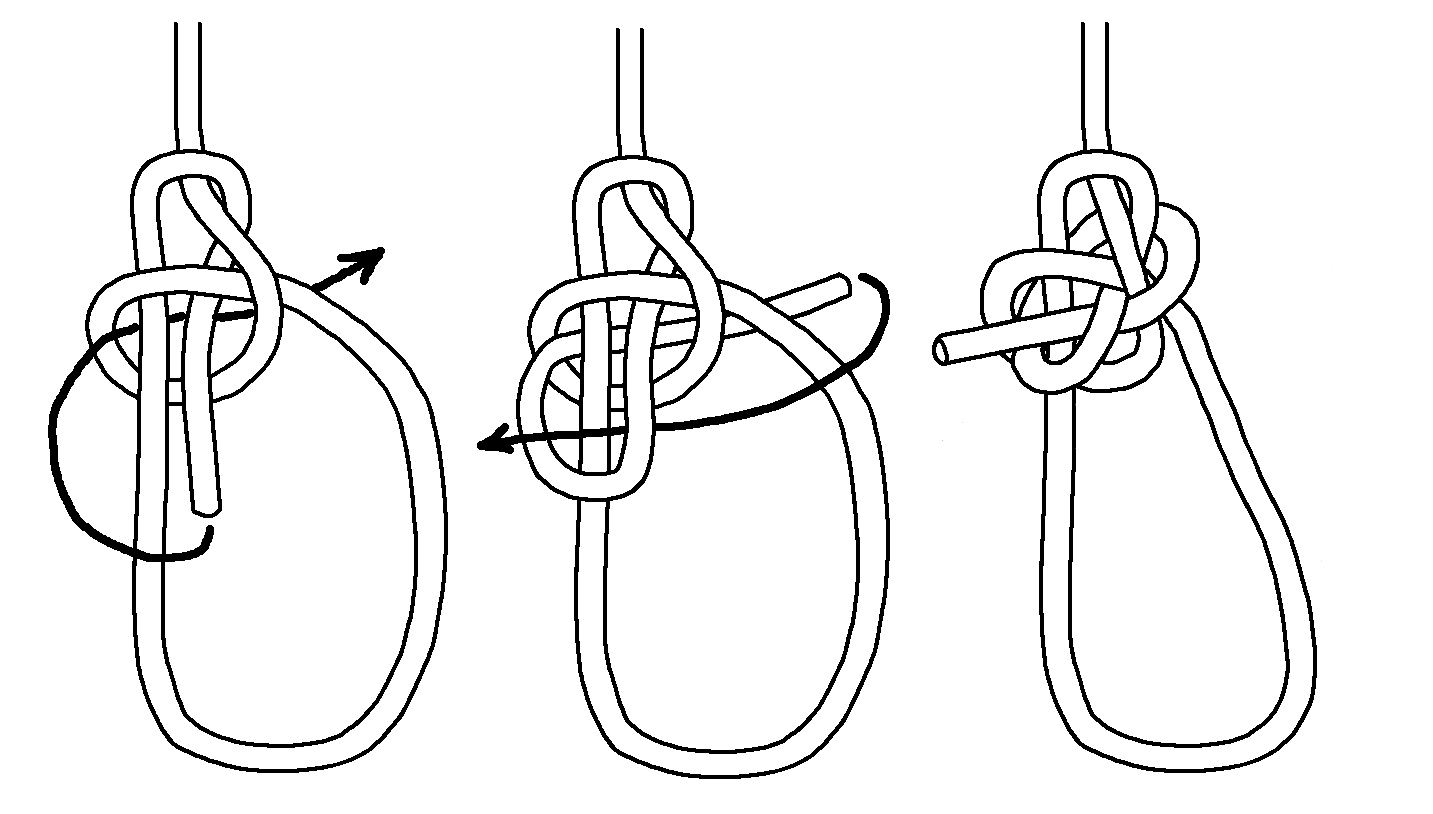
Thanks for all the replys, you are more then well come.
So busy, just do a simple video for Super Locked ABOK#134 1/2 1034 1/2 (TIB).
Thanks.
https://www.dropbox.com/s/8lkv3bdauj3m01u/ABOK%23134%20Half%20TIB%29%20%26%20Other.MOV?dl=0
Alan,
I did not mean to be critical in Reply #7 when I mentioned that you did not “cross over” the adjacent leg of the eye in the Easy Lock #1014 (version 2). When I played with your Super Lock #1034.5 to try to get it TIB, I discovered that it becomes TIB if you do the same there (not cross over). I have not worked out how to tie it (I have little interest in TIB for fixed end eye knots), but I was able to untie it without access to either end.
Interesting Bowline presented by Alan Lee (original creator ‘knotsaver’) at reply #5.
I immediately compared it to “Lees link Bowline”.
Lees link Bowline is remarkable because of the following reasons:
TIB
3 rope diameters inside the nipping loop
no sharp turns (all rope maneuvers pass around at least 2 rope diameters)
knot core has a relatively small footprint
inherently secure (the ‘eye’ is also resistant to transverse loading profile)
So, comparing knotsavers creation indicates:
also TIB
4 rope (3 rope) diameters inside the nipping loop
also no sharp turns
knot core has larger footprint compared to ‘Lees link Bowline’
also inherently secure (the eye is also resistant to transverse loading profile)
I will measure how much rope is required to form ‘knotsavers’ knot in comparison to ‘Lees link Bowline’.
I suspect that ‘Lees link Bowline’ will be marginally more efficient in rope consumption…
EDIT NOTE: The amount of rope material consumed to form the knot is equivalent (the difference is negligible). This is interesting, because the footprint/size of the knot core in Lees link Bowline is somewhat smaller in comparison…
In terms of ease of tying (which is a relative concept) - practice obviously improves confidence and long term memory - and I admit that I am biased toward ‘Lees link Bowline’ (also because knotting master Xarax had a key role in its discovery).
But, I can see that knotsaver has created a very interesting Bowline variant - and this leaves me wondering if he had tied Lees link Bowline as a candidate - and was then trying to outdo it?
Hi All,
         Here I have a few difference class of Bowline Locked Variation,  all of them would work well.
         Only have a quick test on "Bowline Locked Variation with Crossing knot  (2)", loaded 1800 kg with
         used 7/16" Blue Water Safeline, and I found very easy to untie after loading, very solid knot and don't deform.
         usually a twisting collar near standing part would have hard time to untie after heavy loading,
         but this  twisting collar have one side of the leg is very long, make it easy to untie.

         The dressing of all these knots here have to tighten the tail first then the nipping collar,
          at last just tie on the knots.

         ,

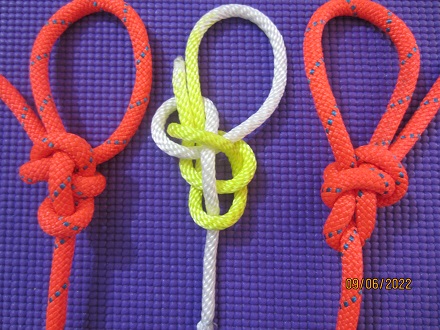
   Hi All, Few more loops here, they are fine for general use.
            Third loop try on the helical nip, is helical nip, so I don't call it Bowline.
            Thanks.
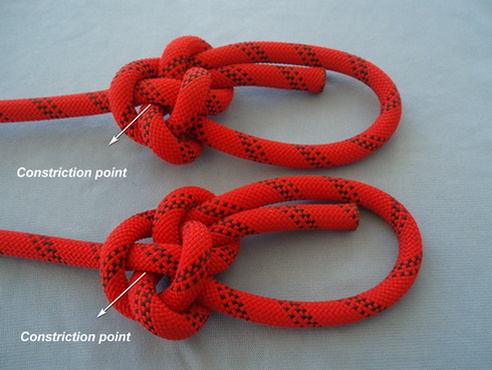
Thanks Alan, i find this crossing knot, returning bight leg component, as a very interesting, worthwhile binder of nipping loop’s crossing point.
Besides the three rope diameters inside the nipping loop, the crossing of the two ends (SP,WE), just before the third visit up through the nipping lopp, adds an extra constriction point, as shown in first image.
This is actually a maneuver, that locks down and firmly secures the knot, fullfilling the bowline requirements at the same time.
Compare the knot at the bottom of the first picture, with your third image structure at reply#11, the one you call bowline locked variation with overhand Knot A, provided that you drive the tail back through the collar, to both knots, side by side with SP.
The knot is TIB of course, and it is closely related to the one presented in the following link…
Link : https://igkt.net/sm/index.php?topic=6965.0
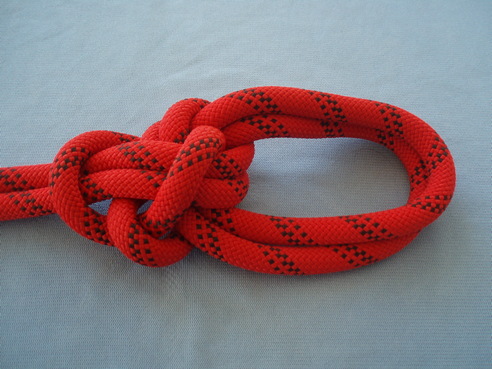
The top first image knot, which is the same with your first image of reply#11, named as bowline locked variation with crossink knot 1, can be TIB by forming a second eye and follow the nipping line (second, third photo).
I’d missed this. It might put the “end-bound” locking
a decade-plus prior my discovery, which I think was around
Y2K (2000) --I’ll have to check this. Do you have insight
into prior Fieldbooks, so to see how early they have the knot?
Note that if one reverses the final pass of the tail,
so that it simply repeats another wrap, you get a
sort of double-wrapped Myrtle, which is more snug
than having that “proper collar” as X. would say.
Further missed,
https://igkt.net/sm/index.php?action=dlattach;topic=7294.0;attach=28156;image
Ah, this looks good :: able to handle stiffer ropes
than some of the stuff being shown where rope
must make hard, 1-diameter turns!
Thanks,
–dl*
? Reply #7 on: May 26, 2022, 06:52:04 PM ? Quote Alan, I did notice that in all but one of your examples, when you start with a regular Bowline or Cowboy Bowline, you cross over the adjacent leg of the eye before re-inserting the free end back into the nipping loop. Do you have some reason for not doing this in the Easy Lock #1010 (version 2) {Link 2 above}?
https://igkt.net/sm/index.php?action=dlattach;topic=7294.0;attach=28156;image Ah, this looks good :: able to handle stiffer ropes than some of the stuff being shown where rope must make hard, 1-diameter turns! Thanks, --dl*
When I tie this Easy Lock #1010, I do have the option for 1 or 2 rope dimeters. In this case, I prefer 1 rope dimeter (collar or loop) hidden in between the two eye legs. widened the two eye legs, so when you tie it to a big or small object you have no interference with the lock.
For the 2 rope dimeter lock, you have one more collar stuck outside of the nub. When you pull on a bigger object, it will loosen the lock some. (try your two hands and pull side way on the two legs) Actually, this is only a minus problem, but for me, I like to fine tune it the best I can (of course, sometimes I am right. Sometimes I am wrong too.)
This is just a simple lock bowline not for rock climbing, only for general use. I believe nobody goes and buys a very expansive stiff rope for common use.
Also, very stiff rope is not good for most common knots.
So when you want to use this Easy Lock bowline, please just say no to stiff rope, that is all.
Thanks, alanleeknots.