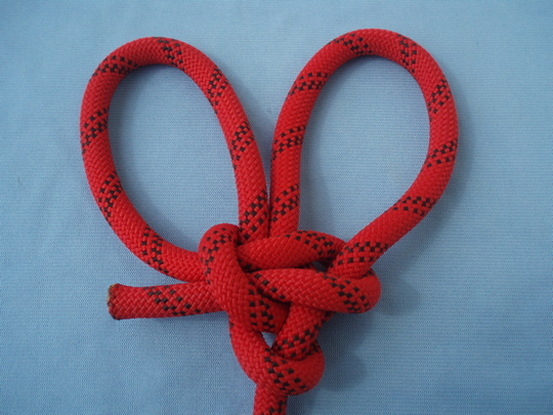
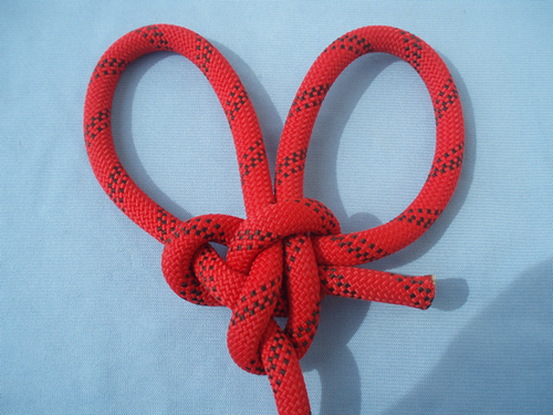
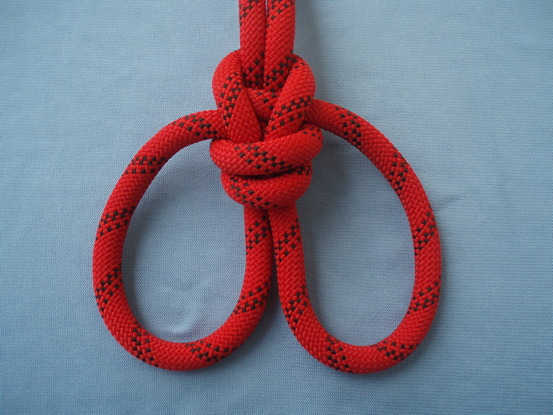
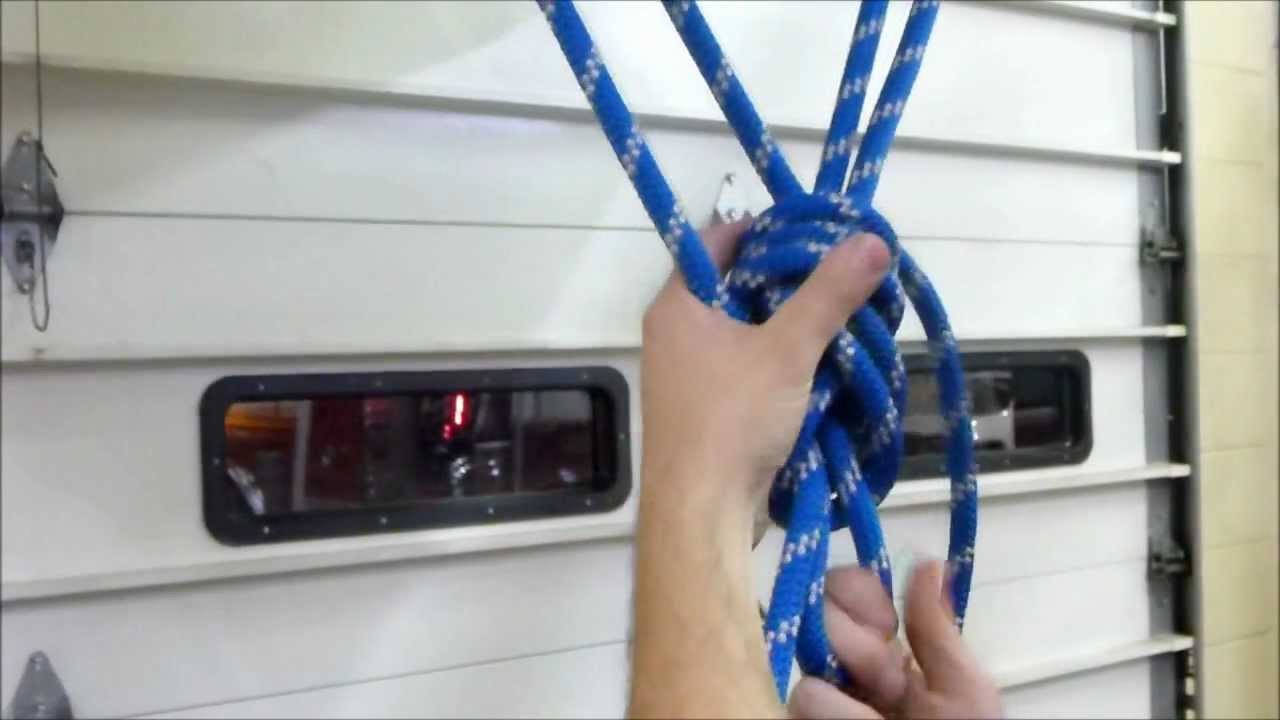
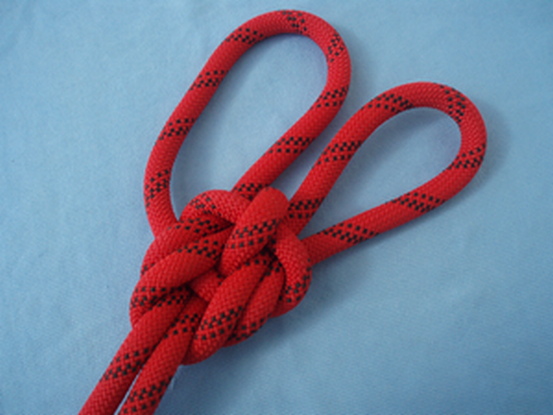
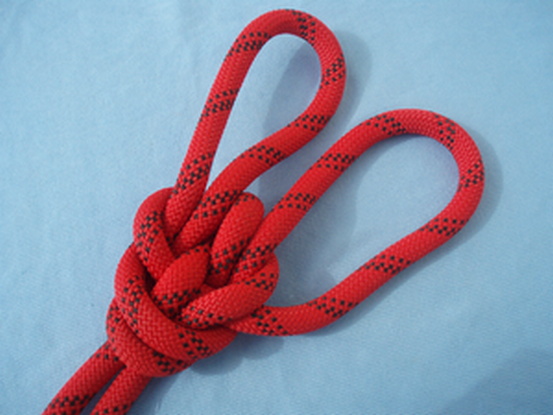
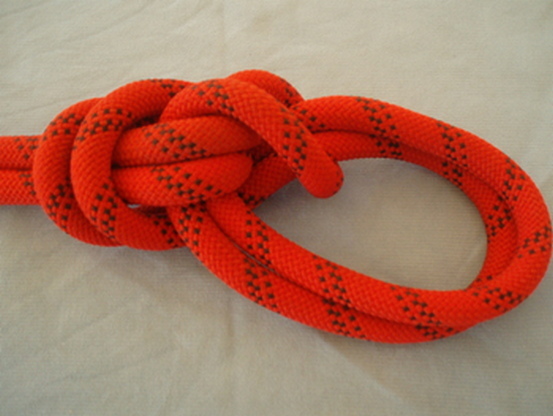
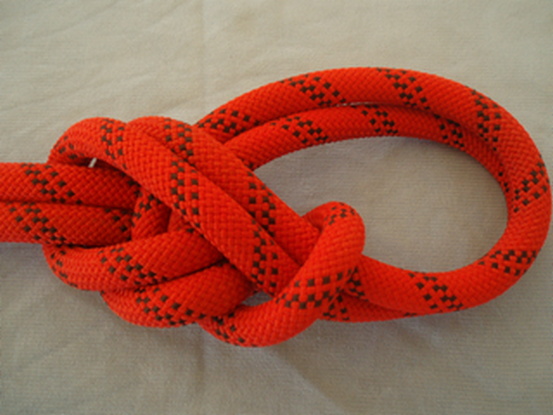
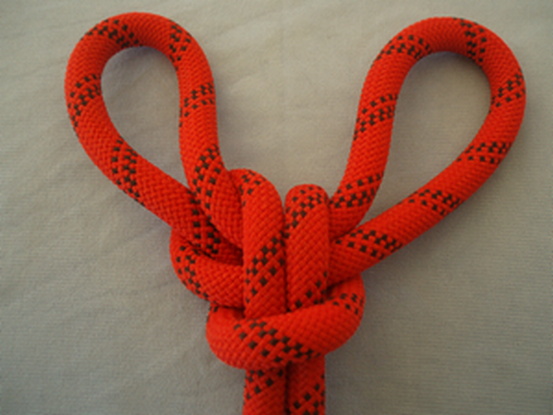
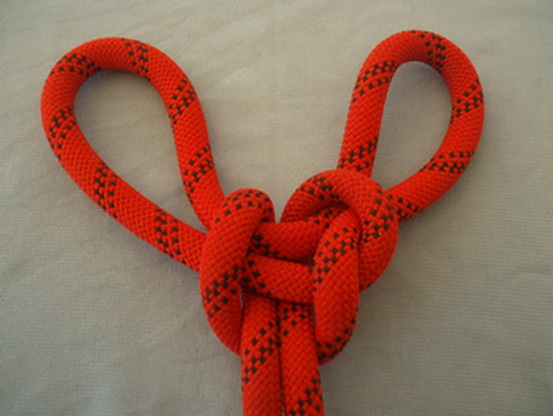
This is a very easy and yet effective way, to build a double eye knot for anchoring, towing, e.t.c.
It can be done by combining a bowline and an anti-bowline, side by side together using one nipping loop with four rope diameters inside it.
One can start with a simple cowboy bowline, leaving a long tail component in order to create the second eye, and nip the returning tail in an anti-bowline fashion.
There are many other ways to restrain the returning line into the nipping loop, like ampersand, fontus or triskel, and they all form a super strong,resistant to cycling loading, dual loop, knot, with very easy system equalization through the bowline collar.
It is not TIB (tiable in the bight) of course and only OEL, (one end loadable), but i’m sure there can be other profiles with those extra properties.
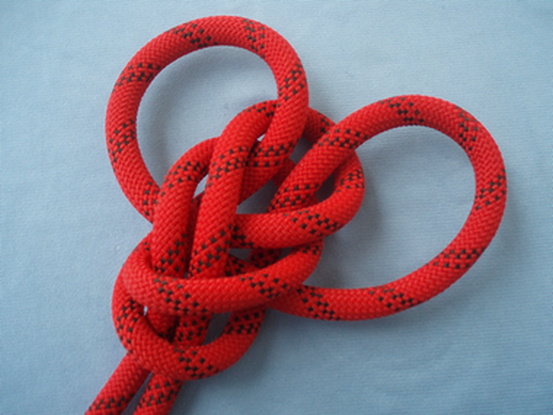
When it comes to TIB, EEL, double splayed loops, bowline-like structures, i could not fail to mention the depicted Karash variation, which i find very stable to flogging forces, even more than a butterfly derivative.
The secondary loop’s complexity has been decreased by one unit/order, without having any effect on the overall stability of the whole structure, compared to the conventional Karash configuration with the two equivalent link components.
If one removes whichever of the two links, there will always be a bowline.
Starting with a simple Karash bowline, in cowboy style, the long tail is tucked under SP, capturing both collar legs for the nipping loop formation, and follows the SPart, side by side down through the collar.
I don’t have a TIB method yet, but i presume that the knot points to an inline profile , interweaved with overhand and figure eight components.
Another double loop variation, that builds a second bowline around a fixed point, using a long tail component.
The secondary eye, is usually tied with a retraced bight, which is tucked back through the two collars, in a yosemite tie off.
Since this method adds plenty of bulkiness in the system, i was thinking about a simpler and easier way to lock down the tail, staying as bowlinesque as possible, such as the Scott’s locked technique.
It’s not only that it adds 5 rope diameter inside the nipping loop, it is also TIB, with a super easy in the bight, TIB tying method.
It’s an easy task to figure it out, if the knot is reverse engineered.
When it comes to double loop, Eskimo-like anti-knots, this one, IMO, is a distinctive instance, while the same stands for its single, one loop variant as well.
The out-going lines are captured by the returning bight structure in a way that ensures nipping structure’s stability, enabling the crossing knot to maintain a distortion-proof form, specifically in heavy loading conditions.
It is crucial to preserve an unalterable crossing knot state.
A double cossack ,for example, can easily collapse to a form of an anti-bowline on a bight, which is a bit challenging to untie at heavy stress.
The returning bight legs are severely compressed by the SP forces, which leaves enough slack for the collar decompression, and as a matter of fact, that’s exactly how a bowline structure functions.
As for the TIB tying method, i shall refer to Alan Lee’s video instructions of tying the anti-bowline on a bight with the following difference…
At 1.20, when Alan is about to thread the left loops down through the right loops, just thread the left loops up through the right and you are done.
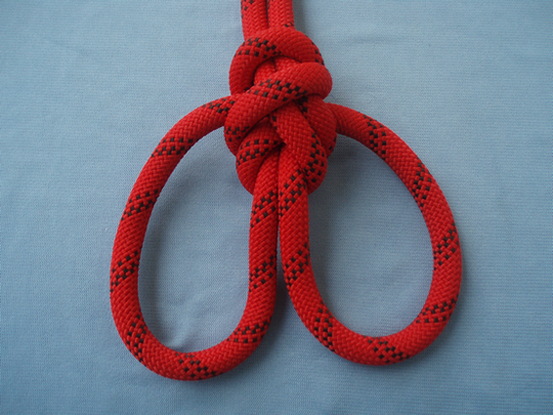
The attached double loop, does not certainly win a trophy in terms of originality and creativity, but i’m not sure if it’s known or tied before, nonetheless, it might be the simplest, double eye variant with minimum rope usage.
The only thing that misses is a simple TIB tying method.
Whenever a double eye is requested for anchoring, towing, e.t.c, i believe it can do the work!
With respect to the issue of redundancy that you are pointing at, about the one eye failure, doesn’t it apply to all double eye variants with communicating loops?
Nonetheless, i have seen the portuguesse bowline (with a moniker of “bowline on a coil”) frequently used in rescue operations, tied around a stretcher or something.
The fixed-loop spanish bowline also appears to develop the same issue if one of its eyes fails.