Designing knots can be an interesting therapy.
It can be a hit and miss type of thing or it can be with a certain intent and/or goal.
The thread “a simple lock for the bowline” has held my interest since casting my eyes on it.
There are few ways to achieve the “lock”, some easy, some not.
I’ve tangled something new, to me at least, and I’m offering it here for review.
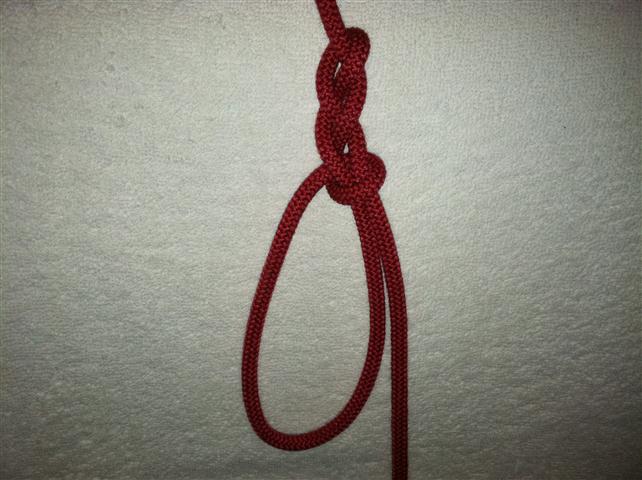
I’ve taken a few elements from knots I like and that have something valuable about them and created a composite knot. An end-of-line eye-loop using the bowline as the base.
The braided double was the other element, but just a portion of it. I like the way it works, spreading tensile grip along its travels.
Some could also view it as a marriage of figure eight/nine and bowline.
I feel that although it uses more line than some other attempts, the usage is justified by the result. It is a streamlined affair and even when not fully cinched up completely snug it works.
Dressed, tightened and loaded to bouncing (3 foot drop) climbers weight (me in harness), it was easy to untie by flexing the “braid”.
Resisted ring-loading at my own weight, as best I could test this.
I find it no more difficult to tie than the other offerings in the bowline securing attempts. Easy to inspect. Secure in all the various materials and sizes I own. And easy to untie.
In the the pictures attached I included 6mm test tether I used.
Hmmm, I see the elements you mention --well, the
obvious and the “braided double” aspect (less so, any
8/9). Yes, designing can be different from surprise
discoveries from fiddling w/rope, though the latter
sometimes are just irresistable impositions.
In some 8mm kernmantle relatively new & only used
for rope play, I find this eye knot to be not so comfortably
drawn up; it’s not obvious how one should set it. E.g.,
one can grasp the collar windings and pull them towards
the body while loading the eye leg(s).
I don’t think that the apparent security of this knot
will be appealing --i.e., it at least doesn’t appear to draw
up into something with a secure vs. loose/open look.
(I guess that the extension of the collar gives some greater
impediment to the SPart feeding into the nub and loosening
–that where the normal collar would turn around the SPart
instead is here a pinching as the collar legs cross en route
to their eventual turn.
(Naturally, once the rope was in the hand, I did some
fiddling … : curses, now another new knot to record.)
Thanks for the brief critique Dan.
Yes, the “irresistible (sp) impositions” do happen and pleasantly so. Then you find out they have been there all along.
In some 5/8 inch bull rope (kernmantle) it is a bear to draw up! But, it resisted my trying to make it slip as a loop. Ring-load test, it didn’t do so well, but I think that is because of the inability to hand set that rope (think Anaconda). Few standard knots do, they usually require back ups till forces set the affair.
I think it surpasses “apparent security”, imo, as it holds very well loose as the nipping loop constricts with load. Unloaded it resists coming undone during slack shaking.
There are a number of knots out there that work pretty well with open spaces throughout the tangle. As the pictures of the post loaded 6mm tether shows.
Snug it up in what you have, dressing it as makes sense to you, then slack shake test it and if you would at that point give it your 5-2-1 stress test.
“curses, now another new knot to record” < Inquiring minds want to know. Shoot a picture please.
Inquiring minds want to know. Shoot a picture please.
Voici! The tail completes the eye from the top,
diving through the turNip and reaching to the lower
side of the SPart (as though for a left-handed bowline)
but, instead of immediately turning, twists away and
then turns back, wrapping once outside of the loop
and then wraps down through, and finishes again
through --but I moved this finish to the left side
of the eye leg, looking to improve the curvature of
the SPart there (its bending around the eye leg seemed
too hard, not benefiting from the 3 diameters surrounded).
Seems a bit on the bulky side after dressing and tightening. And with springy rope it doesn’t care to stay set at the coils above the nipping loop. Ring loading shows the movement. And it actually feeds the tail out. :o
One man’s “bulky” is another man’s “corpulent”.
–5 dia. on one aspect, I’d say. But, it works.
And with springy rope it doesn't care to stay set at the coils above the nipping loop.
Ring loading shows the movement. And it actually feeds the tail out. :o
?!
I don't find this : in firm (maybe not "springy") 8mm kernmantle
nylon; in rather springy, softish-laid 5/16" (sounds like 8mm!) PP.
What are you dealing with? One should be able to set the knot
by pulling the coils snug ([i]blood knot[/i] -like); that holds the SPart
and it's [i]turNip[/i] holds the other end of the nub.
Repeating this with smaller PP soft-laid cord that was given
to me by someone cursing its intransigence as "the Devil's material":
same solid result (and this was material that the [i]EBDB[/i] loosened in!).
Ring-loading my PP doesn’t see any movement.
Going now for some really ornery rope --aged BW II (ha!)–,
the wraps hardly bend (I can insert a finger), but the knot
stays wide-openly tied (it’s a fight to bend it less than 5dia).
(I will not resort to contortions with the pulley to set this!)
I tested this knot to failure several times in some cord I have around. It didn’t slip or jam. When it failed, however the knot disappeared, so finding out where and how it failed might be a challenge. I took the liberty of making a video of testing the knot to near failure (68 kg, when those tested to failure failed at about 70 kg.) and untying it, which was by no means difficult. If you are interested, the videos are at: http://archive.org/details/Composite_Knot.
In it’s current configuration, I have two limitations – the weight that the scale can measure: 150 kg., and the load that the baseball bat/windlass can withstand – I think that to be somewhere between 150 and 180 kg. I once used a pulley to double the weight that the scale could measure, but the windlass failed at around 180 kg.. In order to test lines for more than 140 – 150 kg, I will have to change the windlass to something stronger than a maple baseball bat – perhaps a bamboo bat or a steel pipe. The video was made with an iPhone taped in a position where it could record the test.
In several informal tests, this variation tested between 71kg – 85 kg before failure. In the video, I loaded it to 70 kg. before untying it. I found the knot easier to remember than the OP’s knot, but it seems more fiddly to tie and dress. Like the OP’s knot, the knot pretty much disappears when tested to failure. The movement of the working end during loading is interesting. This knot appears much like the 1x2L variation of the Lazy Dog, but with the addition of the collar.
Great. Now we can dispense with X1’s vain overreach for some
pejorative qualitative definition of “vast” for a quantitative one :
about 20% greater.
;D
I found the knot easier to remember than the OP's knot,
but it seems more fiddly to tie and dress.
I found myself making the final end tucks a half-turn too
soon, emerging in the same rather than opposite direction
as the nipped eye leg. Then, I think I’m coming to favor
making both tucks of the tail on the eye-side of the eye
leg, rather than the first on the away side and just the
final one on the eye side. YMMV ?!
Quantitatively speaking, what I see is an about 100% less presence of the picture(s) that could had accompanied the verbal description of this quite different variation…
It is a minor difference, easily seen from the photo above:
where the tail on its finishing wrapping leftwards
tucks through the turNip on the right side of an
eye leg initially and then on the left side,
I suggest that both of these tucks lie on the right.
(But one might try also both on the left, and see how
your particular material fancies that, too!)
I guess that pictures can show minor differences, too !
Another “minor” difference… ( As I have said in many occasions, there are no minor differences between simple knots ! Any difference can change things much more than we can anticipate…)
I guess your smart-phone would have been recharged by now.
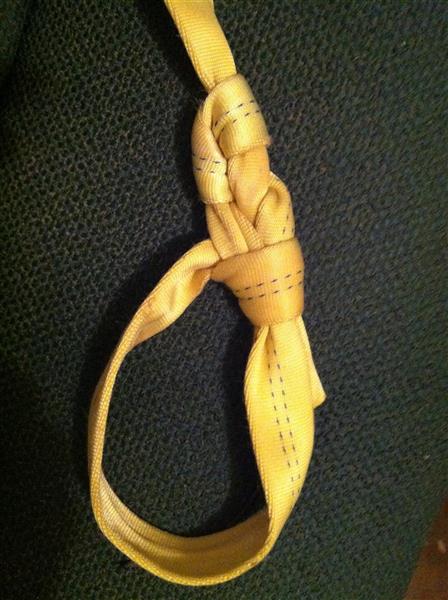
I do not know anything about “knots” tied on webbing, but I think that they should be more secure, because they use the “collar mechanism” much more than the knots tied on ordinary ropes. By this, I mean that they can be considered as knots tied on a plurality of ropes, the one arranged next to the other, in a row, so they form a tape. So, these knots have a plurality of collars, in comparison to knots tied on a single rope. As the collars are so efficient mechanisms in knotting ( we have seen that in the amazing efficiency of the common and the “Eskimo” bowline ), I suspect that the “knots” on webbing are much more efficient than the “corresponding” knots tied on ordinary knots. ( I say “corresponding” , because, although the forms are “similar”, the structural mechanisms are very different ! )
So, one would tend to think that, with webbing, we can use simpler, less convoluted knots, which would be as secure as more complex knots tied on ropes. The braided bowline tied on a webbing seems an overkill to me. I suspect that you should try to imitate simpler bowlines, tie them on webbing, and see what happens - because I suspect that they would be much more secure than their “corresponding” knots tied on ropes.
Of course I will try other knots. I have before and will when the thought occurs to me. ;-))
Yes, the tubular webbing could be more efficient, but it is very slippery and that plays into the knotting scenario as well as that some are extremely firm and some very soft.
I do think that the attribute of being easily crushed, scrunched, deformed goes towards at east the perception of more security.
I believe that knots in webbing, if they approximate a “double back” condition ( as in harness waist belts), the more stable the knot will be.
The Braided bight component / collar structure is a general idea, that can be applied in bowlines with more complex = double nipping structures as well. I tend to believe that a double nipping structure, be it in the form of a double nipping turn, or in the form of a Clove / Constrictor / Girth hitch based nipping structure around the two legs of the bight component, is necessary, regarding the material strength and the psychological security they offer to the climber or the rescue worker. This most simple yet most efficient idea of how to secure the Tail even further, by weaving the continuation of the eye leg of the Tail side and the Standing Part higher / above than the nipping turn, is ingenious IMHO, and it should be explored even further.
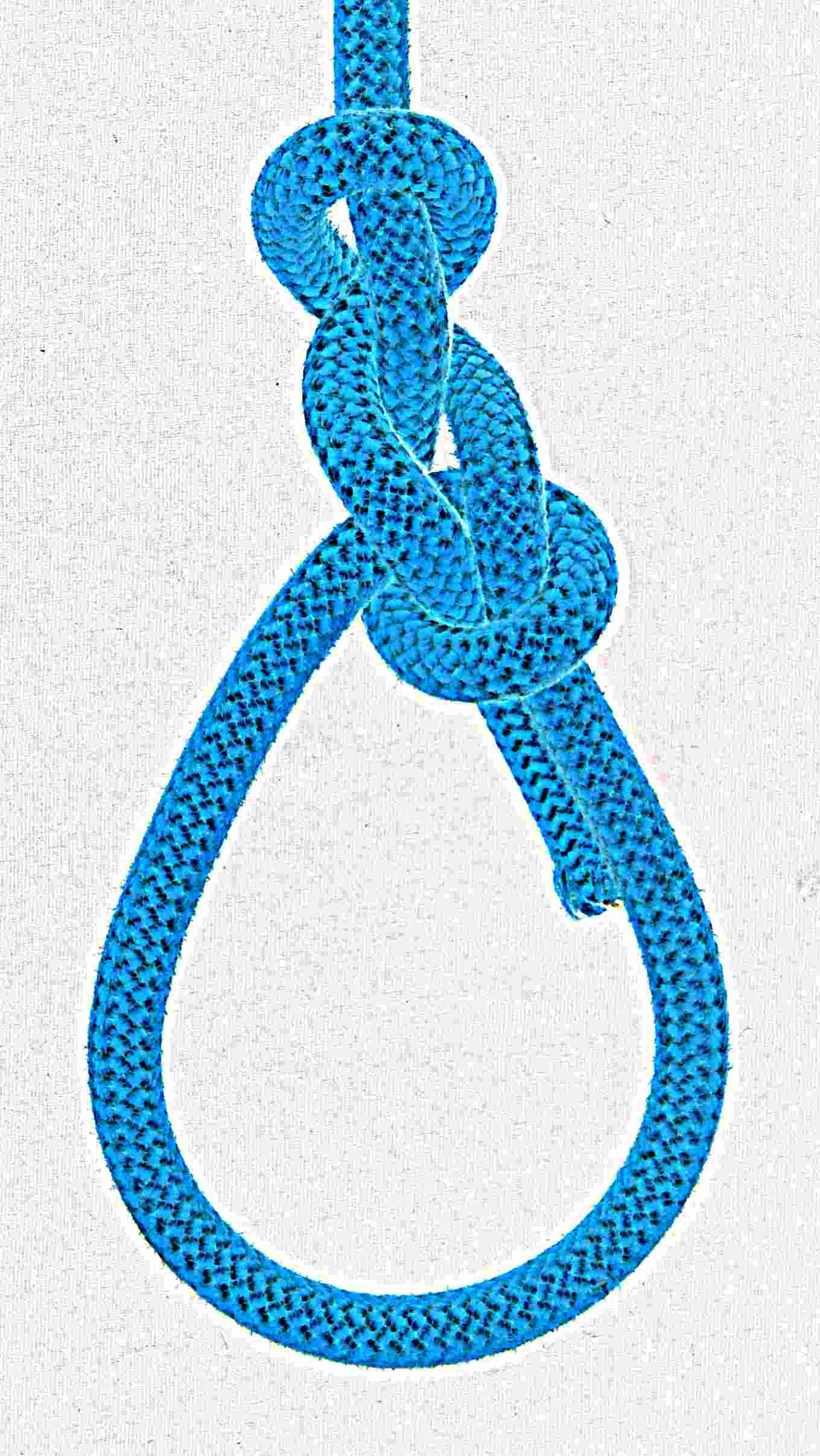
There is a number of different ways we can weave the bight component and the Standing part (1) - all seem very secure, and the only way we can decide which is more secure is to test them in a variety of loading patterns / rope materials combinations. In this post one can see a simplified Braided structure, where the continuation of the eye leg collars the standing end by making a 360 degrees turn around it, then passing underneath itself, in between the ascending leg of the collar and the standing end, before it finally returns into the nipping turn. It is far less “braided” than the original structure presented in this thread, of course, but I believe it is also very efficient - and, perhaps, for most applications, more efficient than enough !
( Waiting to receive my new blue rope, I had taken the pictures with my old orange one on a black background, and I had simply inverted the colours, so that Mark Gommers can print them without soaking his printer s papers with black ink ! )
In the pictures below, as well as in the pictures of the Braided bowline presented at : http://igkt.net/sm/index.php?topic=4480.msg28687#msg28687
we can keep the standing end as it is, and interchange the two legs of the bight component / collar structure, so the direct continuation of the eye leg of the Tail side becomes the Tail, and vice versa. I have no clue which of the two variations of each knot is more secure…
P.S. I have used the characterization " Simplified braided ", rather too loosely. The structure shown is not a “braid”, in the ordinary sense, but what is left of a simple braid, just after it is simplified further, and before it becomes a straight line ! I could have used the moniker “pseudo-Braided”, or something like that. The fact remains that even this simple structure, tied around the standing end “higher” / “above” the nipping turn, is very efficient in enhancing the efficiency of the simple collar mechanism, and thus in improving the security of the “common” bowline.
This “simplified braiding” is but a round turn that goes under itself.
I agree that it helps the “standard” bowline security (perhaps others as well I would think), in that there is a biting element above the nip that helps arrest tail movement.
Multiply/duplicate that out a few times and you’ll have a braided bowline composite eye shaped loop.
Or something that works somewhat like a rat-tailed stopper above the nipping section.