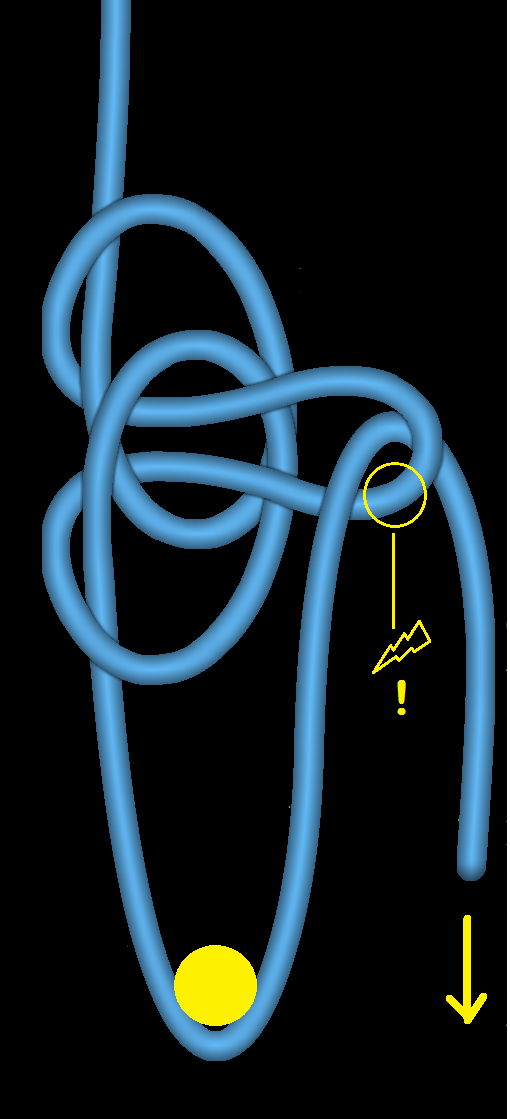
From the Naming ropeParts as components in a working support structure/architecture thread..
i will do another thread on pulley basics a/n. This is kinda an advanced view, but jumps right to the ongoing discussion of orchestration of these forces
.
In study of more aspects of rope usage to define what is hidden in knot internals of same materials, forces and geometries;
i have found can get more than the normal expected potential of a pulley system by not pulling just at the end,
but rather insetting self as power source inside the system to pull ar more than 1 input from within the system
autonomously, with no further effort.
.
Also, usually input of system if pulling up is own strength, whether arm or leg as input.
if pulling down is to the limit of your own bodyweight, unless grab some anchor outside the system
then can be limited by that pull + bodyweight
This pattern of using the same system i suggest uses both at once:
has effort and bodyweight as inputs
by not reaching to anchor outside the system for more pull, but rather to the inside of the system.
If put a pulley over a branch and you weight 100# and someone else hauls you up, they have a 1/1
exerting or body weight ballasting 100# to lift you
pull 10’ to lift you 10’
branch catches all 200# load
But, if lift self, have a 2/1 over own self
but pull 20’ of rope to rise 10’
load on branch is 100#
If you on the long end of rope put 200# so holds you off of ground
your bodyWeight ballasts out 100# against load to leave 100#
if you lift up on weight 10#, it makes you like 10# heavier
for total of bodyweight + 2xEffort against load
so only takes 50# effort to lift the 200#
Approach everything you can like this saves LOTS of effort by conserving all forces against target.
.
Using bodyWeight as ballast against load
is a ‘free lunch’ of force, can sit and eat yet w/o effort work
also, with bodyweight off the ground as take to next phase if bodyweight gets heavier or lighter from efforts
it is not on the ground but rather against target load
So will be free lunch, plus some effort
https://upload.wikimedia.org/wikipedia/commons/f/f4/Will_lift_1.png
.
If hold a weight force of 75# that too can ballast against the load
if instead pull up 75# in system, still make self heavier ballast but also are picking up on load too!!!
instead of using stiff legs receiver, to arm effort input to double
we can stiffen arms as receiver and flex legs to input into the system, doubling their power and adding to bodyweight !
So that 75# arm lift in pattern shown delivers 300# lift>>225 as ballast from loop + 75 effort
and 200# leg effort gives return of 550#>>350# as ballast in loop + 200# leg effort
https://upload.wikimedia.org/wikipedia/commons/6/63/Will_lift_2.png
In each case the loop standing in is catching bodyweight + equal and opposite of effort
usually this would ‘express’ into the ground
but 1st class lever of pulley or seesaw can intercept this quantity from bearing on ground
to bear against load as the primary effort is exerted also.
https://upload.wikimedia.org/wikipedia/commons/b/ba/Will_lift_3.png
And and then into pulley system:
https://upload.wikimedia.org/wikipedia/commons/8/8e/SaveForces_5.png
Voila, what seems impossible, really can’t be any other way than shown!
.
No cheating, all same numbers are required, just collected differently and all focused against load instead of outside the system.
i learned some folks called these a ‘closed’ system.
thus if can get 8x from a 5x compression jig that would have only lifted 4x>>now both ends are 8x lift and compress.
And found if minimized to 1 ground connection, get most power
if standing on ground, reaching for ground
literally not so much (power)!
.
Is counterintuitive, but really just follows the same rules further than you’d think it would
as the Chinese Windlass, you don’t have to believe it; it just works!
and by the same rules as all else.
https://upload.wikimedia.org/wikipedia/commons/a/a8/L-differentialwinde.png