I think it is confusing, and counterproductive to apply the name of the bowline to just any tangle that ends with a loop.
Nomenclature of course is built on convention, and knotting matters are rather flimsy when it comes to descriptions. Therefore, in the paper that is presented, by Mark Grommers, knots are laid out for photogenic appearance, disregarding distinctive features and their true nature.
The bowline, the simple one that has been used for centuries, has four basic forms, all incorporating a single distinctive feature, that was usually not described in literature or when teaching it, the turNip. The turNip is a single round turn, that upon load orients itself in a spiral almost in line with the standing part. What holds the knot together is the force that opposes the straightening out of this spiral. This is achieved in the bowline by the bight collar around one of the parts, either the standing part or one of its legs, as well as the opposing force from one of the loop legs.
By adding complexity to the distinctive feature of the bowline, other knots emerge. They may be simple extensions, as when you make another round turn or adding another “twist”, which will effectively form something resembling a clove hitch with the turns separated, but all extensions that eliminate the turNip and force the knot into another form, will not to my eye constitute bowlines. Thus the “clove hitch” bowline is still a bowline, provided the twists are sufficiently separated to permit the one closest to the standing part to form a turNip. The two round turn knot also in some way preserves the turNip function, but further extensions as “reversed clove hitch” or constrictor deviate too much from the original pattern to share the name in my opinion.
Part of the confusion comes from the photogenic appearance, that does not show the nature of the knot, but only a geometric pattern to explain how it may be contrived by clearly indicating the orientation of its parts at one stage of its making.
One might be more exigent regarding the name, not accepting any change of the knot pattern to share the same name, but as there are eskimo and cowboy bowlines, which share the turNip feature, I am prone to accept any loop which has a turNip that is locked by a bight collar around one of the parts as a bowline. That gives four basic bowlines, the right-hand bowline, the cowboy bowline, and those two forms in eskimo style.
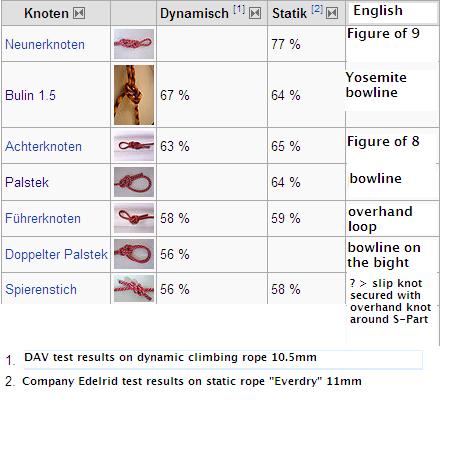
There are several ways of tucking the extra Janus collar, which introduces some extra material into the turNip and adds friction to restrain the end from slipping out of the knot. The Janus collar is the most sensible addition to the pattern, as it extends from the loose end and preserves the turNip in its original orientation. Yosemite finishes, to me look mainly cosmetic. the “fig 8” that is formed is not loaded on the end, and does not pass through any nip. It is more likely just a different orientation of the end, taking a half turn around the cook’s leg and tucking it through a rather loose bight. The knot is still a bowline, but the extra complication is not secured, so it adds little to the knot besides appearance.
When extending the knot pattern, there is also a risk of removing important features from the original knot. One feature that has made the bowline particularly popular is the ease of untying. Quite naturally, any extension may make it more difficult to untie or even prone to jam. particularly a reversed clove hitch or constrictor might be difficult to untie after severe loading, thus eliminating one of the basic features of the original bowline apart from the evident lack of a turNip in their structure.
The most sensible extensions would preserve the turNip, resist straightening of its sprial form, and secure the end as well. The Yosemite finish preserves the turNip, but does not secure the end or add resistance to straightening the spiral form of the turNip, because the end is not nipped. The Janus finishes however puts the end another time into the nip, thus securing the end, while still permitting the turNip to form naturally from the standing part. The advantages of the Janus finish are that it indeed does add security and that it does not compromise the original knot, neither in its simple forming by a twist of the hand, the natural forming of a turNip upon loading, nor its ease of untying by “breaking the neck”, a twofold process in the Janus variant.
Grommers does not show any eskimo bowline, which is the form most resistant to ring loading. My option for a more secure bowline would be the eskimo with a Janus finish. The knot has one single turNip, is resistant to ring loading, has extra material that widens the initial turn from the standing part, and it secures the end by passing it through the nip after making a second collar around the standing part. It is easily tied, easily inspected and easy to untie even after severe load. It is not prone to capsize like the original bowline. Further testing is needed before recommending it for SAR work.

 ).
).

 - but never fully understood why?